



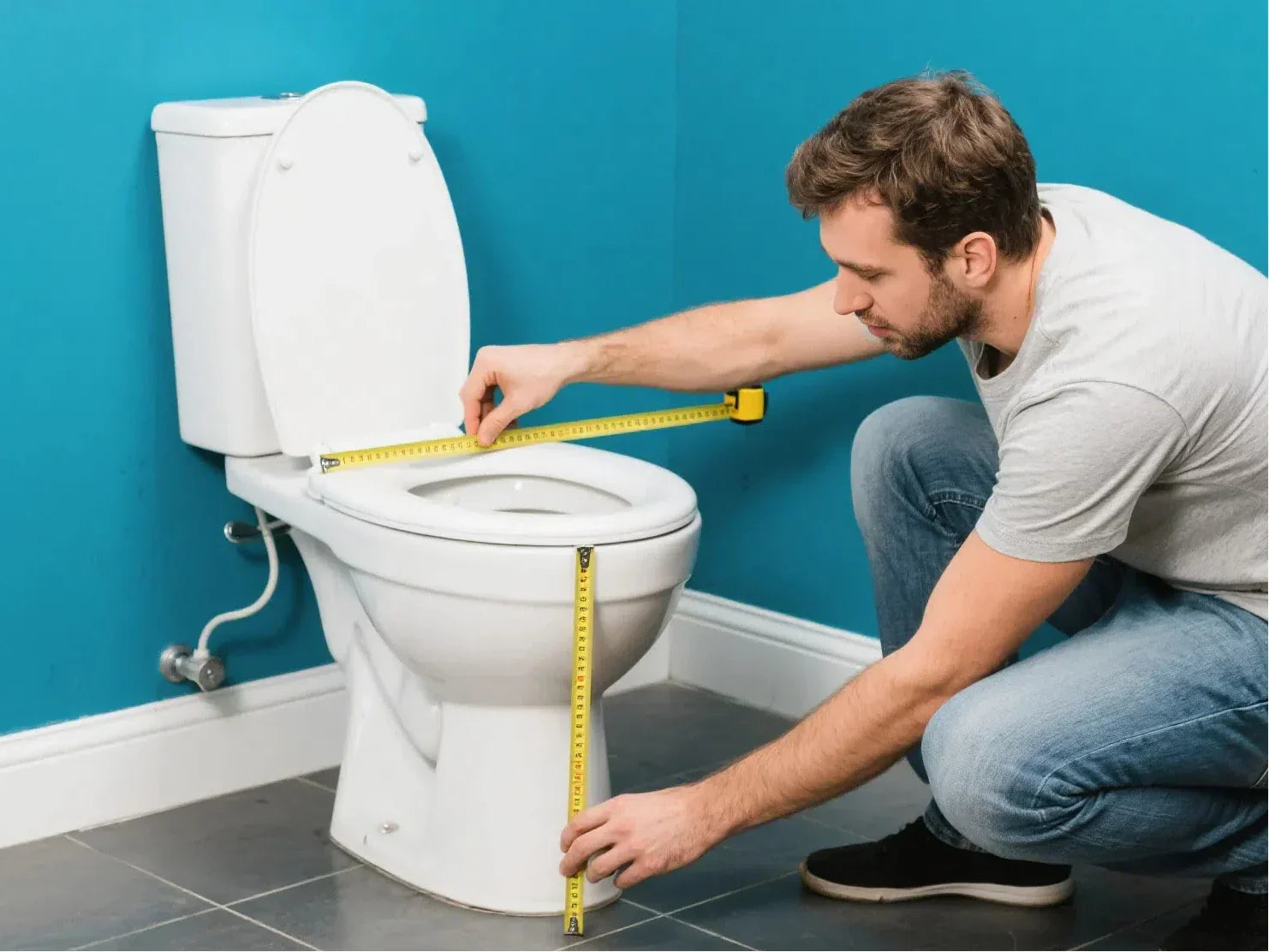
Toilet Bowl Dimensions at a Glance
| Measurement | Standard Toilet Dimensions |
|---|---|
| Rough-in | 10", 12" (most common), 14" |
| Bowl Shape/Length | Round: ~16.5" / Elongated: ~18.5" (front to bolts) |
| Seat/Rim Height | Standard Rim: 14–15" / Comfort/ADA Seat: 17–19" |
| Overall Width | ~20 inches |
| Overall Depth (Projection) | 28–30 inches for a standard toilet |
| Tank Height | 27–32 inches |
- To find your rough-in, measure from the wall behind the toilet (not the baseboard) to the center of the bolt caps.
- To check your bowl shape, measure from the seat bolts to the very front of the bowl.
Visual Schematics & Measurement Basics
Diagram 1: Side View
- This view shows the most important measurements for fit.
- Overall Height: Measured from the floor to the top of the toilet tank lid. This matters if you have a shelf or window above the toilet.
- Projection/Depth: The total distance the toilet sticks out from the wall. This is the measurement from the wall to the very front of the toilet bowl.
- Seat Height: The distance from the floor to the top of the toilet seat. This determines comfort and accessibility.
- Rim Height: The height from the floor to the top of the bowl without a seat.
- Rough-in: The distance from the finished wall to the center of the drainpipe.

Diagram 2: Top View
- This view helps with clearance planning.
- Overall Width: The widest point of the toilet, usually the tank.
- Bowl Width: The side-to-side width of the bowl itself.
- Side Clearance: The space needed on either side of the toilet.

Diagram 3: Measuring the Rough-In Correctly
- The most common mistake is measuring from the baseboard instead of the wall.
- Your measuring tape must be flat against the wall, extending to the center of one of the rear bolts that hold the toilet to the floor.
- For toilets with four bolts, always measure to the rear set of bolts.

How to Measure Every Key Dimension Correctly:
- Depth/Projection: Place one end of a tape measure against the wall behind your existing toilet. Extend it straight out to the very front edge of the bowl.
- Width: Measure the toilet tank at its widest point.
- Height: Measure from the floor to the top of your toilet tank lid. For seat height, measure from the floor to the top of the seat.
- Bowl Length: Measure from the center of the seat mounting holes to the front edge of the toilet bowl. This helps you know if you have a round or elongated model.
Standard Toilet Bowl Dimensions: Detailed Ranges
Rough-in Dimension
- 12-inch Rough-in: This is the standard toilet size in modern American homes. The vast majority of floor-mounted toilets are designed for this rough-in size.
- 10-inch Rough-in: Often found in older homes or small bathrooms where space was saved by placing the drain closer to the wall. Your options will be more limited.
- 14-inch Rough-in: Less common, but also found in older construction. It leaves a large, awkward gap behind a standard 12-inch toilet.
- Offset Flanges: These special plumbing fittings can sometimes adapt a toilet to a slightly off rough-in, but they may impact flushing performance and should be installed by a professional.

Shape and Size of A Toilet Bowl
- Length: Typically measure ~16.5 inches from the seat mounting holes to the front rim, which is about the average length for round toilet bowls.
- Benefit: Their shorter length saves about two inches of space, making them ideal for small bathrooms, powder rooms, or when a door swing is close.
- Length: Measure ~18.5 inches from the mounting holes to the front rim. This is a very consistent measurement across most models.
- Benefit: The longer bowl shape is generally considered more comfortable and hygienic for adults. Elongated toilet seats are the modern standard for master bathrooms.

Heights: Standard vs. Comfort Height
- Rim Height: 14 to 15 inches from the floor to the top of the bowl rim.
- Seat Height: With a seat installed, the height is about 16 to 17 inches.
- Best For: This standard height is often better for children and shorter adults.
- Rim Height: About 15 to 17 inches.
- Seat Height: The seat height of 17 to 19 inches is the key feature. This is similar to the height of a standard chair.
- Best For: This is an excellent choice for taller individuals, the elderly, and people with mobility challenges. An ADA-compliant toilet makes sitting and standing much easier.

Tank Height, Width, and Impact
- Tank Height: Most tanks bring the total height toilet measurement to between 27 and 32 inches. Check this if you plan to install a cabinet or shelf over the toilet.
- Tank Width: The toilet width is usually determined by the tank and ranges from 17 to 20 inches.
Overall Projection & Width
- Overall Projection: A standard toilet with a round bowl might project 27-28 inches from the wall, while an elongated toilet can project 29-31 inches.
- Overall Width: Plan for about 20 inches of width, though some compact models are narrower.
HOROW Toilets Worth Comparing for Different Bathroom Dimensions
Choosing the right toilet bowl dimensions involves more than measuring rough-in size. Seat height, bowl shape, overall projection, and accessibility requirements can all affect which model fits your bathroom best. If you're comparing toilets for ADA compliance, compact layouts, or specific rough-in dimensions, these HOROW models may be worth reviewing. Always verify rough-in requirements, available floor space, and installation specifications before ordering.

HOROW T0338W
This model may be worth comparing if you need a comfort-height toilet designed to make sitting and standing easier for everyday use.
- 17.3-inch ADA-compliant seat height
- Elongated bowl design
- One-piece construction
- Comfort-height seating
- Suitable for accessibility-focused bathrooms

HOROW T38P
Suitable for homeowners looking for a smart toilet with a standard 12-inch rough-in and ADA-compliant seating height.
- 12-inch rough-in compatibility
- ADA-compliant seating height
- Integrated bidet functionality
- Auto flush feature
- Heated seat and warm air dryer

HOROW T37
This model may be worth comparing if your bathroom requires a 10-inch rough-in toilet and you want integrated smart features.
- 10-inch rough-in installation
- Integrated bidet seat
- Smart toilet functionality
- Compact footprint
- Designed for limited installation space
Determining the Best Fit for Your Bathroom Layout
Clearance Requirements (Code & Comfort)
- Front Clearance: You need at least 21 inches of clear space in front of the toilet bowl. This allows enough room to comfortably use the fixture.
- Side Clearance: You need a minimum clearance of 15 inches from the center of the toilet to any wall, vanity, or other obstruction on either side. This means you need a total space of at least 30 inches wide for your toilet.
Door Swing and Fixture Proximity
- Door Swings: Ensure your bathroom door or shower door can open fully without hitting the toilet.
- Vanity Drawers: Check if cabinet doors or drawers can be opened completely when standing next to the toilet.

Putting It All Together: An Example
- Action: You should choose a round toilet bowl or a compact elongated model with a total projection under 27 inches. An elongated toilet with a 30-inch projection would block the door.
How to Measure: Error-Proof Workflow
- Find Your Rough-in: This is your first and most important measurement. Measure the distance between the wall (not the trim or baseboard) and the center of one of the rear floor bolts. It will be very close to 10, 12, or 14 inches. If your rough-in is 12 inches, you have the most options.
- Identify the Shape of the Bowl: Measure your toilet from the center point between the seat bolts to the very front tip of the bowl. If it’s about 16.5”, you have a round bowl. If it’s about 18.5”, it’s an elongated bowl.
- Confirm Total Projection Fit: Measure from the wall to the nearest obstacle in front of the toilet (like a door, vanity, or tub). This is the maximum depth your new toilet can be.
- Validate Clearances: Find the centerline of your toilet drain. Measure to the left and right. You need at least 15 inches of clear space on each side.
- Select Your Height: Decide if a standard height (around 16-17 inches with seat) or a comfort height toilet (17 to 19 inches with seat) is better for your household.
- Double-Check Access: Make sure you can easily reach the water shut-off valve behind the toilet and that the toilet tank lid can be removed without hitting anything above it. If you plan to add a bidet seat, ensure there's about 1-2 inches of space between the tank and the seat bolts.
Comparison Table: Toilet Bowl Shapes & Sizes
| Type | Length (in) | Typical Width (in) | Seat Height (in) | Best For | Bidet-Ready |
| Round | ~16.5 | 14–16 | Standard or Comfort | Tight spaces, powder rooms | Yes |
| Elongated | ~18.5 | 14–16 | Standard or Comfort | Master baths, user comfort | Yes |
| Compact Elongated | ~17–18 | 14–15 | Standard or Comfort | Balance of comfort & space | Yes |
| Wall-Hung | Variable | 14–15 | Adjustable (at install) | Modern look, easy cleaning | Yes |
Special Cases & Older Homes: What to Watch For
- 10" or 14" Rough-ins: If you discover a non-standard rough-in, your choices are to buy a toilet specifically made for that dimension or to consult a plumber about using an offset flange. Be aware that an offset flange can sometimes affect flushing power.
- Thick Baseboards & Moldings: If you have thick trim along the floor, it can trick you into an incorrect rough-in measurement. Always measure from the back wall itself to ensure accuracy. The tank of your new toilet must sit flush against the wall, not the molding.
- Narrow Clearances: Older bathrooms were often built with less space. You might find you don't have the recommended 15 inches of side clearance. While not ideal, choosing a narrower one-piece toilet or a model with a smaller tank might help.
Accessibility & Ergonomic Upgrades
- ADA/Comfort Height: This is a simple upgrade with huge benefits. The taller seat height of 17 to 19 inches reduces strain on the knees and back, making it a great choice not just for those with mobility issues but for most adults.
- Grab Bar Planning: If you plan to install grab bars, their placement depends on the toilet's location and height. The taller profile of a comfort height toilet works well with standard grab bar installation guidelines.
- Children or Shorter Statures: A standard height toilet is often more suitable for households with small children, as their feet can reach the floor more easily.
Maintenance and Long-Term Usability
- Tank Lid & Shutoff Access: You need enough clearance above and behind the toilet to perform basic maintenance, like removing the tank lid or turning off the water supply.
- Bidet Seat Clearance: Many modern bidet seats require extra space. Check the bidet's specifications to ensure it fits the shape of the toilet bowl and that there is enough clearance behind the mounting holes.
- Cleaning Envelope: A toilet with tight clearances is difficult to clean. Leaving a few extra inches of space around the toilet makes cleaning the floor and the sides of the bowl much easier.
Interactive "Will it Fit?" Checklist
- What is my rough-in measurement? (___ inches)
- What is the maximum depth I have? (Measure from the wall to the nearest obstruction: ___ inches)
- What is the total width I have? (Measure from the wall/vanity on the left to the wall/tub on the right: ___ inches)
- Is my desired bowl shape Round or Elongated? (Circle one)
- Do I prefer Standard Height or Comfort Height? (Circle one)
- If your rough-in is 12 inches, you can choose almost any standard toilet. If it's 10" or 14", you must buy a model made for that specific size.
- Your new toilet's "Overall Depth" must be less than your answer to question 2.
- Your new toilet's "Overall Width" should fit inside your answer to question 3, with about 30 inches being the comfortable minimum (15 inches from center).




Leave a comment
This site is protected by hCaptcha and the hCaptcha Privacy Policy and Terms of Service apply.