

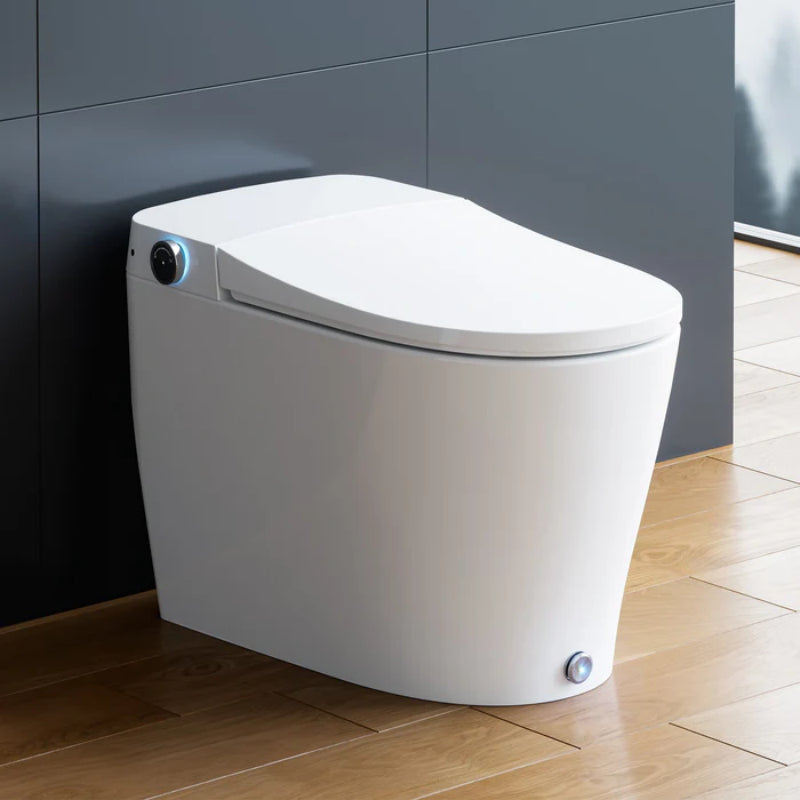


An electric smart toilet or electric bidet seat needs a power supply that matches the exact model. Before buying, confirm the rated voltage and frequency, grounding requirements, GFCI protection, power-cord length, outlet location, and available branch-circuit capacity. Do not assume every smart toilet needs a dedicated circuit or that any nearby bathroom receptacle will work.
Use the installation manual and specification sheet for the exact model. If the existing receptacle is ungrounded, damaged, difficult to access, or the bathroom circuit already trips during normal use, have a licensed electrician evaluate the installation before connecting the toilet.
Decision Snapshot: When Smart Toilet Electrical Requirements Work
Minimum checks before installation:
-
The home's electrical supply matches the toilet's rated voltage and frequency.
-
The receptacle meets the product's grounding requirements.
-
The bathroom receptacle has the required GFCI protection.
-
The factory power cord reaches without an extension cord, tension, pinching, or unsafe routing.
-
The GFCI protection can be tested and reset without removing the toilet.
-
The branch circuit has sufficient capacity for the toilet and other connected loads.
A plug-in smart toilet is easier to accommodate when:
-
The bathroom already has a properly wired and grounded receptacle in a practical location.
-
The factory cord can follow a clean route without crossing an open floor or being trapped behind the toilet.
-
The plug has enough clearance beside or behind the toilet body.
-
The existing circuit does not already experience breaker or GFCI trips during normal use.
Have a licensed electrician evaluate the installation if:
-
You find an open ground, two-prong receptacle, reversed polarity, or questionable wiring.
-
Breaker or GFCI trips already occur during normal bathroom use.
-
The existing outlet is too far away for the factory cord.
-
A tight alcove, finished tile, masonry, or an exterior wall makes outlet placement difficult.
-
The panel or branch-circuit capacity is unknown.
-
You need to add or relocate an outlet or circuit.
The key planning mistake is waiting until the toilet is in the bathroom before checking whether the electrical connection actually fits.
Use japanese toilet USA to review the product type, compatibility, and safe-use guidance before acting on the “Decision Snapshot: When Smart Toilet Electrical Requirements Work” section.
Who Should Choose Plug-In vs Non-Electric Bidet Options
A non-electric bidet attachment or seat can be a practical alternative when adding a suitable electrical connection would require significant work.
A non-electric option avoids electrical considerations such as:
-
Finding an appropriate GFCI-protected receptacle near the toilet
-
Power-cord routing and cleaning interference
-
Evaluating branch-circuit capacity for powered functions
-
Losing powered features during an electrical outage
If your priority is water washing and you do not need powered features such as a heated seat, warm-water heating, air drying, or automatic functions, a non-electric bidet may reduce installation complexity.
A plug-in option may make more sense when:
-
You already have a suitable electrical connection near the toilet.
-
The factory cord has a clear and accessible route.
-
You are willing to add or relocate the receptacle if necessary.
-
You specifically want powered comfort or bidet functions.
Most powered bathroom upgrades fall into two groups: an integrated plug-in smart toilet or an electric bidet toilet seat installed on a compatible toilet. Electrical fit should be checked before choosing either option.
Homes That Are Easier to Prepare for a Smart Toilet
Plug-in smart toilets are generally easier to plan when the bathroom already has:
-
Grounded wiring and a properly wired receptacle
-
Appropriate GFCI protection
-
Space beside or behind the toilet for a receptacle without interfering with the toilet body
-
A layout that allows the factory cord to route cleanly with reasonable slack
-
A branch circuit whose capacity and connected loads are understood
This is more common in newer homes and renovated bathrooms where electrical service was planned near the toilet before the fixture was installed.
Older Wiring, Questionable Connections, and Limited Outlet Access
Older homes can still accommodate smart toilets, but the existing electrical system may need more evaluation before installation.
-
Two-prong receptacles or ungrounded three-prong receptacles
-
Small or crowded electrical boxes that may not accommodate a modern GFCI receptacle within applicable box-fill requirements
-
Long branch-circuit runs or questionable connections
-
Older wiring methods that require professional evaluation
-
A bathroom circuit with unknown or heavily shared loads
Electrical supply problems can sometimes appear as intermittent resets, unexpected shutdowns, or inconsistent operation. Those symptoms should not automatically be blamed on the toilet without checking the supply and installation conditions.
When Non-Electric Bidets Avoid Electrical Work
A non-electric bidet can be useful when the bathroom has no practical receptacle location, the existing wiring needs substantial work, or powered features are not a priority.
If the factory power cord for a smart toilet cannot reach a safe, permanent receptacle location, do not plan around an extension cord. Either correct the permanent electrical setup or choose a non-electric alternative.
When Hardwiring Should Be Considered
Some homeowners consider hardwiring because they want a cleaner appearance or do not want a visible receptacle near the toilet. The product manufacturer's instructions should control that decision.
Only consider hardwiring when:
-
The manufacturer explicitly supports that connection method.
-
The installation complies with locally adopted electrical requirements.
-
Required disconnect and service access can be provided.
If a smart toilet is supplied for cord-and-plug connection, follow the manufacturer's specified installation method. Do not convert it to hardwired operation simply for appearance.
When to Use an Electrician
Use a qualified electrician when a suitable bathroom receptacle is not already available, the circuit or grounding is uncertain, the receptacle shows damage, extension cords would be required, or the product instructions call for electrical work. The electrician should evaluate the current installation against the exact product requirements and applicable local rules.
Do not present one voltage, amperage, outlet distance, or circuit rule as universal across models.
Smart Toilet Electrical Requirements: What You Must Confirm
Before installation, confirm the exact model's voltage and frequency, rated current or power requirements, grounding instructions, GFCI requirements, plug configuration, factory cord length, and any installation-specific electrical notes.
Check these in the product specification sheet or installation manual:
-
Rated voltage and frequency
-
Rated current or power
-
Plug and grounding requirements
-
Power-cord length
-
Manufacturer-specific outlet or electrical installation instructions
Verified HOROW Electrical Examples
Electrical requirements vary by model. The HOROW T33 and T16 provide two verified examples of why the exact product specification should be checked before planning the receptacle location.
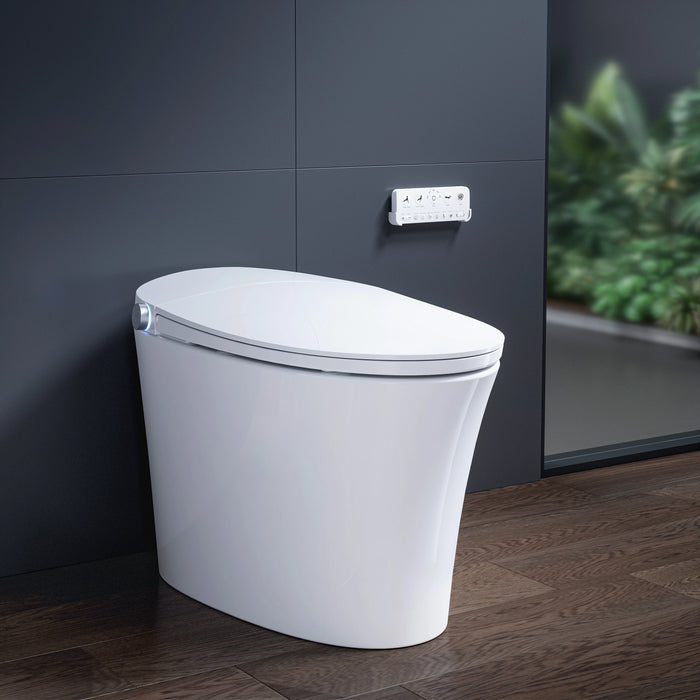
HOROW T33
-
Electrical requirements: 10A at AC 120V, 60Hz
-
Power cord length: 33-7/16 in. (850 mm)
-
Confirm grounding, GFCI protection, outlet accessibility, and local electrical requirements before installation.

HOROW T16
-
Electrical requirements: 10A at AC 120V, 60Hz
-
Power cord length: 33-7/16 in. (850 mm)
-
Use the specified cord length when planning the receptacle and verify the final installation against the product instructions and applicable local requirements.
These specifications apply to the T33 and T16 only. Do not assume another smart toilet uses the same current rating or cord length.
For products that meet the “Verified HOROW Electrical Examples” requirements, compare the current choices in HOROW toilets.
Voltage for Smart Toilets and 230V Homes
For U.S. installations, 120V AC, 60Hz is a common smart-toilet specification. The HOROW T33 and T16, for example, are both specified for AC 120V, 60Hz. Always verify the exact model rather than relying on a category-wide assumption.
If your home's electrical supply does not match the product rating, do not attempt to solve the mismatch with a travel plug adapter. Plug shape and supply voltage are separate issues.
-
Use only a model rated for the available electrical supply.
-
Do not treat a plug adapter as a voltage converter.
-
If voltage compatibility is unclear, contact the manufacturer or a qualified electrician before connecting the product.
Even if a product appears to power on, that does not confirm that the electrical supply is correct for the appliance.
When “Voltage for Smart Toilets and 230V Homes” points toward a product change, HOROW smart toilets shows the current range without replacing this page's informational role.
Rated Current and Why Circuit Capacity Matters
Smart toilets may use electricity for water heating, seat heating, drying, pumps, valves, sensors, controls, and other powered functions. The exact electrical load depends on the model.
Do not size the installation from a generic wattage range. Check the electrical rating for the exact toilet first. For example, both the HOROW T33 and T16 specify 10 amps at AC 120V, 60Hz, while another model may have different requirements.
The toilet is also only one load on the branch circuit. Other devices connected to the same circuit affect the available capacity.
Before installation:
-
Identify the breaker that supplies the intended receptacle.
-
Determine what other loads are supplied by the same circuit.
-
Compare the exact toilet's electrical requirements with the existing circuit.
-
Treat existing breaker or GFCI trips as a reason for further evaluation rather than normal operation.

If the branch-circuit rating, connected loads, or existing wiring configuration is unclear, have a licensed electrician determine whether the circuit is suitable.
GFCI Protection and Grounding
Bathroom receptacles are generally subject to GFCI protection requirements under the National Electrical Code as adopted locally. GFCI protection may be provided by a GFCI receptacle or by upstream protection such as a GFCI circuit breaker.
If a GFCI receptacle is used, keep the TEST and RESET controls accessible after the toilet is installed. If protection is provided upstream, make sure the protective device can still be reached for testing and reset.
GFCI protection and equipment grounding are not the same thing. A GFCI device can provide ground-fault protection in certain retrofit situations, but it does not create an equipment grounding conductor.
If the smart toilet requires grounding and the existing receptacle is two-prong, open-ground, improperly wired, damaged, or otherwise questionable, have a licensed electrician determine the appropriate correction.
Other electrical requirements may also affect the work:
-
AFCI requirements may apply depending on the installation and locally adopted code.
-
Tamper-resistant receptacle requirements may apply.
-
Existing electrical boxes must have adequate space for the installed wiring and device.
-
Older wiring methods may require additional evaluation or upgrades.
Electrical Readiness Matrix
Confirm the electrical load, receptacle, circuit, and cable route for the exact model before installation.
| Check | What to verify | Evidence required |
|---|---|---|
| Exact product load | Voltage, frequency, current, and rated power | Current model manual |
| Receptacle | Location, grounding, protection, and condition | Qualified electrical review |
| Circuit | Capacity and other connected loads | Qualified electrical review |
| Installation route | No extension cord or improvised connection | Manual and local requirements |
If a required detail is missing, contradictory, or tied to another model, use the current documentation for the exact product before ordering or installation.
Outlet Placement and Cord Reach Failure Points
Many smart-toilet electrical problems come from outlet placement rather than voltage. The receptacle must be positioned so the factory cord can reach without tension, pinching, interference, or an unsafe route.
Measure before buying:
-
Measure the actual cord route around the toilet.
-
Confirm plug and receptacle clearance.
-
Confirm that the GFCI protection can be tested and reset.
-
Check cleaning and service access.

How Far Should the Outlet Be From a Smart Toilet?
There is no single outlet-to-toilet distance that applies to every smart toilet. Plan the receptacle from the exact product drawing, the cord exit point, and the specified factory cord length.
Measure the real routing path rather than the straight-line distance between the toilet and receptacle. The cord should reach without being stretched, trapped behind porcelain, routed across an open walking area, or placed where routine cleaning is likely to damage it.
Also consider nearby showers, tubs, cleaning water, and other bathroom conditions when choosing the final receptacle position. The locally adopted electrical code and the exact product instructions control the final installation.
Power Cord Length for Smart Toilets and Safe Routing
Power-cord length is model-specific. Check the product manual or specification sheet rather than assuming a standard cord length.
For example, the HOROW T33 and T16 each specify a 33-7/16 in. (850 mm) power cord. That dimension is useful when planning those two models, but it is not a universal smart-toilet outlet-distance rule.
Measure the actual route:
-
Start at the toilet's actual cord exit point.
-
Follow the route the cord will take around the toilet body.
-
Finish at the face of the receptacle.
-
Confirm the plug itself has adequate space for insertion and removal.
The cord should not be under tension. It also should not be left loose across a walking or cleaning path.
Plug Bumping and Pinching Clearance
A receptacle and plug take up physical space. Behind or beside a toilet, that can create several installation problems.
-
The plug or receptacle can interfere with the toilet body.
-
The cord can be pinched between porcelain and the wall.
-
The plug can become difficult to reach after installation.
-
Cleaning tools can repeatedly bump or snag the cord.
In a tight toilet alcove, check whether a hand can physically reach the plug after the toilet is in its final position.
Plan for:
-
Plug insertion and removal space
-
GFCI test/reset access where applicable
-
Cleaning access
-
Service access
-
A cord route that cannot be pinched or snagged
Outlet-to-Toilet Mapping for Tight Alcoves
Before installation, map the toilet body, wall, vanity, water connection, cord exit point, and intended receptacle location on the product drawing.
A workable outlet location should:
-
Remain accessible after the toilet is installed.
-
Allow the factory cord to reach without tension.
-
Leave enough space for the plug and receptacle.
-
Keep the cord away from open walking paths and areas where it can be pinched.
Locations that deserve extra scrutiny include:
-
Directly behind the toilet where the plug may interfere with the body
-
Inside a vanity when the cord would need to cross exposed floor or sharp cabinet edges
-
Any location that blocks GFCI testing, reset, cleaning, or service access
If you cannot map a clean, permanent cord path before installation, solve the outlet-location problem first.
Circuit Capacity and Load Sharing Considerations
A smart toilet must match the electrical supply and operate on a branch circuit with adequate capacity for the connected loads.
Possible warning signs of an electrical supply problem include recurring breaker trips, recurring GFCI trips, or intermittent operation that changes when other loads are used.
How to Check Circuit Capacity Before Installation
Do not deliberately overload the bathroom circuit as a test. Instead, identify the branch circuit that will supply the smart toilet and review its normal connected loads.
Check:
-
Which breaker supplies the intended receptacle
-
Whether other bathroom receptacles are on the same circuit
-
Whether other high-load equipment normally uses that branch circuit
-
Whether breaker or GFCI trips already occur
-
The exact electrical rating of the smart toilet being considered
If you do not know which loads share the circuit, or the circuit already trips during ordinary use, have an electrician evaluate it instead of using additional appliances to stress-test it.
Do I Need a Dedicated Circuit for a Smart Toilet?
Not automatically. A dedicated circuit is not a universal requirement for every smart toilet.
Whether the existing branch circuit is suitable depends on:
-
The electrical requirements of the exact smart toilet
-
The branch-circuit rating
-
Other loads connected to that circuit
-
The existing wiring condition
-
The manufacturer's instructions
-
Applicable locally adopted electrical requirements
If circuit capacity is unclear, loads are heavily shared, or breaker trips already occur, a licensed electrician can determine whether the existing circuit is suitable or whether electrical changes are appropriate.
Voltage Drop and Other Supply Problems That Can Look Like Product Failure
Electrical supply problems can sometimes resemble a product problem. Long wiring runs, loose connections, heavily loaded circuits, or other wiring conditions may affect the voltage available to the appliance.
Possible symptoms can include:
-
Intermittent resets
-
Unexpected shutdowns
-
Display behavior that changes when other loads operate
-
Inconsistent powered heating performance
These symptoms do not prove that voltage drop is the cause. If operation changes with other electrical loads, have the supply and connections checked before assuming the toilet itself is defective.
When to Call a Licensed Electrician
Have a licensed electrician evaluate the bathroom electrical system when:
-
The receptacle is loose, cracked, warm, discolored, or damaged.
-
You find an open ground, reversed polarity, or another wiring problem.
-
Breaker or GFCI trips already occur during normal use.
-
The panel or branch-circuit capacity is unknown.
-
You cannot determine which loads share the circuit.
-
You need a new circuit or a new or relocated receptacle.
-
Work inside finished walls is required.
-
The home has older or unusual wiring methods that require professional evaluation.
Bathroom electrical work is not the place to guess about wiring, grounding, circuit capacity, or code requirements.
Retrofit Versus New Wiring Costs and Code Considerations
The scope of electrical work varies widely from one bathroom to another. Access, wall finish, wiring route, panel location, existing circuit capacity, and local permitting requirements can all change the project.

Adding an Outlet Near the Toilet
Do not rely on a fixed national price estimate for adding a bathroom receptacle or circuit. Labor rates and installation conditions vary substantially.
The job may be simpler when:
-
The wall cavity is accessible.
-
The existing electrical system can support the installation.
-
The wiring route does not require extensive finished-surface work.
-
The existing electrical box and wiring are suitable.
The job may become more involved when:
-
The wall is finished with tile, stone, or decorative panels.
-
The toilet is against masonry or another wall with limited access.
-
A new branch circuit is needed.
-
The electrical panel is far from the bathroom.
-
The existing panel or wiring requires additional work.
-
Local permits or inspections are required.
Get a local electrical estimate based on the actual bathroom and wiring route rather than planning around a generic cost range.
Wiring a Bathroom for a Bidet in an Older Home
Older bathrooms may contain electrical conditions that make a seemingly simple receptacle installation more complicated.
-
Small or shallow electrical boxes
-
No equipment grounding conductor
-
Older wiring methods
-
Questionable alterations from earlier remodels
-
Limited panel or branch-circuit capacity
A GFCI receptacle is typically larger than a basic receptacle, so existing box size and conductor fill also need to be considered. If the existing box cannot accommodate the required device and wiring, the electrical installation may need to be changed rather than forced into the existing space.
Upstream GFCI protection may be an option in some installations, but the final method must comply with the product instructions and locally adopted electrical requirements.
Hardwiring Versus Plug-In Smart Toilets
If a product is designed for cord-and-plug connection, use the manufacturer's specified connection method.
A plug-in installation can also simplify routine service because the appliance can be disconnected without changing permanent wiring. Hardwiring should only be considered when the manufacturer permits it and the electrical installation provides the required service and disconnect conditions.
Do not convert a plug-in smart toilet to a hardwired installation based only on appearance.
Permits and Inspection for Bathroom Electrical Work
Permit and inspection requirements vary by jurisdiction. Bathroom electrical work may require local approval depending on the scope of the project.
Work that may require additional review includes:
-
Adding a new branch circuit
-
Adding or relocating a bathroom receptacle
-
Modifying wiring inside finished walls
-
Changing required GFCI or AFCI protection
Check with the local authority having jurisdiction or a licensed electrician before beginning electrical work if you are unsure which requirements apply.
Long-Term Ownership and Electrical Fit
A smart toilet may power on even when the electrical setup is inconvenient or marginal. Good planning also needs to account for reset access, cord protection, cleaning, and future service.
GFCI Trips and Reset Access
If GFCI protection trips, powered toilet functions may stop until power is restored. That makes access to the protective device important.
If a GFCI receptacle is installed behind the toilet where the TEST or RESET controls cannot be reached, routine troubleshooting becomes unnecessarily difficult.
Plan the electrical protection so it can be tested and reset without removing the toilet. If that is not practical, discuss other code-compliant protection arrangements with an electrician.
Cord Wear and Cleaning Friction Hazards
Power cords can be damaged by:
-
Repeated rubbing against an edge
-
Being pinched between the toilet and wall
-
Being pulled tight with insufficient slack
-
Being repeatedly snagged during cleaning
Inspect the cord route as part of routine cleaning. If the cord or plug becomes damaged, stop using the electrical connection and follow the manufacturer's service instructions.
If the cord must cross open floor space to reach power, treat that as an outlet-placement problem rather than a permanent routing solution.
Power Outage Behavior and Powered Function Limitations
Smart toilets rely on electricity for their powered functions. Depending on the model, a power outage may disable features such as seat heating, warm-water washing, drying, sensors, lights, and automatic functions.
Flushing behavior during an outage is model-specific. Do not assume that a smart toilet has manual flushing, battery backup, or another outage-flush method unless the exact product manual confirms it.
Before buying, check the exact model manual for:
-
Which functions stop when power is lost
-
Whether flushing remains available
-
Whether any manual or backup procedure is provided
-
How normal operation is restored after power returns
If outage operation is important to you, make it part of the model-selection process rather than assuming all smart toilets behave the same way.
Maintenance Access Planning and Safe Cord Management
Plan for the tasks you will perform repeatedly:
-
Cleaning around the toilet base
-
Reaching the water shutoff
-
Accessing removable covers where applicable
-
Testing or resetting GFCI protection
-
Disconnecting power for service when required by the manufacturer's instructions
That means:
-
Leave enough cord slack to avoid tension without creating a tripping or cleaning hazard.
-
Avoid a route that requires routine unplugging just to clean around the toilet.
-
Do not trap the plug behind the toilet body.
-
Keep the electrical connection accessible for service.

Before You Buy Checklist
-
Confirm the exact model's voltage and frequency and make sure they match the home's electrical supply.
-
Confirm the outlet's GFCI protection and the model's grounding requirements, and make sure the electrical protection remains accessible after installation.
-
Check the factory power-cord length in the product documentation.
-
Measure the actual cord route around the toilet rather than relying on straight-line distance.
-
Confirm plug and receptacle clearance so the toilet body cannot crush or interfere with the connection.
-
Identify which branch circuit will supply the toilet and what other loads are connected to it.
-
Treat existing breaker or GFCI trips as a reason for electrical evaluation before installation.
-
Inspect the existing receptacle, wiring, and electrical box for obvious problems or limitations.
-
Determine before installation whether you need to keep the existing receptacle, relocate it, add electrical service, or choose a non-electric option.
-
Do not plan on an extension cord as the permanent solution.
FAQs
1. Can I Use an Extension Cord for a Smart Toilet or Bidet Seat?
Do not design a permanent bathroom installation around an extension cord. Plan the receptacle so the factory-supplied cord can reach without tension, pinching, or routing across an open floor, and follow the connection instructions for the exact model. If the receptacle is not in a workable location, correct the permanent electrical setup before installation or consider a non-electric bidet option.
2. Does a Smart Toilet Need GFCI Protection?
Bathroom receptacles are generally subject to GFCI protection requirements under the National Electrical Code as adopted locally. Protection may be provided by a GFCI receptacle or by an upstream GFCI device such as a circuit breaker. The exact product instructions and locally adopted electrical requirements should be followed for the final installation.
3. Do Smart Toilets Need a Dedicated Circuit?
Not automatically. Check the electrical requirements for the exact toilet, identify the other loads on the branch circuit, and follow applicable local electrical requirements. If circuit capacity is uncertain or the bathroom already experiences breaker trips, have a licensed electrician determine whether the existing circuit is suitable or whether electrical changes are appropriate.
4. What Voltage Does a Smart Toilet Use?
Check the exact model specification. For example, the HOROW T33 and T16 are both specified at 10 amps at AC 120V, 60Hz. Another smart toilet may have different requirements, so never assume electrical compatibility based only on the plug shape or product category.
5. Where Should the Outlet Be Placed for a Smart Toilet?
There is no universal outlet distance that applies to every model. Use the product drawing and specified power-cord length, then measure the actual route from the toilet's cord exit to the receptacle. The final location should also provide adequate plug clearance, GFCI test/reset access where applicable, cleaning access, and service access.
For example, both the HOROW T33 and T16 specify a 33-7/16 in. (850 mm) power cord. That dimension applies to those models and should not be treated as a universal smart-toilet outlet distance.
6. Is GFCI Protection the Same as Grounding?
No. GFCI protection is designed to respond to ground-fault conditions, while equipment grounding provides a separate electrical safety function. Installing GFCI protection does not automatically create an equipment grounding conductor. If the toilet requires grounding and the existing receptacle is ungrounded or improperly wired, have the installation evaluated by a qualified electrician.
7. How Long Is a Smart Toilet Power Cord?
Cord length varies by model. Always check the product specification sheet or manual before choosing the outlet location. The HOROW T33 and T16, for example, each specify a 33-7/16 in. (850 mm) power cord.
8. When Should I Call an Electrician Before Installing a Smart Toilet?
Have a licensed electrician evaluate the installation if the receptacle is damaged, the wiring is ungrounded or questionable, breaker or GFCI trips already occur, branch-circuit capacity is unknown, a new or relocated receptacle is needed, or the project requires changes to permanent bathroom wiring.
References
-
U.S. Consumer Product Safety Commission — GFCI Fact Sheet
-
HOROW T33 Smart Toilet — Official Product Page
-
HOROW T16 Smart Toilet — Official Product Page



Leave a comment
This site is protected by hCaptcha and the hCaptcha Privacy Policy and Terms of Service apply.