


In this guide to the pros and cons of farmhouse sinks, you’ll get a quick verdict first, then a clear look at what makes an apron-front sink great (big capacity and comfort) and what can make it frustrating (cost, splashing, wear, and lost storage). If you’re buying a new kitchen sink or planning a remodel—and wondering about the difference between apron and farmhouse sink — this guide will help you choose the right sink style without surprises.
Quick Verdict: A Fast, Skimmable Summary
Farmhouse sinks are best when you cook a lot, wash large pots and pans, and want a sink that feels roomy and comfortable. They also shine in new builds or full remodels, because cabinets can be planned around the sink from day one.
You should think twice if you’re trying to swap a standard sink for a farmhouse-style sink on a tight budget, if you need every inch of under-sink storage, or if you hate visible marks on a white sink.
Who it’s for: busy kitchens, frequent dish loads, and anyone who wants a deep sink that’s easy to stand at. Who should avoid it: tight retrofits, tiny kitchens, and people who want a low-maintenance sink that hides wear.
Pros and Cons of Farmhouse Sinks at a Glance
| Pros | Cons |
| Large capacity for stockpots, roasting pans, baking sheets | Higher sink + installation cost (often needs cabinet modification and support) |
| Ergonomics: stand closer to the basin (less leaning) | Splashing risk (depth + faucet pairing matters) |
| Strong design focal point (modern farmhouse, transitional, rustic) | Wear: stains/scuffs on glossy white; chips on lower-quality fireclay/enamel |
| Many materials and layouts (single bowl, double sink, workstation ledges) | Under-sink storage loss from deeper/wider basin footprint |
| Can feel “professional” for daily workflow | Hard basins can increase dish breakage from deeper drops |
What Is a Farmhouse Sink and How an Apron-Front Design Works
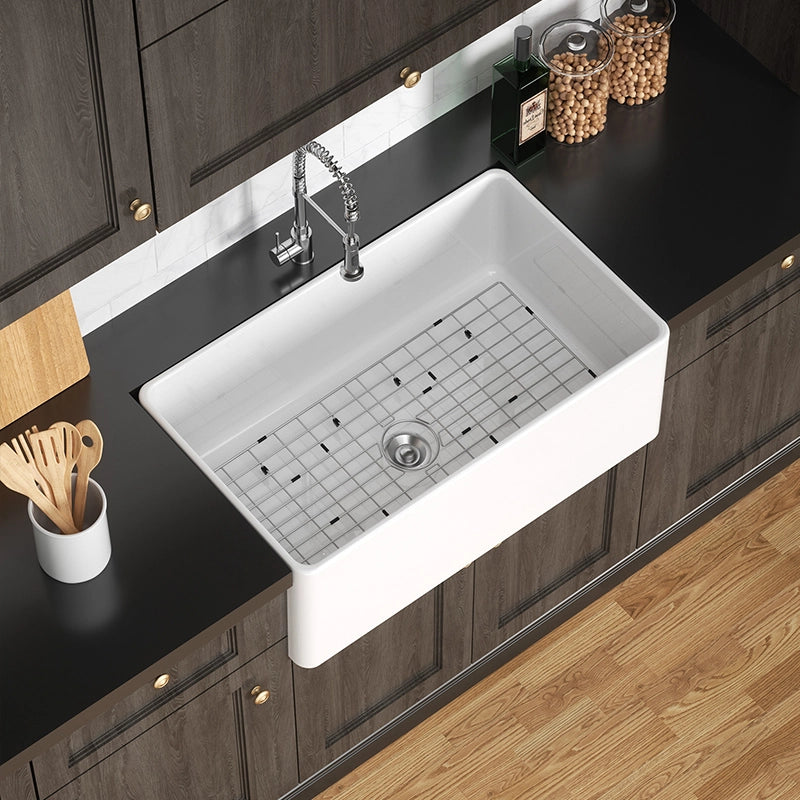
A farmhouse sink (also called a farm sink or farmer sink) is a deep kitchen sink with an exposed front panel called an apron. Instead of having a strip of counter in front of the sink, the apron replaces part of the cabinet face. That’s why you can stand closer to the sink basin.
This is also where people get confused about names. So what is the difference between an apron and farmhouse sink? In everyday talk, many people use the words as if they mean the same thing. To put it simply: “apron-front” describes the shape (exposed front), while “farmhouse” describes the style. Many farmhouse sinks are apron-front sinks, but you can also find apron sink designs that look modern and not “traditional farmhouse” at all.
Common Farmhouse Sink Dimensions for Kitchen Planning
Farmhouse sinks are typically larger than many traditional sinks, so size matters before you buy.
| Common dimension | Typical range (most homes) | What it affects |
| Sink width | 30"–36" (33" is very common) | Cabinet size, usable basin space |
| Front-to-back | ~20"–22" | Counter depth fit and faucet reach |
| Bowl depth | ~8"–12"+ | Capacity, splashing, reach-to-bottom comfort |
| Weight (by material) | ~30–250+ lb | Support framing and install difficulty |
If you’re wondering, what size is a standard farmhouse sink? In many kitchens, “standard” ends up meaning 33 inches wide with a deep single bowl sink. But “standard” depends on your cabinet and how much space you have.
The Biggest Advantages of Farmhouse Sinks
Farmhouse sinks stand out for more than just their looks. Their biggest advantages show up in daily use—how much they can hold, how comfortable they feel to work at, and how they shape both kitchen workflow and design.

Large Capacity for Real Kitchen Tasks
If you’ve ever tried to wash a roasting pan in a small sink and ended up splashing water everywhere, you already understand the biggest draw. A farmhouse sink gives you a large sink basin that can actually handle daily life: sheet pans can lie flatter, big pots fit without awkward tilting, and bulky items like air fryer baskets and cutting boards are easier to rinse.
A single sink (single bowl sink) is often the reason people switch. With a divided double sink, each side can feel cramped. With a large single bowl, you can soak, scrub, and rinse without playing sink-Tetris. If you bake often, you may love being able to set a baking sheet down and clean it without twisting it sideways.
Some farmhouse kitchen sinks also come with workstation ledges for accessories like a cutting board or colander. Workstation sinks can turn the sink into a practical prep station rather than just a cleanup zone. This can be a real workflow upgrade if you prep food in the sink. It’s not magic, but it can make the sink area feel like a useful station instead of just a place where dishes pile up.
Better Ergonomics and Everyday Comfort
Farmhouse sinks are popular because the apron changes how you stand. Since there’s no counter edge pressing into your hips, you can step closer. That can reduce the forward lean that bothers your lower back and shoulders, especially if you wash dishes by hand every day.
This is one of those benefits that feels small until you live with it. If you’re tall, if you have back strain, or if your kitchen sink is always in use, the comfort difference can be real. A sink is used constantly, so tiny ergonomic improvements matter more than you might expect.
Strong Design Impact and a Natural Focal Point
Why does everyone want a farmhouse sink? Part of it is function, but part of it is how it looks. An apron front sink creates a strong visual anchor. In a modern farmhouse kitchen, a white farmhouse sink is often the centerpiece. In a more transitional or even modern space, a stainless steel apron-front sink can give the same bold shape with a cleaner, more minimal feel.
One practical tip: trends come and go, but simple shapes last. If you like the farmhouse look but worry it could feel dated later, focus on a clean apron shape and a finish that matches your other fixtures. A farmhouse sink could still feel timeless if the rest of the kitchen isn’t built around a single trend.
Material Durability When You Choose the Right One
The sink material changes the whole experience. A well-made fireclay farmhouse sink can be tough and resistant to stains. A stainless steel sink is forgiving and less likely to chip. A cast iron farmhouse apron sink can feel solid and premium, but it needs serious support.
When people say “durable,” they often mean different things. For a kitchen sink, durability can mean:
-
The shower valve is old, leaks, or is hard to turn
-
The drain and overflow are corroded
-
You’re changing tub depth or drain style
-
You want to move the tub, or the drain location won’t line up
If you pick the right material for your habits, farmhouse sink pros can feel even bigger.
The Biggest Drawbacks of Farmhouse Sinks and How to Reduce Them
Farmhouse sinks offer real advantages, but their downsides tend to show up after installation and everyday use. Understanding these drawbacks—and how to plan around them—helps avoid expensive surprises later.
Higher Total Cost for the Sink, Labor, and Cabinetry
A common question is how much is a farmhouse sink? The sink price is only part of it. Many people get surprised by the “all-in” cost, because the cabinet often needs changes.
The typical 2025 price ranges (sink only) look like this:
| Sink material | Typical price range (sink only) |
| Stainless steel apron-front sink | ~$300–$900 |
| Fireclay farmhouse sink | ~$500–$1,500 |
| Cast iron (enamel) apron sink | ~$800–$2,000 |
| Granite/quartz composite | ~$500–$1,600 |
| Copper sinks / copper farmhouse | ~$900–$2,500+ |
Then you add labor. A farmhouse sink may need cabinet cutting, reinforcement, and careful leveling. Plumbing may need to shift. If you’re retrofitting, you might also need new doors or drawer fronts. That’s why two people can buy the same type of sink and end up with very different final costs.
A simple budget reality: new build or full remodel usually costs less in labor than a “simple swap” retrofit, because the kitchen can be designed around the sink instead of forced to accept it.
More Complex Installation, Especially for Retrofits
Installing a farmhouse sink is not always hard, but it is less forgiving than many types of kitchen sinks. The apron has to line up cleanly with the cabinet face. The sink needs strong support. If the sink is heavy, the cabinet must carry that weight safely.
I’ve seen one common scenario: someone buys a beautiful sink, then learns the current cabinet wasn’t built for it. A local installer once told me, “The sink isn’t the problem. The cabinet is.” That stuck with me because it’s true. The apron-front sink may look simple, but the support underneath is where success or failure happens.
Retrofit pain points often include door resizing, changing the face frame, and losing drawer space. Even when it works, it can turn into a bigger project than expected.

Splashing and Water Control Challenges
Do farmhouse sinks splash more? They can, yes. It’s not because farmhouse sinks are “bad,” but because of physics and layout. You stand closer to the basin, the bowl is often deep, and if your faucet is tall with a strong spray, water can hit the bottom and bounce back.
You can reduce this with smart choices:
-
Match faucet height and reach to the sink depth so the stream lands closer to the drain area, not on a flat bottom.
-
Use an aerator or lower the water pressure if the stream is harsh.
-
Consider a sink with a gently sloped bottom that guides water to the drain instead of letting it spread.
If your sink area is already splash-prone (for example, the sink sits on a narrow run with open shelves nearby), this is a con to take seriously.
Visible Wear, Stains, and Surface Scuffs
Some farmhouse sinks develop a “used” look faster, and whether that bothers you is personal. A glossy white porcelain farmhouse sink can show metal marks from pans, plus stains from coffee, tea, wine, or strong spices. This doesn’t mean it’s impossible to keep clean, but it does mean you may clean it more often than you expect.
Fireclay farmhouse sinks and enamel-coated sinks can also chip at edges if a heavy pot hits the rim. If you’ve ever dropped a cast iron pan, you know it doesn’t gently bounce.
Mitigation is simple but important. Use a bottom grid, don’t use abrasive powders, and don’t leave strongly colored foods sitting overnight. If hard water is common where you live, drying the sink after use can prevent dull spots and rings. The United States Geological Survey (USGS) explains that hard water contains higher levels of minerals like calcium and magnesium, which are a common cause of visible residue and spotting on sinks, faucets, and other kitchen surfaces.It sounds picky, but it becomes a quick habit.
If you know you’ll hate visible marks, consider a textured composite finish or stainless steel. A sink may look “perfect” in photos, but your reality matters more than a showroom.
Reduced Under-Sink Storage Space
Farmhouse sinks tend to be deep and wide, which is the whole point—but it also steals cabinet volume. That can affect where your trash pull-out goes, how your disposal fits, and whether you can still store tall cleaning bottles. If you already feel cramped under the sink, a farmhouse sink for your kitchen may make that worse.
There are ways around it if you plan early: choose a wider sink base cabinet, use compact plumbing parts where possible, and keep bulky storage elsewhere. But if your kitchen is small, this con can be a dealbreaker.
Increased dish breakage risk
A deep sink is great until a glass slips. Hard materials like fireclay and cast iron don’t give much. Add the deeper drop, and breakage can happen more often than in a shallower stainless steel sink.
If this is a worry in your house—kids helping, lots of glassware, rushed mornings—stainless steel is the most forgiving choice. A bottom grid also helps by creating a small buffer.
Farmhouse Sink Materials Compared: Fireclay, Stainless Steel, And Cast Iron
If you’re choosing a farmhouse-style sink, the material is not a small detail. It affects noise, cleaning, breakage, and even how stressful installation will be.
Fireclay Farmhouse Sinks
A fireclay farmhouse sink is popular because it fits the farmhouse style so well, especially in white. It’s fired at high heat, which can make it dense and non-porous when it’s made well. That usually means good stain resistance and a smooth surface that doesn’t hold odors easily.
The downside is weight and chipping risk. Fireclay is heavy, and quality varies. A poorly made sink may crack or craze over time, especially if it’s forced into a cabinet opening that isn’t level or if it takes repeated hard impacts.
Fireclay is best for people who want that classic look and don’t mind using a grid and gentle cleaning habits.
Stainless Steel Apron-Front Sinks
A stainless steel sink in apron-front form is often the most practical option. It’s lighter than fireclay or cast iron, so installing a farmhouse sink is usually simpler. It’s also kinder to dishes and less likely to chip.
The tradeoff is scratches and noise. Stainless shows wear, and some finishes show water spots or fingerprints. Thicker steel and sound pads help a lot, but stainless steel will still develop a lived-in patina.
Stainless is best for busy households that want function first and low stress day to day.
Cast Iron Enamel Apron Sinks
A cast iron farmhouse apron sink can feel like a “forever” choice. The body is strong, and the enamel finish can be beautiful when cared for. Many people like the solid feel and the way it pairs with both traditional farmhouses and classic kitchens.
The main con is extreme weight. This type of sink needs serious cabinet support. The enamel can also chip if hit hard, and chips are tough to hide.
Cast iron is best for long-term installs where the cabinetry can be properly reinforced.
Granite And Quartz Composite Farmhouse Sinks
Composite sinks are often chosen by people who hate visible mess. Many are strong against scratches and stains, and the color runs through the material, so wear can be less obvious than on a glossy surface. They can also be quieter than metal.
They’re still heavy, and darker colors can show hard-water spotting. If your water leaves white deposits on showerheads or faucets, you may see the same on a dark composite sink unless you wipe it dry.
Composite is best for people who want durable function with less visible scuffing.

Farmhouse Sink Material Comparison at a Glance
| Material | Maintenance effort | Noise | Weight | Chip risk | Scratch visibility | Typical price band |
| Fireclay | Medium | Quiet | Heavy | Medium | Low–medium (metal marks can show) | Mid–high |
| Stainless steel | Low | Medium (lower if insulated) | Light | Low | Medium–high | Low–mid |
| Cast iron (enamel) | Medium | Quiet | Very heavy | Medium–high | Medium | High |
| Granite/quartz composite | Low–medium | Quiet | Heavy | Low | Low | Mid–high |
| Copper farmhouse | Medium | Quiet | Medium | Low | Medium (patina changes) | High |
Farmhouse Sink Size, Configuration, And Daily Workflow
A farmhouse sink could be the perfect sink, or it could annoy you every day. The difference often comes down to sink size, bowl layout, and how you use your kitchen sink.
A single bowl sink is usually best if you cook big meals and wash large cookware. A double farmhouse setup (double sink or double farmhouse) can help if two people work at once or if you like separating clean and dirty dishes. The catch is that each bowl gets smaller, so you can lose the “big pan” advantage.
Depth is also personal. A deep sink sounds great, but if you’re shorter, reaching the bottom can be uncomfortable. Depth can also increase splashing if the faucet stream hits hard. Many people find the sweet spot is deep enough for pots but not so deep that daily washing feels like a workout.
Drain placement and basin slope matter too. A sink with a good slope drains better and is easier to keep clean because water doesn’t pool. If you’ve ever had a sink that always looks wet and spotty, you already know why this matters.
Installation And Cabinetry Checklist For Farmhouse Sinks
If you’re buying a farmhouse sink, measure twice and plan like you’re doing a small construction project—because you are. This checklist keeps it simple and focuses on the steps that prevent expensive mistakes.
-
Measure cabinet width and interior clearance. A 33-inch sink often needs a 36-inch sink base cabinet, depending on the sink’s outside width and how it mounts.
-
Check farmhouse sink dimensions, not just the listed width. Look at outside corners, apron height, and front-to-back depth.
-
Confirm how the sink mounts. Some apron-front sinks mount like an undermount, some are drop-in, and some are made for a specific cabinet cut.
-
Plan structural support for heavy materials. Fireclay, cast iron, and composites may need a strong support frame, not just clips.
-
Match faucet reach and height to the bowl depth. This reduces splashing and makes the sink easier to use.
-
Plan plumbing, disposal, and filters early. This protects under-sink storage space and prevents last-minute surprises.
-
Choose an installer with apron-front experience. Small alignment errors are easy to see because the apron is exposed.
How Far A Farmhouse Sink Should Stick Out
This is one of the most common “wait, what?” details. Many homeowners assume the apron should stick out a lot. In most kitchens, the apron is set flush with the cabinet face or slightly proud by about 1/8" to 1/4". Some designs go closer to 1/2" or even 1" proud, but that should be a deliberate style choice, and it must still work with the countertop edge and cabinet doors.
If it sticks out too far, you can bump into it. If it sits too far back, it can collect grime at the seam and look poorly installed. The right answer depends on your cabinet style and countertop thickness, so you want to confirm this before the cabinet is cut.
Maintenance Guide To Keep A Farmhouse Sink Looking New
Are farmhouse sinks hard to clean? They don’t have to be, but some finishes show dirt faster, and deep basins can hide grime at the bottom if you don’t rinse well.
Daily care is mostly about small habits. Rinse the sink after cooking, don’t leave strong dyes sitting for hours, and use a soft sponge. If you have hard water, wiping the sink dry helps a lot. This is especially true for darker composite sinks and stainless steel, where spots can show.
For cleaning products, keep it gentle. Abrasive powders and rough pads can dull glossy surfaces and scratch metal. The Centers for Disease Control and Prevention (CDC) also recommends using mild, properly diluted cleaners rather than harsh disinfectants for routine household surfaces, reserving stronger solutions like bleach only for specific sanitation needs and with proper ventilation. If you need to remove metal marks on a white sink, use a non-scratch cleaner and light pressure, then rinse well. If you’re not sure what’s safe, follow the care instructions that came with the sink, because finishes vary even within the same sink material. According to the National Institute for Occupational Safety and Health (NIOSH), prolonged exposure to strong cleaning chemicals—especially in enclosed spaces like kitchens—can, can increase irritation risks, which is another reason to avoid overly aggressive cleaners when maintaining your sink.
Two add-ons make life easier in almost any farmhouse sink: a fitted bottom grid and a simple drain strainer. The grid protects the surface, reduces dish breakage, and helps water flow under dishes so you’re not washing in a puddle.
Is A Farmhouse Sink Worth It A Simple Decision Framework
Are farmhouse sinks worth it? They are worth it when their strengths match your daily kitchen life.
Choose a farmhouse/apron-front sink if you care most about capacity, comfort, and a statement sink design. If you cook often, a big sink basin can reduce stress every single day. If you wash by hand, standing closer and leaning less can feel like a small upgrade that adds up.
Reconsider if you need the easiest installation, the most under-sink storage, or a sink that hides wear. The cons of farmhouse sinks are real, and they usually show up after the first few weeks—when the novelty fades and the sink becomes just another tool you rely on.
Here’s a quick self-check. If you answer “yes” to most of these, a farmhouse sink is likely a good fit:
| Quick question | Yes / No |
| Do you wash large cookware weekly? | |
| Are you doing a full remodel or new build? | |
| Can you give up some under-sink storage? | |
| Are you okay using a grid and gentle cleaners? | |
| Do you want the sink to be a visible design feature? |

Buying Checklist What To Verify Before You Purchase
Before buying a farmhouse sink, it helps to treat it like buying an appliance: check the details, not just the photo.
Make sure you verify the sink’s weight and what support is included. Review the warranty and what it actually covers, since some warranties are limited when it comes to chips, cracks, or finish wear. Also check the return policy, because heavy sinks can be expensive to ship back.
Finally, be honest about your home. If you have hard water, a finish that shows spots may bother you. If you cook with lots of colorful spices and sauces, a glossy white sink may stain more than you want to deal with. The right sink is the one that fits your real habits, not just your saved pictures.
Conclusion
The main tradeoff in the pros and cons of farmhouse sinks is simple: you get big capacity, better stance at the sink, and strong design impact, but you pay for it with higher cost, tougher installation, possible splashing, visible wear on some finishes, and less under-sink storage.
If you want the easiest day-to-day care and the most forgiving surface, stainless steel is often the safest choice. If you want the classic farmhouse look and don’t mind using a grid and gentle cleaning, a quality fireclay farmhouse sink can be a great fit. If you want a quieter sink that hides marks better, a composite sink is worth a look. And if you want a heavy, classic feel and can build the cabinet support correctly, cast iron can be a long-term option.
A farmhouse sink can really improve how your kitchen works—if you choose the right sink type, the right size of the sink, and a plan for installation from the start.
FAQs
1. Do farmhouse sinks splash more than a standard sink?
They can, especially because farmhouse sinks are often deeper and you stand closer to the basin. Splashing usually happens when a deep bowl is paired with a tall, high-pressure faucet. That said, it’s mostly a setup issue. Choosing a faucet with the right reach, using an aerator, and picking a sink with a gently sloped bottom can reduce splashing a lot.
2. What cabinet size do I need for a 33-inch farmhouse sink?
Most 33-inch farmhouse sinks work best with a 36-inch sink base cabinet. This gives enough room for the sink’s outer dimensions, mounting style, and proper support. Exact requirements vary by model, so always check the manufacturer’s spec sheet instead of relying on the listed sink width alone.
3. Are fireclay farmhouse sinks hard to maintain?
Not really, but they do show wear more easily than some materials. Metal marks and stains can appear if dirty dishes sit too long. Using a bottom grid, rinsing after use, and sticking to non-abrasive cleaners keeps maintenance simple for most homeowners.
4. How far should the apron front stick out?
In most installations, the apron front is flush with the cabinet face or slightly proud—about 1/8" to 1/4". This gives a clean look without affecting comfort. More projection is a style choice, but it needs to be planned carefully with the countertop and cabinet design.
5. Are farmhouse sinks worth it in a small kitchen?
Sometimes. If you cook often and value a large, single basin, a farmhouse sink can still work well. But in very small kitchens, the loss of under-sink storage and cabinet space can outweigh the benefits, making a standard sink the more practical option.
References



Leave a comment
This site is protected by hCaptcha and the hCaptcha Privacy Policy and Terms of Service apply.