

Is It Worth It?
Depends on your layout, budget, and plumbing
A freestanding tub faucet is worth considering when the bathtub sits away from a wall and the room has enough space for a floor-mounted fixture. It provides placement flexibility and a strong visual focal point, but usually demands more precise planning, structural support, and installation work than a wall- or deck-mounted faucet.
Good for: open, design-focused bathrooms and renovations where the floor is accessible before finishes are installed.
Less suitable for: tight rooms, limited budgets, inaccessible floors, or projects where the tub position may change after plumbing work begins.
Best for spacious, design-focused bathrooms
A floor-mounted filler works especially well when a freestanding tub is positioned as the room’s centerpiece. Because the supplies approach through the floor, the tub does not have to sit beside a plumbing wall.
The visual effect is often the main reason to accept the additional cost and installation demands. If appearance is secondary to simple service, efficient use of space, or a forgiving installation, another mount type may be more practical.
Precision and cost are the main limitations
The tub footprint, faucet orientation, spout projection, floor support, and rough-in all need to work together. A placement error can leave the stream hitting the rim, increase splashing, or put the controls out of comfortable reach.
Total cost also extends beyond the visible faucet. Depending on the model and project, it may include a compatible rough-in, mounting hardware or carrier, floor work, and more involved plumbing labor.
When It Works Well
Floor-mount suits tubs positioned away from walls
A freestanding tub faucet floor mount is the logical choice for a tub away from walls or a tub without compatible faucet holes. It offers the most freedom around the tub, particularly in a new build or major renovation where supplies and structural support can be planned before flooring.
That freedom comes with tight installation tolerances. Select the tub and faucet together, and use their actual drawings rather than estimating from product photos.
Wall-mount works better beside accessible walls
A wall-mounted filler is often more space-efficient when the bathtub sits close to an accessible plumbing wall. It also removes the faucet column from the floor, which can improve circulation and make the area around the tub easier to clean.
The main constraint is spout projection. The spout must extend beyond the tub rim far enough for the stream to land inside the basin without taking up excessive bathing space.
Deck-mount saves space when tub holes allow
A deck-mounted faucet attaches to compatible holes or a suitable mounting surface on the tub. It can be a compact choice because it does not need a separate floor column or a long wall spout.
Confirm the tub’s hole configuration, mounting surface, and faucet requirements before purchase. A deck-mounted model is not an option when the tub lacks a suitable mounting area.
Higher flow suits large soaking tubs
A large soaking tub can take an inconveniently long time to fill when paired with a low-flow fixture. Compare the tub’s usable capacity with the faucet’s rated flow, while recognizing that actual performance also depends on the home’s supply system and other water use.
A simple estimate is:
Estimated fill time = water volume needed ÷ delivered flow rate
This is only a planning estimate because bathers usually enter before the tub reaches its maximum capacity, and delivered flow may differ from the faucet’s rating.
When It May Not Be Ideal
Is it worth it for small bathrooms?
Usually not if the faucet would narrow a walking path, crowd the tub entry point, or create a difficult cleaning gap. A tub and floor-mounted filler may each fit on a plan while still feeling cramped in daily use.

If the tub is already beside a wall, a wall- or deck-mounted faucet will often use the available space more efficiently.
Avoid it when underfloor access is difficult
A floor-mounted faucet may be a poor first choice when opening or servicing the floor would be highly disruptive. Concrete floors, finished rooms below the bathroom, and completed tile can complicate initial work and later repairs.
Before buying, determine how the supplies, mounting assembly, and serviceable components will be installed and accessed. Do not assume every floor-mounted faucet uses the same rough-in arrangement.
Skip it without secure structural anchoring
A tall filler creates leverage at its base and should not rely on tile alone for stability. The required support depends on the faucet’s mounting system and the floor assembly, so the installer should follow the selected model’s instructions.
A freestanding bathtub faucet is not a grab bar. If someone needs support when entering or leaving the tub, plan a separate fixture designed for that purpose.
Hard water increases cartridge maintenance
Mineral buildup can contribute to restricted spray outlets, difficult controls, or drips around cartridges and seals. A homeowner who wants minimal maintenance should consider water conditions, replacement-part availability, and how easily the faucet can be serviced.

Pros and Cons
|
Advantages |
Trade-offs |
|
Creates a distinctive focal point |
Usually has a higher total project cost |
|
Works with tubs away from walls |
Requires an exact, model-compatible rough-in |
|
Allows flexible placement during an open renovation |
Needs substantial floor support |
|
Can fill a large tub efficiently when properly matched |
Excessive height, reach, or flow can worsen splashing |
|
A hand shower helps with rinsing and cleaning |
The hose, diverter, and connections add potential leak points |
|
Exposed controls can be easy to reach when well positioned |
The base and surrounding floor may be harder to clean |
Is it reliable long-term?
A floor-mounted faucet can be reliable when it has sound valve components, secure anchoring, correct installation, and obtainable replacement parts. The freestanding shape itself does not determine reliability.
Common complaints include wobbling at the base, slow spout drips, hand-shower weeping, and water around the controls. These problems may result from weak support, worn seals or cartridges, mineral buildup, or installation errors.
Real-World Considerations
Where should the faucet be positioned?
Place the faucet where the stream falls clearly inside the basin without striking the rim. The controls should be reachable from outside the tub, while the faucet body should stay clear of the normal entry and exit path.
Side placement often makes controls easier to reach. End placement can work when it does not crowd the bather’s head or shoulders. The correct position depends on the actual tub shape, spout projection, and stream angle—not simply the tub’s overall length.
Before rough-in, mark or temporarily position the tub and confirm the stream landing point, handle access, hand-shower movement, cleaning space, and nearby doors or fixtures.
What height and reach prevent splashing?
There is no universal installation height for every freestanding bathtub faucet. The important dimensions are the finished floor height, tub-rim height, spout-outlet height, projection, and expected stream landing point.
The spout must clear the rim and extend far enough into the basin. Too little reach may send water onto the rim, while excessive reach can intrude on bathing space. Extra height may also increase splash.
Review the tub and faucet drawings together. For a detailed measurement process, see the guide to bathtub faucet height for freestanding and wall-mounted installations.
What rough-in and valve access come first?
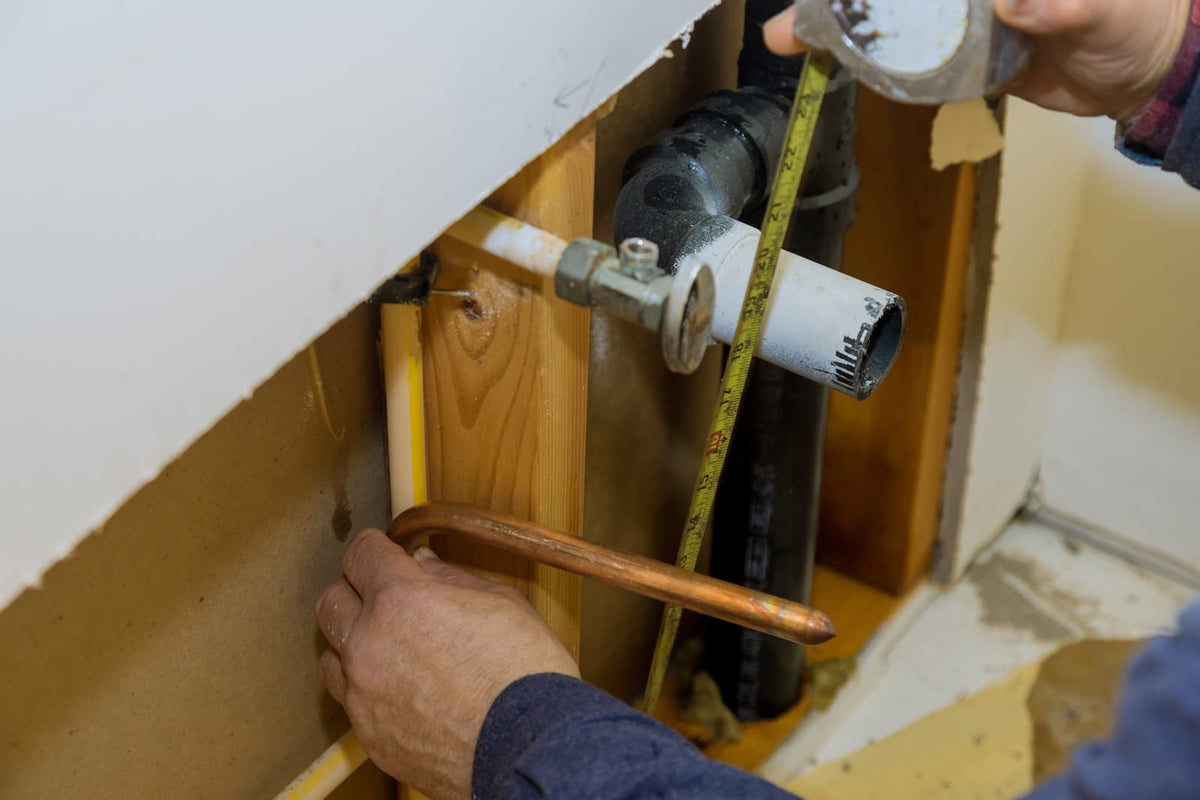
Floor-mounted models generally need hot and cold supplies, a secure mounting assembly, and the rough-in specified for the selected faucet. Compatibility is model-dependent; a generic or mismatched rough-in can create fit and service problems.
Complete the planning before final flooring. Account for:
- The confirmed tub footprint and rim position
- Finished flooring thickness
- Faucet orientation and spout landing point
- Support within the floor assembly
- The manufacturer’s installation sequence
- Access for shutoff, valve, cartridge, or connection service
The tub drain and faucet supplies are separate systems, but both must align with the final layout. Review the freestanding tub plumbing rough-in and drain guide before finishes are installed.
How does flow rate affect fill time?
A higher delivered flow generally shortens filling time, but the faucet rating does not guarantee the same performance in every home. Supply capacity, valve design, and simultaneous water use can affect the result.
Balance flow with tub geometry. A forceful stream landing on the rim or close to the sidewall may create more splash than a correctly positioned stream with a lower flow.
Who Should Buy or Skip
Buy a freestanding tub faucet when:
- The tub sits away from an accessible wall.
- The room has space for movement, cleaning, and control access.
- The floor is open for compatible plumbing and secure support.
- The tub and faucet dimensions can be confirmed before rough-in.
- Visual impact justifies the added expense.
- Experienced installation and future service are available.
Choose another mount type when:
- The bathroom is tight or the faucet would obstruct tub access.
- The tub sits beside a suitable plumbing wall.
- The tub accepts a compatible deck-mounted faucet.
- Opening or servicing the floor would be difficult.
- Lower cost and simpler maintenance are higher priorities.
- Users may try to pull on the faucet for support.
Pre-Installation Checklist
Before ordering or installing, confirm:
- The faucet mount type fits the tub and room layout.
- The spout clears the rim and lands well inside the basin.
- Controls are reachable without blocking tub entry.
- The hand-shower hose can move without dragging awkwardly.
- The rated flow is appropriate for the tub and supply system.
- The exact compatible rough-in and mounting parts are identified.
- Structural support is planned beneath the finished surface.
- Finished floor height is included in installation measurements.
- A practical route for future valve or cartridge service exists.
- Replacement cartridges, seals, and hand-shower parts are obtainable.
Frequently Asked Questions
Does a freestanding tub require a floor-mounted faucet?
No. A freestanding tub can use a floor-, wall-, or deck-mounted faucet when the tub construction, spout reach, and room layout support that option.
Is a hand shower worth adding?
A freestanding tub faucet with a hand shower is useful for rinsing the tub and washing hair. It also adds a hose, diverter, and connections that may require cleaning or future service.
What is the biggest first-purchase mistake?
The most consequential mistake is selecting the faucet for appearance before confirming the tub position, spout reach, rough-in compatibility, floor support, and service access. Those factors should be settled before flooring is finished.


Leave a comment
This site is protected by hCaptcha and the hCaptcha Privacy Policy and Terms of Service apply.