
Is It Worth It?
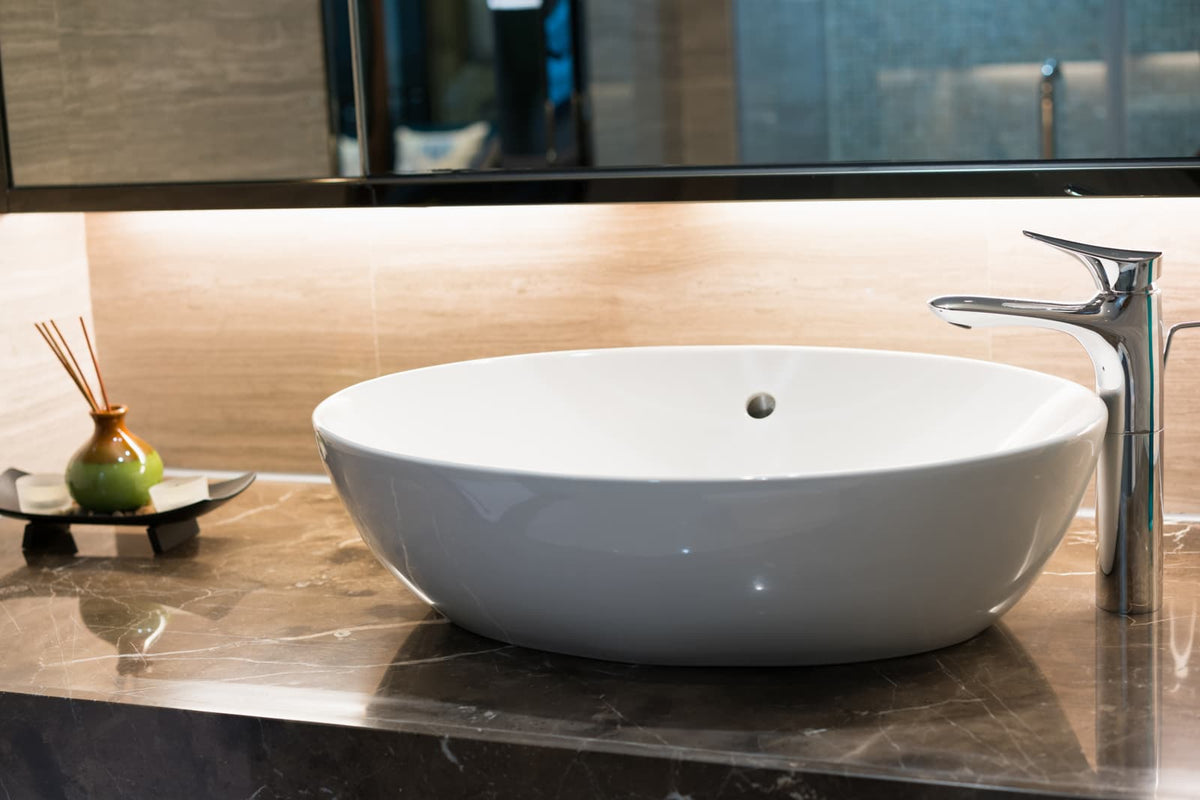
Vessel sink faucets are worthwhile when the faucet, bowl, countertop, and vanity are planned as one system. They are good for design-focused powder rooms and adult bathrooms, but less suitable for kid-heavy or low-maintenance spaces.
Use these pairing rules as a starting point:
- Position a deck-mounted spout outlet about 1–3 inches above the vessel rim. Treat this as a practical target, not a universal specification.
- Make the stream clear the inner rim and land near the drain or lowest central area.
- Check the finished sink height, not just the vanity height.
- Verify mounting holes, handle movement, backsplash clearance, and supply-line access before drilling.
- Choose a wall-mounted faucet only when its rough-in height and projection can be set precisely.
Depends: Worthwhile when sink, faucet, and vanity align
A faucet that merely clears the rim is not necessarily compatible. Its reach, stream angle, flow characteristics, controls, mounting base, and surrounding clearances must also suit the bowl.
Most poor results come from choosing a faucet by appearance before checking the sink’s technical drawing. Review the vessel’s rim height, depth, drain location, outer dimensions, and installation position first.
Best for planned powder rooms and adult users
Bathroom vessel sink faucets work especially well in lower-traffic rooms where visual impact matters and the users can comfortably reach the controls. They can also work in a primary bathroom, but the finished rim and faucet-control heights require closer attention.
Main limitation: Mismatched geometry causes splash and awkward reach
A high outlet, shallow bowl, strong stream, or incorrect landing point can send water onto the counter or user. An oversized bowl may also force users to reach too far for a handle mounted behind it.
When Do Vessel Sink Faucets Work Well?
Works when spout clearance stays within 1–3 inches
For a tall deck-mounted vessel sink faucet, measure from the countertop to the top of the vessel rim. Then add roughly 1–3 inches to estimate a practical spout-outlet height.
For example, do not use the faucet’s total height as the deciding measurement. A tall decorative handle or arched body does not show where the water exits. The technical drawing should identify the outlet height separately.
More space is not automatically better. Extra height can improve hand clearance, but it increases the water’s fall and may worsen splash in a shallow bowl.
Works when water lands near the drain
The stream should pass beyond the inner rim and land near the drain or lowest central portion of the bowl. If it strikes high on the rear wall, hands may be cramped against the vessel. If it lands too far forward, water can splash toward the user or over the front edge.
Mark the drain center, inner rim, faucet base, and expected stream position on a cardboard template. This simple mock-up is more reliable than judging the pairing from product photographs.
Deck-mount works best for straightforward retrofits
A tall vessel sink faucet mounted on the countertop is generally the more practical option when updating an existing vanity. It avoids placing the faucet valve inside the wall and may require only one countertop hole when a single-hole model is selected.

The trade-off is counter space. The faucet base must fit between the vessel and backsplash while leaving enough room for installation, handle operation, and cleaning.
Wall-mount works best during plumbing-accessible remodels
A wall-mounted faucet frees counter space and avoids a faucet base behind the bowl. It is most suitable when the wall is already open and the spout position can be coordinated with the exact vessel.
Its height and projection are less forgiving. Once the plumbing and valve are enclosed, correcting a poorly positioned outlet can require reopening the wall.
When May They Not Be Ideal?
Is it worth it for small bathrooms?
It can be, but a compact room does not always mean a compact installation. A wide vessel and tall deck-mount faucet may consume most of a shallow countertop. Tight gaps can also make the faucet base and backsplash difficult to clean.
A wall-mounted faucet saves counter area but may conflict with a mirror, shelf, cabinet, or backsplash. Before choosing either style, check whether users can reach the water and controls without leaning over the bowl.
Not ideal when vanity height limits comfortable control reach
Placing a tall vessel on an existing vanity can make the finished rim and faucet controls uncomfortably high. This is particularly relevant for children and shorter users.
Plan from the floor to the completed vessel rim rather than looking at cabinet height alone. If the vanity is still being selected, use the guidance on bathroom vanity dimensions to assess the complete installation.
Avoid shallow bowls with high, forceful streams

Shallow, flat-bottomed, and angular bowls tend to be less forgiving when water falls from well above the rim. Splash risk rises when the stream hits a sloped or vertical surface rather than the drain area.
A deeper bowl and softer aerated stream can help, but flow adjustments cannot fully correct poor faucet reach or placement.
Wall-mounts punish inaccurate rough-in height and projection
A wall-mounted spout that is too short may hit the bowl wall. One that projects too far may direct water toward the front edge. Incorrect height can leave too little hand space or create an unnecessarily long water drop.
Replacement choices may also be constrained by the existing in-wall valve and outlet position. Wall mounting is therefore less suitable when the selected sink or faucet may change later.
What Are the Main Pros and Cons?
Main advantage: Strong looks and flexible faucet placement
Vessel sink taps can sit behind or beside the bowl, depending on the sink shape and available counter space. They also complement the sculptural appearance that leads many homeowners to choose an above-counter sink.
When comparing above-counter bathroom sinks, use each sink’s dimensions and technical drawing—not its product image alone—to evaluate faucet compatibility.
Main drawback: Compatible choices cost more and narrow quickly
Standard low-profile bathroom faucets commonly lack enough outlet height to clear a vessel rim. Buyers may therefore need a dedicated tall vessel sink faucet or a wall-mounted model, reducing the number of suitable choices.
Wall-mounted installations may also involve additional plumbing and wall work. Actual project cost depends on the existing plumbing, countertop material, faucet configuration, and access.
What problems do users report?
Common complaints include:
- Water splashing onto the counter, mirror, or user
- Controls that are too high or too far behind the bowl
- Hands striking the rim or inner wall
- Water running down users’ arms
- Residue collecting around the bowl base or faucet
- Limited replacement choices after installation
These problems usually reflect the complete layout rather than the faucet alone.
Cleaning access shrinks as faucet spacing tightens
Moving a deck-mounted faucet closer to the vessel may improve stream placement, but it can create a narrow gap that is difficult to wipe. Moving it farther away improves cleaning access but requires greater spout reach.
Leave enough room to clean around the faucet base, vessel exterior, backsplash, and bowl-to-counter seam. For a broader evaluation of upkeep and usability, see the guide to vessel sink pros and cons.
What Real-World Checks Prevent a Bad Fit?
Add 1–3 inches above the rim for practical clearance
Measure the counter-to-rim height and add approximately 1–3 inches for the initial outlet-height target. Then confirm that the resulting position provides enough room for hands without creating an excessive drop into the bowl.
Always use the manufacturer’s dimensional drawing for the actual faucet and sink.
Size reach to land water near the drain
Spout reach is measured horizontally from the faucet body or mounting centerline to the outlet. It must account for the gap between the faucet and vessel, the rim thickness, and the drain position.
Dry-fit or mock up the layout before countertop fabrication. Test the expected water path as well as normal hand position.
Verify mounting holes, handles, backsplash, and supply lines
Before ordering, confirm:
- The countertop holes match the faucet configuration.
- The faucet base and mounting hardware fit the available surface.
- The spout clears the rim at the planned position.
- The handle opens fully without hitting the bowl, wall, mirror, or backsplash.
- Supply hoses can reach without being stretched or sharply bent.
- Connections remain accessible for installation and future service.
- The countertop fabricator approves the hole location and spacing.
Is it reliable long-term?
The vessel format does not by itself determine faucet life. Reliability depends more on faucet construction, secure mounting, correct installation, and serviceable plumbing connections.
Deck-mounted connections are usually easier to reach through the vanity. Concealed wall-mounted components are less convenient to change, so access and future replacement should be considered before the wall is closed.
Who Should Buy or Skip Them?
Buy if you will mock up the complete system
Choose a vessel sink faucet if you will verify the finished height, outlet clearance, reach, stream landing point, controls, and cleaning access before drilling or rough-in.
Vessels need tall deck-mount or correctly placed wall faucets
A vessel sink does not require a proprietary faucet. It generally needs either a tall deck-mounted faucet that clears the rim or a wall-mounted faucet positioned for the specific bowl.
Choose wall-mount only with precise plumbing access
Wall mounting is a good choice during a planned remodel with open-wall access. For a straightforward vanity update, a tall single-hole deck-mount is usually more adaptable.
Skip for high-use, kid-heavy, low-maintenance bathrooms
Consider another sink-and-faucet format if easy reach, broad faucet choice, simple replacement, and minimal wiping matter more than the vessel look.
Compatibility Checklist
Before purchasing, verify:
- Finished vessel-rim height is comfortable for intended users.
- Spout outlet clears the rim by a practical amount.
- Stream lands near the drain or bowl center.
- Hands fit beneath the spout without hitting the bowl.
- Faucet base fits between the vessel and backsplash.
- Handle completes its full travel without obstruction.
- Countertop holes match the faucet.
- Supply connections are reachable and serviceable.
- Mirror, shelf, and backsplash clear the complete faucet.
- The full layout has been mocked up before drilling or wall closure.
Frequently Asked Questions
How tall should a faucet be for a vessel sink?
For a deck-mounted faucet, start with an outlet approximately 1–3 inches above the vessel rim. Calculate from the countertop to the rim, then add the desired clearance. Confirm the result against the actual faucet drawing and bowl depth.
How far should a faucet reach into a vessel sink?
It should extend beyond the inner rim far enough for the stream to land near the drain or lowest central area. Because vessel shapes and drain positions vary, there is no single reach measurement that fits every sink.
Do vessel sinks require special faucets?
Not proprietary ones, but most require either a tall vessel-height deck faucet or a correctly positioned wall-mounted faucet. A standard low bathroom faucet is often too short to clear the rim.
What causes a vessel sink faucet to splash?
The main causes are excessive outlet height, a shallow bowl, strong flow, and a stream that strikes the bowl wall instead of the drain area. Correcting the landing point is usually more effective than reducing flow alone.
Final decision: Vessel sink faucets are a good choice when design matters and the complete installation can be measured and mocked up. They are less suitable when the vanity height is fixed, children need easy access, or the goal is the simplest possible cleaning and replacement.




Leave a comment
This site is protected by hCaptcha and the hCaptcha Privacy Policy and Terms of Service apply.