
Cleaning soap scum is one of those chores that never feels finished. You scrub the tub, rinse the shower door, step back…and still see that cloudy film or gritty ring. If you’re tired of fighting it, this guide shows you exactly how to remove soap scum, why it keeps coming back, and how to keep it under control for good.
You’ll learn the best way to remove soap scum from your tub, shower doors, and tiles, including:
-
Fast 10-minute methods using items you already own
-
The simple science of soap scum formation (and how to use it to your advantage)
-
Safe, smart use of baking soda, vinegar and dish soap for soap scum
-
When to use commercial soap scum removers
-
How to protect glass, tile, acrylic, fiberglass, and natural stone
-
Routines that prevent soap scum buildup so cleaning gets easier over time
Think of this as your complete handbook for cleaning soap scum in a way that is effective, safe, and as low-stress as possible.
Quick-Start: Fastest Way to Remove Soap Scum Today
If you’re standing in your bathroom right now wondering, “How do you get rid of soap scum fast?” start here. This 10‑minute method is perfect for light to moderate soap scum buildup on tubs, showers, and tiles (but not on natural stone like marble or travertine).
10‑minute method to remove soap scum from tubs, showers, and tiles
Use this when you want to easily remove soap scum today without special products.
-
Mix your cleaning solution. In a spray bottle, combine equal parts white vinegar and warm water. For extra power on greasy film, add 1–2 teaspoons of liquid dish soap.
-
Spray the surface generously. Cover the tub, shower walls, shower floor, and glass shower doors wherever you see soap scum. Make sure the area is dry before you start; water will dilute the cleaner.
-
Let the vinegar sit. For light buildup, let it sit 10–15 minutes. For more stubborn spots, 20–30 minutes is better. This “dwell time” lets the vinegar dissolve soap scum by softening the minerals and soap residue.
-
Add gentle abrasion where needed. Sprinkle a small amount of baking soda on a non-scratch sponge or soft cloth. Scrub in circles. The mild grit helps take off soap scum without scratching most surfaces.
-
Rinse with warm water. Rinse the shower or tub with warm water to remove any remaining residue. For shower doors and glass panels, rinse and then thoroughly dry the glass with a microfiber cloth to avoid spots.
-
Spot-check and repeat if needed. For any stubborn soap scum patches, spray again and give them another 10–15 minutes before scrubbing.
This simple routine combines acid (vinegar) to loosen minerals with gentle abrasion (baking soda) to remove the softened film. It’s one of the best all-around ways to remove soap scum at home.
What you need: basic tools & ingredients (quick table)
Here’s a simple overview of common items you can use for soap scum removal and what they do.
| Item | Main purpose | Approx. cost (USD) |
| White vinegar | Dissolves minerals from hard water, softens scum | Low |
| Baking soda | Gentle abrasive to lift residue | Low |
| Liquid dish soap | Cuts body oils and soap residue | Low |
| Spray bottle | Evenly applies vinegar and water solution | Low |
| Non-scratch sponge | Safe scrubbing on tubs and showers | Low–Medium |
| Microfiber cloth | Streak-free drying on glass and tile | Low–Medium |
| Rubber gloves | Protects skin from dryness and irritation | Low |
You can tackle most tubs and showers with just these items.
Safety first: products and surfaces you must never mix
When it comes to cleaning, more power is not always better. Some mixes are dangerous.
To stay safe:
-
Never mix bleach with vinegar or any acid. This combination can create toxic chlorine gas, which can irritate or damage your lungs and eyes. If you ever used bleach in the shower, rinse very well with water before using any vinegar-based cleaner.
-
Avoid harsh abrasives on acrylic and fiberglass. Powder cleansers and metal scrubbers can scratch acrylic, fiberglass, and some enamel tubs. Scratches make future soap scum stick even more.
-
Ventilate well. Open a window, turn on the exhaust fan, and avoid breathing in strong vapors from any cleaner.
-
Patch-test new cleaners. Test on a small, hidden area of your tile, shower door, or tub first. Check for dull spots, color change, or etching before you clean the whole surface.
PAA: What is the most effective way to remove thick soap scum?
The most effective way to remove thick soap scum is to use an acidic cleaner, give it enough dwell time, and combine it with gentle scrubbing.
In simple terms:
-
Use a stronger acidic solution (like full-strength white vinegar or a commercial acid-based soap scum remover).
-
Let it sit on the scum for 20–30 minutes so it can break down the mineral and soap mix.
-
Scrub with a non-scratch pad or melamine sponge, then rinse well.
For very heavy layers or years of soap scum, you may need to repeat this process or step up to a commercial soap scum remover made for severe buildup. You’ll find detailed methods for that in the sections below.Causes and Chemistry: How Soap Scum Forms and Sticks
To beat soap scum, it helps to know why it forms so easily and why it’s so hard to clean.
Hard water, bar soap, and minerals: the perfect storm
Soap scum is most common in homes with hard water. Hard water has extra calcium and magnesium minerals in it. On their own, these minerals are not harmful, but they react with soap in a way that leads to trouble.
When you wash with bar soap in hard water, the fatty acids in the soap react with those minerals. Instead of rinsing away as soft bubbles, they form insoluble “soap scum” that clings to surfaces.
Bar soap vs liquid soap
-
Bar soap often contains fatty acids, talc, and fillers. These react more with minerals and leave behind more soap residue.
-
Liquid soap or shower gel is usually made from synthetic surfactants that rinse away more cleanly in hard water.
This is why switching to a liquid soap or body wash can help prevent soap scum at the source.
What is soap scum made of?
Soap scum is not just “dirt.” It is a mix of:
-
Fatty acid salts from soap
-
Mineral deposits from hard water
-
Body oils, skin cells, and product residues (like shampoo and conditioner)
You can think of the reaction like this:
Soap (fatty acids) + hard water (calcium & magnesium) → sticky, insoluble film on surfaces
This sticky layer builds up on shower walls, shower floors, glass doors, tubs, and tiles, trapping more grime and even mildew. Over time, it can make surfaces look dull, yellowed, or cloudy.
Why some bathrooms get worse soap scum than others
Have you ever noticed that some people’s showers stay clear much longer than yours? Here are a few of the main culprits behind soap scum buildup:
-
Water hardness. Homes with very hard water see faster soap scum formation. You can often check your local water hardness through your water utility or government geological service.
-
Type of soap used. Heavy use of bar soap and certain body bars leads to more scum. Households that use liquid soap or shower gel tend to get less buildup.
-
Ventilation. Bathrooms that stay damp (poor fan, no window, always closed door) dry slowly, giving scum more time to set and harden.
-
Surface type. Rough or textured surfaces (textured shower floors, unsealed grout) grip soap scum more than smooth, sealed surfaces or coated glass.
So if you’ve asked yourself, “Why does my bathtub always get so grimy?”, the answer is usually some mix of hard water, bar soap, and poor drying.
PAA: Does bar soap cause more soap scum than body wash?
Yes. Bar soap is more likely to contribute to soap scum buildup than body wash or liquid soap.
Bar soaps often include talc and fatty acids that react strongly with calcium and magnesium in hard water, forming that gray or white scum. Liquid soap, shower gel, and many body washes use ingredients that stay dissolved and are easier to rinse.
If you want to prevent soap scum, one of the simplest changes is switching to a liquid soap and seeing if your tubs and showers stay cleaner longer.

Step-by-Step Guide to Cleaning Soap Scum Naturally
Natural and low‑toxic methods can work very well for everyday soap scum removal, especially if you don’t wait until the buildup is extreme.
Vinegar and baking soda: classic recipe for removing soap scum
Many people ask, “Do baking soda and vinegar dissolve soap scum?” The short answer is: yes, together they loosen and remove it very well, as long as you give them time and a bit of scrubbing.
Here’s how to use baking soda and vinegar for soap scum:
-
Dry the area first. Soap scum sticks better when surfaces are dry, and this also prevents dilution.
-
Spray vinegar. Fill a bottle with equal parts vinegar and water (for tougher jobs, use more vinegar or even full-strength vinegar on non-stone surfaces). Spray all the tiles, tub walls, and shower doors where you see scum.
-
Let the vinegar sit. How long to let vinegar sit on soap scum? For normal buildup, 15–20 minutes is usually enough. For heavy areas, aim for 20–30 minutes. The key is to let the acid dissolve mineral deposits.
-
Sprinkle baking soda. Sprinkle a light layer of baking soda directly on scummy areas or on a damp non-scratch sponge. You’ll see some fizz when vinegar and baking soda meet. That fizz helps lift residue.
-
Scrub gently. Work in circles, especially on tub rings, shower floor, and around fixtures. Baking soda acts like a very fine polishing powder, which can remove stubborn film without harsh scratching.
-
Rinse and dry. Rinse with warm water until all residue is gone. Then dry your shower and tub with a towel or microfiber cloth to help prevent soap scum buildup from starting again.
This method works best on light to moderate buildup on ceramic tile, porcelain, glass, and many acrylic or fiberglass tubs. Skip vinegar on natural stone like marble and travertine, since acid can etch stone.
Dish soap and vinegar mix for glass shower doors and tile
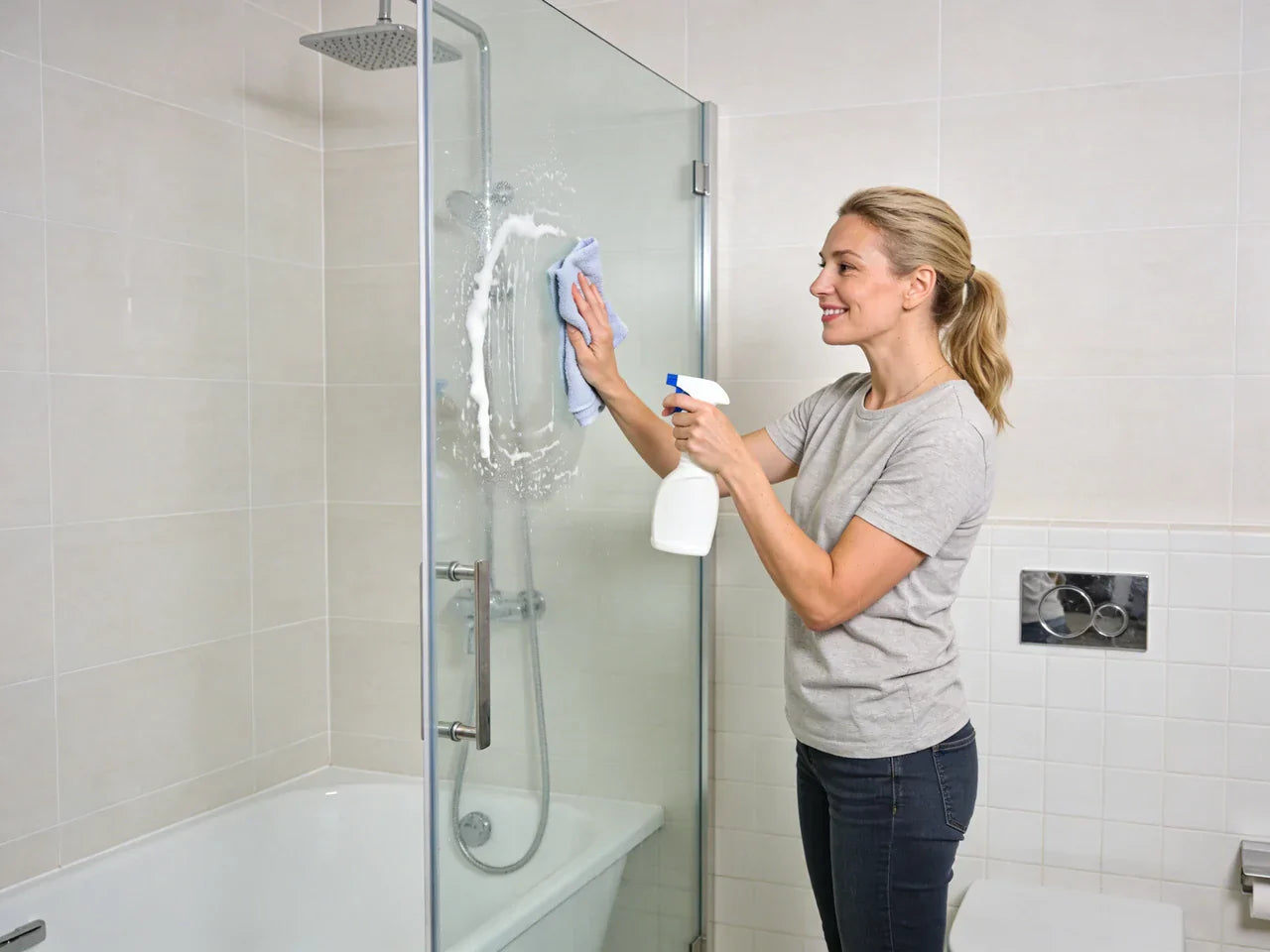
If your main headache is soap scum on glass shower doors, a mix of vinegar and dish soap is often the best way to remove soap scum from glass shower doors at home.
People often ask, “Does dish soap and vinegar remove soap scum?” Yes, it does—because:
-
Vinegar dissolves hard water minerals
-
Dish soap cuts body oils, shampoo residue, and soap residue
Here’s a simple mix:
-
Warm up white vinegar until it’s pleasantly warm (not boiling).
-
Mix equal parts vinegar and liquid dish soap in a spray bottle.
-
Shake gently until combined.
How to remove soap scum from shower tile and glass shower doors:
-
Spray the mix on glass doors, door tracks, and tile.
-
Let it sit 15–30 minutes so it can soften the scum.
-
Wwipe with a non-scratch sponge or cloth.
-
Rinse with warm water and thoroughly dry the glass to avoid streaks.
This vinegar and dish soap combo is especially good when the glass feels greasy or cloudy. It’s also a strong answer to the question, “Does blue dish soap and vinegar remove soap scum?”—yes, any regular liquid dish soap mixed with vinegar does the job.
Magic erasers and gentle abrasives: safe use for stubborn spots
Sometimes, even with vinegar, some patches refuse to budge. This is where gentle abrasive tools can help, especially on:
-
Textured shower floors
-
Corners and edges around shower door tracks
-
Grout haze on tiles
Melamine sponges (often called “magic erasers”) excel here. They work like very fine sandpaper.
To get soap scum off a shower floor or deal with stubborn soap scum:
-
Wet the melamine sponge with warm water, squeeze out extra water.
-
Rub the scummy patch with light pressure, checking often.
-
Rinse and feel the area with your fingers—stop as soon as the roughness is gone.
Always be more cautious on acrylic tubs, coated glass, and glossy plastic. Too much pressure can dull the finish. When in doubt, test first in a low‑show area.
Comparison table of DIY soap scum removers
| Method | How it works | Ideal surfaces | Pros | Cons / cautions |
| Vinegar + water spray | Acid dissolves hard water minerals | Tile, glass, porcelain | Simple, cheap, low-tox | Not for natural stone |
| Vinegar + baking soda | Acid + gentle abrasion to lift residue | Tubs, shower walls, tile | Great for moderate buildup | More scrubbing needed for very thick scum |
| Vinegar + dish soap | Dissolves minerals + cuts oils and soap residue | Glass doors, ceramic tile, enameled tubs | Excellent on glass and grease | Can leave streaks if not rinsed and dried |
| Baking soda paste + water | Mild abrasive scrubbing | Textured floors, grout | Safe on many surfaces | Less effective on mineral-heavy deposits |
| Melamine sponge (with plain water) | Very fine physical abrasion | Corners, textured areas | Great for spots | Can dull soft or coated surfaces if overused |
Commercial Products and Advanced Chemical Soap Scum Removers
DIY methods work well for regular cleaning, but years of soap scum or very hard water sometimes need stronger help.
How to choose a soap scum remover: labels, pH, and safety icons
When you shop for a soap scum remover, don’t just read the front label. Flip the bottle and check:
-
Active ingredients. Look for acids like glycolic acid, lactic acid, citric acid, or sulfamic acid for mineral-heavy scum.
-
pH level.
-
Acidic cleaners (low pH) target minerals and soap film.
-
Alkaline cleaners (high pH) target grease, oils, and some mildew.
-
-
Safety symbols and instructions. Check warnings, ventilation needs, and surface limits.
-
Eco labels. Certifications like EPA Safer Choice or other environmental marks can guide you to lower-toxicity, biodegradable formulas.
If you wonder, “What is the best thing to clean soap scum with?”, the answer is usually:
An acidic cleaner that is safe for your surface + enough dwell time + gentle scrubbing.
That cleaner might be white vinegar for everyday jobs or a commercial acid-based cleaner for very thick buildup.
Acid-based vs alkaline vs enzymatic cleaners: which is best?
Different cleaning methods work best on different kinds of grime.
-
Acid-based cleaners These are often the best way to remove soap scum from a tub or shower when scum is heavy. They dissolve calcium and magnesium deposits and break the bond between minerals and soap. Good for: Hard water stains, cloudy glass, thick soap scum Not good for: Natural stone (unless labeled safe for stone)
-
Alkaline or oxygen-based cleaners These cleaners are better at lifting body oils, some mildew, and organic grime. Some powdered oxygen cleaners can help clean grout and textured floors. Good for: Grease, light mildew, stained grout Not as strong on: Heavy mineral-based soap scum
-
Enzyme-based cleaners These use enzymes to break down organic matter such as body oils. They can help in certain bathrooms but usually work slower. Good for: People wanting low-fume, specialized cleaners Need: Enough time to work, and the right temperature range
Most people have the best results on soap scum from shower walls and doors with an acid-based product, either vinegar or a commercial option, then follow with an alkaline or oxygen cleaner if they also have mildew issues.
Industrial-strength and patented soap scum formulas
For extreme buildup, such as years of soap scum in a tub that was rarely cleaned, even strong consumer products can struggle.
Some industrial or patented formulas use blends of:
-
Glycolic acid
-
Phosphorous or phosphonic acids
-
Surfactants that help loosen oils and residues
These systems are common in commercial bathrooms and industrial settings where cleaning needs to be fast and reliable. At home, you might only reach this level if:
-
The tub has thick, rock-hard soap scum and scale
-
Normal scrubbing barely makes a dent
-
You’re considering resurfacing or replacing the tub soon
In these rare cases, call a professional cleaner or refinisher. They often have access to stronger chemistry and tools and know how to manage safety and ventilation.
PAA: Is commercial soap scum remover better than vinegar?
It depends on your situation.
-
For everyday cleaning and light to moderate soap scum, white vinegar and water (often with dish soap or baking soda) work very well and are low-cost and low-toxicity.
-
For thick, older, or mineral-heavy scum, a good commercial soap scum remover with strong acids can be faster and require less scrubbing.
The trade-offs are:
-
Commercial products can cost more and may have stronger fumes.
-
Vinegar is cheap and gentle but may need more time and elbow grease.
Interactive: Quiz to choose the best soap scum remover for your bathroom
You can mentally “quiz” yourself with a few key questions to decide what to use:
-
What surfaces do I have?
-
Natural stone? Stick with neutral pH, stone-safe products.
-
Glass, tile, acrylic, fiberglass? Vinegar and many acid-based cleaners are fine.
-
-
How bad is the buildup?
-
Light film, visible only when dry → Vinegar and water solution is usually enough.
-
Cloudy glass you can’t see through, rough tub ring, chalky deposits → Stronger acidic cleaner may save time.
-
-
What are my safety priorities?
-
Kids, pets, or asthma in the home? Start with DIY soap scum removers like vinegar and dish soap and look for eco labels if you buy products.
-
As a simple rule: Start mild. If the scum laughs at your first attempt, then move one step stronger.

Surface-Specific Strategies for Cleaning Soap Scum
Different surfaces need different care. The best way to remove soap scum from a tub is not always the same as cleaning a glass door or marble tile.
Glass shower doors and screens: streak-free cleaning method
For soap scum on glass shower doors, your goals are to remove the haze and avoid new streaks.
A reliable routine:
-
Spray equal parts vinegar and water (or the vinegar and dish soap mix) on dry glass.
-
Let it sit for 15–20 minutes.
-
Wipe with a non-scratch sponge.
-
Rinse and then thoroughly dry the glass with a microfiber cloth.
Work in vertical strokes on one side of the door and horizontal strokes on the other. If you see streaks later, you’ll know which side they’re on.
If your glass has an anti-spot or water-repellent coating, follow the manufacturer’s care guide. Some coatings do not like strong acids or abrasive tools.
Acrylic, fiberglass, and enamel tubs: protecting delicate finishes
When people ask, “How to take off soap scum from a tub?”, it’s often an acrylic or fiberglass tub that has dulled and roughened over time.
For these softer surfaces:
-
Stick with non-scratch sponges and cloths.
-
Use baking soda carefully; it is mild but can still dull a very soft shine if scrubbed too hard.
-
Avoid powdered scouring cleansers and metal scrub pads. They may fix the scum but leave permanent scratches.
A safe approach:
-
Spray warm vinegar and water or vinegar and dish soap on the dry tub.
-
Let it sit 20–30 minutes, especially on the tub ring.
-
Sprinkle a bit of baking soda on a damp non-scratch sponge.
-
Scrub gently and rinse.
-
Repeat as needed instead of scrubbing harder.
If the tub has years of soap scum and still feels rough after cleaning, it may be etched or worn. At that point, refinishing or replacing the tub may be the only way to get a truly smooth, new surface again.
Tile, grout, and natural stone (marble, travertine, granite)
Ceramic and porcelain tile are quite tough. You can usually clean them with:
-
Vinegar and water solution for general soap scum
-
Baking soda paste and a soft brush for grout and textured floors
For shower floors, which get heavy use:
-
Spray your chosen cleaner.
-
Let it sit 15–20 minutes.
-
Scrub with a soft-bristle brush to reach small pits and textures.
For natural stone like marble or travertine, be much more careful:
-
Do not use vinegar or acidic cleaners unless they are clearly marked as safe for that stone. Acid can etch and dull stone permanently.
-
Use neutral pH stone cleaners made for soap scum on stone.
-
Seal your stone regularly to make scum easier to remove.
Surface compatibility chart for cleaners and tools
| Surface / Tool or Cleaner | Vinegar / acids | Baking soda | Strong abrasives | Melamine sponge | Steam cleaner |
| Glass shower doors | Safe (check coatings) | Safe | Not needed | Use lightly | Safe |
| Ceramic / porcelain tile | Safe | Safe | Often safe but not needed | Safe | Safe |
| Acrylic tub | Safe in moderation | Safe (gentle) | Not recommended | Light pressure | Safe (not too hot) |
| Fiberglass shower unit | Safe in moderation | Safe (gentle) | Not recommended | Light pressure | Safe |
| Enamel-coated tub | Usually safe | Safe | Use with caution | Safe | Safe |
| Natural stone (marble etc.) | Avoid acids unless stone-safe | Often safe | Use only if stone-safe | Caution | Check stone instructions |
Always check your specific manufacturer’s care advice if you still have the manual or can find it online.
Prevention: How to Stop Soap Scum From Coming Back
Once you get soap scum under control, keeping it from growing again is much easier than doing another deep clean later.
Everyday habits: squeegees, microfiber wiping, and quick-dry tips
You can keep soap scum at bay with a simple 30–60 second routine after each shower:
-
Rinse walls and glass quickly with warm water.
-
Use a squeegee or microfiber cloth to pull water off glass doors, tiles, and tub walls.
-
Leave the shower door or curtain slightly open and run the fan for at least 15–20 minutes to dry the air.
Dry surfaces make it harder for scum to form because the reaction between soap and minerals needs moisture to keep building.
Switching from bar soap to liquid soap or body wash
One of the best long-term ways to prevent soap scum is to change the type of soap you use.
-
Bar soap + hard water = more scum
-
Liquid soap, shower gel, or body wash + hard water = less scum
By switching to a liquid soap, you reduce the fatty acid reaction that reacts with soap and minerals. Many families notice their soap scum on glass, tile, and tubs goes down within weeks after changing this one habit.
If you prefer bar soap for skin reasons, simply be more strict with rinsing and drying the shower and tub after every use.
Water softeners, filters, and coatings to reduce hard water stains
If your area has very hard water, you may see both soap scum and hard water scale (white chalky spots). In that case, you can:
-
Install a water softener for the whole house. This removes most of the calcium and magnesium that drive soap scum formation. Showers stay cleaner and laundry often feels softer too.
-
Consider a point-of-use conditioner for just the shower if a full softener is not an option.
-
Use water-repellent coatings on glass and tile to make water bead and run off more easily.
One common myth: standard shower filters do not usually soften water. They might remove chlorine or odors but do not remove minerals enough to stop scum.
PAA: How often should you clean to prevent soap scum buildup?
Your ideal routine depends on water hardness and household size:
-
Soft to medium water, 1–2 people:
-
Quick rinse and squeegee: after each shower
-
Deeper clean: every 2–3 weeks
-
-
Hard water, 2–4 people:
-
Quick daily shower wipe-down: after each use
-
Deeper clean with vinegar or a product: once a week
-
-
Very hard water, big family:
-
Daily rinse and wipe are almost required
-
Weekly focused clean of tub, shower floor, and glass doors
-
Simple weekly checklist:
-
Spray vinegar and water solution on glass and tile, let sit, wipe, rinse.
-
Check shower door tracks and corners for signs of mildew or buildup.
-
Wipe fixtures (faucets, handles) before they get crusty.
Monthly checklist:
-
Inspect caulk and grout. Clean and dry any problem spots.
-
Deep clean any soap scum from shower floors and around drains.
-
Reapply glass water-repellent if you use one.
Eco-Friendly, Low-Toxicity, and Allergy-Safe Bathroom Cleaning
If you are sensitive to fumes, have children or pets, or just prefer greener cleaning, you have good options.
Green DIY recipes: vinegar, baking soda, and plant-based soaps
The vinegar and water solution, baking soda paste, and vinegar and dish soap mix are all:
-
Low-toxicity (with normal ventilation)
-
Easy to rinse
-
Cheap and easy to mix fresh when needed
To keep things as gentle as possible:
-
Use fragrance-free liquid dish soap or body wash if scents bother you.
-
Stick to white vinegar and water for daily or weekly light cleaning on safe surfaces.
-
Remember: Never use vinegar on natural stone unless the product label says it is stone-safe.
Evaluating “natural” and eco-labelled soap scum removers
Many products now claim to be natural, green, or eco-friendly. Not all labels are equal.
To judge a product:
-
Look for clear ingredient lists, not just vague “plant-based” claims.
-
Check for official eco labels such as EPA Safer Choice or other third-party marks from trusted organizations.
-
Avoid products that need heavy ventilation in a small bathroom if you’re sensitive.
Official resources from government agencies can help you understand ingredient safety and eco labels better, which you’ll find in the references at the end of this article.
Innovations: dry steam cleaners and electrolyzed water systems
If you want to cut down on chemicals even more, you might explore:
-
Dry steam cleaners. These use very hot, low-moisture steam to soften and remove soap scum, as well as kill many germs on hard surfaces. They work well on tile, grout, and some glass, as long as the surface can handle heat.
-
Electrolyzed water systems. These units turn salt and water into mild cleaning solutions using electricity. They can handle light daily cleaning and help prevent soap scum without strong chemicals, though they may not match the power of strong acids on very heavy buildup.
Both options reduce bottles and packaging waste, but they do cost more up front and may need maintenance.
Troubleshooting, Case Studies, and Expert FAQs on Cleaning Soap Scum
Sometimes, even when you follow directions, the scum still seems glued on. Let’s look at why and what to do next.
Real-life case study: restoring a heavily scaled, long-neglected shower
Imagine a shower in a hard water area that has seen years of soap scum and bar soap use with little cleaning. The glass is fully cloudy, the tub feels rough, and the grout is discolored.
A stepwise plan might look like this:
-
First attempt – DIY acids and abrasives
-
Spray full-strength white vinegar on glass, tile, and tub. Let sit 30–40 minutes.
-
Scrub with baking soda and a non-scratch sponge.
-
Result: some improvement, but still heavy buildup.
-
-
Second attempt – stronger commercial acid cleaner
-
Apply an acid-based commercial soap scum remover safe for tile and tubs.
-
Let it dwell as instructed (often 10–20 minutes), keeping the surface wet.
-
Scrub with a soft-bristle brush and melamine sponge on rough patches.
-
Repeat in sections until the majority of the scum is gone.
-
Result: glass becomes mostly clear, tub smoother, but visible etching remains.
-
Final step – repair and prevention
-
For etched tub surfaces and stained grout, a refinisher or regrouting may be needed.
-
After repair, the owner switches to liquid soap, installs a water softener, and uses a daily shower spray and squeegee routine to keep new scum from forming.
This path shows how you move from DIY to commercial acids, and finally to surface repair, depending on how badly the scum has damaged the finish.
When to call a professional cleaner or consider resurfacing/remodeling
You don’t have to struggle forever. Call in help or think about upgrades when:
-
Surfaces feel rough even after cleaning.
-
The tub or tile shows pits, chips, or deep stains.
-
You can’t stand the fumes or physical effort needed for a deep clean.
-
The shower has mold or mildew in places you can’t safely reach.
Here’s a simple comparison:
| Option | What it includes | Typical use case |
| Professional deep clean | Strong chemicals and tools, expert technique | Heavy scum but surfaces still sound |
| Refinishing / resurfacing | New coating on tub or shower walls | Etched, stained, or worn out finishes |
| Full replacement | New tub/shower, maybe new tile or surround | Structural damage or full remodel desired |
PAA: Why won’t my soap scum come off even with scrubbing?
If you have scrubbed hard and still can’t get rid of soap scum, the problem is usually one of these:
-
Not enough dwell time. You wiped too soon, before the cleaner had time to soften the scum.
-
Wrong pH. You used only an alkaline cleaner (like plain baking soda) on a mineral-heavy problem that really needs acid (like vinegar or an acid-based product).
-
Wrong tool. A very soft cloth on very thick scum won’t do much. Sometimes you need a brushing action or a melamine sponge.
-
Damaged surface. The scum has been cleaned off, but what remains is etching or staining in the surface itself.
In short: switch to an acidic cleaner, allow 15–30 minutes of dwell time, then scrub with the right level of abrasion. If that still fails, the surface may need professional help.

Short FAQs on Cleaning Soap Scum
1. What is the best thing to clean soap scum with?
The easiest and most effective way to clean soap scum is to use an acidic cleaner—white vinegar, citric-acid sprays, or a commercial soap-scum remover. These products break down both the soap residue and the minerals that make the buildup hard and chalky. Warm vinegar works well for everyday cleaning as long as you give it enough time to sit. For old, stubborn layers, a commercial remover is faster because it’s formulated to cut through heavy deposits. Whatever you use, the key is dwell time: spray generously, let it sit for 10–20 minutes, then scrub with a non-scratch pad and rinse with warm water.
2. Does Dawn and vinegar remove soap scum?
Yes. A 1:1 mix of warm white vinegar and Dawn (or any good dish soap) is a very effective DIY cleaner for shower doors, tubs, and tile. Dish soap breaks down oils and body residue, while vinegar dissolves the mineral deposits left by hard water. Together, they cut through the cloudy film much faster than either ingredient alone. Warm the vinegar before mixing so it spreads and sticks better. Spray it on, let it sit for around 15 minutes, then scrub lightly and rinse well. This method is especially good for glass shower doors where haze and streaks tend to stick.
3. How do I get soap scum off the shower floor?
Start by spraying a dry shower floor with a vinegar-and-water mix and let it sit for 15–20 minutes to soften the residue. Then sprinkle baking soda and scrub with a soft-bristle brush. The baking soda adds gentle abrasion without scratching. Pay extra attention to textured areas where soap scum often hides. Rinse with warm water to wash away loosened grime. For floors with deep texture or older buildup, a melamine sponge can help lift stubborn spots—but go gently on fiberglass. Cleaning the floor weekly keeps it from getting slippery and prevents heavy layers from forming.
4. How to remove years of soap scum from a tub?
For years of soap scum, expect to work in stages. Start with full-strength vinegar and let it sit 20–30 minutes, then scrub with baking soda to remove the first layer. If the tub still feels rough, switch to a commercial acid-based soap scum remover, which is stronger and better for thick buildup. Follow the instructions and repeat if needed. Older fiberglass tubs may look dull after heavy buildup because the surface gets worn down over time. If cleaning doesn’t restore smoothness or shine, refinishing or reglazing might be the only way to get the tub looking new again.
5. Do baking soda and vinegar dissolve soap scum?
Yes, they work well together, but not by mixing them in a bowl. Vinegar dissolves the mineral portion of soap scum, and letting it sit for 15–30 minutes softens the chalky layer. Then, adding baking soda provides mild scrubbing power to lift the softened residue. This combo is great for regular cleaning or medium buildup, but extremely thick or long-term soap scum may require a commercial cleaner afterward. Still, baking soda and vinegar are safe, affordable, and effective for most day-to-day cleaning needs.
6. How long to let vinegar sit on soap scum?
For light to moderate soap scum, 10–20 minutes of dwell time is usually enough. For tougher or older buildup, 20–30 minutes works better. Vinegar needs time to dissolve minerals, so patience gives you better results with less scrubbing. Spray it onto a dry surface so it doesn’t get diluted, and use warm vinegar if you’re cleaning vertical areas like shower doors—it helps it cling longer. After soaking, scrub with baking soda or a non-scratch pad and rinse thoroughly. Repeat if needed, rather than scrubbing harder.
References


Leave a comment
This site is protected by hCaptcha and the hCaptcha Privacy Policy and Terms of Service apply.