
Looking for bathroom mirror ideas that elevate style, lighting, and your daily routine? This 2025–2026 guide breaks down the smartest choices—backlit LEDs, smart features, frameless minimalism, and bold shapes—so you can plan with clarity and confidence.
At-a-glance: 2025–2026 bathroom mirror ideas
Want a quick snapshot of where bathroom mirror ideas is heading in 2025–2026? The at-a-glance list below highlights the shapes, lighting styles, and smart features that are defining modern remodels. Whether you're updating a small powder room or planning a full renovation, these trends help you narrow in on what actually improves daily use, boosts ambiance, and adds long-term value. Up next, you’ll see which ideas are leading the market—and why they’re worth considering for your own space.
-
Backlit LED mirrors lead for function and ambiance. They give a soft, even glow with fewer shadows and often include touchless sensors and dimming. According to the U.S. Department of Energy, LED lighting uses significantly less energy than incandescent bulbs while providing long-lasting brightness.
-
Smart mirrors add voice or app control, demisters, calendars, and Bluetooth audio. They’re rising fast in luxury and custom builds.
-
Organic shapes—round, oval, pill, and asymmetrical/wavy—soften hard lines and add a calm, spa-like feel.
-
Statement frames and unique shapes—arched, oversized, sculptural, geometric—make a strong focal point. Matte black, brass, and antique gold are popular finishes.
-
Double mirrors for double vanities improve flow and symmetry, especially in shared baths.
Numbers that matter:
-
About 90% of high-end remodels now specify backlit or smart mirrors, and frameless styles replace roughly three-quarters of older heavy frames in those projects.
-
LED-integrated mirrors make up more than half of new mirror installs in many North American markets.
-
Requests for frameless and tech-integrated mirrors have jumped by around 30% year-over-year.
-
Smart mirrors appear in more than 40% of new luxury home builds (up from roughly 5% five years ago).
-
Designers report up to a 15% lift in bathroom ROI after mirror upgrades in before-and-after projects.
In short: if you want a modern bathroom that looks great and works well, start with lighting and shape, then layer in smart features that match your routine.
Top bath mirror ideas for 2025–2026
Trends are useful, but what matters most is how a mirror looks and works for you every single day. Below, you’ll find the bathrrom mirror ideas that lead in both style and function right now, plus how they fit different spaces and users.
Backlit LED mirrors
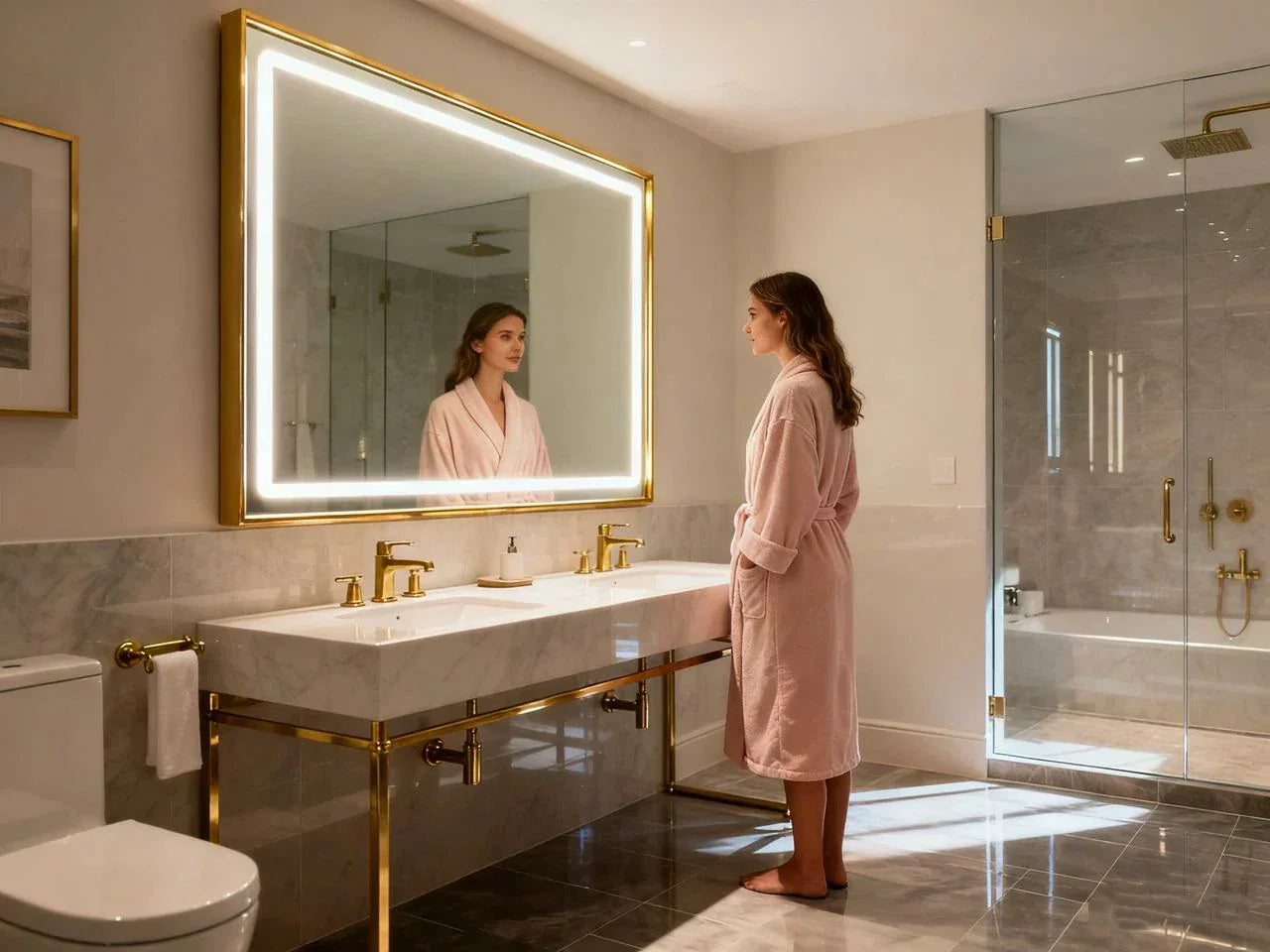
A backlit LED mirror places LEDs behind the glass. Light glows around the edges and bounces off the wall, creating a halo effect. This soft, diffuse light reduces harsh shadows on your face. Many mirrors include touch control, dimming, motion sensors, and color temperature options. For makeup and shaving, a shadow-free setup helps you see clearly without straining.
Why they work: The glow feels calm and high-end, like a spa. LEDs are energy-efficient and long lasting. Backlighting also helps small bathrooms feel bigger because the mirror seems to float, and light spreads evenly.
Best for: Small bathrooms, powder rooms, and anyone who needs clean, even light for grooming.
Tip: If you wear makeup often, look for color temperature controls in the neutral range (around 3000–4000K) and high color accuracy (CRI 90+). Neutral light helps with accurate color match.
Smart bathroom mirrors
Smart mirrors add practical tech to the daily routine. Features vary, but many include voice or app control, built-in demisters (anti-fog), weather and calendar, and Bluetooth audio. You can set scenes, switch color temperature, track time, and stay organized—all without picking up your phone.
Why they work: Smart features save time and reduce clutter. A demister keeps the glass clear right after a hot shower. Voice control helps if your hands are wet or soapy, and integrated audio can replace a separate speaker.
Best for: Busy households, tech-forward primary baths, and anyone who likes a quick, informed morning start.
Tip: Check if the mirror allows independent control of different features (light, heat, audio) so everyone can set it up their way.
Frameless minimalist mirrors
Frameless mirrors use clean, polished edges to create a sleek, modern look. They suit wall-to-wall or full-height installs, and they visually expand small or narrow bathrooms. You can float them above the backsplash for a light, airy feel.
Why they work: Without a frame, the mirror blends into the wall and lets tile, stone, or paint stand out. It’s easy to match across finishes because there’s no metal color to coordinate.
Best for: Modern bathrooms, small baths, and anyone who prefers low visual clutter.
Tip: If the room has bold tile patterns, a frameless mirror balances the look and stops it from feeling busy.
Round, oval, pill, and asymmetrical/wavy mirrors
Curves soften the hard edges we see in tile, grout lines, and cabinetry. A round mirror or an elongated pill shape brings calm to a tight space. Asymmetrical and wavy mirrors read like art and feel fresh without being fussy.
Why they work: Organic shapes are friendly to the eye and help small spaces feel less boxy. In powder rooms, they deliver instant character.
Best for: Powder rooms, small bathrooms, and spaces that need a softer vibe.
Tip: If you have a narrow vanity, an oval mirror in a vertical orientation can add height and slim the silhouette.

Statement frames and unique shapes
If you want a focal point in your bathroom, a striking frame or unique shape sets the tone. Arched mirrors feel timeless and warm. Oversized geometric mirrors add drama. Matte black finishes ground a modern room, while brass or antique gold add a luxury note.
Why they work: A statement frame can complete your bathroom design the same way a frame completes a painting. It can also tie together metal finishes across faucets, pulls, and shower hardware.
Best for: Feature walls, high-contrast bathrooms, and any space that needs a strong centerpiece.
Tip: A slim, metal frame looks current and “sleek and modern,” while a wood frame adds warmth. If you use mixed metals, repeat each finish at least twice so the mirror doesn’t feel random.
Double mirrors for large vanities
Two mirrors over a double vanity keep a balanced look and give each person their own light and view. They also allow separate settings for brightness and warmth if you choose mirrors with built-in controls.
Why they work: They help with morning flow and create symmetry. With the right spacing, you can fit sconces between mirrors for face-friendly, front lighting.
Best for: Shared primary baths, guest suites, and family bathrooms.
Tip: If you prefer one large mirror that spans the whole vanity, add front-lit sconces to cut facial shadows.

How to choose the perfect modern bathroom mirrors
Choosing the right bathroom mirror involves size, light, style, material quality, and who will use it. Here’s a simple path to get it right.
Size and proportion
Start with the vanity. A common rule is for the mirror width to match the vanity or be slightly narrower. Many designers set the mirror 1–2 inches inside the vanity width on each side. If you want a wall-to-wall look, you can run the mirror across the full space, but plan the sconce and faucet clearances first.
Mounting height should fit the primary users. Place the center roughly at eye level for the main user group. For full-height mirrors, ensure the top lines up with the door frame or ceiling for a clean look. If you share the space with kids or taller adults, a taller mirror helps everyone see without crouching.
Lighting integration
Light is the biggest upgrade you can choose. Backlit mirrors create even light with minimal glare. Front lighting from sconces gives the most accurate, shadow-free face light. Many homes use both. For makeup, a neutral color temperature (about 3000–4000K) and high CRI (90+) help you see true color. Dimming keeps light comfortable at night, and motion sensors add convenience.
Style and finish
Decide if you want the mirror to blend in or stand out. Frameless mirrors keep a minimalist look and help small rooms feel bigger. Framed mirrors add warmth or drama. Choose finishes that echo your faucet and hardware. Matte black is crisp; brass and antique gold read as luxe; chrome is bright and timeless.
Materials and quality
Look for low-iron glass if you want extra clarity (less green tint). Polished or beveled edges prevent chipping. Safety backing helps protect the glass if it breaks. In humid spaces, moisture-resistant finishes and sealed edges reduce the risk of “desilvering” at the edges. For steam-heavy rooms, an anti-fog/demister pad is a smart add-on.
Bathroom type and users
-
Powder room: Go bold with an asymmetrical or arched statement mirror. Guests notice small details here.
-
Primary bath: Smart mirror features and layered lighting support daily tasks.
-
Kids or guest bath: Durability and rounded corners reduce bumps. Choose easy-clean glass and finishes.
3-step style quiz (quick pick)
-
Budget: Set a range. Do you prefer a plug-in LED mirror or a hardwired smart mirror with demister?
-
Light level: Do you need task-level brightness for makeup or shaving, or a soft glow for ambiance?
-
Vibe: Are you drawn to sleek and modern frameless designs, or do you want a framed focal point?
AR try-on idea
Snap a photo of your vanity wall with your phone. Use a simple AR or measurement app to outline the wall space. Overlay a rectangle at your target size. Try a circle or arch at the same width. You’ll quickly see which mirror shape feels natural with your tile, faucet, and sconces.
Measuring checklist (use this as a template)
-
Vanity width and height
-
Faucet height and spread
-
Sconce spacing and backplate size
-
Available outlet or junction box location
-
Wall studs and mounting points
-
Ceiling height and any bulkheads or shelves
-
Door swing clearance
Design playbooks by space, layout, and users
Every bathroom has its quirks. These playbooks help you select the mirror that works with your layout, instead of fighting it.
Small bathrooms and powder rooms
In a small bathroom, the mirror does more than reflect—it reshapes how the room feels. A wall-to-wall frameless mirror can “double” the visual width. Backlit LEDs push light across the wall and make corners fade, so the room feels larger. If your bath is narrow, try a tall pill or oval mirror to draw the eye up. For artistry in a powder room, an asymmetrical or wavy mirror becomes the focal point and turns a simple sink into a gallery wall.
A personal example: I helped a friend update a 5x8 bath with a single sink. We swapped a small rectangular mirror for a taller, backlit pill mirror and raised it 3 inches to clear the faucet spout. The result felt brighter and bigger with zero change to tile or paint.

Luxury primary baths and spa retreats
Primary baths often mix multiple mirror types. A full-height mirror behind a freestanding tub adds drama and bounces natural light. Over the double vanity, two smart mirrors with warm-dim LEDs and demisters feel hotel-level polished. Brass or antique gold frames can add depth and warmth next to marble or limestone. Consider a shaving mirror on a pull-out arm near the shower or vanity for precision tasks.
For a true spa feel, pair backlit mirrors with hidden toe-kick lighting under the vanity. A low night light saves your eyes on early mornings.
Awkward layouts and niches
Odd walls and offset plumbing can make standard mirrors tricky. A custom-cut frameless mirror might be the simplest fix. Notches can wrap around tile borders or switches, and a cutout can keep a sconce centered. In tight spots, a recessed mirror cabinet (often called a bathroom mirror cabinet or medicine cabinet) gives storage without jutting out. For sloped ceilings or tight corners, pivot or tilt hardware lets you fine-tune the angle so you catch natural light without glare.
Family and tech-enhanced shared baths
When several people use the same bath, two mirrors over a double vanity support better flow. If each mirror has its own controls, one person can keep warm light while another prefers cooler, brighter light. Demister pads help when showers run back-to-back. A smart mirror that shows weather and calendar can shave off a few minutes each morning. It sounds small, but small time-savers add up during the week.
Accessibility and universal design
If you’re planning for aging in place or a multigenerational household, think about height, reach, and glare. Tilt mirrors help people who use wheelchairs or have different standing heights. High-contrast, easy-to-press controls help if vision is limited. Voice activation means you can adjust light with wet or soapy hands. Rounded corners reduce bumps. A lower mounting height for at least one mirror helps everyone check their reflection without strain.
Key rule: Mount the reflective surface low enough so seated users can see themselves. Many accessible designs set the bottom edge around 40 inches from the finished floor, while still ensuring safety and clearances for faucets and backsplashes. If you add a shelf under the mirror, check that the shelf edge does not block the view for seated users.
DIY, installation, and maintenance
You can hang a basic mirror in an afternoon. But LED and smart mirrors often need wiring and moisture-safe planning. Here’s how to decide and how to proceed safely.
DIY vs. pro
-
DIY is reasonable for small, lightweight mirrors that hang from robust hardware into studs or strong anchors.
-
Hire a licensed pro for any hardwiring, especially for a bathroom mirror with lights or a smart mirror. Wet areas need GFCI-protected circuits and moisture-rated components. A pro will also help size wiring for LED drivers and demisters.
Essential tools and steps (high level)
-
Tools: tape measure, level, stud finder, painter’s tape, drill/driver, anchors or screws, safety glasses, and gloves. For LEDs: non-contact voltage tester.
-
Steps:
-
Measure and mark your mirror outline with painter’s tape. Confirm centerline and height relative to the vanity and faucet.
-
Locate studs. If studs don’t align with the hardware, use rated anchors or a French cleat system designed for your mirror weight.
-
Dry fit the brackets or cleat. Check level. Adjust before drilling.
-
For hardwired mirrors, shut off the breaker. Verify no voltage. Connect per manufacturer instructions. Use a GFCI-protected circuit in bathrooms.
-
Hang the mirror. Confirm it’s secure and level. If it’s backlit, test lights, dimming, and any sensors.
-
Seal where the manufacturer recommends to limit steam reaching the backing. Do not seal in a way that traps water behind the mirror.

-
Common pitfalls to avoid
-
Underpowered circuits for LED/smart features. If the lights flicker or dim when other devices run, call a pro.
-
Misaligned sconces. Measure from the centerline of the sink; dry-fit the mirror and light locations on the wall with tape before drilling.
-
Poor ventilation. Steam can damage mirror backing (desilvering) over time. An effective exhaust fan and regular airing help.
-
Ignoring weight rating. Heavy mirrors need strong anchors or direct-to-stud mounting. Always check the mounting hardware’s load rating.
Care and upkeep
-
Clean with a microfiber cloth and a non-ammonia cleaner. Spray the cloth, not the mirror, to protect edges and backing.
-
Check seals and edges every few months. Reseal if needed.
-
Test LED lighting and demister pads as part of your seasonal home check.
-
Avoid harsh abrasives on frames and edges, especially on coated metals and finishes.
Sustainable and energy-smart choices
Sustainability is not just about materials. It’s also about lighting, lifespan, and energy use.
LED-integrated mirrors use less power and last longer than incandescent or halogen bulbs. Dimming and motion sensors can reduce energy use further because lights only run when needed. Based on ENERGY STAR guidelines, using certified LED bulbs ensures maximum energy efficiency and long-term savings. Choosing a quality mirror that resists moisture and has a durable finish means fewer replacements over time. That reduces waste and saves money.
What to look for
-
Efficient LEDs with dimming and motion sensors
-
High-quality drivers and long-life components
-
Low-VOC adhesives and finishes for healthier indoor air
-
Recyclable packaging and sturdy, repairable designs
-
Durable materials (moisture-resistant backings, sealed edges) to extend service life
Pro tip: If you need maximum task light, add front-lit sconces to a backlit setup. You’ll run the backlight at lower brightness most days, saving energy, and turn on task lighting only when you need it.
Real-world proof: case studies, ROI, and social buzz
We see the same pattern again and again in homeowner stories, designer walk-throughs, and project recaps: mirrors upgrade a bathroom far beyond their cost. A few common wins:
-
Small-bath transformations: Swapping a small, framed mirror for a taller, frameless, backlit model often makes the room feel a size bigger. Users say they can see better when shaving and doing makeup, with less glare and squinting.
-
Luxury primary baths: Smart mirrors and warm-dim LEDs add that hotel-like glow. Demisters keep things clear even on busy mornings. The mirror becomes more than a reflection—it’s part of the routine.
-
ROI signal: Designers report that mirror changes—especially when paired with better lighting—can lift the look of dated tile and paint. Some pros estimate up to 15% improvement in bathroom ROI after mirror upgrades when comparing before-and-after appeal.
In short: the right mirror can transform your small bathroom, help your morning flow, and improve how the whole room feels.
Buyer’s checklists and planners
The checklists below break the process into simple steps so you can confirm measurements, compare features, avoid installation surprises, and stay on budget. Use these planners as a quick guide to make sure the mirror you pick fits your space, works with your lighting, and holds up long-term with minimal maintenance.
Mirror selection checklist
-
Size: width vs. vanity, height vs. users, door and faucet clearance
-
Shape: rectangular, round, oval, pill, arched, asymmetrical/wavy
-
Lighting: backlit, front-lit sconces, or both; dimming; motion sensors
-
Color temperature: adjustable or fixed; aim for neutral for makeup
-
Features: demister, Bluetooth audio, clock/weather/calendar
-
Finish: frameless, matte black, brass, antique gold, wood
-
Safety: safety backing, sealed edges, GFCI circuit for hardwired models
-
Budget: mirror, installation, any electrical work
-
Install plan: studs, brackets, French cleat, recess for mirror cabinet
-
Timeline: order lead times, electrician schedule, mirror delivery
Measurement worksheet
-
Vanity width and depth
-
Sink centerline(s)
-
Faucet height from counter and spout reach
-
Sconce placement and backplate size
-
Outlet or junction box location
-
Ceiling height and crown molding
-
Wall stud locations
-
Any wall switches or obstacles near the mirror edge
-
Recess depth and stud bay width (if planning a recessed mirror cabinet)
Maintenance schedule
-
Quarterly: clean glass and frame, test LEDs and demister, check seals
-
Semiannual: inspect mounting hardware tightness, confirm GFCI and breakers
-
Annual: review light color/brightness preferences, update any smart settings

Advanced tips for different mirror design
Ready to go beyond the basics? The advanced design tips below help you fine-tune your mirror choice for challenging layouts, elevated aesthetics, and everyday practicality. Whether you’re working with tight corners, experimenting with floating styles, adding storage, or optimizing lighting and sight lines, these pointers make it easier to choose a mirror that not only looks refined but also solves real-world bathroom needs.
Beveled and floating mirrors
A beveled edge adds a subtle sparkle without a frame, which suits modern mirrors in classic spaces. A floating mirror sits slightly off the wall on cleats or spacers. The shadow line behind it looks refined and helps with cable routing for backlighting.
Corner mirrors and odd walls
A corner mirror can be a clever move in a small bath or a loft with angled walls. It expands sight lines and reflects more of the room. Use custom cuts and ensure a straight, strong corner mount to prevent twist. If the mirror sits near an outside wall, check for condensation issues and seal edges carefully.
Vanity mirrors vs. wall mirrors
A vanity mirror typically sits above the sink and pairs with task lighting. A wall mirror can be placed anywhere—over a tub, near a dressing area, or across from a window to bounce natural light. When a mirror sits across from a window, it can amplify daylight but may also highlight glare. If glare is a problem, adjust angle or add sheer window treatment to soften the beam.
Shaving mirrors
An extendable shaving mirror with a double-sided panel (one side regular, one side magnified) is practical next to a primary mirror. Mount it so you can see without leaning, and check the arm swing so it folds flat when not in use.
Bathroom mirror with storage
If you choose a mirror with storage, map the stud bay and pipe paths before you cut. Recessed cabinets need enough depth between studs. Surface-mounted cabinets are easier but plan the side clearance for doors to open fully.

Lighting basics for accuracy and comfort
Good lighting can make or break how a bathroom mirror performs. Before diving into the specifics, it helps to understand the basics—how color temperature affects clarity, why CRI matters, and how layered lighting creates both accuracy and comfort. The guide below outlines the essentials so you can choose lighting that feels natural, flattering, and practical for everyday use.
Color temperature and accuracy
For makeup, many people prefer a neutral white in the 3000–4000K range because it stays true to skin tones. A high color rendering index (CRI 90+) helps you see colors clearly and avoid a mismatch when you step outside.
Layering light
Ambient: Ceiling lights brighten the whole room.
Task: Sconces or front-lit mirrors give clean light at face level.
Accent: Backlit mirrors, toe-kick lighting, or shelf lights add depth and calm.
If you can only pick one improvement, go for task lighting at face level. That single change often makes everything else feel better.
Budget and value: where to spend, where to save
Spend more on the mirror you use daily. If your primary bath is your main prep area, an LED mirror with demister and good color control is worth it. If this is a guest bath used a few times a month, choose a mid-range framed mirror and good sconces. Custom glass (wall-to-wall) can be worth the splurge if your bathroom lacks natural light because it will bounce light around and make the room shine.
To save, consider a plug-in LED mirror to skip opening the wall, and use a surface-mounted mirror cabinet for storage without carpentry. For a modern look on a budget, a frameless mirror with polished edges and a simple sconce pair looks clean and current.
Conclusion: key takeaways and next steps
If you want your bathroom to feel current and work better day to day, start with light and shape. Backlit LED mirrors, smart features, and either frameless or organic shapes lead the way for 2025–2026. They look modern, reduce shadows, and often pay off with better daily comfort and a stronger resale story.
For small baths, go bigger than you think: an oversized frameless or asymmetrical mirror with backlighting can transform a tight room. In primary baths, consider smart control, demisters, and layered light so each person gets their best setup.
Ready to act? Measure your vanity, map your outlets, pick your light level and vibe, and shortlist two or three shapes. Use your phone to “try on” sizes on the wall with tape or an AR measurement app. Then use the checklists above to ensure the mirror you choose fits, looks right, and installs safely. The right bathroom mirror doesn’t just reflect your space—it makes it.
FAQs
1. What’s trending in bathroom mirrors?
The short list: backlit LED mirrors, smart bathroom mirrors with demisters and app or voice control, frameless minimalist designs, and organic shapes like round, oval, pill, and asymmetrical or wavy forms. Statement frames in matte black, brass, or antique gold are also strong. Double vanity mirrors remain a favorite for shared spaces because they look balanced and speed up morning routines. Beveled bathroom mirrors are making a quiet return too, especially when you want a touch of detail on a frameless edge without a heavy frame.
2. What are the rules for bathroom mirrors?
-
Width: Choose a mirror that matches your vanity width or is slightly narrower. Many people keep it 1–2 inches inside the vanity edges on each side.
-
Height: Center the mirror at eye level for primary users. In shared baths, taller mirrors help kids and taller adults see themselves.
-
Clearance: Leave room for faucets and sconces. Dry-fit with tape before drilling.
-
Light: For makeup, combine a backlit or front-lit mirror with side sconces to reduce shadows.
-
Safety: In bathrooms, hardwired mirrors should be on GFCI-protected circuits. Use moisture-rated gear and follow local codes.
-
Accessibility: For universal design, mount at a height that allows seated users to see themselves. Consider a tilt mirror if heights vary.
These “rules” are flexible. For a wall-to-wall or full-height mirror, you can break the width rule and still get a clean, high-impact look.
3. How to make a bathroom mirror look better?
Small changes can make a big difference. Here are a few strategies that work without a full remodel:
-
Add light: Swap to a backlit mirror or add sconces at eye level on each side. Even light makes your face look natural and bright.
-
Go bigger: A larger mirror (or a mirror that spans the wall) makes the room feel airy.
-
Reframe or deframe: Replace a heavy, dated frame with a slim metal frame—or go frameless for a modern bathroom refresh.
-
Lift and align: Raise the mirror a few inches to clear the faucet, and align the top with nearby trim for a tidy look.
-
Try a shape: A round or arched mirror adds interest and softens square tile lines.
-
Add a demister: If fog is constant, install a mirror with anti-fog for a clean, clear view right after a shower.
-
Fix the background: Paint or regrout a narrow backsplash area around the mirror. A crisp backdrop makes the mirror pop.
4. What is a bathroom mirror with storage called?
It’s commonly called a medicine cabinet or a bathroom mirror cabinet. These come recessed (built into the wall between studs) or surface-mounted. Recessed cabinets look sleek and do not stick out as far. Surface-mounted versions install faster and can be a better option if you don’t want to open the wall. Many modern cabinets include built-in LED light, a demister, and even interior outlets, which keeps counters clutter-free.
5. How big should a mirror be over a vanity?
Here’s a simple way to get the proportions right:
-
Single vanity: Choose a mirror the same width as the vanity or 1–2 inches narrower on each side. For example, on a 36-inch vanity, a 32–36-inch mirror usually looks balanced. Height depends on the faucet and ceiling, but many people place the mirror so the top aligns with door trim or sits a few inches below the ceiling.
-
Double vanity: Either use two mirrors (each centered over a sink) or one large mirror that spans the vanity. If using two mirrors, center each on the sink and leave space for sconces if you want them between the mirrors.
-
Tall ceilings: Use a taller mirror or an arched top to make the space feel connected.
-
Small spaces: Err on the larger side. A bigger mirror often makes a small bathroom feel open.
If you have a wall-mounted faucet, check the spout height and water splash zone before choosing the final mirror height. The right mirror shouldn’t fight the faucet.
References


Leave a comment
This site is protected by hCaptcha and the hCaptcha Privacy Policy and Terms of Service apply.