
Bath sink sizes can make or break a bathroom remodel: pick the wrong width, depth, or basin depth and you’ll fight splashing, tight clearances, and a vanity top that simply won’t fit. This guide gives the standard bathroom sink size for 2026 up front (with a quick chart), then breaks down bath sink sizes by sink type (drop-in, undermount, vessel, wall-mount, pedestal, trough/double), shows how to match a sink to your vanity and countertop, and walks you through measuring step-by-step. You’ll also get real-world sizing examples for small baths, family masters, and ADA-friendly layouts—so you can choose confidently the first time.
Standard Bath Sink Sizes (2026 Quick Chart)
When people search bath sink sizes, they usually want a fast answer they can compare against a vanity that’s already picked (or already installed). In 2026, most residential bathroom sink measurements fall into a tight “works in most homes” band.
Quick-answer dimensions (most searched)
-
Standard range (2026): 16–24" wide, 12–22" front-to-back, 5–8" basin depth
-
Small-bath range: ≤18" wide (common in bathrooms under 50 sq ft)
-
Large/double range: 24–36"+ single or 36–48"+ trough (often on 60–72" vanities)
The key point is that “sink size” is not one number. Your bathroom sink width, the front to back depth, and the basin depth each change comfort in a different way. A sink can be wide but still feel cramped if it’s shallow front-to-back, and a sink can be deep front-to-back but feel messy if the basin is too shallow for the faucet.
Master table: size bands + best use (visual)
| Size band | Width | Front-to-back depth | Basin depth | Best for | Typical vanity width |
| Small / powder | 11–18" | 10–18" | 5–7" | Tight layouts, guest baths, wall-mount/corner | 18–30" |
| Standard | 16–24" | 12–22" | 5–8" | Most homes, daily brushing/shaving/cleanup | 24–48" |
| Large / double / trough | 24–36"+ (single) or 36–48"+ (trough) | 16–24" | 5–8" | Shared use, master bath, two sinks | 60–72" |
Key sizing terms (avoid confusion)
A lot of sizing mistakes happen because people measure the wrong part of the sink. Before you compare bathroom sink specifications, get clear on the language.
Bathroom sink dimensions vs. basin depth vs. overall rim: the advertised width/depth is often the outer rim, not the bowl. The basin depth is the vertical distance inside the bowl (top edge down to the drain area), and it affects splashing and how useful the sink feels.
Front-to-back depth vs. vanity/counter depth: many vanities are around 21 inches deep, but not all. A sink that is 22 inches deep can work on a deeper top, yet feel tight on a shallow cabinet—especially if you need space behind the sink for a faucet deck or backsplash.
“Landing space” around the sink: you want some counter space around the sink so soap, toothbrushes, and hands don’t bump the edge. A common planning allowance is about 1.5–2 inches of counter showing on each side of the sink footprint (more is nicer, but this is a realistic minimum in many bathroom layouts).
Bathroom Sink Dimensions by Type (Drop-In to Trough)
Your type of sink changes which dimensions matter most. A drop-in sink hides a slightly rough cutout under the rim, while an undermount bathroom sink depends on a perfect cutout and solid countertop. A vessel sink shifts the “height” question because the bowl sits on top of the counter.
Drop-in / top-mount sink size ranges + fit notes
Drop-in sinks are still the most common type because they’re forgiving during sink installation. The rim covers the cutout, so you have a little wiggle room if your opening is not perfect.
Typical: 16–24" W, 12–20" D, 5–8" basin depth
| Drop-in option | Typical width | Typical depth | Install notes |
| Small (compact) | 16–20" | 12–16" | Great for a powder room or narrow vanity; watch faucet clearance |
| Large (roomy single) | 25–30" | 18–22" | Needs a wider bathroom vanity and more counter depth; better splash control |
Fit notes that save headaches: drop-ins need a cutout size that matches the template, not just the outer rim. If you’re swapping a new sink into an old top, a drop-in is often the easiest way to “fit what you have” without replacing the whole countertop.
Undermount sink size ranges + countertop considerations
Undermount sinks are popular because wiping water into the bowl is easy—no rim in the way. But undermounts demand more planning. The countertop cutout edge shows (to some degree), and mounting clips need room under the counter.
Typical: 17–25" W, 12–22" D, 5.5–8" basin depth
| Undermount option | Typical width | Typical depth | Countertop considerations |
| Small (space-saver) | 17–20" | 12–15" | Better on shallow tops; confirm drain and clip clearance |
| Large (comfort) | 24–27" | 18–22" | Best on deeper tops; plan reveal style and faucet reach |
A practical detail people miss: undermount dimensions can vary depending on “reveal.” A negative reveal hides the cutout under the counter; a positive reveal shows a bit of sink rim. Either way, the cutout size matters as much as the sink’s outer size.
Vessel sink diameter/height planning (diagram)
Vessel sinks are chosen for style, but size and faucet pairing make or break them. Many vessel bowls are not very deep inside, so a high faucet can cause splash.
Common vessel sizes:
-
Round: 14–20" diameter (you’ll often see 20 inches in diameter on 30–36" vanities)
-
Square/rectangular: 15–25" L × 15–20" W
-
Typical inside bowl depth: 4–7"
Diagram suggestion (what to sketch before you buy):
Draw the countertop side view. Mark the top of the counter, then draw the vessel bowl height above it. Add the faucet spout height and reach so the water lands near the drain, not near the edge. Finally, mark a “splash zone” circle around the bowl. This simple sketch helps you avoid a vessel that looks great but sprays water onto the edge of the countertop every time you wash your hands.
One more real-world note: vessel sinks change your sink height. A vanity that feels normal with an undermount can feel tall once a vessel is added on top.
Wall-mount, pedestal, console, corner: small-space sizing (mini gallery)
If your bathroom is tight, the best “size” choice may be changing the sink style, not just shrinking an inch or two.
Wall-mount sinks usually run 11–24" wide and 10–18" front-to-back. They work well when you need more floor space or easier cleaning. In a narrow room, cutting even 4 inches off the sink depth can be the difference between “I can pass by” and “I always bump my hip.”
Pedestal sinks often sit in the 19–24 inches wide range and 16–22" deep. They can feel airy and classic, but you give up storage, so you may need a cabinet or shelf somewhere else.
Corner sinks are often triangular, with ~12–19" legs. They can be one of the smallest options that still feels like a real sink, which is why they show up in very tight powder rooms.

Vanity Size vs Sink Size: How to Get the Fit Right
Most mistakes happen when someone falls in love with a sink first, then tries to “make it fit” on a vanity that was never meant for it. If you want the smooth path, pick your vanity and countertop size first, then match the sink.
Vanity width pairing guide (primary decision table)
Here’s a simple pairing guide. It’s not the only way to do it, but it keeps you away from the most common clearance problems.
| Vanity width | Recommended sink width range | What to watch |
| 24" | 16–18" | Keep side clearance; choose a compact bowl to preserve counter space |
| 30" | 16–20" | Great for rectangular sinks; vessel bowls around 16–18" often fit well |
| 36" | 18–24" | “Comfort single” zone; easy to center and keep landing space |
| 48" | 20–28" | Room for a wider sink or extra counter; confirm faucet deck space |
| 60" | Two sinks ~18–22" each or 36–48" trough | Plan plumbing and drawer layout |
| 72" | Two sinks ~20–24" each or 48"+ trough | Easier to give each user real elbow room |
Rule of thumb: aim for ~1.5–2" clearance around the sink footprint. That means if your vanity is 24 inches wide, a sink that’s 23 inches long can technically fit, but it often looks squeezed and leaves almost no landing space.
What size sink for a 30 inch bathroom vanity?
If you’re choosing a sink for your bathroom and your vanity is 30 inches wide, you’re in a sweet spot. Most people do well with a sink around 16 to 20 inches wide. If you like a more open counter feel, stay closer to 16–18 inches. If you want a bigger bowl and don’t mind giving up some counter, 18–20 inches is a common comfort pick.
Depth matters just as much: a sink around 12–18 inches deep usually fits well on standard tops without pushing the bowl too close to the front edge.
Countertop depth, overhang, and faucet deck space (diagram)
Many vanities are about 21 inches deep, but you should still measure your cabinet and top. On a shallow top, a deep sink can push the faucet too close to the backsplash, or too close to the front edge.
Diagram suggestion (top view):
Sketch the countertop rectangle. Draw the sink cutout centered. Mark a line about 2" behind the cutout for faucet holes (or faucet base). Now check how much counter remains behind the faucet for a backsplash or a small lip. This quick drawing prevents the “my faucet hits the backsplash” surprise.
Also think about overhang. If your top overhangs the cabinet a lot, the sink can be set forward slightly while keeping the bowl centered over the plumbing. If the top is flush, you have less flexibility.
Double sink & trough planning: spacing + usability
Two sinks are not just about fitting two sinks on a long counter. They’re about daily traffic. In a shared bathroom, people want space to set down items and not bump elbows.
A common double vanity is 60–72" wide. A simple planning rule is at least 24 inches per basin for comfortable use. This is why a 60" vanity often uses two smaller sinks rather than two oversized bowls.
For a trough, many people aim for faucets around 30 inches apart so two users can share without crowding. Your exact faucet spacing depends on the trough shape and how wide the “wet zone” is, but this gives you a practical starting point.
What is the difference between 60 40 and 70 30 sink?
This question shows up a lot, even in bathroom searches, because people see “split” numbers on spec sheets. A 60/40 or 70/30 sink usually describes how the bowl space is divided between two sections.
A 60/40 sink means one side takes about 60% of the bowl width (or usable space) and the other side takes 40%. A 70/30 sink makes that difference more extreme, giving one user a much larger section and the other a smaller one. In bathrooms, you might see this on a divided trough or a double-bowl unit where one side is meant for more frequent use or for tasks like rinsing.
If you expect two people to use the sink at the same time, a 60/40 split feels more balanced. If one side is mostly a “backup” or kid side, a 70/30 can make sense.
What size sink fits a 24-inch vanity?
A 24-inch vanity is common in small bathrooms and hall baths. Most people land on a sink around 16 inches wide, sometimes up to 18 inches if the top is roomy. Keep the depth modest, often around 12 inches front-to-back, so you don’t lose walking clearance in a narrow room. Also check drawer and door swing inside the vanity—some bowls are deep enough to bump storage hardware.
How to Measure for a Bath Sink (Step-by-Step)
If you only do one careful thing in this whole process, do this: measure before you buy. It takes ten minutes and can save weeks of returns and rework. And yes, how to measure a bathroom sink is different from measuring a vanity.
Measure vanity + countertop first (checklist)
Start with what can’t easily change.
-
Vanity top width (left to right) and cabinet width
-
Vanity top depth (front edge to wall)
-
Backsplash height and thickness (if present)
-
Side splashes or walls near the sink
-
Drain location (centerline from side wall, and distance from back wall)
-
Supply lines (hot/cold) and how much room shutoff valves need
If the plumbing is staying put, the drain location matters a lot. A sink that looks perfect can still be wrong if its drain sits too far forward or too far back for the existing trap.
Measure sink correctly: rim vs cutout vs basin (diagram)
When you look at bathroom sink specifications, you will usually see at least three sets of numbers. Record them all.
What to record (for replacement or new install):
-
Overall width/length (outer edge to outer edge, across the widest point)
-
Front-to-back depth (outer edge to outer edge)
-
Bowl/basin depth (inside the bowl, top lip down to drain area)
-
Cutout size (for drop-in/undermount)
-
Faucet hole spacing (single-hole vs widespread; center-to-center spacing if needed)
Diagram suggestion (cross-section):
Draw the sink from the side. Label the overall height, then label the inside bowl depth. This is where people get tricked. A sink can look “deep” because the rim is tall, but the usable bowl may not be.
How do I measure a bathroom sink size?
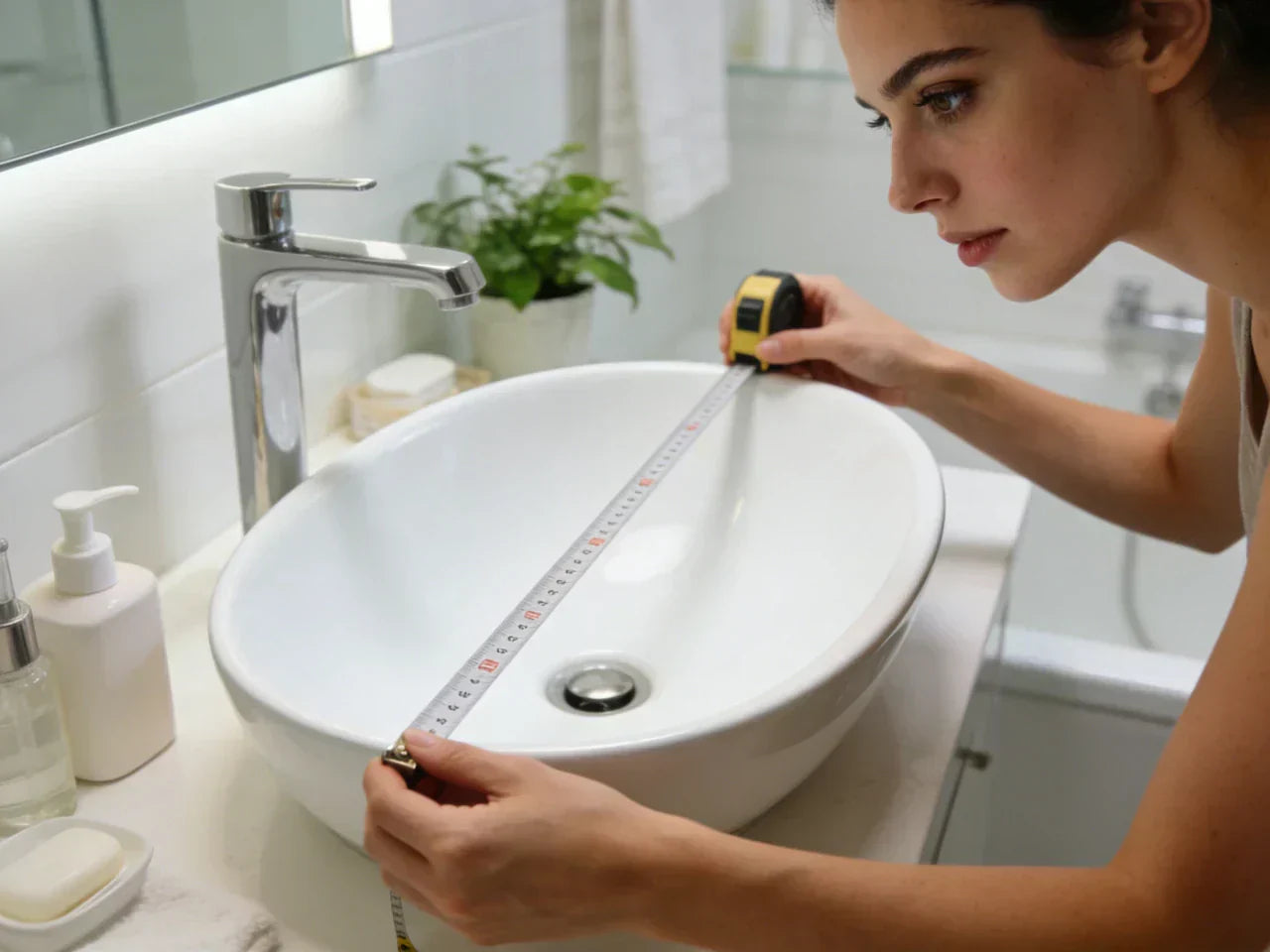
For a quick measurement, use a tape measure and record the sink’s width left-to-right, the front to back depth, and the inside basin depth. If it’s a drop-in or undermount, also measure (or find) the cutout size, because that controls whether the sink will fit your existing countertop opening.
Common measuring mistakes (watch out): measuring only the bowl and not the rim, ignoring the cutout/template size, and forgetting the faucet and backsplash clearance behind the sink.
How do you measure a bathroom sink for replacement?
Replacement is stricter than new construction because your countertop cutout and drain location are already set. Measure the existing cutout opening as carefully as you can. If you can remove the old sink, measure the underside cutout. If you can’t, measure the visible opening and compare it to manufacturer cutout specs.
Also measure the drain centerline from the back wall and from one side. This helps you avoid a sink where the drain is shifted and forces you to redo plumbing just to make it work.
Interactive tool: “Sink Size Finder” (recommended feature)
If you like the idea of a fast answer without doing math, a simple “Sink Size Finder” can be built around real constraints. You enter vanity width and depth, pick a sink type (drop-in, undermount, vessel, wall-mount), choose faucet style (deck-mount or wall-mount), and select your priority (small bath clearance, low splash, or maximum bowl room). The tool can then output a recommended sink width/depth range and warn you if you’re trying to fit, say, 24 inches wide and 16 inches deep on a top that is only 19" deep.
Even without a tool, you can copy that logic: vanity first, then type of sink, then faucet, then bowl depth.
Choosing the Right Size for Your Bathroom Layout (Real Scenarios)
Reading charts is helpful, but it’s easier when you can picture your own room. Ask yourself one simple question: “Where will my body be when I use this sink?” If the answer is “twisted sideways by the door,” the sink is too deep or the vanity is too large.

Small bathrooms & powder rooms (<50 sq ft): maximize clearance
In a small bathroom, the best sink is the one that does not steal the walkway. Many people do best with ≤18" wide, especially when the toilet and door swing are close. In such tight layouts, a sliding shower door can save space and keep the room feeling open.
Case example: A tiny bath with a 24" vanity often works well with a 16" × 12" drop-in sink. If storage is not needed, a 14" wall-mount can feel even better because it keeps the floor open.
I once helped a friend redo a narrow 4×6 room sink area where the vanity felt like it “blocked” the bathroom. We didn’t change the room size at all. We just reduced the sink depth by a few inches and used a wall-mount style. Suddenly, you could stand in front of the sink without brushing the door with your back.
Family primary baths: comfort + depth to reduce splash
For a busy household, the “most installed” band still wins: 18–24" wide and a bowl depth that is not too shallow. This is the zone where most hands fit, most toothbrush routines are easy, and the sink does not feel like a tiny bowl.
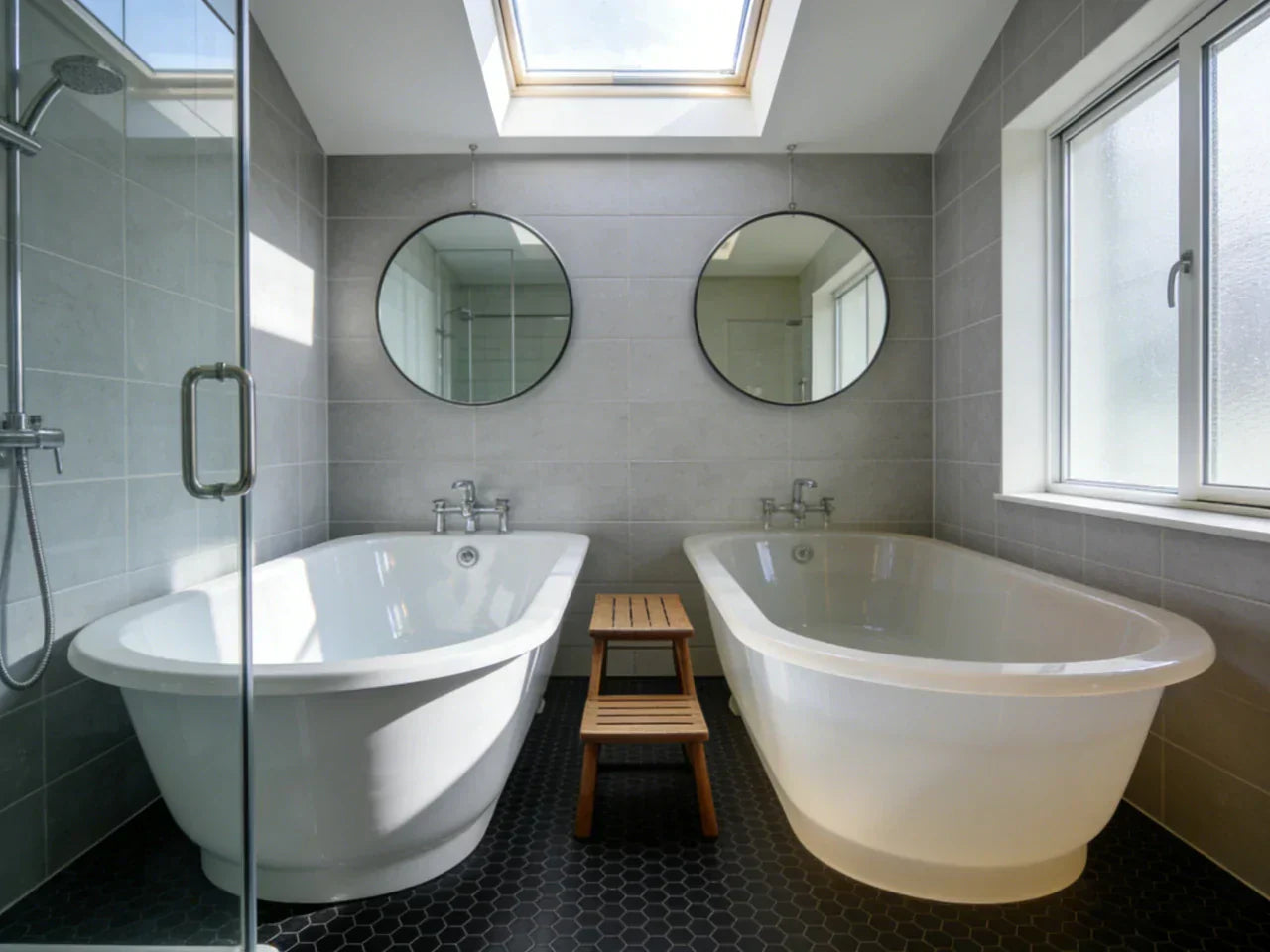
Case example: A 60" double vanity often fits two undermount sinks around 22" × 18" with a 6.5" basin depth. This layout tends to reduce splash because the bowl is deeper and the faucet can be centered to land water near the drain. For a complete master bath setup, pairing these sinks with a freestanding bathtub can create a spacious, comfortable, and visually balanced bathroom environment.
Guest bath / Airbnb / hotel look: vessel balance
Vessel sinks can look great in a guest bath, but they need the right faucet reach and a sensible bowl size.
Case example: A ~30" vanity with an 18" diameter vessel can strike a good balance. You get a statement look without overwhelming the counter.
To keep it from splashing, focus less on “bigger bowl” and more on faucet pairing. A tall faucet with a short reach can drop water right near the edge of the bowl. A slightly lower spout, with reach that lands the stream closer to the drain, usually behaves better.
Is a deeper bathroom sink better?
A deeper sink is not always “better,” but it often helps with splash. Most homes do well with 5 to 8 inches of basin depth. Shallower bowls can work in a powder room where use is light, but they can splash more when kids wash up or when someone cleans up after shaving. Complementing a deeper sink with a deep bathtub helps maintain a cohesive, splash-free design for both sink and bathing areas.
If your top priority is less mess, choose a bowl in the deeper end of the standard range and pair it with a faucet that does not shoot water from too high above the bowl.
Ergonomics, Clearances, and ADA-Accessible Sizing
A sink can “fit” on paper and still feel wrong in daily life. Comfort comes from height, reach, and clear floor space.
What is the best height for a bathroom sink?
When people ask how tall are bathroom sinks, they usually mean the height to the rim or to the countertop. In many homes, the top of the counter lands around the low-to-mid 30s in inches. For many adults, a finished height around 34–36" feels comfortable. For kids’ bathrooms, people often prefer slightly lower, around 30–32", if the household is designed around children.
If you need accessibility, the ADA framework is commonly referenced, and many installations use a maximum of 34" to the top of the rim or counter in accessible setups (confirm local rules and the fixture type). The best sink height is the one that lets the main users stand comfortably without bending and still meets any required standards for your project.
ADA-friendly planning (dimensions to verify)
For an ADA-style approach, wall-mount sinks are common because they can provide knee and toe space under the bowl. A practical example many installers use is a wall-mount sink around 21" × 17" with the rim at about 34" high, while making sure pipes are protected so knees do not touch hot or sharp surfaces.
ADA planning often also considers clear floor space in front of fixtures. If you’re aiming for an accessible layout, confirm requirements for your jurisdiction and your exact sink.
Circulation & door-swing clearances (layout mini-diagrams)
In narrow bathrooms, the biggest comfort problem is often the vanity depth, not the width. A sink that is 20 inches long but too deep front-to-back can push the user into the walkway.
A quick layout check that works: stand in the room and mark, with painter’s tape, where the front edge of the vanity will land. Open the door. Now imagine standing at that tape line and leaning slightly forward to wash your hands. If your knees or hips will constantly touch the door swing path, choose a shallower sink or a wall-mount.
Faucet selection impacts size (faucet reach, spout height)
Faucet choice changes how a sink behaves. A shallow bowl with a tall faucet is a common splash problem, especially with vessel sinks. An undermount with a deep bowl can handle a higher spout better, but reach still matters. The stream should land near the drain, not near the front curve.
If you’re choosing between two sinks that are the same width, pick the one that lets your faucet land water in a stable, centered spot. That small match-up can matter more than an extra inch of bowl width.
What is the minimum size for a double bathroom sink?
A “minimum” double setup can work on a 60" vanity, but comfort improves quickly as width increases. Many people plan at least 24 inches per user so each basin has real elbow room and counter space. If you go tighter than that, it can still function, but expect shared storage and more bumping during busy mornings.
Materials, Cost, and 2026 Trends That Affect Sink Size Choice
Size is not the only limiter. Material affects what shapes are common, how thin the edges can be, and how heavy the sink is.
Material constraints and typical sizing (table)
| Sink material | Common size availability | Typical basin depth feel | Durability notes (plain language) |
| Ceramic/porcelain | Very common in 16–24" widths | Often 5–8" | Easy to clean; can chip if hit hard |
| Stone resin / solid surface | Common in standard and large sizes | Often 5–8" | Smooth shapes; can scratch but often repairable |
| Natural stone (carved) | Often larger statement sizes | Varies; can be deep | Heavy; needs strong support and sealing |
| Glass | Common in vessel sizes 14–20" | Often 4–6" | Shows water spots; can chip |
| Metal (stainless/copper style) | Less common in bathrooms | Varies | Can dent or patina; check cleaning needs |
Material also affects the “real” inner bowl size. Thick materials may reduce the inner basin even when outer dimensions look large.
Cost vs size: what actually drives price
People expect cost to rise only because the sink is bigger, but price often rises because the install is harder. A larger undermount can require extra support, a more complex cutout, and more careful handling of heavy countertops. A larger trough can also push you into specialty faucet layouts and longer supply runs.
If you’re budgeting, remember to price the whole system: sink, faucet, drain, trap, shutoff access, and any countertop cutting or patching. Sometimes a slightly smaller sink avoids moving plumbing and saves more money than you’d think.
2026 trends: compact + wall-mount growth, trough popularity
In 2026, small-bath solutions keep growing because many homes add half-baths, finish basements, or remodel older tight layouts. Wall-mount sinks and compact vanities are popular because they free circulation space without sacrificing basic function.
On the other end, trough and double-sink setups remain popular in master baths because mornings are busy, and people want “my side, your side.” In those rooms, the sink is less about fitting into a corner and more about daily comfort.

Global sizing note (US inches vs metric)
If you shop across regions, you’ll see sizes listed in both inches and millimeters. A common “standard” class undermount might be around 500 × 400 mm, which is close to a mid-size sink in US terms. Always convert and confirm the cutout template, because “standard size ranges” vary by manufacturer even when the category name sounds the same.
Summary and Checklists
Choosing the right bath sink sizes is easier when you decide in a smart order. Start with the vanity and room clearance, then pick the sink type, then lock in width and depth, then choose basin depth, then match the faucet, and only then finalize details like material and shape.
One-page printable cheat sheet
If you like to keep things simple during a bathroom remodel, a one-page cheat sheet helps. A good printable page includes the standard ranges (W/D/basin depth), the vanity pairing chart, and a measuring checklist. Even if you don’t print it, you can keep those three items on your phone while you shop.
Closing takeaway
If you remember one thing, make it this: the right size sink is the one that fits your vanity and your body at the same time. A sink that’s inches wide enough but too deep for the room will feel awkward every day. A sink with a good bowl depth, paired with the right faucet reach, will feel clean and easy even if it’s not the biggest option on the shelf.
FAQs
1. What are standard sizes for bathroom sinks?
Most common bathroom sinks in 2026 fall into a fairly predictable range. Standard sink size options are usually 16 to 24 inches wide, with front-to-back depths around 12 to 22 inches, and a basin depth of 5 to 8 inches. Whether you’re going for round and oval sinks or rectangular designs, understanding these dimensions helps you plan your vanity sink and countertop space. A guide to bathroom sink dimensions can show you sizes by type, so you can match a perfect sink to your size and shape needs. This ensures your bathroom is both functional and comfortable.
2. What is the difference between 60/40 and 70/30 sinks?
The 60/40 or 70/30 numbers describe how a double or divided sink’s basin is split. A 60/40 sink has one larger side for tasks like washing hands or face, and a smaller side for quick use, while a 70/30 sink makes that difference even more pronounced. These ratios are often seen in trough-style or double vanity sinks, especially in master baths. Knowing the split matters because it affects countertop clearance, faucet placement, and size of your vanity. Choosing the right ratio ensures both users can comfortably share the bathroom as well without bumping elbows.
3. What size sink for a 30-inch bathroom vanity?
For a standard 30-inch vanity, most people do well with a sink around 16 to 20 inches wide. This leaves enough counter space on each side for soap, toothbrushes, or daily essentials. Smaller sinks—around 18 inches wide—work in tight powder rooms, while a slightly larger bowl provides extra comfort. Whether you pick round and oval sinks or rectangular ones, the key is balancing the size of your vanity with the dimensions in 2026 standards. A guide to bathroom sink dimensions can help you find a sink that fits perfectly while keeping the space airy and usable.
4. What is the best depth for a bathroom sink?
Basin depth plays a big role in preventing splashes and keeping your vanity sink functional. Most homes do well with a depth of 5 to 8 inches. Shallower bowls, around 4–5 inches, may look sleek but can splash more, especially with a high faucet. Deeper sinks handle water better but need careful faucet placement. Whether you’re choosing the right sink size for a small bath or a large master, knowing the depth helps you pick a perfect sink that suits your size and shape needs, while keeping daily routines mess-free.
5. How do you measure a bathroom sink for replacement?
When replacing a sink, accuracy is key. Start by measuring the existing cutout—especially for drop-in or undermount sinks. Record the overall width, depth, and basin depth, and note the drain’s location. If you have a vanity sink, check the size of your vanity and leftover countertop space to make sure your new sink fits comfortably. Measuring correctly helps you find a sink that matches the dimensions in 2026 standards and avoids awkward gaps or tight spots. A careful measurement makes sure your bathroom as well remains functional and visually balanced.
6. What is the best height for a bathroom sink?
Most adults find a standard height of 34 to 36 inches from the floor to the top of the counter comfortable. Kids or ADA-accessible bathrooms may use slightly lower heights, around 30–32 inches. The right height lets you use your vanity sink without bending or straining, while keeping faucet reach and splash zones comfortable. When choosing the right sink size, think about the size and shape of the bowl too—some round and oval sinks sit higher, especially vessel sinks. Picking the perfect sink height ensures your bathroom as well stays ergonomic and easy to use daily.
References



Leave a comment
This site is protected by hCaptcha and the hCaptcha Privacy Policy and Terms of Service apply.