
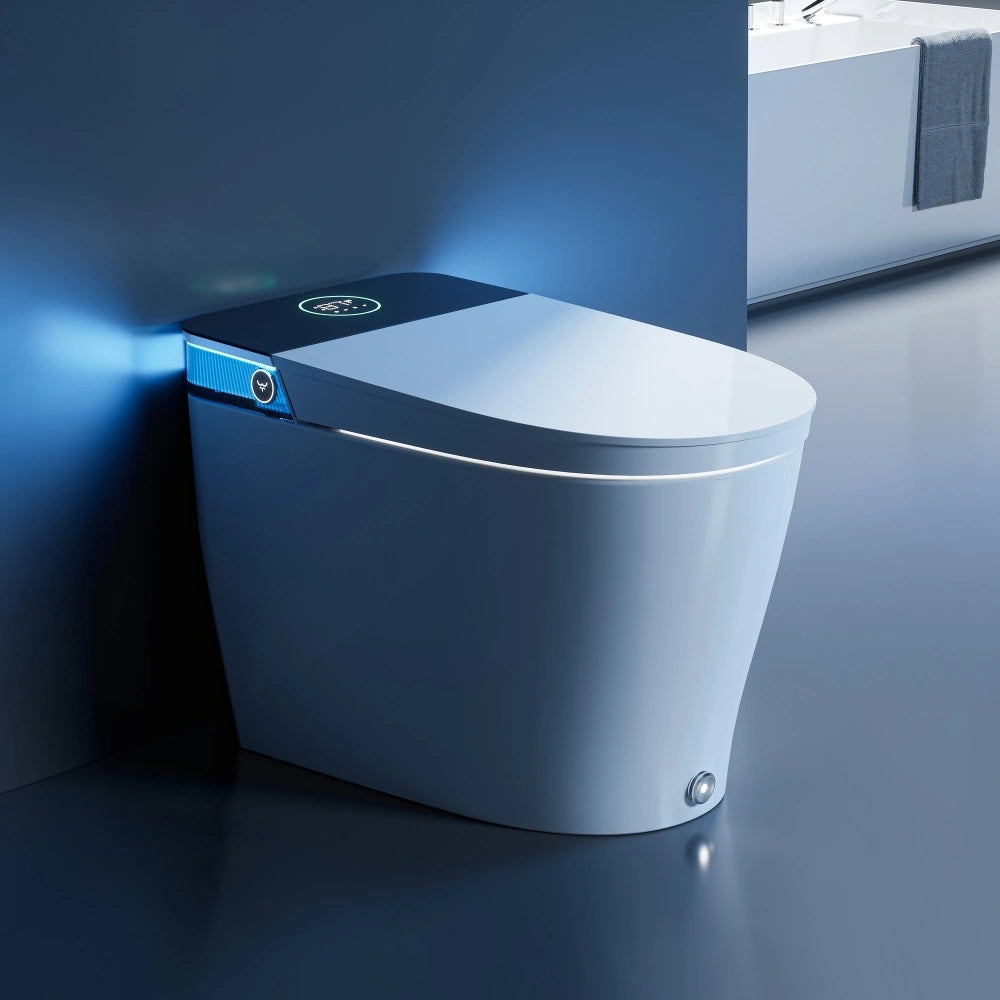
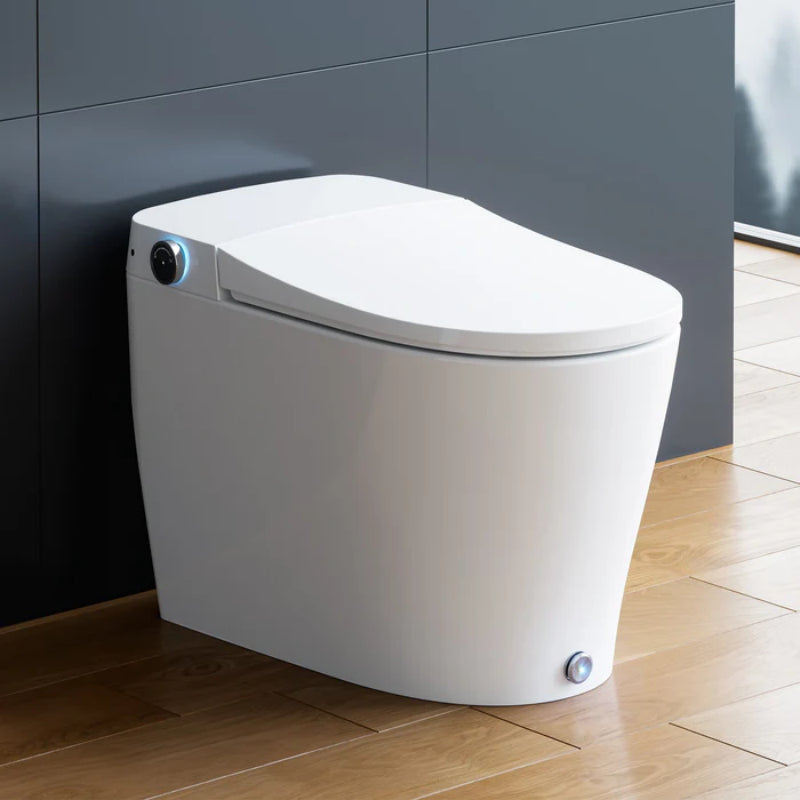
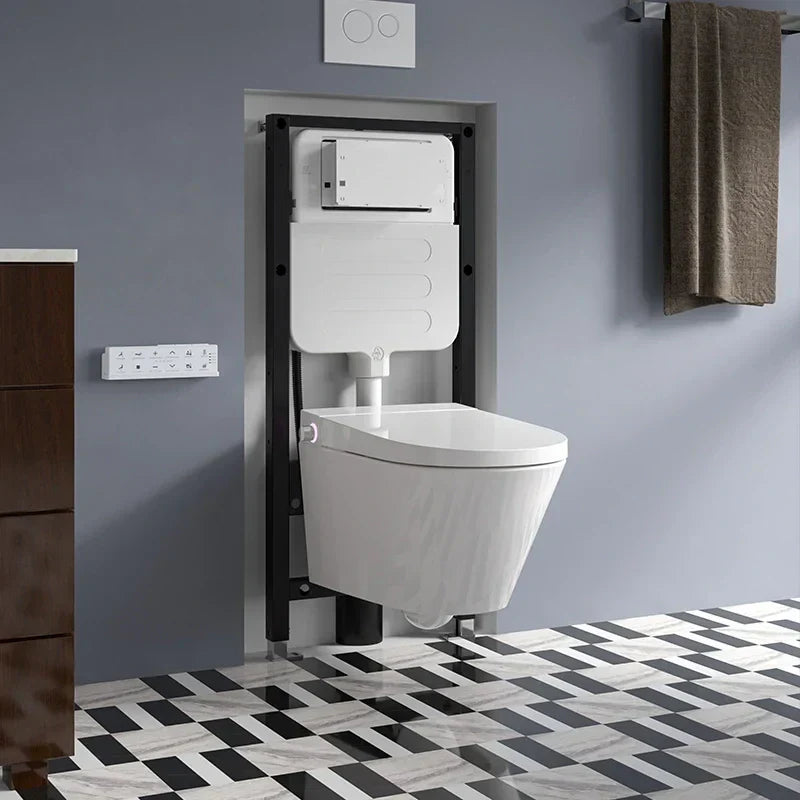
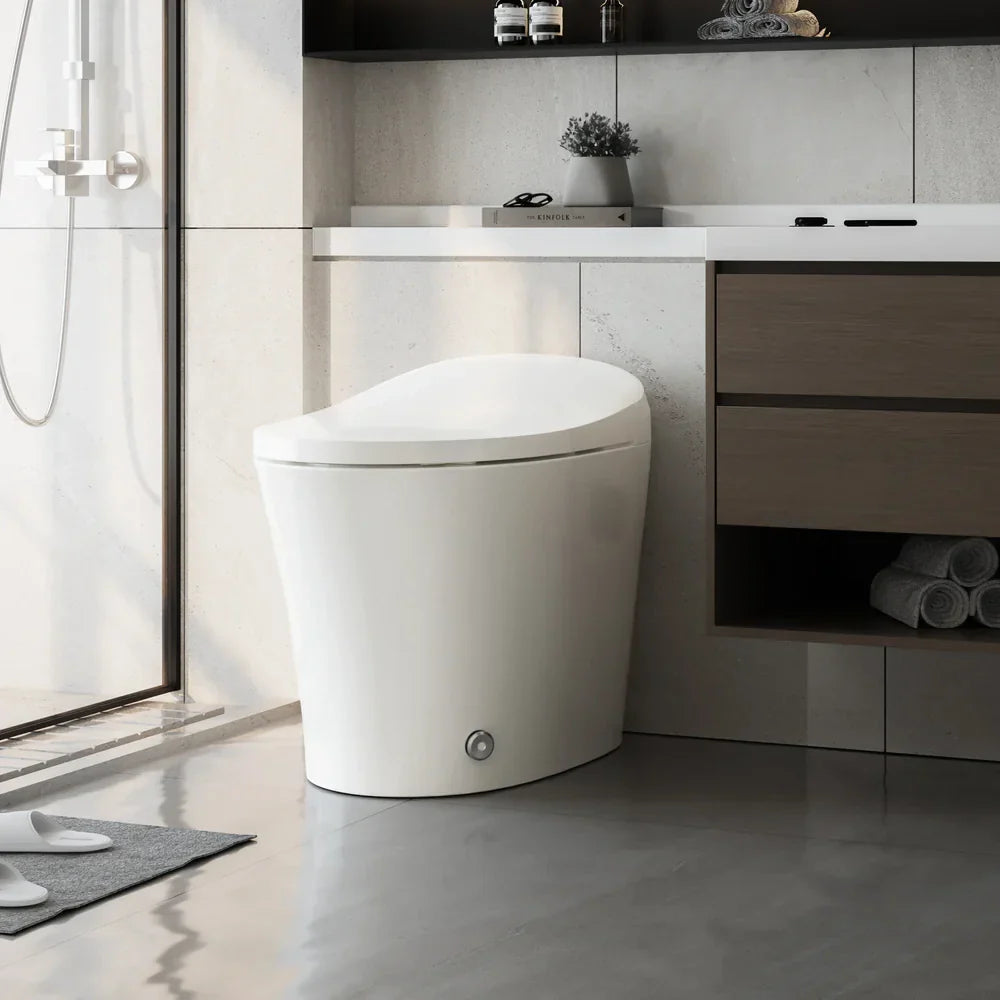
A wall hung smart toilet (also called a wall mounted intelligent toilet or intelligent wall-hung toilet) is a floating toilet bowl with a concealed tank inside the wall, plus smart toilet features like a bidet wash, heated seat, warm air dryer, night light, and automatic flushing.
People buy them for two big reasons: floor space and cleaning. You can see more floor, you can mop under the bowl, and the room looks less crowded. The trade-off is just as real: it costs more and it’s harder to access parts because the tank is hidden. Many buyers also love the modern aesthetics and sleek profile that elevates any bathroom design.
This guide is written to help you make one confident first decision: Is a wall-hung smart toilet the right type for your home and your bathroom layout? Then we’ll narrow down what to choose and what to avoid. Whether you compare different models online or in stores, this guide keeps you focused on what actually matters.
Decision Snapshot: Who should (and shouldn’t) buy a Wall Hung Smart Toilet?
Before you click “buy,” it helps to quickly assess whether this system truly matches your space, renovation plans, and daily priorities.
Best-fit scenarios: small bathrooms, modern remodels, hygiene-first households
A wall-hung smart toilet is usually a good fit when:
-
You’re remodeling and walls are already open (or you’re willing to build a false wall/chase).
-
You want a space saving floating bidet setup to make a small bathroom feel less tight.
-
You care about easy mopping, fewer grime traps, and a cleaner look.
-
You want a smart toilet with bidet built in (wash + dry + heated seat) and you’re fine paying extra to get it done cleanly.
In real homes, I see this work best in:
-
Small primary baths where every inch matters
-
Modern remodels where “floating” fixtures match the design
-
Households that value hygiene (bidet use, less toilet paper, easier cleaning)
You should choose a floor-mounted smart toilet or bidet seat instead if…
-
Your budget is limited and you want the lowest-cost bathroom upgrade.
-
You rent your home or plan to move soon and can’t recover installation costs.
-
You intend to complete a fully DIY installation (wall-hung smart toilets are rarely DIY-friendly).
-
Your wall has limited space, poor structural support, or difficult service access.
-
You prioritize simple, fast repairs and full component access over a floating design.
Not a fit: tight budgets, renters, DIY-only installs, older/weak wall construction
Not a fit if:
-
The budget is limited, or you want the lowest-cost bathroom upgrade.
-
You rent or plan to move soon.
-
You intend a full DIY install (most wall-hung toilets are not DIY-friendly).
-
Your wall has limited space, poor structural support, or difficult service access.
Wall Hung vs Floor-Mounted Smart Toilet: Key Trade-Offs Buyers Mention in Customer Reviews
This is where most buying regret comes from. People fall in love with the floating design, then get surprised by the install details and service access.

Rule of thumb: when “floor space + easy mopping” beats “easy access + simple repairs”
If you value open floors + easier cleaning more than simple repairs and the lowest cost, a wall-hung smart toilet can be a great fit.
If you value easy access and easy replacement more than the floating look, a floor-mounted smart toilet (or a standard toilet + add-on bidet seat) is usually the safer decision.
Space-saving floating bowl vs hidden-tank access for repairs
Yes, it saves space. In many bathrooms, the difference you feel comes from two things:
-
More visible floor (your eye reads the room as larger)
-
A shorter bowl projection option (some wall-hung bowls stick out less than many floor toilets)
But the tank is inside the wall. A concealed tank smart toilet is designed so key parts can be reached through the flush plate opening (the actuator plate). That helps, but it’s still more cramped than opening a normal tank lid.
Practical takeaway: if you’re the kind of homeowner who wants to see every valve and gasket and handle it fast, a hidden tank can feel annoying.
Service access reality
Most internal components can be serviced through the actuator plate opening without removing wall finishes. Major repairs to supply lines, fittings, or carrier framing may require opening or removing part of the wall. Always confirm service access points before finalizing your intelligent wall-hung toilet installation.
Stability & weight support: carrier frame ratings and “installed correctly” realities
“How much weight can a floating toilet hold?” is one of the most searched questions for a reason.
A wall-hung toilet is not held up by drywall. It is supported by a steel carrier frame anchored to studs (or masonry) and the floor structure behind the wall. When installed correctly with the right in-wall carrier, wall-hung toilets are commonly rated to handle very high loads (often hundreds of pounds).
Where problems happen is not the concept—it’s the execution:
-
wrong carrier frame or missing hardware
-
weak framing, poor anchoring, or rushed installation
-
bowl not tightened correctly, leading to a “wobble”
-
wall finished before pressure testing and leak checks
Practical takeaway: don’t buy the toilet first and hope the wall works. Confirm the carrier and wall build plan before you purchase the product.
Buy-before-wall check
-
Confirm your wall type (stud, masonry, or planned false wall).
-
Finalize the carrier frame model, anchoring method, and structural reinforcement plan.
-
Lock in bowl height and projection to avoid fit conflicts after walls are closed.
-
Verify that rough-in plumbing and electrical locations match the carrier layout.
What happens if there’s a leak or clog behind the wall?
This question scares people, and it should be answered clearly before you buy it.
Reality:
-
most service access is through the actuator plate opening
-
some repairs are simple through that opening (fill/flush components)
-
a major leak from a pipe or fitting may require opening the wall
Clogs are usually in the bowl trapway or drain line, like any toilet. The difference is access and the fact that the bowl is mounted, so removal is more involved than a toilet floor.
Stop-doing list
-
Don’t close the wall or finish tile before completing pressure and leak tests.
-
Don’t skip planning a clear, accessible water shutoff for the Wall Hung Smart Toilet.
-
Don’t install without marking and confirming long-term service access points.
-
Don’t assume all clogs or leaks can be fixed only through the actuator plate.
-
Don’t rush carrier anchoring or ignore wall structure requirements.
Practical takeaway: plan for access and shutoffs. Ask where the shutoff will be, how the system can be serviced, and what parts are considered “in-wall serviceable.”
Will it feel different to sit on? bowl height, elongated vs compact, seat sensor quirks
A wall-hung toilet can be set at different heights during installation. That’s great—unless nobody checks comfort.
Things that change daily comfort:
-
Bowl height: too low feels like a squat; too high makes feet dangle (especially for kids).
-
Elongated vs compact bowl: an elongated bidet or one-piece elongated smart toilet is usually more comfortable for adults. Compact bowls save space but can feel tight.
-
Seat sensor behavior: many smart toilets use a seat sensor to know someone is seated. If the sensor doesn’t detect you well, you may get issues like:
-
seat sensor no longer detects reliably over time
-
wash won’t start unless you shift your weight
-
auto flush timing feels “off-seat” and annoying
-
Practical takeaway: choose comfort first, then space savings. A slightly longer bowl that people actually like using beats a compact bowl everyone complains about.
Flush performance & noise: concealed tank behavior vs traditional tanks
Wall-hung toilets use a concealed tank and an in-wall flush system. You’ll typically see:
-
a dual flush option (full/partial) via the actuator plate
-
a different sound: less “tank refill whoosh” in the room, but sometimes a sharper in-wall refill sound
Flush performance can be excellent, but it depends on:
-
proper drain connection and venting
-
correct bowl + carrier pairing
-
good water supply and pressure
-
correct installation (again)
Practical takeaway: don’t assume all concealed tanks flush the same. Clean install matters as much as the toilet specs. Top brand models often deliver more consistent and powerful flush performance.
Wall Hung Smart Toilet System Cost: Full Product Price Including Concealed Tank & Installation
Wall-hung smart toilets cost more than most people expect because you’re buying a system:
-
toilet bowl + smart bidet toilet components
-
in-wall carrier frame
-
concealed tank
-
actuator plate
-
electrical outlet (often GFCI)
-
labor to open the wall, frame, plumb, wire, finish, and test
All-in cost components table
| Cost Component | Description |
| Toilet bowl | Wall hung smart toilet ceramic bowl |
| In-wall carrier | Structural carrier frame for mounting |
| Concealed tank | In-wall tank and flush mechanism |
| Actuator plate | Flush control and service access panel |
| Electrical / GFCI | Wiring, outlet, and GFCI protection |
| Wall opening & repair | Demolition, framing, drywall or tile repair |
| Finish work | Painting, tiling, trim, and final finishes |
| Water filter | Inline filter for bidet system (recommended) |
| Shutoff components | Water shutoff valve and supply lines |
| Labor & testing | Professional installation and testing |
Price tiers: wall mounted intelligent toilet basics vs premium smart toilet with bidet built in
Typical pricing breaks down like this (wide ranges by region and features):
-
Entry smart wall-hung setup: basic bidet wash + heated seat, fewer auto features
-
Mid-range: better wash controls, better drying, deodorizer, more reliable sensors
-
Premium: auto open/close lid, advanced auto flush, stronger dryer, more adjustability, better materials and finish
The moment you want a true floating bidet toilet combo (bidet + dryer + heated seat built in), you’re usually past “budget bathroom upgrade” territory.
If you’re ready to explore options, compare different models online or visit local showrooms to check features and details. For personalized help, contact us anytime.
Installed-cost ranges for new build vs retrofit (cost range table)
These ranges assume you want a complete wall-hung smart toilet system with a concealed tank and professional installation.
| Project type | What’s involved | Typical installed range (USD) |
| New build / gut remodel | Open studs, easy rough plumbing & wiring | $3,500–$7,500 |
| Retrofit, stud wall | Open/repair wall, move drain/supply, add outlet | $4,500–$10,000 |
| Retrofit, masonry wall | Chase/false wall, heavier labor | $6,000–$12,000+ |
Why the spread is huge: wall conditions, tile work, access, local labor rates, and whether the drain line needs to move.
Hidden line items: carrier frame, actuator plate, electrical/GFCI, filters, trim parts
These are the “surprise costs” that catch homeowners:
-
Carrier frame + concealed tank: not optional for wall-hung
-
Actuator plate: sometimes sold separately
-
Electrical: a nearby outlet (often GFCI protected), sometimes a new circuit
-
Water filter: many smart bidet systems benefit from an inline filter (especially with hard water or sediment)
-
Trim and finish work: tile repair, patch/paint, access detailing
-
Shutoff planning: you still need a water shutoff strategy that’s serviceable
Practical takeaway: if a quote seems cheap, ask what’s missing. Many low quotes exclude wall repair and electrical.
Is it worth it if you’ll move in 3–5 years?
Usually, this is not the best “short-stay” upgrade. You may enjoy it daily, but resale value is unpredictable. Some buyers love it, others worry about repairs.
A simpler path for a 3–5 year horizon:
-
keep a standard toilet
-
add a quality bidet seat (easier to remove or replace)
If this is your long-term home and you value the design + cleaning ease, the cost can make sense.
Will it fit your bathroom layout, wall depth, and rough-in?
Most failed purchases happen because someone clicks “buy” before measuring. Taking the time to measure ensures your elongated smart toilet with bidet operates smoothly in your space.
Measure-first numbered checklist (with measure-from/to instructions)
-
Projection: Measure from the finished wall surface to the front edge of the bowl.
-
Side clearance: Measure from the bowl centerline to the nearest vanity, tub, or wall on both sides.
-
Front clearance: Measure from the front of the bowl to the nearest obstacle or wall in front.
-
Door swing: Measure the full door swing path to ensure it does not hit the bowl or block access.
-
Seat height: Measure from the finished floor to the top of the toilet seat at your intended mounting height.

Measure-first checklist: projection, knee clearance, door swing, bowl height (fit diagram)
You want to measure your space like you’re placing a chair, not like you’re buying a gadget. This ensures your elongated smart toilet with bidet fits and functions as intended.
Key measurements:
-
Projection: how far the bowl sticks out from the finished wall
-
Side clearance: space from bowl centerline to vanity/tub/wall
-
Front clearance: knee space and comfort in front of the toilet
-
Door swing: door clearing your knees (or the bowl)
-
Seat height: finished floor to top of seat
Simple fit sketch (not to scale):
-
Finished Wall: The wall where the toilet is mounted.
-
Concealed Tank + Carrier Inside Wall: The hidden tank and supporting carrier are installed inside the wall.
-
Projection: The toilet bowl sticks out from the finished wall (measurement of how far it extends).
-
Toilet Bowl: The actual toilet bowl is mounted on the carrier.
-
Front Clearance: The space in front of the toilet, which includes knee space and standing space.
-
Door Swing Path: The path the door will take when opened, ensuring it clears the bowl and doesn't block movement.
Practical takeaway: the floating look only helps if the bowl doesn’t stick too far out. A “space saving” choice should reduce projection or improve circulation, not just show more tile—critical when installing an elongated smart toilet with bidet.
What wall cavity is required for a concealed tank smart toilet (and what if you don’t have it)?
Most concealed tank systems need wall depth to hide:
-
the carrier frame
-
the tank
-
the water supply connection
-
the flush mechanism
In many homes, the existing wall cavity may be too shallow, crowded with pipes, or not located where you need it.
If you don’t have the depth, you have three common options:
-
Build a false wall/chase (steals a few inches from the room but makes installation possible)
-
Reframe a thicker wall (bigger remodel)
-
Choose a floor-mounted smart toilet instead
Practical takeaway: building a false wall is normal, but it changes the room. It can also be a chance to create a small ledge/shelf behind the toilet—useful, but it’s still lost space.
Will this work in a small bathroom or powder room without feeling cramped?
Often yes—if you choose the right bowl projection and plan the door swing.
In tiny powder rooms, I’ve seen the two biggest mistakes:
-
choosing a bowl that’s too long (elongated can feel huge in a tight room)
-
forgetting the door swing, so the door hits knees or the bowl area
A compact wall-hung toilet can help a powder room, but be honest about who uses it. If tall adults use it daily, compact can become a comfort complaint.
Practical takeaway: small room = prioritize projection first, then decide elongated vs compact.
Water pressure + power needs for bidet wash, heated seat, warm air dryer, and night light
A wall-hung smart toilet needs:
-
a water supply with enough pressure for consistent wash performance
-
power for the smart features (heated seat, warm air dryer, night light, controls, sometimes auto lid/flush)
Common real-world issues:
-
Weak pressure leads to disappointing wash strength
-
Hard water can clog small passages over time
-
no nearby outlet means added electrical work (and sometimes wall opening)
Practical takeaway: check water pressure and outlet location before you choose features. The best feature list won’t help if the wash feels weak or the install becomes a wiring project.
Installation reality check: what your contractor must confirm before you buy
This is the “save yourself from regret” section. A wall mounted intelligent toilet is a system install, not a simple toilet swap.

Contractor pre-buy verification checklist
-
Confirm the carrier system model and installation plan.
-
Review anchoring and structural reinforcement based on wall type.
-
Agree to pressure and leak testing before closing the wall.
-
Locate and mark the final water shutoff position.
-
Confirm clear service access via the actuator plate or planned access panels.
-
Finalize electrical layout, GFCI protection, and nearby outlet placement.
-
Review wall-specific approach (stud, masonry, false wall).
-
Align on local code requirements and inspection expectations.
Retrofit decision tree: stud wall vs masonry wall vs building a false wall/chase
If it’s a stud wall and you can open it: usually the cleanest retrofit. Your installer can add a carrier, set height, and run supply and drain properly.
If it’s masonry: it’s doable, but often means more labor. Many homeowners end up building a false wall in front of the masonry instead of cutting into it.
If plumbing is on an exterior wall: be careful. You may have insulation, vapor barriers, and freezing risk depending on climate. A false wall inside the room is often safer than putting a tank in a cold cavity.
Practical takeaway: the wall type decides the project more than the toilet does. Confirm wall plan first.
Carrier frame mounting and reinforcement: where most “wobbles” and failures start
The carrier is the backbone. If it isn’t anchored correctly, you’ll feel it.
What “installed correctly” typically means in practice:
-
The carrier frame is rated properly and installed per its manual
-
anchored to studs (or structural backing) and secured to the floor
-
drain and supply are aligned without stress on fittings
-
bowl is mounted, torqued, and checked for movement
-
system is leak-tested before the wall is closed
If you ever read customer reviews about a wall hung toilet feeling loose, it’s almost always a carrier/installation problem, not the bowl itself.
Practical takeaway: ask your contractor exactly how they plan to reinforce and anchor the carrier, and how they’ll test it before tile goes up.
Code/inspection considerations: shutoff access, actuator plate access, ADA height options
Local code varies, but common inspection-related items include:
-
correct drain sizing and venting
-
proper electrical protection for outlets near water (often GFCI)
-
accessible shutoff strategy (this is often overlooked)
-
height choices if you’re matching ADA-style comfort height
If anyone in the home has mobility needs, wall-hung can be helpful because height can be set during install. But it has to be planned early.
Practical takeaway: treat this like plumbing + electrical + finish carpentry. Make sure your installer expects inspections where required.
Choosing the features that actually improve daily use (and avoiding regrets)
Smart features can be great. They can also be the reason you hate your toilet. The goal is to choose features that still feel good after the “new toy” phase.
Bidet essentials: adjustable pressure/temperature, nozzle position, stainless steel nozzle, self-cleaning
If you’re buying a smart bidet toilet, prioritize wash performance and hygiene over flashy features. Look for instant warm water and smooth operation.
Features that matter most day-to-day:
-
Adjustable water pressure: wide range, stable output
-
Adjustable water temperature: with a comfortable warm setting
-
Nozzle position adjustment: helps different body types
-
Stainless steel nozzle: tends to resist staining and is easier to clean than plastic
-
Self-cleaning nozzle rinse: before/after use (still clean it manually sometimes)
Can you add a bidet to a wall-hung toilet?
Yes, in two ways:
-
buy a wall-hung smart toilet with bidet built in (one integrated system)
-
choose a wall-hung bowl and add a compatible bidet seat (harder because many wall-hung bowls use seat shapes that limit compatibility)
Practical takeaway: integrated models are simpler for fit and function. If you want to mix-and-match a seat, confirm seat compatibility before you buy anything.
Comfort upgrades that matter: heated seat, soft-close lid, warm air, deodorizer, nightlight
These features tend to deliver real value:
-
Heated seat: many people end up using it year-round, not just winter
-
Soft closing lid/seat: prevents slams, feels higher quality
-
Warm air dryer: reduces toilet paper use, but drying takes time (and not everyone uses it)
-
Deodorizer: helpful in small bathrooms
-
Night light / nightlight: genuinely useful and low-drama
Practical takeaway: heated seat + night light are “high satisfaction, low annoyance.” Warm air dryers are more personal—some love them, some don’t bother.
Auto features: auto flush, auto open/close—when sensors misfire or annoy users
Auto features sound great, but they’re the most common source of complaints. Many elongated smart toilet with bidet models work automatically, but sensitivity matters.
What can go wrong in daily use:
-
auto flush triggers when you lean forward (“off-seat auto flush” feeling)
-
lid opens when you walk by (especially in tight bathrooms)
-
seat sensor is picky, so functions don’t start unless you sit “just right”
-
guests don’t know what’s happening and think the toilet is broken
If you like auto features, look for:
-
adjustable sensitivity
-
clear manual override options
-
a reliable remote control and/or side panel
-
a “guest mode” or simple one-touch wash
Practical takeaway: if you share a bathroom with kids, guests, or older relatives, simpler controls often beat more automation.
Controls & usability: remote control vs side panel, guest mode, kids overriding settings
Control design matters more than most buyers expect.
-
Remote control: flexible and easier to read, but can get lost or need battery changes
-
Side panel: always there, but can be cramped and harder for guests
-
App control: rarely necessary for a toilet; adds complexity
In real homes, the happiest owners usually have:
-
a simple “rear wash / stop / dry” set of buttons
-
a way to adjust temperature and pressure without a manual every time
-
a way to lock settings so kids don’t max out pressure and surprise someone
Practical takeaway: imagine a guest using it with no instructions. If that sounds stressful, pick a simpler interface.
Long-term ownership: cleaning, maintenance, parts, and customer support
A wall-hung smart toilet can be a pleasure long-term, but only if you plan for upkeep and parts.
Cleaning reality: why floating bowls are easier—and the gaps/edges people still miss
The big win is real: floating bowls are easier to mop under. You also avoid the grime ring around floor bolts found on many floor toilets.
But you still need to clean:
-
the seam where the bowl meets the wall (dust can collect)
-
the underside edges (splashes happen)
-
the nozzle area (even with self-clean)
-
the seat hinges and lid edges
Practical takeaway: cleaning is easier, not automatic. You’ll still do normal toilet cleaning—just with fewer awkward floor crevices.
5-year upkeep costs: filters, descaling, consumables, potential service calls (TCO table)
Smart toilets have maintenance costs that standard toilets don’t.
Here’s a realistic 5-year “total cost of ownership” view (ranges vary by water quality and usage):
| Item | Typical frequency | 5-year cost range (USD) |
| Water filter (if used) | Every 6–12 months | $60–$250 |
| Descaling / cleaning solution | 1–4x per year (hard water = more) | $30–$200 |
| Seat/lid bumpers, small parts | As needed | $0–$80 |
| Service call (if something fails) | 0–2 times | $0–$600+ |
| Extra electricity | Ongoing | Usually modest |
Hard water is the big wildcard. If your area has hard water, plan on more descaling and possibly a filter.
Practical takeaway: budget some money and time for maintenance, especially if you’re buying a bidet toilet with heaters and sensors.
Common issues owners report: seat sensor no longer detects, off-seat auto flush, splash tuning
These are the complaints that show up again and again in customer reviews and real-world conversations:
-
Seat sensor no longer detects consistently Often related to user position, sensor wear, or installation/seat alignment.
-
Auto flush triggers at the wrong time More likely, in small bathrooms where you move around close to the toilet.
-
Splash or “too strong” wash at default settings Usually fixed by lowering pressure and adjusting nozzle position, but it’s frustrating at first.
-
Warm air dryer feels weak Some people expect “hand dryer power.” Many toilets are gentler and take longer.
Practical takeaway: the best smart toilets are the ones you can easily tune—pressure, temperature, nozzle position, and sensor behavior.
Warranty, parts availability, and service network: how to avoid being stuck with a dead smart toilet
Because you’re buying a system, support matters.
Before you purchase, confirm:
-
warranty length for electronic parts vs ceramic parts
-
how replacement parts are ordered
-
whether service is local or mail-in
-
whether the carrier and concealed tank parts are standard or proprietary
-
how you access parts through the actuator plate opening
If your toilet needs a special control board or sensor and it’s not available, the whole unit can become a headache.
Practical takeaway: don’t treat customer service as an afterthought. A smart toilet is closer to an appliance than a basic toilet.
Before You Buy checklist
-
Confirm your wall type and plan: stud wall, masonry, or false wall/chase.
-
Confirm you have (or can add) the right in-wall carrier and concealed tank.
-
Measure projection, door swing, and front clearance—don’t guess.
-
Decide on bowl shape: compact for tight spaces, elongated for comfort.
-
Plan electrical: outlet location and protection (often GFCI).
-
Check water pressure and consider a filter to see if water quality is poor.
-
Choose features you’ll actually use: heated seat + adjustable wash first, automation second.
-
Verify service access: actuator plate access and shutoff strategy.
FAQs
1. Can you add a bidet to a wall-hung toilet?
Yes — but it depends on the model. The easiest route is choosing a wall-hung smart toilet that already has a bidet function built in. That way, everything is designed to work together from the start, including water lines, power supply, and controls. If you already have a wall-hung toilet, adding a separate bidet seat is sometimes possible, but compatibility can be tricky. Not all wall-hung bowls are shaped to fit universal bidet seats, especially elongated or designer models. You’ll need to double-check mounting hole spacing, bowl curvature, and clearance around the wall. In short, it’s doable — just don’t assume every bidet seat will fit. Measure first and confirm compatibility before buying.
2. How much weight can a floating toilet hold?
More than most people expect. When a wall-hung toilet is installed with the correct in-wall carrier frame and properly anchored to structural studs, it’s typically rated to support several hundred pounds. The strength doesn’t come from the bowl itself — it comes from the steel frame hidden inside the wall. If installed correctly, it feels just as solid as a floor-mounted toilet. Most reports of wobbling or instability aren’t about the design concept; they usually trace back to poor framing, incorrect anchoring, or shortcuts during installation. So the real key isn’t the toilet type — it’s the quality of the installation. Done right, a floating toilet is extremely sturdy and safe for everyday use.
3. Is a wall-hung bidet harder to repair?
In general, yes — it can be a bit more complex. Many routine maintenance items, like flush adjustments or minor component replacements, are accessible through the actuator plate opening on the wall. That design allows technicians to reach inside without major demolition. However, if there’s a serious plumbing issue, pipe leak, or structural problem behind the wall, repairs may require opening up drywall or tile. That’s where it becomes more involved compared to a standard floor-mounted toilet, where most components are fully exposed. It doesn’t mean wall-hung systems are unreliable — just that access is different. For major repairs, expect a bit more labor compared to a traditional setup.
4. Does it save more space than a compact floor tub?
Visually, yes. Physically, not always by a huge margin. A wall-hung toilet can make a bathroom feel larger because the tank is hidden inside the wall and the floor underneath remains open. That floating effect creates more visible floor space, which makes small bathrooms feel less cramped. In terms of actual footprint, the savings may only be a few inches depending on the model. The real advantage is perception and easier cleaning underneath the bowl. If you’re working with a very tight layout, you’ll still need to measure carefully. So while it may not dramatically shrink dimensions, it often improves how the room feels and functions.
5. Is the tank hidden in the wall?
Yes. With a wall-hung system, the tank sits inside the wall cavity, supported by a heavy-duty steel carrier frame. From the outside, you only see the bowl and the flush plate mounted on the wall. When you press the actuator plate, it triggers the concealed tank behind the surface. This setup creates a sleek, minimalist look and eliminates the bulky tank normally visible in traditional toilets. It also reduces surface clutter, making cleaning easier. That said, because the tank is concealed, installation requires opening the wall and building in the support frame properly. Once installed, it operates just like a standard toilet — just with the hardware hidden out of sight.
6. Are wall-hung toilets more expensive?
Almost always, yes. The higher cost isn’t just about the toilet bowl itself — it’s about the full system. You’re paying for the concealed tank, the steel carrier frame, possible wall reconstruction, plumbing adjustments, and often electrical work if it’s a smart bidet model. Installation labor can significantly increase the final price, especially if the bathroom isn’t already being remodeled. Compared to a basic floor-mounted toilet or simply adding a bidet seat upgrade, the upfront investment is noticeably higher. However, many homeowners choose it for the modern look, easier cleaning, and long-term design appeal. It’s less about budget convenience and more about design and functionality priorities.
References


Leave a comment
This site is protected by hCaptcha and the hCaptcha Privacy Policy and Terms of Service apply.