



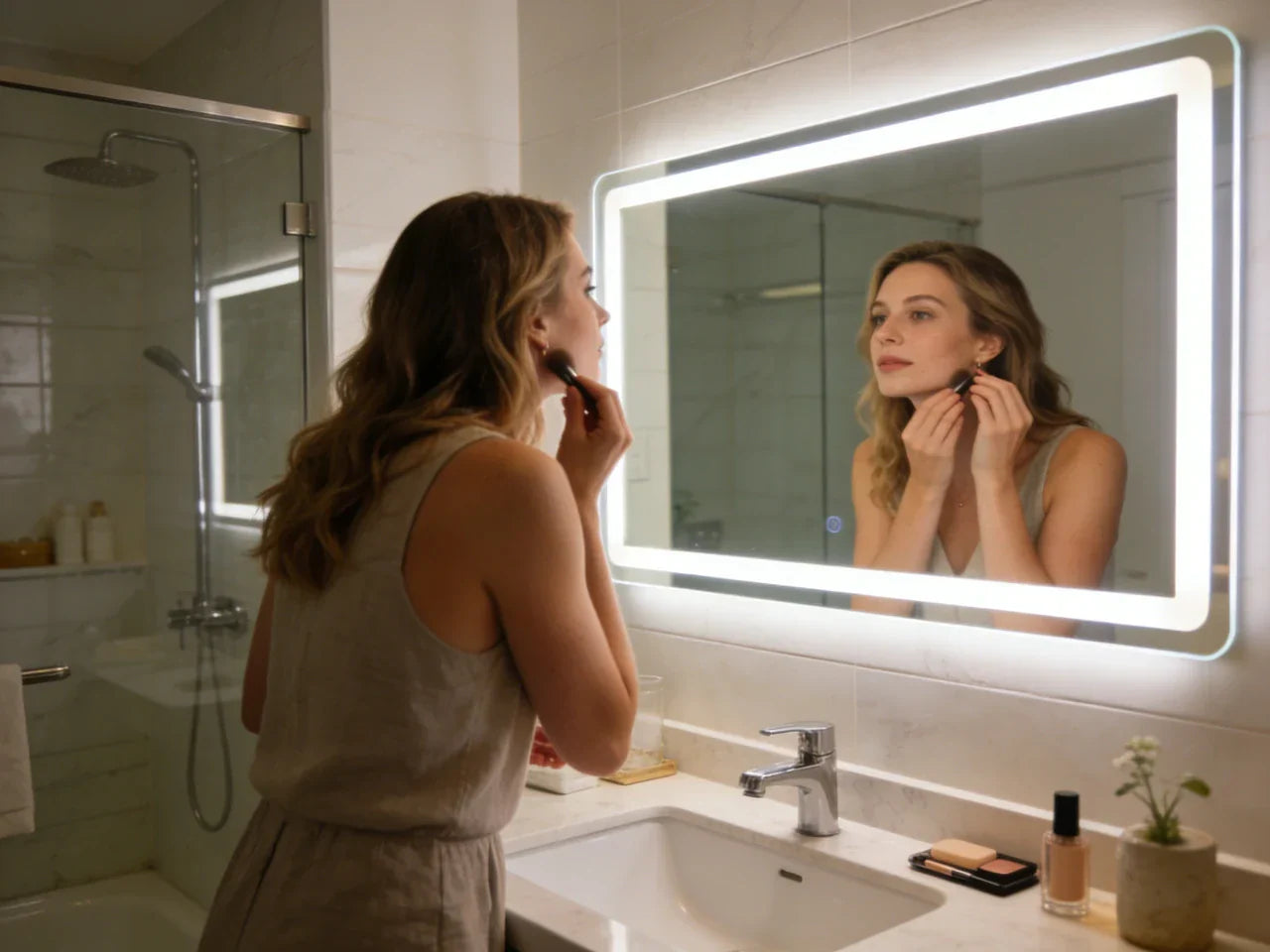
The right types of bathroom mirrors can change your bathroom more than almost any other single item. A new mirror can make a small bathroom feel bigger, brighten a dark vanity, and even help a busy family get ready faster in the morning.
In 2025, you can choose from simple flat glass, framed and frameless mirrors, LED and smart mirrors, organic shapes, mirrors with built‑in storage, and anti‑fog tech that keeps the glass clear in steamy rooms. With so many options, it’s easy to feel stuck.
This guide is for you if you:
-
Own a home and want a bathroom refresh
-
Are planning a renovation
-
Design bathrooms for clients
-
Love DIY and want to install a new mirror yourself
By the end, you’ll know:
-
What type of mirror is best for bathrooms in different situations
-
The main kinds of bathroom mirrors and when to use each
-
How high the bathroom mirror should be above the sink
-
What lighting works best for a bathroom vanity
-
A simple 3‑step framework for choosing a bathroom mirror that fits your space, style, and budget
Bathroom Mirror Types at a Glance (Quick Guide)
If you just want a fast answer, start here. The table below compares the main types of bathroom mirrors you’ll see in 2025.
Quick Comparison Table
| Mirror type | Best for | Key features | Pros | Cons | Typical price (USD) |
| Standard flat | Most bathrooms, rentals, budget | Plain glass, moisture-resistant backing | Affordable, simple, fits any style | No storage or lighting, basic look | $30–$200 |
| Framed | Style upgrade, decorative mirrors | Wood/metal/composite frame | Adds character, protects edges | Frame can swell or rust if low quality | $60–$400 |
| Frameless | Modern, small bathrooms | Polished edges, clips or adhesive mounting | Clean lines, makes room look bigger | Edges and hardware more visible | $40–$300 |
| Beveled | Subtle upscale look | Angled polished edges | Decorative without a frame | Slightly higher cost than plain mirrors | $70–$350 |
| LED / backlit | Low‑light, makeup, shaving | Built‑in lights, often dimmable, demister pad | Even light around face, energy efficient | Needs power, higher price, more complex install | $120–$800 |
| Smart | Luxury, tech‑focused homes | App/voice control, speakers, display | High convenience, wow factor | Expensive, wiring and privacy concerns | $300–$1,500+ |
| Magnifying | Makeup, shaving, grooming | 3x–10x magnification, often wall-mounted | Great for detail work | Not for full-room reflection | $25–$150 |
| Medicine cabinet | Small bathrooms, extra storage | Mirror cabinet, shelves, sometimes lighting | Hides clutter, uses wall depth | Heavier, harder install, wall modification needed | $80–$600 |
| Fog-free / heated | Steamy, high‑humidity bathrooms | Anti-fog coating or heating elements | Clear mirror after hot shower | Coatings can wear; heated pads need power | $80–$600 |
| Pivoting / tilting | Families, ADA needs | Adjustable angle bracket | Works for different heights and seated users | Slightly more hardware to clean and maintain | $60–$300 |
| 2-pack / symmetrical | Double vanities | Two matching wall-mounted mirrors | Balanced look, flexible layout | Can cost more than one large mirror | $100–$600 |
| ADA-focused | Accessible bathrooms | Lower height, tilt, low-glare glass | Better for wheelchair users and low vision | May not match standard-height mirrors elsewhere | $80–$500 |
If you want a starting point:
-
Small bathroom with not much light? A slim frameless mirror or a round LED mirror helps the room appear larger and brighter.
-
Dark, windowless bathroom? An LED or backlit bathroom mirror gives even light around your face.
-
Busy family bathroom? A fog-free mirror, sturdy framed mirror, or medicine cabinet mirror handles steam and storage.
-
Luxury remodel? A smart mirror or a large integrated LED mirror can turn the vanity into a feature wall.
-
Eco‑focused home? A wood‑framed mirror with low‑energy LED lighting is a strong match.
Main Types of Bathroom Mirrors (2025)
So, what type of mirror is best for bathrooms? The honest answer is: it depends on your bathroom type, size, lighting, and how you use the space. Let’s walk through each major mirror type so you can see which one fits your mirror needs.
Standard Flat Bathroom Mirrors
A standard bathroom mirror is a simple flat sheet of glass with a reflective coating and a moisture-resistant backing. This kind of mirror is designed for bathroom walls, so it can handle humidity and steam much better than a cheap decorative mirror from another room.
These plain mirrors are still the most common mirror type used in a bathroom in 2025. They are:
-
Easy to find in many sizes
-
Affordable compared to tech-heavy options
-
Neutral enough to work with almost any bathroom design
If you are doing a rental refresh, a starter home renovation, or you just want a clean, uncluttered look, a standard flat mirror is often the best type of mirror. You can always add vanity lighting for bathroom tasks with separate fixtures, such as sconces at the sides.
Flat mirrors also work well when you plan to update other elements later. For example, if you might add backlight or change the vanity, this basic mirror can stay in place without clashing.
Framed Bathroom Mirrors
Framed mirrors add a clear edge and a bit of personality around the glass. The frame can be made from metal, wood, or composite materials, and each one changes the feel of the bathroom.
Metal frames in finishes like brushed nickel, matte black, or warm bronze can tie into your faucet, shower frame, or cabinet handles. A black frame often works for an industrial style, while warm metals suit more classic or luxury spaces.
Wood frames—such as oak, walnut, bamboo, or reclaimed wood—bring warmth and texture to hard, glossy bathroom surfaces. In a white or gray bathroom, a wood frame can stop the room feeling too cold. Just make sure the wooden frame has a good finish that helps prevent moisture damage, since bathroom humidity can affect cheaper or unsealed wood.
Composite or plastic frames are lighter and often cheaper. They work well if you need a large mirror on a weaker wall, or you want a decorative look on a smaller budget.
So when do you choose a framed mirror instead of frameless? Choose framed when you:
-
Want the mirror to act like wall art or a focal point
-
Need the frame to match other metal or wood finishes
-
Prefer to hide the edges of the glass and mounting hardware
For example, in a guest bathroom, a decorative mirror with a bold frame can make the space feel special without a big remodel.
Frameless Bathroom Mirrors
Frameless mirrors are all about a clean, modern look. The edges are usually polished, and there is no frame around the glass.
Because you only see the glass, a frameless mirror can make a small bathroom appear larger. Light can move more freely across the reflective surface, and your eye is not stopped by a heavy border. This can be very helpful in tight powder rooms or narrow ensuites.
Frameless mirrors often pair well with:
-
Backlighting or LED strips behind the mirror, which create a glow around the edges
-
Beveled edges for a subtle decorative finish
They are also easy to clean, since there are no frame corners where dust and moisture collect. You simply wipe the glass with a soft, lint‑free cloth and a mild cleaner.
On the other hand, frameless mirrors make the edges and mounting hardware more visible. You might see clips, brackets, or a mounting bar. For some people that is part of the contemporary look; others prefer the neat border of a frame.
If your style is minimalist, Scandinavian, or very modern, or if you want your tile or wall finish to be the star, a frameless mirror often works best.
Beveled Bathroom Mirrors
A beveled bathroom mirror has edges that are cut at a slight angle and then polished. This angled band catches the light and creates a small frame effect without adding a separate material around the glass.
This type of mirror is great when you want something more special than a plain flat mirror, but you don’t want a bulky frame. Beveled mirrors offer:
-
A refined, decorative look
-
A bit of light play around the edges
-
A style that works in both modern and traditional bathrooms
These mirrors are often held with simple clips, adhesive, or a hidden cleat system. Many homeowners use rubber bumpers or pads on the back to protect both the mirror and the bathroom walls.
Pairing a beveled mirror with LED backlighting can be very effective, since the beveled edge catches some of the light and adds depth.
Shape-Based Bathroom Mirror Types
Beyond framed versus frameless, the shape of your mirror has a big impact on how the bathroom feels.
Rectangular and square mirrors are the most common kinds of mirror used over vanities. They offer the most reflection area, which matters in shared or family bathrooms.
If you have a wide vanity with two sinks, you can use one large bathroom mirror that spans almost the full width, or two smaller mirrors placed symmetrically, one over each sink. A wide mirror gives maximum reflection and makes the room feel open; two separate mirrors can feel more tailored and are easier to replace one at a time.
Round mirrors are very popular in 2025. A round bathroom mirror softens all the straight lines from tile, cabinets, and fixtures. It is a strong choice for single vanities and powder rooms, especially when paired with a slim metal frame. A round mirror can also help a narrow wall feel more balanced by drawing the eye to the center.
Oval and arched mirrors stretch the shape vertically. They tend to make mid‑sized bathrooms feel taller and more graceful. Arched mirrors with simple wood or metal frames fit well with the “modern organic” style, which mixes soft shapes with natural materials.
Finally, asymmetrical, wavy, and irregular mirrors are trending for 2025. These mirrors are less about strict function and more about adding character. They suit bathrooms where design is a big priority—think a stylish powder room that guests will notice. When paired with LED light around the edges, these mirrors work almost like glowing art.

LED, Backlit & Lighted Bathroom Mirrors
LED mirrors and backlit mirrors are now common, not just luxury items. These mirrors have built‑in lights either around the edges or behind the glass. The LED lighting can be along the front surface (front-lit) or behind the mirror (backlit), creating a halo on the wall.
Most good LED mirrors provide:
-
Adjustable brightness
-
Changeable color temperature (from warm light to cool daylight)
-
Touch controls, often right on the mirror surface
-
Sometimes a demister pad or other anti-fog feature
LED mirrors provide even light around your face, which is very helpful for makeup application, shaving, or other grooming tasks. Because the light comes from near eye level rather than just from the ceiling, you get fewer shadows under the eyes and chin.
In a small bathroom with no window, an illuminated mirror can make a huge difference. You may even be able to use a lighted mirror as your main vanity lighting for bathroom tasks, supported by a ceiling fixture for general light.
Many lighted mirrors are rated for damp environments, often marked with an IP44 rating or similar. This means the fixture is safe for normal bathroom humidity and some water splashes when installed correctly.
LED lighting also uses much less power than old bulbs and lasts longer, which is helpful if you want a more eco-friendly bathroom.
Smart Bathroom Mirrors (TV, Voice, App‑Integrated)
Smart mirrors take LED and backlit mirrors a step further. They add technology such as:
-
Touch or motion sensors
-
Voice control through your smart home hub
-
Bluetooth speakers
-
Time, date, and weather display
-
App control for brightness, color, and anti-fog functions
Some smart mirrors can show news, traffic, or streaming video directly on the glass. Others simply let you store presets so your morning lighting is bright and cool, while evening lighting is warm and dim.
So what type of mirror is best for bathrooms if you love tech? For many people doing a luxury remodel of a master bath, a smart mirror is a strong choice. It adds convenience and a clear wow factor.
There are trade‑offs, though. Smart mirrors cost more. They usually need hard‑wired power rather than a simple plug. You also need to think about privacy—if your mirror has a microphone or connects to the internet, treat it like any other smart device and use secure settings.
Magnifying & Shaving Mirrors
A magnifying mirror is a helpful second mirror, especially if several people use the bathroom. These mirrors often mount on the wall with an extendable arm near the main vanity mirror, or they sit on the counter.
Common magnification levels are:
-
3x to 5x for everyday makeup and grooming
-
7x to 10x for more detailed work like eyeliner or shaving tricky areas
Higher magnification is not always better; it can distort the view or make you feel too close. Many people like 5x as a middle ground.
Place a wall‑mounted magnifying mirror to one side of the main mirror, at a height where you can see your whole face when seated or standing, depending on how you groom. That way the main mirror stays clear for general use, while the smaller mirror handles close‑up tasks.
Medicine Cabinet & Storage Mirrors
If you struggle with clutter on the vanity, a mirror cabinet (also called a medicine cabinet mirror) can help. This type of mirror has a shallow cabinet behind it, built into or onto the wall.
You can choose between:
-
Recessed cabinets, which sit inside the wall. They save space and look sleek but require cutting into the wall and checking for pipes or wiring.
-
Surface‑mounted cabinets, which sit on top of the wall. They are easier to install but stick out more and are heavier mirrors.
Inside, you get adjustable shelves for items like toothpaste, skincare, medicine, or shaving equipment. Some cabinet mirrors also include built-in lights, power outlets, and even demister pads.
These mirrors are ideal for small spaces where you need storage and a mirror in the same footprint. The main downsides are weight, more complex installation, and the need to plan around wall studs and bathroom fixtures.
Fog-Free & Heated Bathroom Mirrors
A fogged-up mirror after a hot shower is a common complaint. Fog-free mirrors solve this in two main ways:
-
Anti-fog coating on the glass, which helps prevent moisture from settling on the surface.
-
A heated mirror using a demister pad behind the glass, which gently warms the mirror so steam does not condense there.
Anti-fog coatings are easy and do not need power, but they can wear off over time and may need reapplication. Demister pads are more consistent and long‑lasting, but they require an electrical connection and add to both cost and installation work.
These mirror types are great in bathrooms with poor ventilation, for large families where the shower runs all morning, or in small bathrooms where steam collects quickly. Many LED mirrors now come with a built-in demister pad activated by a touch button.
Pivoting, Tilting & 2-Pack Symmetrical Mirrors
Pivoting or tilting mirrors attach to the wall with arms or posts that let you adjust the angle. This can be very helpful if:
-
Users are different heights
-
Someone uses a wheelchair or sits to groom
-
You want less glare from a bright window or light
Tilting mirrors are common in classic and traditional designs, especially with oval or rectangular frames.
2‑pack or symmetrical mirrors are sets of two identical mirrors, usually hung over a double vanity. Many people like this look because it:
-
Splits the space clearly between two sinks
-
Allows one mirror to be replaced without touching the other
-
Feels balanced and custom
This layout can make a master bath look more high‑end even with standard materials.
ADA-Compliant & Accessibility-Focused Mirror Types
If you are planning an accessible bathroom, mirror choice matters. For wheelchair users, the height and tilt of the mirror must allow a clear view when seated.
Common guidelines based on accessibility standards include:
-
The bottom edge of the reflecting surface no higher than about 40 inches (roughly 101–105 cm) above the floor for a seated user
-
A larger vertical size, or a tilting mirror, so both seated and standing people can use it
Accessibility-focused mirrors may also use low-glare glass to reduce harsh reflections and pair with easy‑to‑reach lighting controls, such as large switches or motion sensors.
In shared spaces, one approach is to use a taller mirror that starts lower on the wall so people of many heights can see themselves without bending or stretching.
How to Choose the Right Bathroom Mirror Type (3‑Step Framework)
Now that you know the main types of bathroom mirrors, how do you choose the perfect one for your space? You can follow this simple three‑step framework.
Step 1 – Match Mirror Size & Shape to Your Bathroom
Start with the mirror size and shape. A beautiful mirror that is the wrong size will always feel off.
A common rule is that the mirror is about 70–80% of the vanity width if you choose one mirror centered over the sink. For example, over a 48‑inch vanity, a mirror between 34 and 40 inches wide usually looks right.
If you have a double vanity, you can:
-
Use one large mirror almost as wide as the whole vanity
-
Use two separate mirrors, each slightly narrower than its sink area
To answer the common question, “How high should a mirror be above a bathroom sink?”, here are simple guidelines:
-
The bottom of the mirror usually sits a few inches above the top of the faucet or backsplash—often 2–6 inches (about 5–15 cm).
-
Try to center the mirror height around eye level of the main users, often around 60–65 inches (152–165 cm) from the floor to the middle of the mirror.
-
Make sure the tallest person can see at least from chin to hairline without bending.
In a small bathroom or powder room, tall or vertical mirrors can help the room feel higher. Round mirrors soften tight spaces. A large bathroom mirror can make a small room appear larger by reflecting more light and wall area.
In a large master bathroom, you have more freedom. You can use bold shapes, oversized mirrors, or several mirrors in a row.
Step 2 – Decide on Lighting & Technology
Once you know the size and shape, think about lighting and tech.
Ask yourself:
-
Is this bathroom bright or dark during the day?
-
Do I use this mirror for detailed tasks like applying makeup or shaving?
-
Is there room for separate vanity light fixtures, or should the light come from the mirror itself?
In a bright bathroom with good vanity lighting already in place, a basic flat or framed mirror may be enough. You can keep the mirror simple and separate the mirror from the light fixtures.
If your bathroom is dim, or the light is only from the ceiling, a lighted LED mirror often gives the best result for grooming. LED mirrors provide consistent light around the face and help reduce shadows.
If you love gadgets or want the bathroom to match a smart home system, then a smart mirror can be the best mirror type for you. Just be sure your wiring and budget can support it. You can also take the upgrade further with a smart toilet to complete the high-tech bathroom setup.
Think about how much wiring work you are willing to do. Plug‑in LED mirrors are easier for DIYers. Hard‑wired mirrors may need a licensed electrician but look cleaner since you don’t see cords.
Step 3 – Choose Material, Finish & Sustainability Level
Finally, pick the material and finish that works with your bathroom design and your values.
Match finishes to:
-
Faucets and shower fixtures
-
Cabinet hardware
-
Towel bars and other metal items
For example, if your fixtures are matte black, a mirror with a black frame or simple frameless mirror surrounded by black sconces will feel like a perfect match.
If you care about the environment, look for:
-
Mirrors with sustainably sourced wood frames
-
Glass made with recycled content
-
Low‑VOC (low chemical) finishes on wooden frames
-
LED lights with low energy use and high efficiency ratings
In other words, when choosing a bathroom mirror, you first fit the size and shape to the room, then match the lighting to your needs, and finally pick a frame and materials that match your style and eco goals.
2025 Design & Style Trends in Bathroom Mirrors
Bathroom mirrors in 2025 sit at the meeting point of function and style. Here are the main trends designers are using.
Minimalist & Frameless Looks
Frameless mirrors with thin, polished edges, invisible mounts, and simple rectangles are common in modern, Scandinavian, and Japandi bathrooms. The mirror almost “floats” on the wall, sometimes with a soft LED backlight.
This style works best with clean lines, flat-front cabinets, and light neutral colors. It puts the focus on natural light and simple shapes.
Organic Shapes & “Modern Organic” Styles
Many homeowners now prefer a softer, more natural look. Organic shapes—like arches, soft ovals, and wavy mirrors—fit this trend.
These mirrors often pair with:
-
Wood vanities
-
Stone or terrazzo countertops
-
Warm metals and neutral tiles
The combination of a curved mirror and natural materials can make even a modern bathroom feel calm and welcoming.
Industrial, Luxury & Vintage-Inspired Mirrors
For industrial bathrooms, black metal frames, grid‑style mirrors, and simple rectangular shapes stand out. The mirror becomes part of a larger set of strong lines and hardware.
Luxury‑style bathrooms often use large mirrors with integrated lighting and rich finishes like warm gold or brushed brass. Backlit mirrors set against stone or marble give a high‑end hotel feel.
Vintage-inspired spaces bring back ornate frames, beveled edges, and warmer finishes like antique brass. A vintage mirror over a simple vanity can give a bathroom a lot of character without changing the layout.
Color & Finish Trends
Popular finishes in 2025 include:
-
Matte black for industrial and modern styles
-
Brushed nickel for a soft, neutral metal that works with many palettes
-
Brushed brass and warm bronze for a cozy, rich feel
-
Natural wood tones like oak, walnut, or even rattan for organic warmth
Many people mix two finishes, such as black for shower frames and warm metal for mirror frames, as long as the combination feels intentional.

Smart & LED Bathroom Mirrors – Feature Deep Dive
If you are thinking about an illuminated or smart mirror, a bit of basic lighting knowledge helps you choose well.
Lighting Performance
Two key terms matter for vanity lighting for bathroom tasks:
-
Color temperature, measured in Kelvin (K)
-
Color Rendering Index (CRI), which runs from 0 to 100
A simple way to think about color temperature:
| Color temperature | Look and feel | Best use around mirrors |
| 2700–3000K | Warm, like soft household bulbs | Relaxing baths, evening lighting |
| 3500–4000K | Neutral white | Everyday grooming, flattering light |
| 5000–6500K | Cool/daylight | Very bright task light, makeup detail |
For most people, 3500–4000K gives the best mix of clarity and comfort. It is bright enough for applying makeup without being harsh.
CRI tells you how well the light shows real colors. For makeup and grooming, aim for CRI 90 or higher so skin tones look natural.
Many LED mirrors now offer:
-
Dimming control to change brightness
-
Presets (for example, “daylight” in the morning and “warm” in the evening)
-
Memory, so the mirror switches on with your last used setting
Controls & Connectivity
Controls on LED and smart mirrors can be:
-
Touch buttons on the glass
-
Small capacitive icons that respond to a light touch
-
Motion sensors that turn the light on when you approach
Smart mirrors may connect to a phone app or smart home system so you can:
-
Set scenes (e.g., “Morning Ready” with bright cool light)
-
Turn the mirror light off remotely
-
Connect to other fixtures like smart bulbs or switches
If you keep things simple, touch buttons are often easiest for guests and kids to understand. If you like automation, app control and motion sensors give more flexibility.
Safety, Energy & Privacy
Bathroom mirrors with built‑in lights are electrical fixtures, so check safety ratings. For wet and damp areas, look for an IP rating (like IP44) that shows protection from moisture and splashes when installed correctly.
LED lights use far less electricity than older bulbs and produce less heat. That means a lighted mirror is usually a good long‑term choice for your power bill.
For smart mirrors that connect to Wi‑Fi or use microphones, treat them like any smart speaker or TV. Use strong passwords, update software, and adjust privacy settings so you share only what you’re comfortable with.
Installation & DIY Guide for Bathroom Mirror Types
Many homeowners install wall-mounted mirrors themselves, especially standard and framed mirrors. LED and smart mirrors with hard wiring may need a professional. Here’s a basic overview.
Tools & Preparation
Before you start, gather:
-
Tape measure and pencil
-
Level
-
Stud finder
-
Drill and bits
-
Wall anchors and screws suited to your wall type (drywall, tile, masonry)
-
Safety glasses and gloves
Turn off power at the breaker if you will work near existing electrical fixtures or wires. Mirrors are heavy and can break, so use two people for large mirrors and carry the glass upright, not flat.
Installing Standard & Framed Mirrors
For a typical flat or framed mirror, the basic steps are:
-
Measure and mark the desired mirror height and center line above the sink.
-
Check for studs with a stud finder and mark their positions.
-
Mark mounting points according to the mirror’s brackets, cleat, or hooks.
-
Drill pilot holes and insert suitable wall anchors where there is no stud.
-
Attach hardware (cleat, brackets, or hooks) securely to the wall.
-
Hang the mirror and adjust until level.
Always follow the manufacturer’s installation methods for that mirror type. Heavier mirrors need stronger anchors or direct attachment into studs. For cabinet mirrors and large mirror panels, this is very important.
Wiring & Mounting LED and Smart Mirrors
If your LED or smart mirror plugs into a regular outlet, you may be able to do the install yourself, hiding the cord where possible. For hard‑wired mirrors, many people hire an electrician.
Key points:
-
Plan for power at the right height, usually behind the mirror or near its edge.
-
Use a GFCI‑protected circuit in bathrooms for safety, as required in many building codes.
-
Keep wires away from plumbing inside the wall.
Once the power is ready, you mount the mirror much like a standard one, but with extra care not to pinch the wiring or damage any heating elements or LED strips on the back.
Common Mistakes to Avoid
Some frequent issues when choosing and installing bathroom mirrors:
-
Hanging the mirror too high, so shorter users see only the top of their head
-
Choosing a mirror that is too small for the vanity, making the wall feel empty
-
Forgetting future upgrades, such as leaving no space for sconces or failing to run a power line for a future LED mirror
It helps to tape the mirror outline on the wall with painter’s tape and live with it for a day or two before drilling.
Lighting Integration with Bathroom Mirror Types
A good bathroom feels bright and even, with no harsh shadows. The mirror is a central part of that plan.
Task vs Ambient vs Accent Lighting
Think of three kinds of light:
-
Task lighting is for grooming—this should be at or near face level around the mirror.
-
Ambient lighting is the general room light, often from ceiling fixtures.
-
Accent lighting adds mood or highlights design features, such as LED strips under a vanity.
A lighted mirror can cover task lighting on its own, especially in small bathrooms. In larger bathrooms, many people combine a mirror with:
-
Wall sconces on either side of the mirror
-
A ceiling light or recessed lights
-
Sometimes a small accent light in the shower or over a tub
Placement & Glare Control
To avoid shadows on your face, try to place lights:
-
At about eye level on both sides of the mirror, or
-
Evenly along the mirror edges in a backlit or front‑lit mirror
If you only have a light above the mirror, angle it or use a tilting mirror to cut down on harsh shadows. Avoid aiming strong light directly into the mirror, which can cause glare. Frosted shades, diffusers, or backlit designs spread light more softly.
A clear, well-designed shower door can also help the space feel brighter. When the shower area has a window nearby—or even just good ambient lighting—a transparent door allows more natural or in-room light to pass through, enhancing the overall brightness of the bathroom and supporting better illumination around the vanity without relying solely on artificial lighting.
Smart Lighting Sync
If your bathroom uses smart bulbs or smart switches, you can sync them with your LED or smart mirror. For example, you might set:
-
A “Morning” scene with bright, cool light over the vanity and in the ceiling
-
An “Evening” scene with dim, warm light and only the mirror glow
Even if your mirror is not smart, smart switches can control power and dimming for other fixtures so the whole room works together.
Sustainability & Eco-Friendly Bathroom Mirrors
Bathrooms may be small, but they use energy and materials every day. Your mirror choice can support a more eco‑friendly home, , according to the U.S. Department of Energy, which says residential LED lighting uses at least 75% less energy and lasts up to 25 times longer than incandescent bulbs.
Materials & Manufacturing
Look for:
-
Glass made with some recycled content
-
FSC‑certified wood frames, which come from responsibly managed forests
-
Low‑VOC finishes and adhesives on frames, which release fewer chemicals into in air
Durability is also a key part of sustainability. A well‑made mirror that lasts for many years is greener than a cheap mirror you replace often.
Energy Efficiency
For illuminated mirrors, LED lights are the clear choice. They:
-
Use far less electricity than halogen or incandescent bulbs
-
Last tens of thousands of hours in many cases
-
Produce less heat, which can be helpful in small bathrooms
Some smart mirrors use a small amount of power even when “off” because of standby features. Check the standby power rating if you are very energy‑conscious and use a switch that can fully cut power if needed.
Brands & Practices to Look For
Since you may not see full manufacturing details on every box, look for signs a company cares about eco‑friendly practices, such as:
-
Recyclable or minimal packaging
-
Clear information about energy use and LED lifespan
-
Mirrors built with replaceable parts (for example, replaceable LED drivers) rather than sealed units that must be thrown away if one piece fails
Warranty, Durability & Maintenance
A bathroom is a harsh place for materials. Steam, water splashes, and regular cleaning all affect how long a mirror lasts.
Understanding Warranties
Common warranty lengths for bathroom mirrors range from 1 year for basic models to 5 years or more for higher-end or tech-based mirrors. Warranties may cover:
-
“Silvering” failure, when dark spots appear around the edges
-
LED strip failures
-
Faults in demister pads or electronic controls
Always read what is and is not covered. Damage from harsh cleaners, scratches, or incorrect installation is usually not included.
Cleaning & Care by Mirror Type
To keep your mirror clear and avoid streaks, use:
-
A mild glass cleaner or a mix of water and a little vinegar
-
A soft, lint‑free cloth or microfiber towel
Avoid spraying cleaner directly onto the edges of the mirror, especially on frameless and beveled mirrors, because liquid can seep behind the glass and damage the backing over time. Instead, spray the cloth and then wipe.
For wooden frames, wipe with a slightly damp cloth and dry right away. Do not soak the wood. For metal frames, avoid abrasive pads that can scratch the finish.
Check the manufacturer’s advice for coated, anti-fog, or smart mirrors. Some anti-fog coatings need very gentle cleaners to prevent wear.
Fog-Free & Heated Mirror Maintenance
Anti-fog coatings slowly lose strength with use. You may notice that over a few years the mirror fogs more than before. At that point you can:
-
Use a new anti-fog spray after cleaning
-
Upgrade to a mirror with a heated demister pad if you want a more long-term solution
Heated mirrors are fairly low maintenance. If a demister pad stops working, it may be possible to replace just that pad instead of the whole mirror, depending on the design.
Top Bathroom Mirror Brands & Where to Buy (2025)
Without naming specific companies, you can think of mirror sources in three main groups.
Mainstream & Trusted Brands
Large bathroom and home brands sell:
-
Standard flat mirrors in many sizes
-
Framed mirrors that match common faucet finishes
-
Pivoting mirrors and simple tilting designs
-
LED mirrors with basic dimming and anti-fog features
These brands are easy to find in big home centers and often have clear warranties and return policies.
Design-Forward & Boutique Brands
Smaller and design‑focused makers often lead trends in:
-
Wavy, asymmetrical, and irregular mirrors
-
Custom sizes and shapes
-
Unique frame materials like unusual woods or colored metals
You often find these through design showrooms, specialty bath stores, or online decor shops. Prices vary widely but can be higher due to the custom feel.
Where to Buy Different Mirror Types
You can find mirrors at:
-
Big‑box home stores, which offer good prices, easy returns, and a wide selection of standard types
-
Specialty bath and lighting stores, which provide expert advice and more advanced LED and smart options
-
Online decor and furniture shops, which carry trend‑driven shapes and finishes and many decorative mirrors
For heavy mirrors, cabinet mirrors, and large LED mirrors, check delivery options and make sure you have help for moving and installing them safely.

Interactive Tools & Resources (For This Guide)
While this article itself is not a calculator or quiz, here is how you can think about the tools you might use.
Mirror Size Calculator
A simple “calculator” for mirror size considers:
-
Vanity width
-
Ceiling height
-
Number of sinks
You can start by taking 70–80% of your vanity width for a single mirror and adjust up or down to taste. For double vanities, plan one mirror per sink or one large mirror centered on both.
Bathroom Mirror Style Quiz
If you are unsure about style, ask yourself:
-
Do I prefer clean lines and simple shapes (minimalist)?
-
Do I like natural wood and soft curves (modern organic)?
-
Am I drawn to black metal and strong lines (industrial)?
-
Do I love rich finishes and large mirrors (luxury)?
-
Do I collect older items or like ornate detail (vintage)?
Your answers lead toward certain mirror types and finishes, such as frameless and rectangular for minimalist, or arched wood-framed mirrors for modern organic.
Lighting & Tech Selector
To choose between:
-
Non‑lit mirrors when your bathroom is already bright
-
LED mirrors when you need better task light
-
Smart mirrors when you want advanced control and features
Also decide whether you prefer warm or cool light and if a defogger is important based on how steamy your bathroom gets.
Printable Installation & Buying Checklist
Before you buy or install, it helps to note:
-
Wall type (drywall, tile, masonry)
-
Stud locations
-
Vanity width and ceiling height
-
Existing wiring and outlets
-
Budget range
Having these details ready makes shopping and installation smoother and safer.
FAQs About Bathroom Mirror Types
1. What type of mirror is best for bathrooms?
For most bathrooms, a simple moisture-resistant flat mirror sized correctly to your vanity is the most practical and reliable choice. It gives a clear view, suits any style, and holds up well in humidity. If your bathroom is on the darker side or you’re particular about grooming, a LED or backlit mirror can be a major upgrade. The even, soft lighting helps reduce shadows and makes makeup, shaving, and skincare easier and more accurate. Ultimately, the best mirror depends on your room’s lighting conditions and how much convenience or built-in functionality you want in your everyday routine.
2. What are the different types of bathroom mirrors?
Bathroom mirrors come in a wide range of styles, each offering different benefits. Standard flat mirrors are the most versatile, while framed and frameless options help define your décor. Beveled mirrors add a subtle decorative edge, and LED or smart mirrors offer lighting, displays, and touch controls. Magnifying and shaving mirrors are ideal for close-up tasks, and medicine-cabinet mirrors provide hidden storage. In humid bathrooms, fog-free or heated mirrors help keep the surface clear, while pivoting or tilting mirrors allow you to adjust the angle. There are also ADA-friendly designs that improve accessibility and ease of use.
3. How high should a mirror be above a bathroom sink?
A good rule of thumb is to place the bottom of the mirror about 2–6 inches above the faucet or backsplash so it looks balanced. More importantly, aim for the center of the mirror to sit around 60–65 inches from the floor, which works for most households. Adjust the height based on the tallest person using the bathroom to ensure everyone can see their full face comfortably. If you choose a tall mirror or one with integrated lighting, you may need small adjustments to keep the mirror visually aligned with the vanity and overall wall layout.
4. What is the best lighting for a bathroom vanity?
LED lighting is the most dependable option for bathroom vanities because it’s bright, energy-efficient, and consistent. A color temperature around 3500–4000K mimics natural daylight and gives a flattering tone for makeup, shaving, and skincare. For accuracy, look for a high CRI rating (90+). Placement is just as important as the bulb type—lights on both sides of the mirror at face level help eliminate shadows. If space is limited, a high-quality LED mirror with built-in lighting can provide even, balanced illumination while keeping the setup clean and modern.
5. How to choose a bathroom mirror?
Start by picking a mirror size and shape that feels proportional to your vanity and the wall—it makes a big difference in how polished the room looks. Then consider whether you want helpful extras like LED lighting, anti-fog features, or smart controls, which are especially useful in low-light or busy bathrooms. Style matters, too: framed mirrors add warmth and personality, while frameless designs offer a clean, modern feel. Since bathrooms are humid, think about durability and how easy the mirror is to maintain. For a more eco-friendly choice, look for long-lasting materials and efficient lighting options.
References


Leave a comment
This site is protected by hCaptcha and the hCaptcha Privacy Policy and Terms of Service apply.