



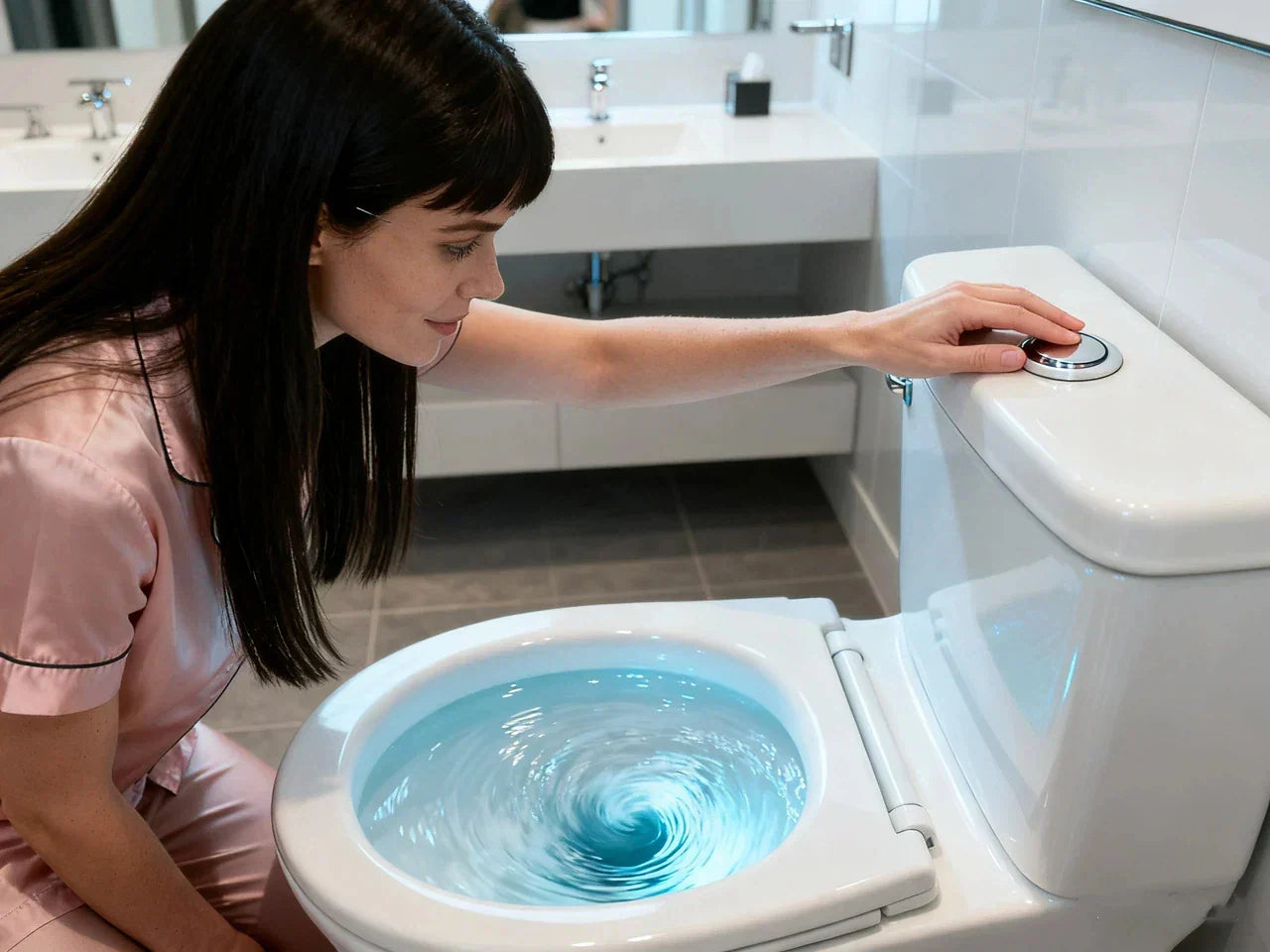
If your toilet flushes twice, you’re watching water and money go down the drain. A “toilet flushes twice” event almost always traces back to two culprits: too much water in the tank or a lightweight or worn flapper that won’t seal fast enough. The good news is that you can fix most cases in under 10 minutes for less than $15. This guide gives you a fast answer, a simple diagnostic path, clear DIY steps, and real savings math. You’ll see how the fill valve, float, and flapper interact, how to stop a double flush for good, when to call a pro, and how much you can save. Start with the quick fixes, then use the flowchart and deep-dive tips if needed.
Why does my toilet flush twice? Fast answer, top causes, quick fixes
Sometimes your toilet seems to have a mind of its own, flushing twice with just one push of the handle. Before you panic, know that this “double flush” behavior usually points to a couple of common issues inside the tank. Understanding why a toilet flushes twice helps you see how a toilet work internally, which can save you time, money, and unnecessary frustration. Here are the main reasons why your toilet might flush twice in a row.
The two most common causes (data-backed)
When a toilet flushes twice in a single handle press, the problem almost always lives inside the tank. The first and most common cause is an overfilled tank. If the fill valve is set too high, the water level rises above the mark, and the toilet bowl receives more than it needs. That extra surge can trigger a second siphon, so the bowl drains again. You’ll see the bowl refill twice, even though you pulled the handle only once. Lowering the float ensures there is just enough water in the tank for a proper single flush.
The second cause is a flapper valve that’s too light, worn, or warped. If you’re wondering how do you fix a toilet flapper, replacing it with the correct size usually restores normal flow and stops your toilet from flushing twice. If it stays open too long or won’t seal quickly, your toilet may pour amount of water, causing a second flush. The extra flow can make the bowl siphon a second time. If the flapper is spongy, curled, or leaves black residue on your fingers, it’s due. Swap it for the correct size, and your flush will return to a single, clean cycle.
In short, the “double flush” behavior links to either too much water or a seal that won’t close fast enough. Fix those and your toilet flushes correctly again.

5-minute fixes that solve most cases
Use these quick steps before anything else. They solve a large share of “toilet flushes twice” complaints.
-
Turn the water supply valve under the tank to ON. Lift the lid and look inside.
-
Lower the water level. Adjust the float on the fill valve so the water stops at the line stamped on the tank, or about 1 inch below the top of the overflow tube.
-
Replace the flapper if it’s worn or too light. Match the size (2-inch or 3-inch). If your model allows, use a slightly heavier flapper design.
-
Set the chain slack to about 1–2 links so the flapper is adjusted correctly. Too tight and the flapper stays up; too loose and the flapper may not lift cleanly.
-
Test one flush. Flush the toilet and watch how the flapper lifts, drops, and seals within a second or two. You should get a single flush without a second surge or gurgle.
If your toilet isn’t flushing correctly even after these steps, further adjustments may be needed.
What you’ll need (and what it costs)
-
Tools: Small screwdriver and pliers (many fill valves adjust by hand).
-
Parts: New flapper (most under $8–$15). If your fill valve is faulty, a replacement unit is often $12–$25.
-
Time: 5–10 minutes for basic adjustments; 10–20 minutes for a flapper swap.
-
Difficulty: Easy DIY.
Toilet flushes twice? Diagnose it in minutes
You don’t need to guess. Follow this simple, if-this-then-that guide and fix only what needs fixing.
Symptom chooser (what matches your toilet’s behavior?)
Start by noting what you see:
-
Does your toilet flush twice every time or only sometimes?
-
Does the flapper visibly linger open or bounce before sealing?
-
Is the tank’s waterline above the stamped mark?
-
Does the bowl refill twice, or does it seem to “whoosh” two times?
Inputs that accelerate diagnosis
Think about your toilet type and history:
-
Type: Traditional flapper, canister, dual-flush buttons, or pressure-assisted.
-
Age: Newer WaterSense models (1.28–1.6 GPF) vs. older 3.5 GPF.
-
Recent part swaps: New flapper, new fill valve, chain changes, retrofits.
Decision rules (if-this-then-that)
-
If the waterline is above the mark, lower the float height. Retest.
-
If the flapper looks spongy, warped, or leaves residue, replace it.
-
If the chain is tight when the handle is at rest, add 1–2 links of slack.
-
If the chain is so loose the flapper doesn’t open fully, remove a link or two.
-
If you have a dual-flush unit and the short-flush button creates a double flush, inspect and replace the small flush seal or shorten the lift duration.
-
If you have a canister valve and it rides up too long, shorten the lift wire or cable per the manufacturer’s directions.
-
If you have a pressure-assisted unit and the flush repeats, check the internal cartridge or air charge; most owners call a pro for these.

The mechanics behind a double flush (how it works)
Understanding why a toilet flushes twice comes down to how its internal parts work together. The flapper, flush valve, fill valve, float, and chain all play a role in controlling water flow and timing. Even small misalignments—like a worn flapper, an overfilled tank, or a poorly adjusted chain—can upset the balance and trigger that extra flush. In the following sections, we’ll break down each component’s role and show how tiny tweaks can stop the double flush for good.
Flapper dynamics and the flush valve seat
The flapper sits on the flush valve seat and seals the tank. When you push the handle, the trip lever lifts the chain and flapper. Water rushes from the tank into the bowl to start a siphon. The flapper then falls back and seals the seat so the tank can refill. That seal is key. It limits how long water flows and how much water leaves the tank.
If the flapper is too light or worn, it stays up longer than it should. Water keeps pouring from the tank into the bowl. The bowl gets extra volume and can form a second siphon. That’s your “double” action. A warped or dirty valve seat can have the same effect, because a poor seal lets water sneak past when the flapper is trying to close.
To put it simply: the flapper controls flush length. A solid seal ends the siphon. A weak seal can trigger a second siphon.
Fill valve, float, and overflow tube roles
The fill valve controls how high the tank refills. The float tells the valve when to stop. If it’s set too high, you get excess water. That extra water has to go somewhere, and it dumps into the bowl through the overflow tube, or it surges on the next flush, pushing the bowl past what it needs. Either way, you can get a second flush effect. The fix is easy: lower the float so the water stops at the line stamped inside the tank or about an inch below the overflow rim.
Chain and handle geometry
The chain must allow the flapper to open fully and then drop cleanly. If the chain is tight when the handle is at rest, the flapper sits slightly open and won’t seal, so water keeps moving and can trigger a double flush. If the chain is too loose, the flapper lifts weakly, wobbles, or lands crooked. That also hurts the seal. A small tweak—about 1–2 links of slack—lets the flapper lift, drop, and seal on center every time.
DIY dual flush toilet repairs step-by-step (tools, time, cost, testing)
Fixing a dual-flush toilet that keeps double-flushing doesn’t have to be intimidating. With just a few basic tools, some patience, and the right parts, you can tackle most issues yourself. Here’s how you can fix a toilet that flushes twice using simple tools and small adjustments.
Adjust the fill valve/float arm (lower water level)
-
Turn off water at the supply valve, then flush to lower the tank water. Turn water back on so you can watch where it stops.
-
Find the adjustment. Some fill valves have a screw at the top, others use a sliding clip on the float. Turn the screw or slide the clip to lower the float.
-
Aim for the tank’s stamped waterline. If there’s no mark, set water to about 1 inch below the overflow tube’s top rim.
-
Flush and watch the refill. The water should stop at your new level. If it still climbs, the fill valve may be worn and worth replacing.
Tip: A slow twist on the screw or a single notch on the clip can change a lot. Make small changes and test.
Replace the flapper (size, material, compatibility)
-
Turn off the water. Flush to empty the tank. Sponge out any remaining water around the flapper area.
-
Remove the old flapper by unhooking the ears from the overflow tube or sliding it off the pegs. Unclip the chain from the handle arm.
-
Match the size. Most toilets use 2-inch or 3-inch flappers. Measure the opening or bring the old part to the store for comparison.
-
Install the new flapper. Attach it to the overflow tube pegs or ears, then clip the chain to the handle arm hole that gives you 1–2 links of slack when the handle is at rest.
-
Turn on water and test. The flapper should lift cleanly, fall within a second or two, and seal with no drips.
Choose a flapper suited to your tank’s design. Many universal flappers fit common flush valves. For hard water, a higher-quality material can resist mineral damage longer.

Chain and seat tune-up
-
Center the flapper so it lands squarely on the flush valve seat. If it catches on the chain, move the clip to a different hole in the handle arm so it drops straight down.
-
Check the flush valve seat. If you see grit or mineral buildup, clean it with a non-scratch pad. A smooth seat is key to a tight seal.
-
Confirm chain slack. One or two links of slack at rest is the sweet spot. That prevents the flapper from staying open or re-lifting.
Test, verify, and fine-tune
-
Do a dye test. Add a few drops of food coloring into the tank. Wait 10 minutes without flushing. If any color shows up in the bowl, the flapper isn’t sealing; adjust chain or replace the flapper.
-
Flush once and watch. You want one strong siphon and a clean stop. No second surge. If needed, adjust the float by 1–2 mm and test again.
-
Repeat one more time later in the day. Toilets can behave differently after several cycles, so verify a single flush under normal use.
Water waste, bills, and a savings calculator
A toilet that flushes twice isn’t just annoying—it’s wasting water and money every day. Understanding how much water is lost and how it affects your bills makes the benefits of a quick fix obvious. In the sections below, we’ll break down the stats, show real-life impacts, and even give you a simple savings calculator so you can see exactly how much money and water you could save by stopping that extra flush.
How much water is at stake (stats you can use)
Modern toilets use about 1.28–1.6 gallons per flush (GPF). Older units use up to 3.5 GPF. A toilet that flushes twice uses twice that per use, which adds up fast across a family and a month of bathroom trips. Fixing a double flush usually cuts your water bills, sometimes by a clear margin in the next cycle. Even small float adjustments can reduce water use by more than 20% in a home where the toilet drives a large share of daily water.

Table: Typical water use per flush
| Toilet Type | Typical Water Use per Flush (GPF) |
| Modern toilets | 1.28–1.6 |
| Older toilets | Up to 3.5 |
| Toilet double flushes | About 2.6–7+ |
Case studies and community reports
Owners often report that lowering the water level by a few millimeters stops a double flush instantly. Others share that a new toilet flapper solves the problem on the first try. Plumbers also report that a double-flushing toilet can waste hundreds of gallons each month if it goes unfixed, especially in larger households. Many see immediate drops in measured usage on the next water bill after these repairs.
Savings estimator (simple tool you can use)
Use this quick math:
-
Before fix: GPF × flushes per day × people × 30 days
-
After fix: Reduce the GPF back to the true rating (for example, 1.6 instead of 3.2 if it was flushing twice)
Example:
-
4 people × 5 flushes/day × 1.6 GPF × 30 days = 960 gallons/month (single flush)
-
If it double flushes: 1.6 × 2 = 3.2 GPF → 1,920 gallons/month
-
Fix saves: ~960 gallons/month
Check your local rate (for example, $0.01–$0.02 per gallon in some areas when sewer and fees are included) and multiply. Even at $0.01, that’s about $9.60 per month saved, or over $100 per year—just for this one fix. Fixing a double flush also prevents excessive strain on the sewer line and the main sewer line, reducing long-term plumbing issues.
Special cases and advanced troubleshooting
Some toilets are a bit trickier than others. Dual-flush, canister-style, pressure-assisted, or older high-flow models each have their own quirks that can trigger double flushes. Add in retrofitted parts, mineral buildup, or hard water, and the problem can become more persistent. In the sections below, we’ll walk through these special cases and advanced troubleshooting tips so you can tackle even the most stubborn double-flush scenarios.
Dual-flush and canister valves
Dual-flush toilets, which often have two buttons or a split handle, are designed to save water. Industry standards from ICC and IAPMO outline how these valves should perform, but in practice, a worn small-flush seal or a lift cable that holds the valve too long can still trigger a double flush. If the short flush becomes a double flush, inspect the small-flush seal and the lift mechanism. Replace the seal and shorten the lift time as your model allows. Dual-flush units are usually easy to repair, but parts must match the design.
Canister-style valves lift the whole seal straight up. If the canister rides too high or too long, excessive water drains. Shorten the lift wire or cable so the canister drops sooner and seals faster. Replace the round gasket if it’s worn.
Pressure-assisted and older 3.5 GPF models
Pressure-assisted units behave differently. If they seem to flush twice, the issue is often a control cartridge or internal air charge problem rather than a float or flapper. These do not have a classic flapper. Many owners call a professional plumber for these because parts and adjustments are specific. For very old 3.5 GPF models, it may be time to consider a high-efficiency replacement if you face repeated issues and high water costs.
Retrofit pitfalls and compatibility checks
Aftermarket kits can work, but a mismatch can hold the valve open too long or prevent a clean seal. If your toilet isn’t responding to normal adjustments, inspect how the retrofit sits in the tank. Make sure the flapper aligns with the seat and the chain pulls straight. If the overflow height changed, reset it to code and manufacturer guidance.
Mineral buildup and hard water issues
Hard water can leave limescale on the flush valve seat and around the flapper hinge. This rough surface prevents a tight seal and mimics a weak flapper. Descale with a non-scratch pad and a gentle cleaner. Avoid bleach tablets in the tank. They degrade rubber parts and lead to early flapper failure, which can bring the double flush problem back.
Preventive maintenance and long-term reliability
Preventing double flushes is often easier than fixing them after the fact. A little regular maintenance—checking water levels, inspecting flappers, and keeping parts clean—goes a long way toward saving water and avoiding costly repairs. In the following section, we’ll cover a simple schedule, long-lasting parts, and pro habits that keep your toilet running smoothly for years.
A simple schedule that prevents double flushing
Checks do not take long and can save water and hassle.
-
Every 3 months: Check the tank waterline against the mark. Press the handle and make sure the chain has 1–2 links slack when at rest. Confirm a single, strong flush.
-
Yearly: Inspect or replace the flapper, especially in hard-water areas. Look for warping or residue left on your fingers.
-
As needed: If you notice ghost flushing (toilet spontaneously flushes without a handle press), do a dye test and replace seals.
Parts and products that last
A heavier flapper design can help close faster and seal better in some tanks. Choose corrosion-resistant materials if you have hard water. Universal flappers are helpful, but the best fit is one that matches your flush valve size and shape. A new toilet fill valve is a smart upgrade if your current one sticks or fails to hold a setting.
Pro habits for a smoother flush
Route the thin refill tube back into the overflow opening, not down the overflow. That prevents siphoning. Keep the handle nut snug so the handle returns to rest and doesn’t hold the chain tight. Skip bleach blocks in the tank; use bowl cleaners that don’t sit in the tank water. These small habits extend seal life and keep your toilet ready for the next flush.
When to call a plumber vs DIY (costs, risks, upgrade path)
Not every toilet problem can—or should—be fixed with DIY tweaks. Some issues require a professional to plumb in the correct parts, especially if the tank or flush valve is damaged. Sometimes the damage or wear is beyond simple adjustments, and calling a plumber saves time, prevents water waste, and avoids costly mistakes. In the sections below, we’ll outline the red flags that signal professional help, compare typical DIY vs. pro costs, and explore when it makes sense to repair, upgrade, or replace your toilet entirely.

Red flags you shouldn’t ignore
If you see a cracked flush valve seat, a distorted or wobbly tank, persistent leaks into the bowl after flapper and float adjustments, or a pressure-assisted system that repeats the flush cycle, call a pro. Also consider help if you see a loose overflow tube or signs of tank sweating and corrosion that keep moving parts from sealing.
Cost ranges and timelines
DIY parts often cost less than $30 and fix the most common double-flush issues. A professional plumber may charge a standard service call plus parts. For a flush valve replacement (not just the flapper), expect a higher cost because it often requires tank removal. If a toilet is very old and uses a lot of water, replacing the entire toilet with a high-efficiency model can pay off within a few years through lower bills.
Table: Typical cost and time (ranges vary by region)
| Task / Service | Typical Cost (USD) | Typical Time Required |
| DIY flapper | $8–$15 | 10–20 minutes |
| DIY fill valve | $12–$25 | 20–30 minutes |
| Pro flapper/adjustment visit | Often part of a minimum service call | Varies |
| Pro flush valve replacement (tank off) | $150–$300+ (parts & labor) | Varies by access & region |
| Full toilet replacement by a pro | $250–$600+ (labor) + toilet cost | Varies |
Repair vs replace decision matrix
-
Age: If your toilet is older than 20–25 years and uses 3.5 GPF, replacement may save more water and money long-term.
-
Efficiency: If you keep fighting double flushes and can’t get a consistent single flush, consider upgrading to a WaterSense model.
-
Recurrence: If the problem returns every few months even after part swaps, look for a deeper mismatch or distorted seat. A pro can inspect, or you may choose a new unit.
-
Water rates: Higher local rates speed the payback on a new toilet.
FAQs
1. How to tell if the flapper or flush valve is bad?
The easiest way to start is just by lifting the tank lid and taking a good look inside. Check the flapper closely—if it feels spongy, looks warped, has cracks, or even leaves black residue on your fingers, it’s time to replace it. You can also do a simple dye test: drop a few drops of food coloring into the tank, wait about 15–20 minutes without flushing, and see if colored water leaks into the bowl. If it does, the flapper isn’t sealing properly. Sometimes, even a brand-new flapper might leak, and in that case, the flush valve seat itself could be warped or cracked. Unfortunately, a damaged seat usually means you’ll need a full flush valve replacement, not just a flapper swap.
2. How do you fix a toilet that flushes twice?
A toilet that keeps flushing twice is usually a water-level or flapper issue. First, check the water level in the tank—make sure it’s right at the fill mark. Then, make sure the chain connecting the handle to the flapper isn’t too tight; leave about 1–2 links of slack so the flapper can drop fully. If the flapper is worn or old, swap it for the right size. While you’re at it, clean the valve seat; buildup there can stop the flapper from sealing properly. After that, test it with a flush or two—you want a single, clean flush. If it’s a dual-flush toilet, you may also need to renew the small-flush seal and adjust how long the flapper or canister stays lifted. For canister-type valves, just shorten the lift cable or wire slightly so the canister drops sooner, and that usually fixes the double flush.
3. How much does a plumber charge to change a flush valve?
Costs can vary a lot depending on where you live, how easy it is to get to the toilet, and the type of hardware you’re using. Typically, if a plumber comes out just to replace a flush valve (where you take the tank off), you’re looking at somewhere around $150–$300, which usually includes both parts and labor. Keep in mind, if the toilet has several worn components or if bolts are seized and hard to remove, the job can take longer and cost more. It’s always good to get a quick quote before scheduling the service.
4. What is the common problem with dual flush toilets?
Dual-flush toilets are great for saving water, but they have a few quirks. The most common issue is the small-flush seal wearing out first. If that seal goes, too much water escapes during the small flush, sometimes causing what feels like a double flush. Another problem is the lift mechanism holding the valve open too long. Usually, just replacing the small seal and adjusting the lift duration is enough to get your dual-flush working properly again.
5. Are dual flush toilets easy to repair?
Yes! Most of the time, they’re pretty straightforward to fix. The steps are a little different from a basic flapper toilet, but you’re generally still just renewing seals, adjusting lift time, and making sure the valve drops quickly and seals tightly. You don’t usually need specialized tools—just some patience and careful observation.
6. How do you fix a double flush toilet?
Start with the basics: make sure the waterline is set correctly, check the chain slack, replace a worn flapper, clean the valve seat, and test a few flushes. Most double-flush issues get solved right there. If you have a more specialized valve type, you might need to tweak the lift time or replace its seal. The key is taking it step by step and observing how the flapper or canister behaves during each flush. Once everything drops cleanly and seals, your double-flush problem is usually gone.
References


Leave a comment
This site is protected by hCaptcha and the hCaptcha Privacy Policy and Terms of Service apply.