
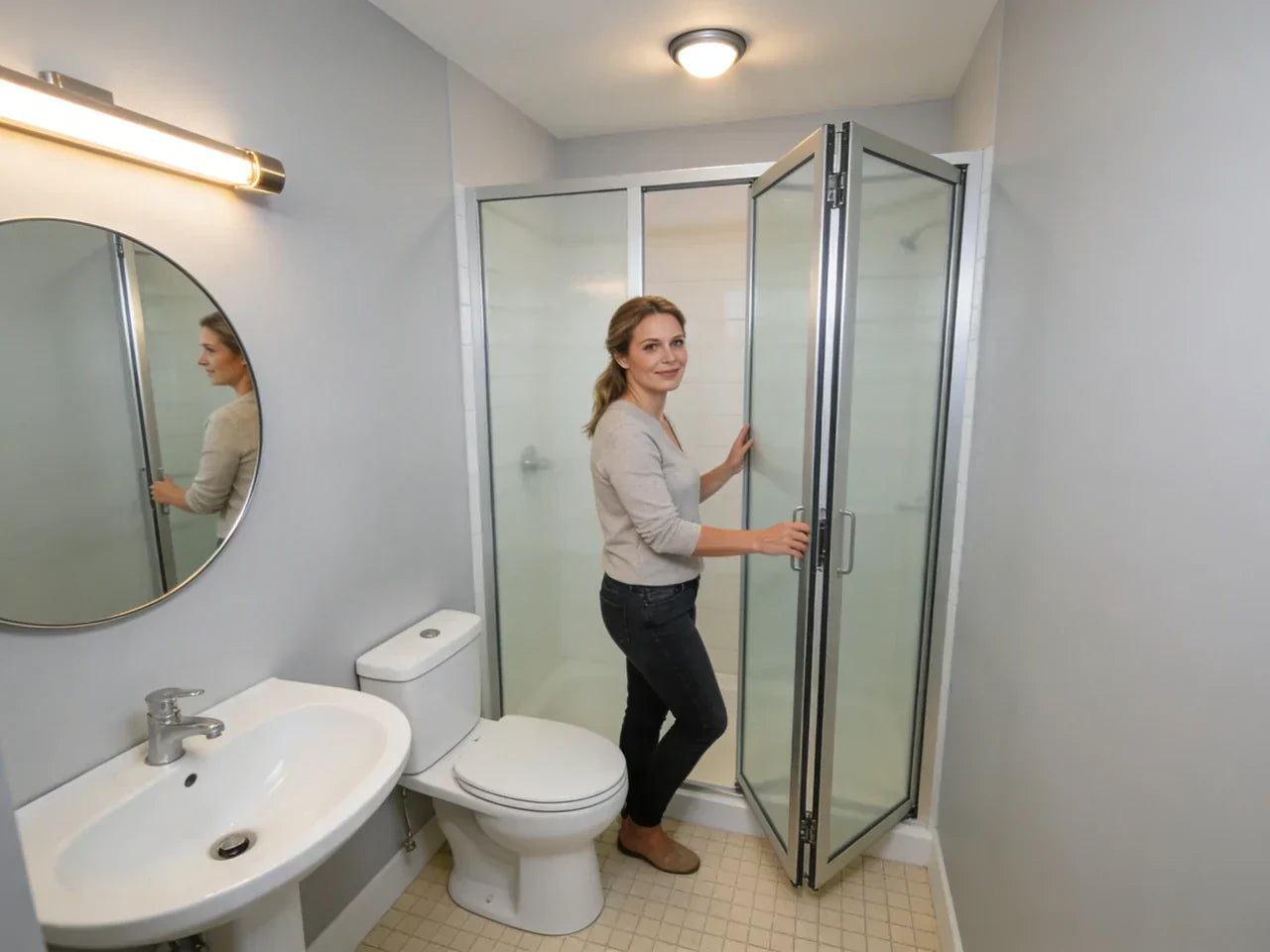
A folding shower door, also called a bifold shower door or bi-fold shower door, uses two or more connected panels that fold together as the opening is cleared. Unlike a full-width hinged door, the moving glass does not need the same large swing area. Unlike a typical sliding system, the panels fold rather than overlapping across the full enclosure opening.
This guide focuses specifically on how folding shower doors work, the differences between bifold and multi-panel configurations, what to measure, what components to check, installation preparation, cleaning, troubleshooting, and buying considerations. If you are deciding among sliding, hinged, folding, and partial glass panels for a compact bathroom, use our separate small-bathroom shower door guide for the broader decision.
Folding Shower Door Basics
What Is a Folding Shower Door?
A folding shower door is made from connected panels joined by hinges or folding joints. As the door opens, the panels fold toward one another instead of moving as one large swinging panel.
Depending on the design, the panels may fold inward, outward, or use another movement pattern. The exact operating direction should always be confirmed in the product specifications because it affects nearby fixtures, usable entry space, and how the door is installed.
Why Choose a Folding Mechanism?
- Reduced swing area: Folding panels generally use less open floor area than a full-width swinging door.
- Flexible entry: The panels stack or fold together rather than remaining spread across the full opening.
- Useful in constrained layouts: Folding systems can work where a toilet, vanity, wall, or other fixture limits the movement of a conventional hinged door.
- Multiple configurations: Folding doors can be used in alcove, corner, walk-in, and some tub/shower layouts depending on the exact product.
What Are the Main Tradeoffs?
- More hinges and joints: Additional moving connections create more areas to inspect and clean.
- Seals matter: Folding panel edges and moving joints need compatible seals to help manage water.
- Alignment matters: Poorly aligned panels can bind, drag, or fail to close correctly.
- Opening varies by design: Do not assume every bifold door creates the same usable entry.
If your question is whether folding is better than sliding or hinged for the entire bathroom, compare the complete room layout rather than deciding from the door name alone.
Types and Configurations of Bifold Shower Doors
Bi-Fold Shower Doors
A bi-fold shower door typically uses two connected moving sections that fold together. One side may attach to a wall, frame, or fixed glass panel depending on the enclosure design.
Tri-Fold Shower Doors
A tri-fold configuration uses additional connected sections so the door can collapse into a smaller stack. This changes both the folding movement and the amount of hardware used in the opening.
Multi-Panel or Accordion-Style Folding Doors
Multi-panel folding doors use several narrow connected sections. The exact construction varies considerably, so compare the panel material, hinges, guides, seals, and operating direction of the specific product rather than treating every accordion-style door as the same system.
| Configuration | How It Opens | What to Check |
|---|---|---|
| Bi-Fold | Two connected sections fold together. | Folding direction, hinge position, usable entry, seals, and wall attachment. |
| Tri-Fold | Multiple connected sections fold into a more compact stack. | Panel stack depth, number of joints, guides, usable opening, and cleaning access. |
| Multi-Panel / Accordion | Several narrow sections collapse together across the opening. | Panel material, track or guide system, seals, hardware quality, and complete operating path. |
Framed, Semi-Frameless and Frameless Folding Doors
Frame style is separate from the folding mechanism. A bifold shower door may use more visible framing, limited framing, or minimal perimeter framing depending on the product.
- Framed: Metal surrounds more of the glass or panel edges and becomes a visible part of the enclosure.
- Semi-frameless: Framing is used in selected areas while other glass edges remain more exposed.
- Frameless: The enclosure minimizes visible perimeter framing and relies more on the glass and mounting hardware.
The right frame style depends on the exact opening, adjustment requirements, desired appearance, hardware configuration, and installation instructions.
Key Folding Shower Door Components
Understanding the components makes it easier to compare products and diagnose problems later.
- Panels: The folding sections that form the moving enclosure.
- Hinges or folding joints: Connect the moving panels and create the folding action.
- Wall channels or mounting profiles: Connect the enclosure to the finished wall and may provide adjustment depending on the design.
- Rollers or guides: Some systems use upper or lower guides to control panel movement.
- Tracks or thresholds: Certain folding doors use a bottom or upper track, while others use a smaller guide system.
- Seals and gaskets: Help manage water at panel edges, joints, and the bottom of the enclosure.
- Handles and latches: Provide a grip and help keep the door in its closed position where applicable.
Smooth folding depends on the panels, hinges, guides, and mounting components being aligned according to the product design. Water control depends on the seals, surrounding shower surfaces, panel alignment, drainage, and spray direction working together.

How Folding Shower Doors Differ from Sliding and Hinged Doors
Folding, sliding, and hinged doors use different movement patterns. This page focuses on the folding mechanism, so the comparison below is intentionally limited to the technical differences that affect a bifold installation.
| Mechanism | Panel Movement | Key Technical Difference |
|---|---|---|
| Folding / Bifold | Connected panels fold together. | Uses multiple hinges or folding joints and requires space for the folded panel stack. |
| Sliding | Panels move horizontally along the opening. | Uses overlapping panels plus rails, tracks, rollers, or guides depending on the system. |
| Hinged | One moving panel swings through an arc. | Requires a clear swing path outside or around the shower according to the product design. |
For a dedicated two-door comparison, see our hinged shower door vs. sliding door guide.
For a broader small-bathroom decision involving folding, sliding, hinged, and partial glass-panel layouts, use our small-bathroom shower door guide.
Measuring for a Folding Shower Door
Measure the Finished Opening
Measure only after the shower opening and surrounding surfaces are finished. Tile, wall panels, and other finishes can change the dimensions available for the door.
- Measure width at several points: Record the opening near the top, middle, and bottom rather than assuming the walls are parallel.
- Measure the finished height: Compare the finished opening with the height requirements for the exact door.
- Check wall plumb: Note whether either side leans inward or outward.
- Check the tray, tub edge, or threshold: Confirm the finished surface is suitable for the mounting or guide system specified by the manufacturer.
- Record nearby fixtures: Note toilets, vanities, towel bars, shelving, handles, and other items close to the folding path.
Do not choose a product simply because its nominal width looks close to your opening. Check the exact adjustment range and installation tolerances in the product specifications.
For a more detailed measuring process, see our shower door size and measurement guide.
Check the Folding Path
A bifold door uses less swing space than a full-width hinged panel, but the folded sections still need somewhere to move and stack. Confirm:
- Which direction the door folds.
- Whether the folded panels remain inside, outside, or partly within the shower area.
- Whether the panel stack interferes with handles, fixtures, walls, or shower controls.
- How much usable entry remains when the door is fully open.
Where Folding Shower Doors Can Be Used
Folding doors can appear in several enclosure layouts. Suitability depends on the exact product rather than the room label alone.
Narrow Alcove Showers
A bifold configuration can be useful where the shower sits between finished walls and there is limited room for a full swinging panel outside the enclosure.
Corner Enclosures
Some corner shower systems use folding sections as part of a multi-panel enclosure. The door geometry must match the finished shower base or enclosure design.
Walk-In Showers
A folding section can be combined with fixed glass panels to create a larger enclosure while keeping the moving portion compact when opened.
Tub/Shower Combinations
Some folding screens and door systems are designed for bathtub installations. Confirm that the product is specifically compatible with the finished tub edge and surrounding walls before ordering.
Entry and Long-Term Usability
If entry space or long-term usability matters, compare the actual clear opening for the exact folding door rather than assuming that every bifold design creates a wide entrance.
Also consider the threshold, handle position, folding force, panel movement, and surrounding bathroom space. If the shower must meet a specific accessibility requirement, verify the complete bathroom and enclosure requirements with the appropriate project professional rather than relying on the door type alone.
Glass, Frame and Style Options
Glass Appearance
- Clear glass: Keeps the enclosure visually open and makes tile and fixtures more visible.
- Frosted glass: Provides more visual privacy while allowing light through.
- Textured or patterned glass: Adds privacy and visual detail while changing how water spots and residue appear.
Glass thickness, safety requirements, and material specifications vary by product. Use the manufacturer's documentation for the exact door rather than applying a generic thickness rule to every bifold system.
Frame and Hardware Finishes
The frame and folding hardware are exposed to water, cleaning products, and bathroom humidity. Compare the specified materials and care instructions for the exact enclosure.
Common visual directions include chrome-like finishes, brushed metals, dark hardware, light-colored frames, and warmer metal tones. Coordinating the shower door hardware with faucets, towel bars, mirrors, or lighting can help the enclosure feel integrated with the room.
Matching a Folding Door to the Bathroom Style
A semi-frameless or frameless folding enclosure can support a lighter contemporary appearance, while more visible framing can become part of a traditional or industrial design. Choose the frame and glass style after confirming that the mechanism and dimensions fit the shower.

Installation Essentials for a Bifold Shower Door
Check the Shower Before Installation
The door should be installed only on finished surfaces that match the product requirements.
- Check the tray, tub edge, or threshold: Confirm the mounting surface is suitable for the specified guide, track, or seal.
- Check the walls: Make sure the finished wall surfaces are stable and suitable for the required mounting hardware.
- Check plumb and level: Significant variation can affect panel alignment and sealing.
- Check waterproofing and surrounding construction: Door installation does not replace correct shower waterproofing.
- Read the exact installation manual: Folding systems use different hardware arrangements, so generic instructions should not replace the product manual.
Typical Installation Sequence
The exact steps vary by model, but many folding shower doors follow a general sequence like this:
- Confirm the opening. Recheck the finished dimensions, wall condition, and folding direction before drilling.
- Position the mounting profiles. Mark the wall-channel or bracket locations according to the product instructions.
- Install tracks or guides where required. Some folding systems use a more substantial track, while others use smaller guides.
- Assemble or position the panels. Protect the glass or panel surfaces while installing hinges, rollers, or other moving hardware.
- Align the folding sections. The door should move without binding, excessive wobble, or panel contact where it is not intended.
- Install seals and finishing components. Follow the product instructions for sweeps, gaskets, magnetic strips, and sealant locations.
- Test the complete movement. Open and close the door through its full intended path before regular use.
Common Installation Problems
- Incorrect sizing: A door outside the intended adjustment range may not align or seal correctly.
- Out-of-plumb walls: Can create uneven gaps or make folding panels difficult to align.
- Improper track or guide position: Can make the door drag, wobble, or fold unevenly.
- Overtightened hardware: Can distort components or damage surrounding materials.
- Incorrect sealant placement: Can interfere with intended drainage or leave gaps where water escapes.
DIY or Professional Installation?
Some framed or semi-frameless systems may be suitable for experienced DIY installation when the opening is straightforward and the product instructions support it. Larger glass panels, complex multi-panel configurations, significantly uneven walls, difficult mounting conditions, or uncertainty about waterproofing can make professional installation the safer choice.
Cleaning and Maintenance
Routine Cleaning
Folding doors have more moving joints than a fixed panel, so regular cleaning around hinges, seals, guides, and tracks where present helps keep the mechanism operating smoothly.
- Remove water from the glass or panels regularly with a suitable squeegee or soft cloth.
- Clean folding joints, hinges, guides, and seals before residue becomes difficult to remove.
- Use products that are compatible with the specific glass, coating, frame, and hardware finish.
- Avoid abrasive tools that can scratch glass, plastic panels, metal finishes, or protective coatings.
Inspect Hinges, Guides and Seals
Periodically inspect moving hardware for looseness, residue, corrosion, wear, or misalignment. If the product allows adjustment or lubrication, follow the manufacturer's procedure and use only compatible products.
Seals can wear, harden, deform, or pull away over time. If water begins escaping at an edge that previously stayed dry, inspect the seal condition and panel alignment before assuming the entire door needs replacement.
Folding Shower Door Troubleshooting
Why Is My Folding Shower Door Leaking?
A folding shower door does not automatically leak because of its mechanism. Water escaping from the enclosure can result from several conditions:
- Worn, damaged, or incorrectly positioned seals.
- Panel misalignment.
- Gaps around the enclosure edges.
- Incorrect sealant placement.
- Threshold, tray, or surrounding construction issues.
- Shower spray directed toward vulnerable joints or the open side of the enclosure.
Dry the exterior, identify where the water first appears, and inspect that area before replacing hardware or adding sealant.
Why Is the Door Hard to Fold?
- Check hinges and folding joints for residue or looseness.
- Inspect guides or tracks for debris.
- Check whether panels are rubbing because of misalignment.
- Confirm that adjustable hardware has not shifted.
- Stop using the door if glass or structural hardware appears damaged.
Why Does the Door Wobble?
Wobble can come from loose hardware, worn guides, incorrect adjustment, or mounting problems. Compare the current door position with the installation instructions before tightening or repositioning components.

What Affects Folding Shower Door Cost?
Folding shower door prices vary by materials, configuration, glass, framing, hardware, dimensions, customization, and installation conditions. Rather than relying on a generic price range, compare the total requirements of the specific door.
| Cost Factor | Why It Matters |
|---|---|
| Number of panels | Additional folding sections can require more hinges, seals, and hardware. |
| Frame style | Framed, semi-frameless, and frameless systems use different structural and hardware arrangements. |
| Glass or panel material | Material, finish, coating, and customization can affect the product cost. |
| Hardware | Hinges, guides, handles, tracks, seals, and specialty mechanisms vary by design. |
| Custom sizing | Unusual openings may require a different product or made-to-measure fabrication. |
| Installation conditions | Uneven walls, difficult surfaces, or complex multi-panel layouts can increase installation work. |
Folding Shower Door Buying Checklist
Before ordering a bifold or bi-fold shower door, confirm the following:
- The finished opening width and height have been measured at multiple points.
- The walls, tray, tub edge, or threshold have been checked for installation conditions.
- The product adjustment range matches the finished opening.
- You know whether the panels fold inward, outward, or in another direction.
- The folded panel stack does not interfere with nearby fixtures or shower controls.
- The actual usable opening is suitable for the people using the shower.
- The frame style and glass appearance fit the bathroom design.
- Tracks, guides, hinges, and seals will remain accessible for cleaning and maintenance.
- The installation requirements are compatible with the finished walls and shower base.
- You have reviewed the exact product documentation before ordering.
Folding Shower Door Glossary
- Bi-Fold / Bifold Door: A door made from connected panels that fold together as the opening is cleared.
- Folding Joint: The hinge or connecting point that allows adjacent panels to fold.
- Wall Channel: A mounting profile that connects part of the enclosure to the finished wall.
- Guide: Hardware that controls panel movement and helps keep the door aligned.
- Threshold: The lower edge or raised element at the shower entrance, which may also support part of the door system.
- Seal: A flexible component used along panel edges or the bottom of the enclosure to help manage water.
- Adjustment Range: The dimensional range within which the door can be fitted according to its specifications.
Conclusion
A folding shower door is defined by its connected panels and compact folding movement. Its main technical advantages are reduced swing area and the ability to collapse the moving sections into a smaller stack. The tradeoff is additional hinges, joints, seals, and guides that need correct alignment and routine care.
Before buying, measure the finished opening, confirm the folding direction and usable entry, check the exact adjustment range, review the installation requirements, and make sure the moving panels will not interfere with the rest of the bathroom.
Folding Shower Door FAQs
1. What are the disadvantages of bifold shower doors?
Bifold shower doors use more hinges, joints, and seals than a single fixed panel. Those components create additional cleaning and adjustment points. A poorly sized or misaligned door can also become difficult to fold or seal correctly.
2. Do bifold shower doors work?
Yes. A correctly sized and installed bifold shower door can provide a compact folding opening without requiring the same swing area as a full-width hinged panel. Performance depends on the product design, alignment, seals, surrounding shower construction, and maintenance.
3. Do bifold shower doors leak?
The folding mechanism itself does not automatically cause leaks. Water can escape because of worn seals, panel misalignment, installation gaps, threshold conditions, drainage problems, or shower spray directed toward vulnerable joints.
4. Are bifold shower doors easy to maintain?
They require routine care around the glass or panels, folding joints, hinges, seals, guides, and tracks where present. The maintenance is manageable when these areas remain accessible and are cleaned before residue builds up.
5. What is the difference between a bifold and sliding shower door?
A bifold shower door uses connected panels that fold together. A sliding shower door moves panels horizontally along the enclosure opening. Folding systems use multiple hinges or joints, while sliding systems use overlapping panels plus rails, rollers, tracks, or guides depending on the product.
6. Is a bifold shower door better than a sliding door?
Neither mechanism is automatically better. The answer depends on the finished opening, usable entry, panel movement, nearby fixtures, cleaning preferences, and exact product configuration. For a broader bathroom-layout decision, compare all suitable door mechanisms rather than ranking bifold and sliding in isolation.
7. Can a folding shower door work in a small bathroom?
Yes, a folding mechanism can work in a compact bathroom because the connected panels collapse together instead of using a full-width swing. The exact fit still depends on the opening, folded panel stack, nearby fixtures, and usable entry.
8. What should I measure before buying a bifold shower door?
Measure the finished width at multiple heights, check the finished height, note whether the walls are plumb, inspect the tray or threshold, identify nearby obstacles, and confirm the adjustment range and folding direction for the exact product.


Leave a comment
This site is protected by hCaptcha and the hCaptcha Privacy Policy and Terms of Service apply.