



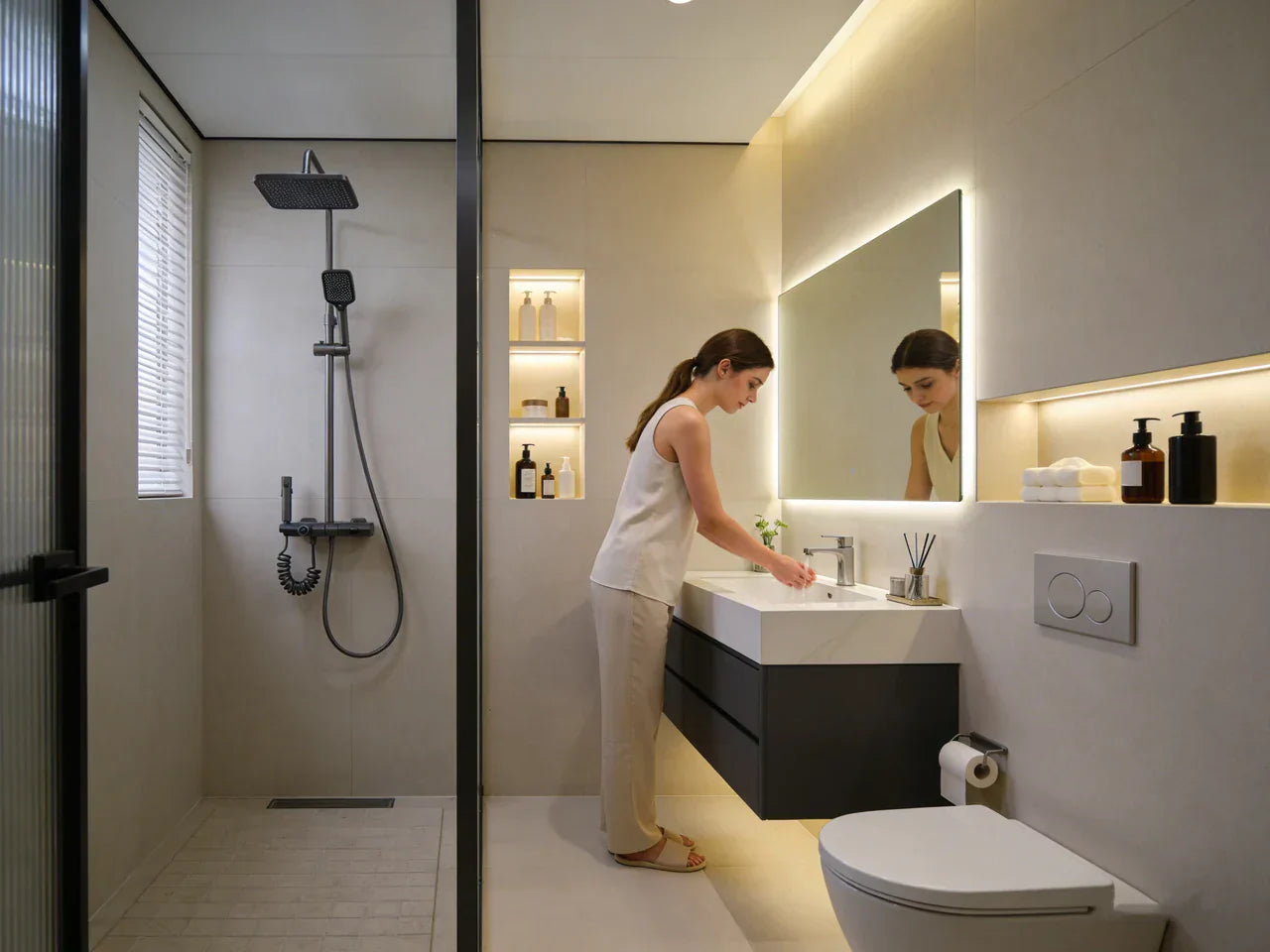
Most small bathroom layouts feel tight because they are tight. A typical small full bath lands around 35–40 square feet, and in a room that size, a few inches can decide whether you move easily or bump into doors, drawers, and elbows every morning. This guide fixes the issues people run into most: poor flow, undersized shower space, wasted corners, and door conflicts. You’ll start with a fast layout-picker matrix, then walk through proven, dimensioned plans for 5x7 and 5x8 bathrooms—plus extra-small options under 36 sq ft. We’ll also cover clearances, comfort targets, 2026 cost ranges, and real-world examples you can copy with confidence.
Quick Answer: Best Small Layout By Room Size
If you want the most efficient plan fast, match your room size to the layout type that protects two things: a clear walking path and a “dry zone” you can stand in without getting splashed. The best layout is usually the one that keeps plumbing on one wall, avoids a door-to-fixture collision, and gives you one open rectangle of floor space when you step in.
Layout-Picker Matrix
| Layout type | Minimum size (typical) | Best for | Big pros | Main trade-offs | Cost tier (2026) |
| 5x7 compact full bath (linear / one-wall run) | 35 sq ft | Apartments, guest baths, tight remodel footprints | Simple plumbing, efficient flow, lowest “layout change” risk | Limited storage, shower size must be planned carefully | $$ |
| 5x8 standard full bath (alcove tub or shower) | 40 sq ft | Families, resale-friendly full baths | Tub option becomes realistic, easier clearances | Tub can dominate the room visually | $$–$$$ |
| Corner shower 6x6 (neo-angle/quadrant) | 36 sq ft | Square rooms, conversions from powder to shower | Frees center floor area, easier to “walk through” | Corner units can limit shelf niches | $$–$$$ |
| Galley (fixtures on two walls) | Varies; best in narrow rooms | En-suites, corridor-like rooms | Clear path down the middle, can feel organized | Needs careful door and vanity depth planning | $$–$$$ |
| Powder room (toilet + sink) | Often 15–25 sq ft | Under-stair, hallway, near living areas | Small footprint, quick upgrade impact | Not a full bath; storage is tight | $–$$ |
| Wet room (fully waterproofed, open shower) | <36 sq ft | Extra small bathroom, barrier-free goals | Makes tiny rooms feel bigger, fewer “hard barriers” | Costs more; waterproofing must be perfect | $$$–$$$$ |
Most Common Dimensions And What Fits
Most homeowners searching for small bathroom measurements land in one of these two buckets. A 35 sq ft (5x7) plan usually works best with the toilet, vanity, and shower aligned on one wall, because it keeps the center open. A 40 sq ft (5x8) plan often allows an alcove tub, which is why many people think of it as a “mini standard” full bath.
For showers, many local codes allow a minimum around 30x30 inches, but that can feel tight in real life. If you want a more comfortable space, aim for 36x36 inches, especially if you prefer turning without brushing the wall or curtain.This is why knowing the minimum size for bathroom with shower is critical when planning small layouts.
Small Bathroom Layout Mistakes To Avoid
The fastest way to ruin a good plan is to ignore moving parts. Door swings are the classic problem: a door that opens into the room can collide with a vanity corner or toilet knee space. If your local rules allow it, a pocket door or an outswing door can remove that conflict in one move.
The next mistake is choosing a vanity that is too deep. People focus on width (“Will a 30-inch vanity fit?”) and forget depth. In small bathrooms, pairing a shallower vanity with a compact undermount sink can help reduce visual clutter at the counter edge and make cleaning easier—both of which matter when space is tight. An extra-deep cabinet can steal the walkway, make drawers unusable, and make the room feel cramped even if the math says it “fits.” People focus on width (“Will a 30-inch vanity fit?”) and forget depth. An extra-deep cabinet can steal the walkway, make drawers unusable, and make the room feel cramped even if the math says it “fits.”
The third mistake is skipping “dry zone vs wet zone” planning. If your towel storage, toilet paper, and outlets sit in the splash zone, the room will never feel calm. A good bathroom layout protects one end of the room as dry, even in a small full bath.
Most Efficient Small Bathroom Layout
The most efficient small bathroom layout is usually a linear plan that keeps fixtures on one wall (or two adjacent walls) so the center stays open. That open center is what makes the room feel usable, even when the square footage is fixed.
Common Small Bathroom Layouts With Dimensions

When people ask, “What is the minimum size for a small bathroom?” they’re often mixing up two things: a powder room (toilet + sink) and a full bath (toilet + sink + shower or tub). A minimum powder room size can be very small if you choose compact fixtures, but a full bath needs more room because bathing needs clearance, waterproofing space, and a dry standing area.
5x7 Compact Full Bath Layout
A 5x7 is a classic small full bath size. Is it too small? Not if the plan is honest about clearance and storage. I’ve measured a lot of these rooms where the owner says, “It’s tiny, but I think we can squeeze in a big vanity.” In a 5x7, that choice usually causes daily frustration, not the square footage.
Diagram (text description): one-wall linear fixture run Imagine the 7-foot wall as your “service wall.” Starting at one end: a 30–36 inch shower, then the toilet, then a narrow vanity. The opposite wall stays mostly clear, which protects the walkway and stops the room from feeling like a hallway full of obstacles.
This layout is a smart choice for apartments, guest baths, and tight remodel footprints because you can often keep plumbing “in line.” That can reduce drain moves, which reduces cost and risk during bathroom renovation.
A key detail: if your entry door lands near the vanity, choose drawers that open away from the door arc, or go with a door strategy that avoids collisions. In many tight rooms, the door is the hidden reason the layout fails.
5x8 Standard Full Bath Layout
A 5x8 is often treated as the standard bathroom size for a compact full bath because it can fit an alcove tub. The extra foot gives you more breathing room at the vanity and makes a tub/shower combo feasible without forcing everything else into undersized clearances.
Diagram (text description): tub/shower alcove + vanity + toilet options Picture the tub running across the full 5-foot width at one end (a typical alcove). Then the toilet sits along one long wall, and the vanity sits along the other long wall, leaving a clear path down the middle. Another option is to place the toilet and vanity on the same wall, keeping the opposite wall open for a towel cabinet or recessed shelving.
Tub Versus Shower In A 5x8 Bathroom
If you take baths weekly or you’re planning for younger kids, a tub can be worth the footprint. If you never use a tub, a well-planned shower often feels more modern and can make the room feel larger, especially with clear glass. For resale, tubs still matter in many markets where buyers expect at least one bathtub in the home. A practical compromise is to keep one tub somewhere in the house, then make the small bath a shower-first layout that improves daily use.
Three Quarter Bath Shower-Only Layout Patterns
A 3/4 bath is often the sweet spot for comfort in a tight footprint because a shower can be shaped more flexibly than a tub. In small rooms, you’ll usually choose between a one-wall alignment (all fixtures on one wall) and a two-wall alignment (vanity/toilet on one wall, shower on the adjacent wall).
A walk-in shower can work as a visual “space expander” if you keep sightlines open. Frameless glass helps, but the bigger win is planning the shower so the bathroom still has a dry standing area where you can towel off without stepping into puddles. In an extra small bathroom, that single detail can change the whole feel.
Can You Fit A Tub In A 5x7 Bathroom?
You can fit a tub in a 5x7, but it often forces compromises: tighter toilet clearance, a smaller vanity, or door conflicts. Many 5x7 rooms feel better with a shower-first plan, unless a tub is a must-have for your household.
Small Bathroom Layouts That Save The Most Space
“Space-saving bathroom ideas” work best when they change the floor plan, not just the decor. The real gains come from reclaiming the center of the room and reducing the number of hard edges you have to walk around. These small bathroom layout ideas are especially useful for 5x7 and 5x8 rooms, helping you maximize every inch efficiently.
Corner Shower Layout Neo-Angle Or Quadrant
A corner shower layout tucks the shower into a corner using a neo-angle or curved front. Typical corner units are around 36–38 inches, and that geometry often frees more usable floor space than you’d expect.
Visual (text description): corner-shower footprint In a square room under ~36 sq ft, put the shower in the back corner so the door opens toward the center. The toilet can sit on the adjacent wall, and the vanity can sit on the opposite wall. The center becomes a clean standing zone instead of a tight corridor.
This is one of the best layouts for a square extra small bathroom because the corner shower “gives back” the middle. That middle is where you turn, dry off, help a child brush teeth, or simply exist without feeling boxed in.
There is a trade-off: corner showers can make built-in niches harder unless you plan them early. If you want a recessed shampoo niche, confirm wall framing depth and waterproofing details before tile goes up.

Galley-Style Bathroom Layout For Narrow Rooms
A galley layout is ideal when your room is long and narrow, like a corridor en-suite. Fixtures sit on parallel walls, and the goal is a clear walkway down the middle.
Visual (text description): “clear path” width Stand at the door and imagine a straight walking line to the far end. Your job is to protect that path. A shallow vanity on one side and a toilet on the other can work well, with the shower at the end. The room feels functional because you move forward without sidestepping around corners.
One common “before and after” swap in narrow rooms is moving a bulky vanity to a floating or wall-mounted style. That doesn’t add square feet, but it adds visible floor, and that can reduce the feeling of a tight tunnel.
Wet Room Layout Fully Waterproofed
A wet room treats the whole space as the shower zone. Instead of a raised curb and a boxed enclosure, you slope the floor to a drain and use partial glass (or no glass) to manage splash.
In a tiny room, this can feel almost magic. When there’s no curb to step over and fewer visual breaks, the bathroom can feel more open. It can also be a strong move for accessibility, because a barrier-free shower is easier to enter now and later.
Chart (comparison table): wet room vs standard shower
| Feature | Standard shower area | Wet room |
| Waterproofing scope | Focused in shower | Whole room (walls/floor) |
| Drainage | Shower drain | Often central or linear drain + whole-floor slope |
| Typical cost impact | Baseline | 20–30% higher |
| Build time impact | Standard | Longer (more detailing, drying time, inspections) |
| Best fit | Typical full baths | <36 sq ft, barrier-free goals |
Is A Wet Room Good For A Small Bathroom?
Yes, a wet room can be great for a small bathroom because it reduces barriers and visual clutter. The caution is cost and workmanship: full-room waterproofing and correct floor slope are not places to cut corners.
Clearances Code And Comfort Targets Plan Like A Pro
The “golden rule for bathroom layouts” is simple: protect the clearances first, then pick the pretty stuff. A bathroom can have expensive tile and still feel wrong if the toilet is cramped or the door hits the vanity.
Minimum Shower Sizes And Comfort Upgrades
Many local rules allow a minimum shower footprint around 30x30 inches, but that can feel like you’re showering in a phone booth. According to guidance from the U.S. Access Board, which develops and maintains the federal accessibility standards under the Americans with Disabilities Act (ADA), accessible bathing spaces require carefully planned clear floor space, entry conditions, and control locations to support safe use and movement. These principles are especially important in small bathrooms where every inch affects comfort and safety. If you want an everyday upgrade you’ll notice immediately, push to 36x36 inches when the room allows. If you want an everyday upgrade you’ll notice immediately, push to 36x36 inches when the room allows.
Corner neo-angle showers can feel larger than their measurements because the angled front gives your shoulders more room at the center. That’s why they’re so common in compact bathroom design—they work with human movement, not just tape-measure math.
Toilet Vanity And Door Clearance Checkpoints
If you only do one planning exercise, do this: draw the door swing and then draw the “use zones” for each fixture. This is your no-collision map.
Visual (text description): clearance overlay you can print Sketch the room as a rectangle. Add the door and draw its arc. Now place a rectangle in front of the toilet (the space your knees and feet need) and another rectangle in front of the vanity (the space you need to stand and open drawers). If any of these overlap badly, the room will feel jammed even if everything technically fits.
People also ask, “What is the minimum space for a toilet?” The practical answer has two parts: width and front clearance. Many guidelines, including the 2010 ADA Standards for Accessible Design, recommend about 30 inches width and roughly 21 inches minimum in front, with 30 inches feeling more comfortable when possible. If you’re planning for accessibility, the targets increase, so check the rules that apply to your project.
Door clearance is where small bathrooms most often fail. If the door arc cuts through the vanity zone, you’ll end up turning sideways every day. Pocket doors can help, but they require wall space and framing planning. Outswing doors can also help where allowed, especially for tight guest baths.
Plumbing Constraints That Shape Layouts
Plumbing is the quiet boss of your bathroom floor plan. The closer you keep fixtures to the existing stack and drain line, the less you spend on labor and the less risk you take on.
A simple rule: if you can keep the toilet and shower on the same “wet wall” (the wall with plumbing), your remodel tends to go smoother. Moving a toilet even a short distance can trigger more work than people expect because it affects drain slope, venting, and sometimes floor structure.
When you’re comparing layout choices, ask yourself: “Am I changing the room because it will feel better, or because I saw a photo?” There’s nothing wrong with inspiration, but in a small bath, a layout that respects plumbing reality often looks better and costs less.
References To Check
Rules vary by location, so the safe move is to confirm requirements with your local building authority and, if accessibility applies, the national accessibility standard used in your country. Even if you’re not building an accessible bath today, reading those guidelines can help you design a more comfortable room for every age.
Storage Lighting And Materials That Make Small Baths Feel Bigger
A small bathroom doesn’t need to feel like a closet. The goal is to reduce visual clutter, keep surfaces easy to wipe, and use light to soften hard corners. This is where space-saving bathroom ideas matter, because you’re not changing the footprint—you’re changing how the room reads.
Floating Vanity And Wall-Mounted Fixture Strategies
A floating vanity is one of the cleanest ways to make a small bathroom feel more open because you see more floors. In many design photo collections, floating vanities show up again and again, and the reason is simple: visible floor signals “space,” even when nothing got bigger.
There is a trade-off, though. You may lose some deep cabinet storage compared with a full base cabinet. If storage is a priority, consider floating vanity with drawers (drawers tend to use space better than doors) and add a recessed medicine cabinet so you gain storage without adding bulk.
If you want a quick win without changing layout, check vanity depth. A slightly shallower vanity can protect the walkway and reduce the feeling of cramp. It’s one of those small adjustments that improves everyday usability.

Tile And Surface Choices That Reduce Visual Clutter
In tight rooms, fewer visual breaks help the eye relax. Large-format tile can reduce grout lines, which can reduce “busyness.” It also makes the space look more seamless, especially when the floor tile continues into the shower.
Visual (table): tile size comparison (simple)
| Tile size | Grout line count (visual effect) | Best use in small baths |
| 12x12 | More grout lines; can feel busy | Good for slip-resistant floors, classic looks |
| 24x48 | Fewer grout lines; calmer look | Great for walls, and floors when slip rating fits |
You can also use vertical tile patterns to pull the eye upward. I once helped a friend plan a tiny bathroom renovation where the ceiling felt low. We used vertical wall tiles in the shower and kept the rest simple. Nothing changed about the room size, but the room stopped feeling like it was pressing down.
Mirror Lighting And Color Palette Design Direction 2026
A mirror can be a focal point, but it also doubles light. In 2026, warm neutrals and nature-inspired tones are still popular because they read as calm and soft rather than stark. If your bathroom has any natural light, protect it. Avoid heavy window treatments, and choose finishes that bounce light, like satin paint and lighter tiles.
Lighting should come in layers. One overhead light is rarely enough because it casts shadows where you need clarity most: at the mirror. Plan for ambient light (general), task light (mirror area), and a shower-rated light if needed. Adequate lighting makes a small room feel safer and more welcoming, not just prettier.
To weave in a few smart compact bathroom design moves: keep a consistent finish palette, use clear glass where you can, and avoid overly bulky accessories that turn counters into clutter zones. A small room wants fewer, better items.
Remodel Costs 2026 By Layout Type And Budget Scenarios
Cost is where plans get real. People often ask, “How much does a 5x7 bathroom cost?” The honest answer depends on how deep you go and how much plumbing you move. Still, there are useful ranges for planning.
5x7 Remodel Cost Range
A typical 5x7 bathroom remodel cost often lands around $10,000–$20,000 in 2026, depending on finishes, fixture quality, and local labor rates. If you keep the same layout and avoid moving drains, you’re more likely to stay toward the lower end. If you change the layout, upgrade wiring, or uncover water damage, the cost rises quickly.
People also search for 5x7 bathroom remodel cost labor because labor is usually the biggest piece. In small bathrooms, labor can be high because the work is detailed: waterproofing, tile setting, plumbing connections, and finish work all happen in a tight space where mistakes show.
Visual (table): simple cost split you can expect (ranges)
| Cost area | Typical share of budget (small bath) | Notes |
| Labor (all trades) | 40–60% | Demolition, install, tile work, finish work |
| Plumbing | 10–20% | Higher if you move drains/vents |
| Waterproofing + substrate | 5–15% | Critical in showers and wet rooms |
| Tile + surfaces | 10–25% | Depends on material and coverage |
| Fixtures (toilet, vanity, faucet, lighting) | 10–25% | Premium fixtures can push this up |
Wet Room Premium And Why It Costs More
A wet room often costs 20–30% higher than a standard shower remodel. The reason is not just the drain. It’s the full waterproofing scope, extra slope work, more careful detailing at corners, and the need to get every layer right so water stays where it belongs.
If you want to spend smart, don’t cheap out on waterproofing materials and installation. A failed waterproof system can cost far more than an upgrade. On the other hand, you can save by choosing simple tile, limiting complicated niches, and keeping the plumbing wall where it is.
Budget Tiers Refresh Partial And Full Gut
A refresh is the fastest route when your layout works: paint, lighting, mirror, faucet, and maybe a new toilet and vanity. A partial remodel usually swaps the vanity and replaces the shower or tub surround, plus flooring. A full gut is when you remove finishes, rebuild the shower system, update wiring and ventilation, and possibly change the layout.
If you’re deciding which tier you need, ask: “Is my problem the look, or the flow?” If the problem is flow—door collisions, tight toilet space, or a shower that feels too small—you may need at least a partial remodel to fix the layout choices.
Real-World Small Bathroom Layout Case Studies
Ideas stick better when you can see them in a real room, with real constraints. These examples show what worked in small spaces without pretending the room suddenly became a spa.
5x7 Compact Drama Bath Layout
This was a 5x7 guest bath with a basic one-wall fixture run. The owners wanted personality, but the room already felt tight. The winning move was a floating vanity with drawers and a recessed medicine cabinet. That combination kept storage strong without making the floor feel blocked.
On the shower wall, they used a vertical tile pattern and kept the rest quiet. The room felt taller, and the hardware added contrast without adding clutter. The best part? The layout stayed the same, so plumbing stayed put, and the project avoided the cost jump that comes with moving drains.
Neo-Angle Corner Shower Project
In a square extra-small bath, the old shower door opened into the walkway and made the room feel like an obstacle course. Switching to a corner shower reclaimed the center. They matched the shower base height cleanly with the bathroom floor so the step felt minimal, and they added a small built-in recessed niche on the plumbing wall to avoid hanging caddies.
The storage win came from using the newly freed wall space for a taller cabinet. That cabinet held towels and cleaning supplies, which removed clutter from the vanity top and made the room feel calmer.
Guest Bath With Consistent Stone-Like Surfaces Open-Feel Tactic
This bath felt busy because every surface changed: small tiles here, different paint there, a dark vanity, and a heavy curtain. The remodel used one main surface look across the floor and wet wall, then a simple, light vanity. The repetition made the room feel more “together,” which is a real scale trick: when the eye stops bouncing between finishes, the room reads as bigger.
Callout (what changed the scale cues): repeating the same surface tone across more area reduced visual breaks, so the room felt more seamless and less chopped up.
What Adds The Most Value In A Small Bathroom Remodel?
The highest value usually comes from fixes you feel every day: a well-sized shower, strong ventilation, good lighting at the mirror, and a layout that avoids collisions. Cosmetic updates help, but function is what keeps buyers and homeowners happy.
2026 Trends And Planning Tools For Layout Decisions
Trends matter most when they solve a problem. In small baths, the problem is almost always the same: not enough room for everything people want. The best 2026 trends reduce visual weight and make cleaning easier.
Trend Snapshot Dominating Small Baths
Floating vanities remain popular because they show more floors. Microcement-style finishes and large-format surfaces are also common because they reduce grout lines and make the room feel seamless. Wet-room styling continues to grow, especially for homeowners thinking about long-term accessibility.
Corner showers are also having a moment because they solve a real layout issue: they return the center of the room to you. In a small space, that’s not just style—it’s function.
Free And Low-Cost Layout Planners
If you’ve never drawn a plan, don’t worry. A free online room planner can help you test a bathroom floor plan in minutes. Look for tools that let you set exact room dimensions (like 5x7 or 5x8), drag fixtures, and print a scaled plan. If the tool allows door swings and clearance zones, even better—those are the details that prevent expensive mistakes.
You can also print a simple grid on paper. A quick method is to use graph paper where each square equals 2 inches or 4 inches, then cut out paper fixtures to slide around. It sounds basic, but it’s surprisingly effective.
Choose-Your-Layout Mini Quiz
Use these five questions to narrow your plan:
-
What is your room size (exact wall-to-wall)?
-
Do you need a tub (yes/no)?
-
Do you need step-free access now or later (yes/no)?
-
What matters more: storage or open floor (pick one)?
-
What is your budget tier (refresh / partial / full)?
If you answer “no tub,” “needs access,” and “open floor,” a wet-room-like shower zone or corner shower plan often rises to the top. If you answer “tub yes” and “resale priority,” a 5x8 alcove tub plan is usually the safer choice.
Minimum Size For A Full Bathroom
A practical minimum for a full bathroom is often around 35 sq ft, which is why 5x7 is such a common baseline for a toilet, vanity, and shower. Local rules and fixture choices can shift that, so confirm requirements in your area.

Final Layout Checklist And Next Steps Actionable Summary
The best small bathrooms feel easy because someone planned the hard parts early. Before you buy tile or fall in love with a vanity, lock your layout fundamentals.
Ten-Point Small Bathroom Layout Checklist
-
Measure wall-to-wall dimensions and note ceiling height, windows, and soffits.
-
Pick a layout type that fits your size (5x7, 5x8, corner, galley, wet room).
-
Draw the door swing and confirm it won’t hit any fixture or block drawers.
-
Confirm minimum toilet space and front clearance for comfort.
-
Choose your shower size (aim for 36x36 in when possible).
-
Decide on a door strategy (swing, pocket, or outswing where allowed).
-
Lock your plumbing wall plan to avoid costly drain moves.
-
Plan storage: recessed medicine cabinet, built-in niche, or a tall cabinet.
-
Plan lighting layers: ambient + task at mirror + shower-safe light if needed.
-
Add a budget buffer for hidden issues (old plumbing, subfloor damage, ventilation).
Decision Tree Which Layout To Choose Quickly
If your room is 5x7 (35 sq ft), start with a one-wall fixture run and choose shower-first unless a tub is required. If your room is 5x8 (40 sq ft), decide tub vs shower based on daily use and resale needs, then protect walkway clearance. If your room is under 36 sq ft, consider a corner shower or wet-room approach to free the center.
What To Do Before Hiring A Contractor Or Designer
Bring a dimensioned sketch, a list of must-haves (tub yes/no, storage priority, accessibility needs), and basic fixture spec sheets with widths and depths. Also plan ventilation early; a small room needs good airflow to control moisture and protect finishes. Proper moisture control is critical to prevent mold, which the U.S. Environmental Protection Agency highlights as a common concern in small, poorly ventilated bathrooms. If you’re doing a wet room or any walk-in shower, ask for a clear waterproofing plan that explains slope, drain placement, and how corners and seams are sealed.
FAQs
1. What is the golden rule for bathroom layouts?
The golden rule for bathroom layouts is to protect clearances first, finishes second. Before thinking about tile, fixtures, or color schemes, make sure the space works comfortably for real movement—door swing, toilet clearance, and shower entry all need enough room to use without twisting or squeezing.
If a door hits a toilet, a vanity blocks knee space, or the shower entry feels tight, the bathroom will never feel right no matter how attractive it looks. A well-designed layout prioritizes circulation and usability first, then layers design choices on top. A bathroom that feels open and easy to use will stay enjoyable far longer than a visually impressive space that feels cramped.
2. Is a 5 by 7 bathroom too small?
No. A 5x7 bathroom is not too small to function well, and it can be a very efficient full bath when planned carefully. The key is to avoid layout conflicts and keep each element sized appropriately for the room.
In a 5x7 space, common success strategies include preventing door collisions, choosing a vanity with reasonable depth, and selecting a shower or tub configuration that does not dominate the room. When circulation stays clear and fixtures are proportionate, a 5x7 bathroom can feel practical, comfortable, and far more usable than its dimensions suggest.
3. How to design a bathroom in a small space?
Designing a bathroom in a small space starts with keeping the center of the room as open as possible. Clear floor area improves movement, reduces visual clutter, and makes the space feel larger than it is.
Separating dry and wet zones helps contain moisture and simplifies daily use. Space-smart storage, such as recessed cabinets or shallow wall-mounted units, provides function without encroaching on movement. Consistent surface materials and well-planned lighting—especially layered lighting—also play a major role. When surfaces flow visually and shadows are reduced, small bathrooms feel calmer and more spacious.
4. What are common bathroom layout mistakes?
Some of the most common bathroom layout mistakes involve movement conflicts and poor prioritization. Door swing collisions are frequent, especially when inward-opening doors block the toilet or vanity. Oversized vanities are another issue—they look appealing in a showroom but quickly overwhelm a small room.
Other mistakes include ignoring the difference between dry and wet zones, which leads to water control problems, and moving plumbing without a strong functional reason. Unnecessary plumbing changes often increase cost without improving usability. Good layouts focus on how people actually move, stand, sit, and turn into space.
5. How much does a 5x7 bathroom cost in 2026?
In 2026, a typical 5x7 bathroom remodel often falls in the $10,000–$20,000 range, depending on scope, materials, and local labor rates. Labor is commonly the largest cost component, especially when plumbing or waterproofing work is involved.
More specialized designs, such as wet-room style layouts or curbless showers, can push costs 20–30% higher due to additional waterproofing, drainage planning, and installation complexity. Keeping fixtures in their existing locations and focusing on smart layout improvements is often the most effective way to control costs while still achieving a meaningful upgrade.
References



Leave a comment
This site is protected by hCaptcha and the hCaptcha Privacy Policy and Terms of Service apply.