
If you’re torn between a pull down vs pull out faucet, you are not alone. Many people pick a kitchen faucet for looks and then regret it the first time water splashes over the counter, a tall pot will not fit under the spout, or a cramped apartment sink feels even tighter. A sink faucet that is too tall, too short, or just awkward to use can waste time, water, and money.
This guide walks you through a clear, practical comparison based on real 2025 trends, user reviews, and common kitchen layouts. By the end, you will know which type of faucet fits your sink size, kitchen layout, cooking style, and budget, so you can choose once and be happy with it for years.
Immediate verdict: which faucet most buyers should choose
If you want the short answer: for most people with a standard or deep kitchen sink, a pull-down kitchen faucet is the better fit. It gives you a high-arc spout, a spray head that pulls straight down into the bowl, and very good control when you rinse dishes or wash the sink.
A pull-out kitchen faucet is usually better for:
-
Small, shallow, or corner sinks
-
Tight backsplashes or low cabinets above the sink
-
RVs, bar sinks, or compact apartment kitchens
Review trends in 2025 show that pull-down models dominate “best kitchen faucet” lists for larger homes and modern kitchens with deep, single-bowl sinks. But that does not mean a pull-out is “worse”; it just shines in different spaces.
What this guide covers and how to use it
Here is how this guide is set up so you can scan or read in full:
-
First, a quick comparison of pull down vs pull out faucet styles, with a simple table and fast “which should I buy?” summary.
-
Next, clear sections explaining what is a pull down faucet and what is a pull out faucet, with pros, cons, and real use cases.
-
Then, a head-to-head comparison by sink size, ergonomics, cleaning power, and durability.
-
After that, we cover installation, cost, features, and water efficiency.
-
Near the end, you get real-world scenarios, a step-by-step checklist, and a final verdict.
Estimated reading time is about 15–20 minutes. If you just want the direct answer, you can skim the “Key Differences at a Glance” section and the final verdict. If you are choosing a kitchen faucet for a remodel, reading the whole guide will help you avoid an expensive mismatch.
Key Differences at a Glance (Quick Answer Section)
When choosing the right kitchen faucet, it helps to see the differences at a glance. This section breaks down the main features, pros and cons, and ideal use cases of a pull down vs pull out faucet, so you can quickly understand which type is better suited for your kitchen setup.
Design and function: pull-down vs pull-out at a glance
To put it simply, pull-down and pull-out faucets are designed for different kinds of sinks and spaces.
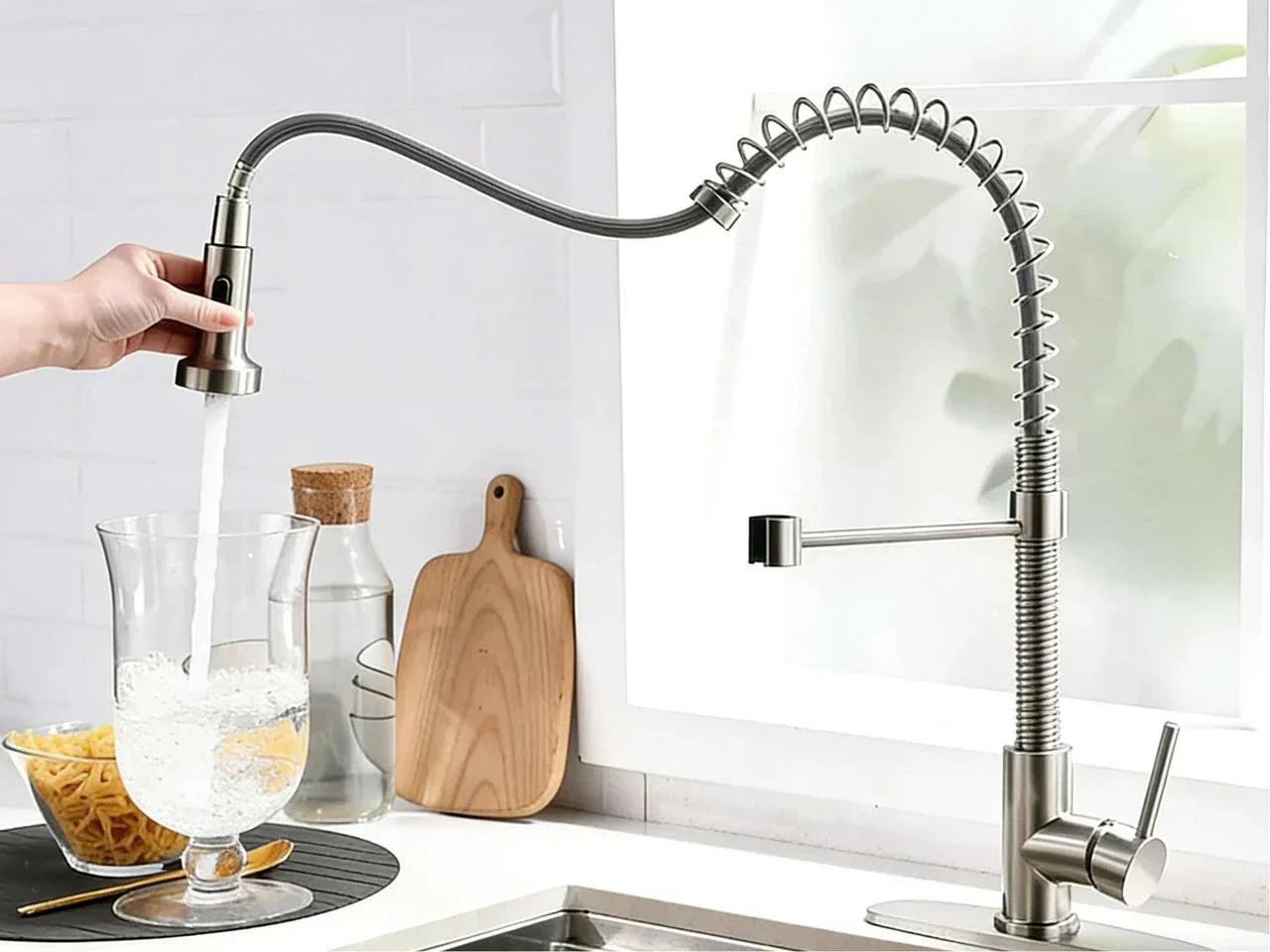
A pull-down faucet is characterized by a high-arc gooseneck spout with a spray wand that pulls straight down from the tip. The hose runs inside the tall spout and drops back into place with a weight or magnet. This style is what many people think of when they picture a modern kitchen faucet.
A pull-out faucet has a shorter, low-profile spout and a larger pull-out spray head that pulls toward you from the base or front of the spout. The hose usually has a bit more range of motion sideways and over the counter, which can help in a tight or shallow sink.
You can imagine a side-by-side drawing: on the left, a tall gooseneck over a deep sink, with the wand pulled down into the bowl. On the right, a compact spout near a backsplash, with the wand pulled forward toward the counter.
Comparison table: features, pros, and cons side by side
Here is a compact pull out vs pull down faucet comparison to scan:
| Feature / Factor | Pull-Down Faucet | Pull-Out Faucet | Best For |
| Spout height | High-arc, tall gooseneck | Low to mid-height, compact | Pull-down: deep sinks; Pull-out: low clearance |
| Hose direction | Mostly vertical “pull-down” | Mostly horizontal “pull-out” | Pull-down: in-sink work; Pull-out: counter reach |
| Typical hose length | Medium (good for sink area) | Often longer hose length | Pull-out: reaching every corner and nearby items |
| Sink compatibility | Best for deep, wide kitchen sinks | Best for small, shallow, or corner sinks | Depends on sink depth and size |
| Ergonomics | Natural downward motion; small spray head | Forward motion; larger spray head | Personal comfort and hand size |
| Spray modes | Often more spray patterns and multiple spray options | Usually 2–3 basic spray modes | Pull-down for variety |
| Splash risk | Higher in small or shallow sinks | Lower in shallow sinks | Pull-out for tiny basins |
| Style variety | Wide range for modern and contemporary kitchens | Fewer styles and finishes | Pull-down for style choice |
This table sums up the core pros and cons: pull-down faucets offer height and versatility in large sinks, while pull-out faucets are best suited to tight, shallow setups where splash control and reach over the counter matter more.
Quick decision flow: which type fits your kitchen?
You can walk through this simple decision path in your head:
-
How deep is your sink?
-
If the bowl is deep (about 9–10 inches or more), a pull-down kitchen faucet is usually the right choice.
-
If the sink is shallow or small, a pull-out faucet may control splash better.
-
-
How much vertical space do you have?
-
If you have a window sill, shelf, or cabinets just above the sink, a tall spout may not fit. In that case, a pull-out kitchen faucet or low-arc pull-down is safer.
-
-
Do you often fill tall vessels like stock pots, pitchers, or vases?
-
If yes, the extra height of a kitchen pulldown faucet and its vertical water flow makes life easier.
-
-
Do you need to rinse counters or nearby appliances?
-
If you often pull the wand over to a coffee machine, large cutting board, or pet bowl on the counter, the longer hose and forward pull of a pull-out spray head gives greater flexibility.
-
-
How big is your kitchen layout?
-
Big, open kitchens with large kitchen sinks and islands lean toward pull-down.
-
Compact apartments, RVs, and bar sinks often work better with pull-out.
-
Is a pull-down faucet better than a pull-out?
Many people ask: Which is better, a pull-down or pull-out faucet? The honest answer is that it depends on your sink and how you use your kitchen.
In most 2025 reviews, pull-down faucets come out ahead for family kitchens because they handle big pots, baking trays, and heavy daily use with ease. They also tend to offer more spray modes, touchless options, and stylish designs.
But a pull-out faucet can be the better choice when you have:
-
A small or shallow sink that splashes easily
-
Low cabinets or a tight backsplash
-
A need to reach sideways more than straight down
So “better” is context-based: pull-down for deep, modern sinks and heavy cooking; pull-out for space-saving, low-splash setups.

Pull-Down Kitchen Faucets Explained
Understanding how a pull-down kitchen faucet works can make your daily tasks easier and more efficient. In this section, we explore the design, mechanics, and advantages of a pull-down faucet, helping you see why it’s a popular choice for modern kitchens and deep sinks.
How pull-down faucets work (mechanics and ergonomics)
So, what is a pull-down faucet in simple terms? A pull-down kitchen faucet has a tall, curved spout and a spray head at the tip. The spray wand is part of the spout and can be pulled straight down into the sink. When you let go, a weight on the hose or a magnetic docking system pulls it back into place so the head lines up smoothly with the spout.
Inside the faucet body, a flexible hose allows the wand to move up and down. The hose runs through the gooseneck and hangs down under the sink. A small weight clips onto the hose so it slides smoothly. Many faucets also use a magnet in the spout to keep the head from drooping.
From an ergonomics point of view, a pull-down motion matches how you naturally move your hand when you rinse dishes or scrub the sink. You point the spray down where the mess is. The range of motion feels natural, and there is less twisting of the hose than with some pull-out designs. This can help hose life and reduce kinks over time.
Advantages of pull-down faucets (data-backed pros)
A pull down kitchen faucet has several strong advantages that explain why it has become the standard in many modern kitchen designs.
First, the high-arc spout gives you plenty of space under the faucet. You can easily fill tall pots, pitchers, or vases without forcing them in at an angle. If you often cook large batches of soup, boil pasta in big pots, or wash baking sheets, this extra vertical space makes daily kitchen tasks smoother.
Second, pull-down models in 2025 usually have more spray modes than basic pull-outs. Many kitchen faucets offer at least two patterns (stream and spray). Newer pull-down designs add things like a wide fan spray, a powerful spray for stuck food, a pause button, or a “boost” mode for faster filling. These multiple spray options help you switch from gentle rinsing of fruit to a strong spray for greasy pans without changing tools.
Third, a pull-down vs pull-out faucet often gives better control of where the water hits in a deep sink. Because the head is smaller and the motion is straight down, it is easier to ensure the spray stays inside the bowl. You can reach every corner of your sink in a deep basin without needing a very long hose.
Fourth, many pull-down kitchen faucets now include extra faucet features such as touchless on/off sensors, integrated filtration, or improved docking systems. These features show up more often in pull-down than pull-out models, because the high-arc body gives more space to hide the tech and batteries.
Finally, reviews and tests in 2025 often rate pull-down and pull-out faucets with similar basic function, but pull-downs usually score higher for style, finish variety, and “feel” of the spray. This is one reason they top many “best kitchen faucet” lists.
Drawbacks and limitations of pull-down faucets
No faucet type is perfect, and pull down faucets require the right setting to shine. It helps to know the key downsides before you decide.
The biggest drawback is splash risk in small or shallow sinks. When you combine a tall spout with a strong water flow and a shallow bowl, water hits the bottom with more force and can bounce out. If you have a tiny stainless sink in an older apartment, a very tall pull-down may not be suitable because you will be wiping the counter all the time.
The second issue is height limits. A high-arc kitchen sink faucet can run into problems if you have:
-
Low cabinets or shelves above the sink
-
A window with a deep sill right behind the faucet
-
A narrow ledge or backsplash that will not fit the base
In those cases, you may need to pick a shorter pull-down or switch to pull-out vs pull-down faucet designs that sit lower.
Cheaper pull-down kitchen sink models can also have weaker magnets or lighter hose weights. This may cause the spray head to droop, not line up well with the spout, or feel loose over time. The hose itself can wear out early if the materials are thin or if you pull very hard.
So, to answer one of the key questions: What are the disadvantages of pull-down faucets? They can splash more in shallow sinks, may not fit under low cabinets, and low-cost versions may suffer from weak docking and shorter hose life.
2025 trends: why pull-down faucets dominate modern kitchens
In 2025, pull-down kitchen faucet designs lead the way in most “top faucet” reviews and social media videos focused on full-size kitchens. There are a few clear reasons.
Many newer homes now use large, deep, single-bowl kitchen sinks. These sinks pair naturally with a high-arc spout and a pull-down vs pull-out style. The tall spout can cover a wide bowl, and the wand is perfect for rinsing big pans or roasting trays.
At the same time, faucet makers have invested more design energy into pull-down models. You see many more choices in finishes like stainless, brushed nickel, matte black, and even warm metals. Touch and touchless controls, integrated filtration, stronger magnetic docking, and extra spray patterns appear most often in the pull-down category.
Reviewers in 2025 often highlight three areas when they rate pull-down and pull-out faucets:
-
Strength and control of the spray
-
Smooth motion and return of the hose
-
Ease of hitting every corner of the sink
Pull-downs tend to win in deep sinks on those points. This does not make pull-outs “bad”, but it explains why pull-down vs pull out faucet discussions often favor pull-downs for main family kitchens.

Pull-Out Kitchen Faucets Explained
A pull-out kitchen faucet offers unique flexibility for small or compact sinks. In this section, we break down how a pull-out faucet works, its design features, and why it can be the better choice in kitchens with limited space or low cabinets.
How pull-out faucets work (design and reach)
Now, what is a pull out faucet? A pull-out faucet usually has a lower spout and a larger, more rounded spray head that pulls toward you from the base of the spout. Instead of moving mostly down, the wand moves forward and sideways. The hose length is often a bit longer than in pull-downs, so you can reach outside the sink more easily.
The spout on a pull-out kitchen faucet often swivels 180–360 degrees. This lets you move the spray over double bowls or toward the counter. Because the spout sits lower, this type of faucet fits under tight cabinets and in compact spaces where a high-arc would hit something.
In practice, the way you use it is simple: you grab the larger head, pull it toward you, and then aim the spray where you need it. When you are done, the hose slides back inside the faucet body, helped by a weight under the sink.
Advantages of pull-out faucets (where they shine)
A pull-out faucet may not look as dramatic as a tall gooseneck, but it can be the perfect faucet for many small kitchens.
Because the spout is lower, pull-out faucets are best suited to small or medium sinks and situations where you want to cut down on splash. In a shallow sink, the lower starting point means the water has less distance to fall. This keeps the splash area smaller, which matters a lot in compact apartments or older kitchens.
The longer hose and forward motion give you greater flexibility to reach beyond the bowl. This helps when you:
-
Rinse cutting boards or trays placed on the counter
-
Fill a pet bowl or coffee maker next to the sink
-
Clean the corners of a tight double-bowl sink or a corner sink
Because the main spout is compact, a pull-out kitchen sink faucet often works well where there is a window, shelf, or cabinet right behind the sink. You do not need much vertical space. This makes it popular in studio apartments, RVs, and bar or prep sinks in larger homes.
From a style view, many pull-out and pull-down designs can both look modern. But pull-outs are often more discreet, which some people prefer in a very simple, minimalist kitchen.
So, if you ask, What is the benefit of a pull out tap? The big benefits are space savings, less splash in shallow sinks, and better sideways reach to the counter and nearby areas.
Drawbacks and trade-offs of pull-out faucets
Of course, pull-out faucets usually involve some trade-offs.
Because the spout sits lower, it can be harder to fit tall vessels directly under the faucet. You can still fill big pots by pulling out the wand and holding it inside the pot, but you do not get the same easy “slide it under the spout” experience that a high-arc pull-down faucet gives.
The motion of pulling forward can feel less natural to some users, especially if they are used to pull-down kitchen designs. People with large hands sometimes find the bigger spray head less comfortable to grip for long periods, although others like the larger handle. This is one of those areas where personal comfort matters.
Pull-out styles also tend to have fewer spray modes and less functionality at the top tier. Many offer simple stream and spray, which is fine for daily use, but if you want lots of spray options or a powerful spray boost, you are more likely to find those in pull-down models.
Another small point: the longer hose and more frequent sideways pulling can twist the hose more over time. Quality construction can reduce this, but it is a factor when you compare pull-out vs pull-down faucet durability.
Best use cases for pull-out faucets (real-world scenarios)
Pull-out faucets shine in several real-world settings.
Think about a compact city apartment with a narrow, shallow stainless sink tucked into a small counter run. A tall pull-down here might spray water onto the floor every time you rinse a pan. A pull-out faucet with a lower spout lets you control the water flow and adjust the angle so it stays inside the sink.
Or consider a corner sink where the backsplash is tight and cabinets hang low. You might not have room for a high-arc kitchen faucet at all. A pull-out kitchen design with a 180–360 degree swivel lets you aim the spray into either bowl or over the nearby countertop without hitting the cabinets.
In many homes, a pull-out is ideal for:
-
Studio apartments and small galley kitchens
-
RVs and tiny houses
-
Bar, prep, or secondary sinks where space is tight
-
Families who do not often fill extra-tall cookware but need to reach awkward corners
So while a pull-down vs pull out faucet debate often leans toward pull-down for main sinks, pull-outs keep winning in small, tight, or shallow layouts.

Head-to-Head: Pull Down vs Pull Out Faucet by Key Factors
To help you make an informed decision, this section compares a pull down vs pull out faucet head-to-head across key factors like sink size, ergonomics, cleaning performance, and durability. Understanding these differences makes it easier to choose the faucet that truly fits your kitchen needs.
Sink size, depth, and layout: matching faucet to basin
The sink is the starting point when you are choosing a kitchen faucet. No matter which style you like, the faucet has to work with the bowl depth, width, and the space around it.
For deep, single-bowl sinks, a pull-down kitchen faucet is almost always the right choice. The high-arc spout gives clearance for tall items, and the downward spray is easy to control. You can pull the wand down into the bowl and move it all around without needing an extra-long hose.
For shallow or double-bowl sinks, you need to think more carefully. If the bowls are shallow, a tall spout can cause extra splash. If the sink is narrow or pushed into a corner, a long, high spout may not swivel freely. Here, a pull-out vs pull-down design with a shorter spout and longer hose can be more forgiving.
Undermount and drop-in sinks both work with either faucet type. But in a wall-facing layout with a low window or shelf, a pull-out often fits better. On the other hand, an island sink in a large, open kitchen almost begs for a graceful high-arc pull-down kitchen faucet as a visual and functional centerpiece.
Ergonomics, comfort, and ease of use
How does the faucet feel during real tasks like washing dishes or cleaning the sink? This is where ergonomics comes in.
A pull-down faucet uses a natural vertical motion. You reach up, grab the spray head, and pull down into the sink. The head is usually smaller and lighter, so it feels easy to handle even during long cleaning sessions. If you scrub pots often, the straight-down control can feel very precise.
A pull-out faucet works more like a hand shower. You grab the larger head and pull it toward you, then aim it where needed. The longer hose lets you reach outside the sink, but the motion is more forward and sideways. Some people love that freedom; others prefer the simpler up-and-down motion of a pull-down.
For older adults or people with limited arm strength or mobility, two points matter:
-
Weight and size of the spray head
-
Smoothness of hose movement
Lighter, smaller pull-down heads can be easier to hold. On the other hand, if you often need to fill containers on the counter so you do not have to lift them, the reach of a pull-out can be very helpful. In that case, whether a pull-down or pull-out works better comes down to your specific tasks and comfort needs.
Cleaning performance, spray modes, and water pressure
Both pull-down and pull-out styles can clean well, but they do it in slightly different ways.
Because of the taller spout, a pull-down kitchen faucet often feels like it has stronger water flow when you use a focused spray pattern. The height can help the spray spread over dishes and pans in a deep sink. The extra spray modes in many pull-down designs make it easier to switch between a gentle aerated stream and a powerful spray that blasts away stuck food.
Pull-out faucets usually have fewer patterns, but the longer hose and flexible angle make it easy to move the head close to the mess. In a small sink, you may not need high pressure; being able to place the head right next to a stain or sticky spot can be just as effective.
In practice, the splash pattern depends on:
-
How high the spout is
-
The depth and shape of the sink
-
The spray pattern you choose
A high-arc pull-down in a deep sink can be fast and clean. The same faucet in a shallow sink can send water over the edge. A low pull-out in a shallow sink will usually splash less.
Durability, hose life, and maintenance issues
Both pull-down and pull-out faucets can last many years if they are built well and installed correctly. Most quality kitchen faucets come with ceramic disc cartridges and strong seals, so leaks are less common than they used to be.
When there are problems, they often show up in the hose and docking system:
-
On some pull-outs, the longer hose can twist or kink from repeated sideways pulling.
-
On some pull-downs, weak magnets or light hose weights can let the head droop over time.
You can extend hose life by pulling the wand gently, not yanking at hard angles, and by checking once in a while that the weight under the sink has not moved or caught on cleaning supplies.
Mineral build-up from hard water can clog spray nozzles in both faucet types. Many modern designs use flexible rubber tips that you can wipe with a finger to clear deposits. Cleaning aerators and descaling the sink faucet with vinegar from time to time will help keep the water flow smooth.
When people ask, Which faucet type lasts longer: pull-down or pull-out?, the fair answer is that material quality and brand matter much more than the type alone. A high-quality pull-out can outlast a cheap pull-down, and the reverse is also true.

Buying Factors Beyond Style: Installation, Cost, and Features
Choosing the right kitchen faucet involves more than just style. In this section, we examine practical buying factors—including installation complexity, price ranges, and advanced features—so you can pick a faucet that works seamlessly in your kitchen and meets your daily needs.
Installation complexity: DIY vs hiring a plumber
Both types install in similar ways. They sit on top of the sink or counter, with hot and cold lines and the hose running below. The main things to check are:
-
How many holes your sink or counter has
-
Space under the sink for the hose weight and any filters or garbage disposal
Many modern kitchen sink faucet models are made for a single-hole setup, but they often include an optional deck plate to cover three holes. This is the same for pull-down and pull-out faucets.
People sometimes ask, Are pull-down kitchen faucets harder to install than pull-outs? In most cases, no. The steps are almost the same. A pull-down may need a bit more care to route the hose through the tall spout, and a pull-out may have a slightly longer hose to manage. If you are handy and can follow instructions, both can be a DIY project. If your plumbing is old or cramped, hiring a plumber can save time and prevent leaks.
Budget and price ranges for pull-down and pull-out faucets
Prices overlap a lot between pull-down vs pull out faucet styles, but features differ by range. Here is a rough guide:
| Price Range (USD) | Typical Pull-Down Features | Typical Pull-Out Features | Best For |
| $75–$150 | Basic high-arc, 1–2 spray modes, standard finish | Compact spout, 1–2 spray modes, simple finish | Tight budgets, rentals, basic upgrades |
| $150–$300 | Better finishes, 2–3 spray modes, improved hose and docking | Longer hose, 2–3 spray modes, smoother swivel | Most homeowners, main kitchen sinks |
| $300–$600+ | Multiple spray patterns, touch or touchless, strong magnets | Higher-quality build, sometimes pull-out with extra features | Heavy use kitchens, remodels, semi-pro feel |
In the mid-range, pull-down faucets offer more variety in finishes and extra modes. High-end pull-downs may include touchless tech, advanced docking, and upgraded finishes. High-end pull-outs usually focus on build quality and smooth hose action rather than lots of modes.
Advanced features: touchless, filtered, and semi-pro designs
When you compare pull down vs pull out faucet options at the higher end, you start to see more advanced features.
Touchless faucets use a small sensor to start or stop the water without touching the handle. This can help keep the faucet clean and reduce germs on busy cooking days. These sensors often appear more on pull-down kitchen faucet designs, since the tall body has room for electronics and batteries.
Some high-end pull-downs use a semi-pro style with an exposed hose coil around the spout. This gives lots of range of motion and a very strong spray wand for heavy scrubbing. Pull-outs rarely use this exposed hose look.
Filtered faucets run water through a built-in filter before it leaves the spout. You do see some filtered pull-outs, but again, more choices tend to show up in the pull-down category.
Water efficiency, regulations, and finishes
No matter which type you choose, water efficiency matters. Many kitchen faucets offer low-flow aerators and carry labels like WaterSense, which shows they meet certain flow rate limits while still feeling strong. According to the EPA WaterSense program, certified kitchen faucets use no more than 1.5 gallons per minute while maintaining adequate water pressure. In many areas, standard kitchen flow is around 1.5–2.2 gallons per minute. Choosing a certified model can cut water use without losing performance
Local plumbing codes may set limits on flow, backflow protection, and which faucets are designed to work with certain supplies. It is a good idea to check local building or plumbing guidelines, or ask a plumber, if you are unsure.
For finishes, both pull-down and pull-out types come in common options like chrome, stainless, and matte black. Many finishes now use spot-resistant coatings to reduce water marks and fingerprints. In 2025, matte and brushed finishes are very popular in contemporary kitchen designs, while polished chrome still works well in bright, simple spaces.
Real-World Insights: Reviews, Data, and Case Studies
Beyond specifications and features, real-world performance matters. This section highlights reviews, test data, and case studies to show how different pull-down and pull-out faucets perform in everyday kitchens, helping you see which type delivers the best results.
What 2025 reviews and tests say about pull-down vs pull-out
Recent guides and videos that compare pull-out vs pull-down faucet models show a clear pattern:
-
In full-size family kitchens with deep sinks, pull-down kitchen faucet designs get higher scores for cleaning speed, spray control, and user satisfaction.
-
In small apartments, RVs, and bar sinks, pull-out faucet designs rate better for space management and splash control.
Tests often highlight three things:
-
How quickly each faucet rinses a dirty baking tray
-
How far the spray splashes in deep vs shallow bowls
-
How smooth and quiet the hose feels when you pull and retract it
Pull-downs often rinse faster in deep sinks and feel smoother when docked. Pull-outs tend to splash less in small, shallow sinks and offer more reach onto the counter.
User scenarios: large family kitchen vs compact apartment
Imagine a large family kitchen with a wide, deep, single-bowl sink. You often cook, bake, and run the dishwasher while someone else uses the sink. Here, a high-arc pull-down kitchen faucet lets you stack pans in the bowl, swing the spout away when you need space, and pull the wand down for a fast, powerful spray. A pull-out would work, but a pull-down fits the scale better and feels more natural to use every day.
Now think about a compact apartment kitchen with a shallow double-bowl sink and low cabinets above. A tall spout would be at risk of hitting the doors or splashing onto the floor. In this space, a pull-out kitchen faucet with a lower spout gives you enough reach across both bowls and up onto the counter, without the extra height. Splash stays inside the sink, and you still get good wash power.
In some light commercial or heavy-use home kitchens, a semi-pro pull-down with an exposed hose and strong spray wand is common. The motion is similar to a home pull-down, just scaled for tougher tasks. This setup is rare with pull-outs.
Longevity and common problems reported by owners
Across user reviews, both types, when made well, can last many years. The most common complaints are similar for each style:
-
Hose leaks or cracks
-
Spray head not docking flush
-
Mineral build-up causing poor spray patterns
-
Spray buttons sticking or failing to change modes
For pull-down faucets, drooping heads and weak magnets are the most common small problem. For pull-out faucets, twisted or stiff hoses and difficulty retracting the head come up more often.
Simple checks can prevent many issues:
-
Make sure the hose weight hangs freely under the sink and does not catch on cleaners.
-
Wipe the spray nozzles now and then to clear mineral build-up.
-
If the head stops docking well, check that the faucet body and head are clean, not blocked by debris.
When people ask which style “breaks more”, the fairest answer remains: higher-quality materials and a good warranty matter more than pull-down vs pull-out style alone.

Checklist, Tools, and Final Recommendation
After exploring features, pros and cons, and real-world performance of pull-down vs pull-out faucets, it’s time to bring everything together. This section gives you a practical checklist, essential tools, and clear guidance to help you decide which kitchen faucet is best suited for your sink, layout, and daily tasks. Following these steps ensures you pick a faucet that combines style, functionality, and long-term convenience without any guesswork.
Interactive tools: quiz, calculators, and comparison sheets
You can turn the points above into a quick “quiz” for yourself. Ask: How deep is my sink? How high are my cabinets? Do I mostly fill tall pots or rinse small items? Do I need to reach onto the counter often? Writing these answers down can help you decide whether a pull-down or pull-out is better suited for your kitchen.
A simple “sink fit calculator” is just measuring three things:
-
Sink depth
-
Space from counter to cabinet or window
-
Width of the sink and counter around it
With those, you can rule out a faucet that is too tall or too short before you spend money.
Step-by-step checklist: how to choose your faucet type
Use this step-by-step checklist when choosing the right faucet:
-
Measure your sink depth, width, and the height to any shelf, cabinet, or window above it.
-
Decide how often you fill tall vessels like big pots, pitchers, or vases.
-
Think about your kitchen layout: large and open, or tight and shallow? Corner sink or island?
-
List your main kitchen needs: heavy cooking, light reheating, lots of dishwashing, or mostly using a dishwasher.
-
Choose a budget range and match it to the feature table above.
-
Decide which faucet features matter most: extra spray modes, touchless, filtration, special finishes.
-
If your sink is deep and space is open, start with pull-down models. If your sink is small or shallow, start with pull-out faucets.
-
Compare 2–3 models in your chosen type, checking hose length, spray options, and finish.
-
Confirm installation needs: hole count, under-sink space, and local water rules.
-
Make your pick and plan installation, either DIY or with a plumber.
If the steps point you to pull-down, focus on spout height, spray variety, and docking strength. If they point you to pull-out, focus on hose smoothness, grip comfort, and fit under cabinets.
Final verdict: when to choose pull-down vs pull-out
To finish, here is the core guidance in simple points:
-
Choose a pull-down faucet if you have a deep or wide sink, a medium or large kitchen, and you often wash big pots, pans, or trays. You will enjoy the tall spout, easy downward control, and extra spray patterns.
-
Choose a pull-out faucet if you have a small or shallow sink, low cabinets, or a tight corner layout. You will benefit from the lower splash risk and longer reach over the counter.
-
For most modern, deep kitchen sinks, a pull-down kitchen faucet is the smarter long-term fit and matches 2025 style trends.
-
For compact spaces, bar sinks, RVs, and older shallow sinks, a pull-out kitchen faucet is often the more practical choice.
-
In every case, put ergonomics, water efficiency, and build quality ahead of trend. A comfortable, efficient faucet that fits your sink will serve you better than any look that makes daily tasks harder.
FAQs
1. Which is better, a pull-down or pull-out faucet?
There’s really no one-size-fits-all answer here—it depends on your kitchen setup and how you use it. Pull-down faucets tend to shine in larger, deep sinks where you often cook with big pots, bakeware, or multiple trays. Their high-arc spout and downward spray make rinsing dishes, filling tall containers, and cleaning the sink straightforward. On the other hand, pull-out faucets are perfect for smaller or shallow sinks, tight corners, or spaces with low cabinets above the sink. Their hose can reach sideways, making it easier to rinse counters, fill a pet bowl, or work in a compact double-bowl setup. In short, pull-down is great for heavy-duty cooking and open layouts, while pull-out gives flexibility in tight spaces. Choosing the “better” one is really about what fits your daily kitchen tasks and physical layout.
2. What are the disadvantages of pull-down faucets?
While pull-down faucets are popular for their high spout and vertical spray control, they aren’t perfect for every kitchen. One common issue is splash risk in shallow or small sinks—when water falls from a tall spout into a shallow bowl, it can bounce out, leaving your countertop wet. Another limitation is height: a high-arc faucet may not fit under low cabinets, window sills, or shelves, so you need to measure your space carefully. Cheaper models may also have weak magnets or light hose weights, which can cause the spray head to droop or not dock properly. Over time, the hose can wear out if it’s thin or repeatedly pulled too hard. Finally, because they are taller and often feature multiple spray modes or touchless tech, installation may require more attention to hose routing. So while pull-downs are great for deep sinks and big cooking tasks, they’re not always ideal in tight, shallow, or low-clearance setups.
3. What is the difference between a pull-down tap and a pull-out tap?
The main difference comes down to spout design and how you move the spray head. A pull-down faucet has a tall gooseneck spout, and the spray head pulls straight down into the sink. It’s great if you want precise vertical control and plenty of room under the spout. A pull-out faucet, however, has a shorter spout and a wider, often more rounded spray head that pulls toward you from the base of the faucet. This design allows the hose to reach not just straight down, but across the sink and even onto the counter. In practice, pull-down faucets work well in deep, open sinks for traditional dishwashing tasks, while pull-out faucets excel in shallow or compact sinks where you need reach and splash control. The movement and coverage really define their strengths.
4. What is a pull-down faucet?
A pull-down faucet is a kitchen faucet with a high-arc spout and a spray head attached to a flexible hose. You grab the head, pull it down into the sink, and when you let go, a weight or magnet helps it dock neatly back into the spout. This vertical motion makes it easy to rinse large dishes, fill tall pots, or clean the sink without awkward angles. Many pull-down faucets also come with multiple spray modes, touchless activation, or integrated filtration, giving extra convenience. The tall spout design gives you more space under the faucet compared to compact styles. Essentially, a pull-down faucet is all about combining style, reach, and control for everyday kitchen tasks, especially in sinks that are wide, deep, or part of a busy cooking setup.
5. What is the benefit of a pull out tap?
A pull-out faucet is designed for flexibility and space-saving. Because the spout is shorter, it fits easily under low cabinets or windows, making it ideal for small kitchens, apartments, or bar sinks. The hose can pull forward and sideways, letting you rinse corners, clean trays on the counter, or fill containers just outside the sink. This reduced splash and extended reach make it practical for compact setups. While it may not offer the same tall clearance as a pull-down faucet, it often makes daily tasks easier in tight spaces. Many models are simple, user-friendly, and maintain a minimalist look, yet they handle common chores efficiently. So, the main benefit is that a pull-out tap adapts to small kitchens and awkward layouts without compromising function.
References



Leave a comment
This site is protected by hCaptcha and the hCaptcha Privacy Policy and Terms of Service apply.