
A bathroom sink color sounds like a simple aesthetic choice, but it quietly shapes how your space looks, feels, and functions every single day, influencing the overall modern design direction and the sense of sophistication in the room, influencing the overall design and the elegance of the room. Matte black and white sinks create completely different experiences—not just in style, but in how they handle water spots and fingerprints, daily mess, cleaning habits, and long-term wear. The right choice isn’t about trends; it’s about how your bathroom is used, how much maintenance you’re willing to handle, and what kind of visual comfort you want to live with over time. According to the CDC, maintaining clean, frequently touched surfaces is an important part of reducing the spread of germs in everyday environments, especially in shared spaces like bathrooms.
Quick Answer: matte black vs white bathroom sink
If you want a sink that hides daily mess better and helps create a sleek modern look, choose matte black. If you want the safest long-term choice for brightness, resale, and easy style matching, choose a white sink, especially if you prefer the classic look and want a right choice for most bathrooms. If you have very hard water or know your sink will not get wiped often, white is usually the safer pick and in some homes gray or stainless may work even better than either.
A bathroom sink seems like a small choice until you live with it every day. Then the real issues show up: water spots, toothpaste marks, hair dye, soap film, chips, and whether the sink makes the room feel bright or heavy.
Here’s what usually matters in real homes. Matte black and white can both look good on day one. The better choice depends less on trend and more on how your bathroom is used, how much natural light you have, how hard your water is, and how picky you are about visible residue.

Decision Snapshot
If you want the short version, use this—especially useful for busy households balancing durability and ease.
Best for busy shared bathrooms
Choose matte black if:
-
Do you need the quietest total experience
-
Or do you need the simplest toilet to own
Avoid matte black if:
-
your water leaves white mineral marks fast
-
you use harsh cleaners
-
you know no one will wipe it down regularly
Best for small bright bathrooms
Choose white if:
-
your bathroom is small or lacks natural light
-
you want the most timeless look
-
you care about resale safety
-
you want a sink color that works with almost any faucet finish
Avoid white if:
-
you dislike seeing toothpaste, makeup, and dirt between cleanings
-
you want the sink itself to act as a design statement
Choose gray or stainless if upkeep fails
Skip both and consider gray, greige, stone-look, or stainless if:
-
you have hard water and hate visible mineral spots
-
your household uses strong cleaners inconsistently
-
you want lower visual contrast and fewer finish worries
Summary:
If you want a fast, no-regret decision, use these elimination rules:
-
Choose matte black if: you prioritize bold design, can commit to frequent wipe-downs, and your water conditions are mild
-
Choose white if: you want low-maintenance, maximum visibility, and flexibility in cleaning habits
Third path (skip both):
-
Choose gray, beige, or stainless-toned finishes if:
-
You want to reduce visible spotting without going high-maintenance
-
Your water is moderately hard
-
You want a balance between design and practicality
-
This “middle option” often avoids the extremes—less staining contrast than black, less clinical feel than white.
Matte black vs white bathroom sink compared
Before we get into style and cleaning habits, here is a comparative view to help you find the right sink faster.
| Factor | Matte Black Bathroom Sink | White Bathroom Sink | Better Choice For Most Buyers |
| Upfront cost | Often similar, but specialty finishes can cost more | Usually easiest to find at standard prices | White |
| Installation | Similar installation if same sink type | Similar installation if same sink type | Tie |
| Space impact | Can feel heavier and more defined | Makes room feel brighter and more open | White for small baths |
| Daily appearance | Hides some soap smears, fingerprints, and minor mess | Shows dirt fast, so it looks dirty sooner but cleaner when washed | Depends on your habits |
| Water spots | Often more visible in hard-water homes | Less dramatic, especially on glossy surfaces | White |
| Toothpaste residue | Can blend in at first, then leave pale marks if it dries | Very visible right away | Matte black for hiding, white for prompting cleaning |
| Scratches and chips | Surface wear can stand out if top color is damaged | Minor wear may be less visually severe | White |
| Cleaning products | Needs gentler cleaning to protect finish | Usually more forgiving | White |
| Comfort/usability | No comfort change, but dark bowl may reduce visual depth for some users | Easier to see debris, hair, and standing water | White |
| Faucet flexibility | Best with black, brass, or brushed metal | Works with almost every finish | White |
| Resale appeal | Strong in modern homes, less universal | Safest broad appeal | White |
| Design impact | Bold, dramatic, modern | Timeless, calm, clean | Depends on style goal |
The key point is simple: matte black tends to hide daily mess but punish neglect, while white tends to show mess quickly but stay easier to live with long term.

Key differences that matter
Key differences often sound simple on paper, but they directly affect easy to clean performance and daily usability. The points below focus on what you’ll actually notice day to day—how your sink looks between cleanings, how much effort it demands, and how it fits your habits and environment.
Do water spots annoy you fast?
This is one of the biggest decision points, and many buyers miss it.
Do matte black bathroom sinks show water spots more than white sinks? In many homes, yes. Not always after every splash, but in hard-water areas the dried mineral film often appears as a pale haze or ring on black surfaces. On white, the same mineral residue may still be there, but it usually blends in more.
So is a matte black or white bathroom sink easier in terms of ease of maintenance? If you mean “which one needs less obvious wiping to look acceptable,” matte black can win in some busy homes because it hides random mess during the day. If you mean “which one stays less frustrating in a hard-water area,” white usually wins.
A lot depends on your water:
-
Soft water: matte black becomes much easier to live with
-
Hard water: white is often the calmer choice
If you already fight scale on shower glass or faucets, do not ignore that. A black sink in the same room will likely show it too.

Will everyone wipe the sink daily?
This is where real-life behavior matters more than design boards.
In a guest bath used lightly, matte black can be easy. In a family bathroom where children leave toothpaste foam, hand soap, and water around the rim, black may hide the mess from a distance. That sounds like a win. But once residue dries, pale streaks can become more annoying to remove.
White does the opposite. It tells on everyone. You see the toothpaste spit, the makeup smudge, the hair near the drain. Some people hate that. Other people prefer it because the sink never gives a false sense of cleanliness.
For busy households, ask yourself one question: Do you want to hide mess, or do you want to notice it fast?
-
If you want to hide it until evening cleanup, choose matte black.
-
If you want the sink to signal when it needs attention, choose white.
Do you want bold or timeless?
Are white bathroom sinks more timeless than matte black sinks? Yes, in most homes they are.
White has stayed standard for a reason in minimalist designs and contemporary homes, especially when sophistication is prioritized over bold contrast. It works with changing wall colors, tile updates, and new hardware. If you remodel in phases, white gives you more freedom. It also tends to support resale value better because it is familiar and easy for buyers to accept.
That does not mean black is a bad choice. Matte black can look excellent in minimalist and modern bathrooms, especially with white walls, concrete-look tile, oak vanities, or warm metal accents. But black is a stronger style decision. Stronger decisions have more upside if you love them, and more risk if your taste changes.
If you are asking which sink color is best for resale value, the safer answer is white.
Is hard water your deal-breaker?
Hard water is one of the biggest deciding factors due to soap residue and mineral buildup, but many buyers underestimate how severe it is in their own bathroom.
Simple in-bathroom severity test: Check these existing signs—no tools needed:
-
Mild: occasional faint spots on faucets or glass that wipe off easily
-
Moderate: recurring white marks on shower glass or taps that need effort to remove
-
Severe: chalky buildup, crust around fixtures, or spots that return within days after cleaning
You can also look at:
-
Kettle or showerhead scaling
-
White residue around drains or overflow holes
Stronger elimination rule:
-
If your bathroom shows moderate to severe signs, matte black is high-risk for frustration
-
In these conditions, mineral deposits will appear faster and require more frequent upkeep
-
White or lighter finishes are significantly more forgiving visually
Bottom line: If you already struggle to keep glass or chrome spotless, matte black will amplify that challenge—not solve it.
Comparative durability: black vs white ceramic
Beyond daily cleaning and appearance, durability between matte black and white ceramic sinks is less about color itself and more about how the surface ages under real use conditions.
In most standard ceramic sinks, the base material strength is similar regardless of color. The real difference appears in the surface layer and how wear becomes visible over time.
White ceramic tends to be more forgiving in long-term use because minor scratches, micro-abrasions, and light surface wear usually blend into the overall tone. Even after years of use, changes in appearance are often subtle unless there is a deep chip or heavy impact.
Matte black ceramic, on the other hand, can make wear more visually noticeable. Fine scratches, edge wear, or coating thinning (in some models) may reveal lighter underlying layers or create uneven sheen. This does not necessarily mean it is less durable structurally, but it can feel less “stable” visually as it ages.
In practical terms:
-
White ceramic = more stable visual aging, better at hiding long-term wear
-
Matte black ceramic = stronger visual impact, but more sensitive to visible aging patterns
This is why durability perception often differs from actual material strength—the sink may last equally long, but one maintains a more consistent appearance over time.
For buyers, the key question is not “which breaks faster,” but “which one still looks acceptable after years of daily use.”
Matte black finish quality: coated vs through-body (what actually chips and scratches)
Not all matte black toilets are made the same, and this is where many buying regrets start. Some models use a surface coating (a black glaze or paint layer applied over ceramic), while higher-end options use a through-body material or integral pigmentation, where the color runs deeper into the material.
Here’s why it matters in real life:
-
Coated finishes are more vulnerable to visible chips and hairline scratches, especially around the seat hinge area and rim where friction is constant. Once damaged, the contrast (black over white ceramic) makes flaws stand out immediately.
-
Through-body or high-quality glazed finishes tend to hide minor wear better because there’s less stark color contrast beneath the surface.
What to verify before buying (simple checklist):
-
Ask if the black color is glazed ceramic vs painted/coated
-
Check warranty language for finish durability or chipping
-
Look closely at product photos for hinge area wear in reviews
-
Avoid vague terms like “matte coating” without material detail
Buyer takeaway: if you want a black toilet for daily use (especially in a busy household), finish quality directly affects how “fragile” it feels over time. Lower-end coatings don’t just wear—they become visually distracting much faster than white.
What “punish neglect” actually looks like (1 week vs 1 month reality)
The phrase “harder to maintain” sounds abstract until you see how quickly things build up when cleaning slips.
After ~1 week without wiping:
-
On matte black: light dust, water droplets, and soap residue start to show as dull patches or streaks
-
On white: the same buildup is present, but blends in and often goes unnoticed
After ~1 month without proper cleaning:
-
Matte black surfaces can develop visible mineral spotting layers, especially around the bowl rim and waterline
-
These spots may require non-abrasive cleaners and repeated wiping, not just a quick rinse
-
On white toilets, buildup is still there—but visually muted, so it feels less “urgent”
What becomes harder to remove:
-
Dried mineral spots on black finishes tend to bond visually and physically, making them more stubborn
-
Scrubbing aggressively is risky, because it can damage the matte surface
What this means in practice: Black doesn’t get dirtier—it exposes neglect faster and demands consistency. White gives you more margin for error, especially in high-use or low-maintenance households.
Visibility as a decision factor (not just aesthetics)
Color isn’t only about style—it directly affects what you can see during daily use.
Who benefits from higher visibility (white toilets):
-
Households prioritizing hygiene monitoring
-
Families with kids (easier to spot incomplete flushing or mess)
-
Elderly users or caregivers who need to visually confirm cleanliness quickly
White surfaces make:
-
Debris
-
Standing water clarity
-
Bowl depth and contours much easier to distinguish at a glance.
Where matte black can be a drawback:
-
Low-light bathrooms where contrast is already reduced
-
Situations where quick visual checks matter (shared or high-traffic bathrooms)
Decision insight: If “seeing clearly” is part of how you manage cleanliness or safety, white is usually the more functional choice. Matte black prioritizes visual design, not visibility.
When matte black is better
When matte black works best, it’s usually because of how it looks between cleanings and how it supports the overall design. The following points highlight where black feels more practical, more forgiving during the day, and more impactful visually in modern spaces.
Shared baths hide daily mess better
Matte black vs white sink for busy households is not as simple as “black is lower maintenance.” It is more accurate to say black is lower-visibility maintenance.
In a bathroom used by teens, guests, or several family members, black can make the room look neater between cleanings. Small smudges, tiny soap drips, and splash marks do not jump out the way they do on white. If your main goal is to reduce the look of chaos during the day, black helps.
This is why some homeowners like matte black in powder rooms or shared family baths. The sink keeps a tidy look even when life is busy.
Modern rooms need stronger contrast
If your bathroom design leans modern, matte black often feels more intentional than white. It creates contrast against light countertops and tile, and it can anchor a floating vanity or vessel sink setup.
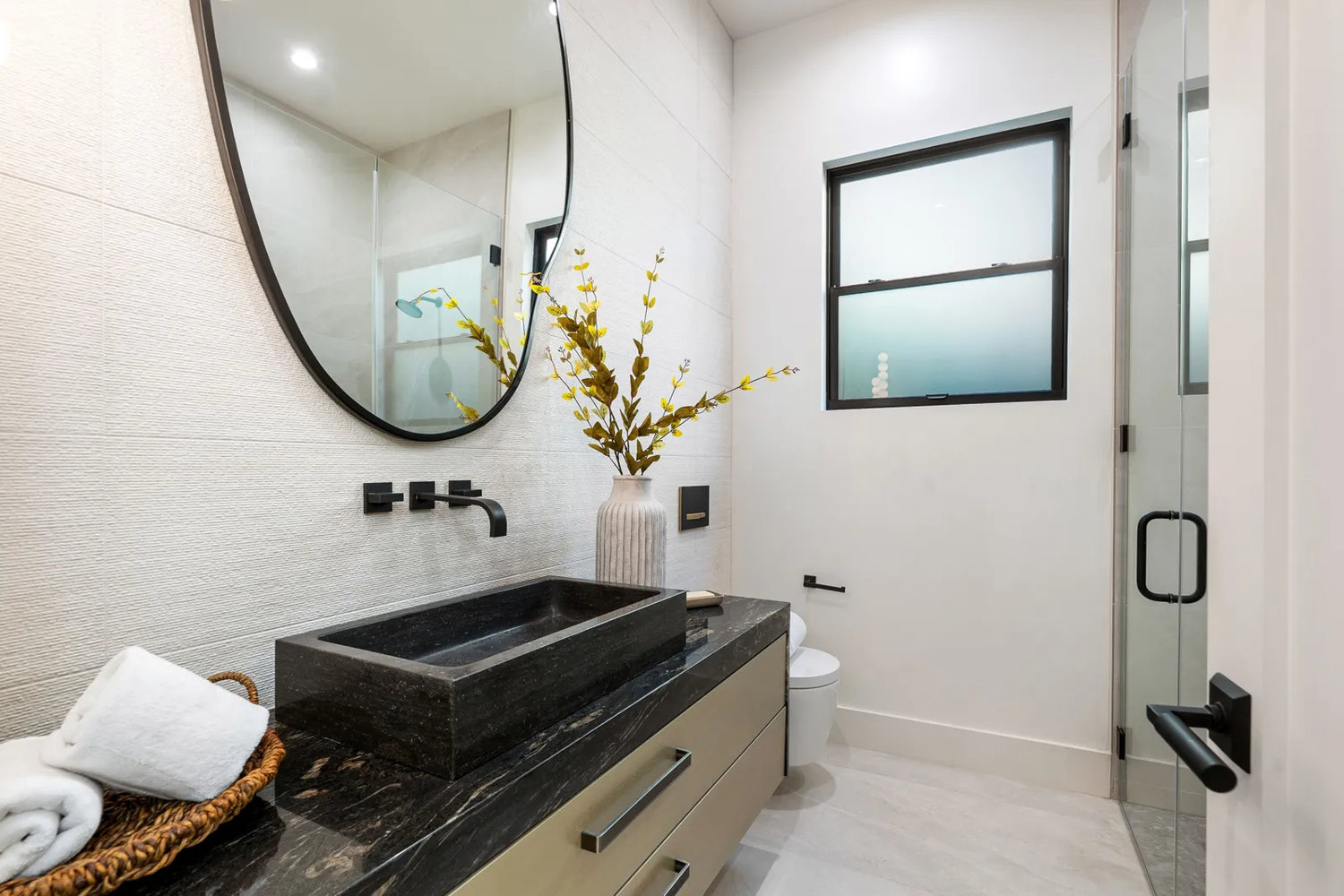
Matte black vs white vessel sink for modern bathroom design is one area where black has a real edge. A black vessel sink tends to look more like a design object. It reads as sculptural. White vessel sinks can still look clean and modern, but they usually disappear more into the room.
So if you want the sink to be part of the visual statement, black is often the better tool.
Soap residue blends in better
Which sink color hides soap residue better, black or white? In day-to-day use, matte black often hides fresh soap smears and splash marks better, especially from a standing distance. This is one reason people think black is easier to keep clean.
But there is a catch. Once residue dries or hard-water minerals build up, the pale film may stand out more on black. So black wins for short-term visual forgiveness, while white often wins for long-term ease.
Vessel sinks look more sculptural
Dark vessel sinks create shape and contrast. If your bathroom vanity is simple and you want one strong focal point, matte black can do that without adding pattern or clutter.
This works well in:
-
modern bathrooms
-
minimalist rooms with warm wood
-
high-contrast black-and-white schemes
-
industrial or concrete-look spaces
A white sink in the same setup will feel calmer and lighter. A black sink will feel more designed.
When white is better
When white is the better choice, it usually comes down to clarity, flexibility, and lower long-term stress. The points below focus on situations where white feels easier to live with day to day and more forgiving over time.
Small bathrooms feel larger
Which bathroom sink color is better for a small bathroom, black or white? In most cases, white.
Does a matte black sink make a bathroom look smaller than a white sink? Often yes, especially in compact layouts where darker tones risk overwhelming the room visually. Dark objects have more visual weight. In a narrow vanity area or windowless bathroom, a black sink can feel heavier and draw more attention to itself. White reflects more light and tends to make the countertop area feel cleaner and more open.
If your bathroom is tight, dim, or already full of visual contrast, white usually helps the room breathe.
Hygiene-first users spot dirt faster
Some buyers want the sink to hide mess. Others want the sink to make mess obvious. If you are in the second group, white is the better fit.
White shows:
-
toothpaste streaks
-
shaving residue
-
makeup marks
-
hair near the drain
-
standing water rings
That may sound like a downside, but for many households it is actually useful. You know when it needs cleaning. There is no guessing.
So are black sinks harder to keep clean than white? In practical terms, black can be harder if you want the surface to look perfect all the time. White may look dirty sooner, but many people find it easier to clean back to a visibly fresh state.
Long-term style feels safer
Are white sinks too traditional for 2026? No. White still works in modern bathrooms, especially with clean shapes and simple lines. A white sink is not outdated just because it is common.
The safer long-term choice is usually white because it adapts to new faucets, mirrors, lighting, and wall colors. If you remodel slowly or expect to sell in a few years, white gives you fewer style conflicts.
Scratches feel less risky to own
Do black bathroom sinks show scratches more than white sinks? Often yes, especially if the black finish is a coating over another base material or if the surface gets abrasive wear. A light scratch, edge chip, or worn area can stand out more because of the contrast.
With white ceramic, wear can still happen, but many minor marks feel less dramatic. Matte black vs white ceramic sink durability depends a lot on manufacturing quality, but from a buyer’s point of view, white usually feels less stressful over time because wear is less likely to create a visible color break.
If your home includes kids, dropped grooming tools, or rough habits around the sink, white is usually the lower-risk ownership experience.
Cleaning burden vs visible cleanliness
This is the heart of the matte black vs white bathroom sink pros and cons discussion.
A matte black sink can look cleaner than it is. A white sink can look dirtier than it is.
That sounds odd, but it matters:
-
Black hides some fresh mess, so the room looks better between cleanings.
-
White shows mess right away, so you clean sooner.
If your standard is “I want the sink to look fine all day,” black can work well.
If your standard is “I want to know exactly when it needs cleaning,” white is better.
Best cleaning products for matte black sinks? Stick with gentle dish soap, warm water, and a soft microfiber cloth for routine cleaning. Avoid abrasive powders, scouring pads, bleach-heavy products, and anything likely to dull or scratch the finish. For white ceramic sinks, you usually have more cleaner options, though it is still smart to avoid harsh abrasion unless the manufacturer says it is safe.
How to prevent water spots on a black vessel sink? The most effective method is simple:
-
Rinse away soap well
-
Dry the sink with a microfiber cloth after use
-
Reduce standing water around the drain and rim
-
Address hard water if it is severe
If that routine already sounds annoying, black may not be your best choice.

Scratch and chip risk over time
Long term durability of matte black vs white bathroom sinks is not just about whether the sink survives. It is about how the sink looks after years of use.
White ceramic has a strong advantage in perceived durability because small wear often blends in better. Matte black can be durable too, but the finish is less forgiving if:
-
metal objects scrape it
-
harsh cleaners dull it
-
chips reveal a lighter layer beneath
-
mineral buildup requires more aggressive scrubbing
This does not mean every black sink will scratch easily. It means the downside is more visible if it does.
If you are worried about “ownership stress,” white is usually easier to own.
Small-bathroom visual impact
For minimalist design, both colors can work. Matte black vs white bathroom sink for minimalist design depends on which kind of minimalism you want.
Choose matte black for minimalist spaces that use contrast, sharp lines, and fewer but stronger elements.
Choose white for minimalist spaces that aim for softness, light, and low visual noise.
In a very small bathroom, white usually wins because it blends rather than interrupts. Black can still work, but it needs support from the rest of the room. For example, black can feel balanced if there are other black elements like a mirror frame, shower trim, or light fixture. A lone black sink in an otherwise pale room can sometimes look isolated.
Faucet pairing and style flexibility
Best faucet finish with a matte black bathroom sink vs white sink depends on your style confidence.
With a matte black sink, the easiest pairings are:
-
matte black for a unified look
-
brushed brass for warmth and contrast
-
brushed nickel for a softer modern mix
With a white sink, almost everything works:
-
chrome
-
polished nickel
-
brushed nickel
-
brass
-
matte black
This is one reason white stays popular. It gives you freedom. If you think you might change fixtures later, white is easier to pair.
When another option wins
Sometimes the best choice isn’t at either extreme. In certain bathrooms, a middle-ground finish can reduce maintenance stress and fit the space more naturally than either matte black or pure white.
Hard water makes black frustrating
If your home has strong mineral buildup, black can become a daily reminder of it. This is where another color may beat both black and bright white. Mid-tone gray, off-white, greige, or stainless often hide water marks better without the design risk of black.
Inconsistent cleaners should avoid black
If different family members use random sprays and scrubbers, matte black is risky. White is more forgiving. A coated black finish can lose its even look if cleaned aggressively.
Soft minimal rooms suit off-white better
Sometimes the real answer is not black or white. If your bathroom uses warm stone, creamy tile, or soft natural wood, a harsh white can feel too bright and black can feel too sharp. Off-white or light gray may fit the room better and still stay practical.
Final Verdict
Choose matte black if you want a modern statement sink, do not mind gentle maintenance, and your bathroom does not suffer from obvious hard-water spotting. It fits style-first households and shared bathrooms where hiding daily mess matters more than seeing every mark right away.
Choose white if you want the safest long-term option for brightness, flexibility, resale, and lower finish stress. It is the better choice for small bathrooms, hard-water homes, and buyers who care more about timeless practicality than making the sink a focal point.
If maintenance worries you more than style, skip the extremes and look at gray, off-white, or stainless.
Before You Buy
Use this quick checklist before you make the final call:
-
Check whether your home has hard water or visible mineral spotting
-
Decide if you want to hide mess or see mess quickly
-
Think about who will clean the sink and how often
-
Match the sink color to your bathroom light level and room size
-
Confirm which cleaners are safe for the sink finish
-
Look at the faucet finish you plan to pair with it
-
If choosing black, ask how scratches or chips would appear over time
FAQs
1. Are black sinks harder to keep clean than white?
In a practical matte black vs white bathroom sink comparison, darker finishes don’t actually get dirtier—they just make water spots, soap residue, and mineral buildup more visible, while lighter surfaces tend to hide those but show stains like makeup or rust more easily; overall upkeep feels different rather than harder, and the choice comes down to whether you prefer seeing buildup sooner or dealing with deeper stains later.
2. Do black sinks show toothpaste stains?
Yes, toothpaste splashes are more noticeable on dark surfaces because the white residue contrasts sharply, but cleaning black ceramic sinks is usually quick and straightforward with a simple rinse or wipe before it dries, so it’s more about staying consistent than dealing with stubborn staining.
3. Are white sinks too traditional for 2026?
White sinks aren’t outdated—they remain a flexible, modern choice largely because of white ceramic sink durability and their ability to pair easily with changing design trends, from minimalist to high-contrast interiors, making them feel current rather than overly traditional.
4. Which sink color is best for resale value?
For resale, neutral options tend to win because buyers focus on practicality, and in terms of comparative durability: black vs white ceramic, lighter finishes are often perceived as easier to maintain and more universally appealing, which can reduce hesitation during home viewing.
5. Best cleaning products for matte black sinks?
When it comes to black vessel sink maintenance, gentle products like mild soap, water, and soft microfiber cloths work best, since harsh chemicals or abrasive tools can damage the surface and make scratches on black vs white sinks more noticeable over time, especially on matte finishes.
6. How to prevent water spots on a black vessel sink?
The simplest way to prevent water spots is to wipe the surface dry after each use, as air-drying allows minerals to settle and become visible, so a quick daily routine combined with reduced splashing and occasional descaling helps keep the sink looking clean without extra effort.
References


Leave a comment
This site is protected by hCaptcha and the hCaptcha Privacy Policy and Terms of Service apply.