
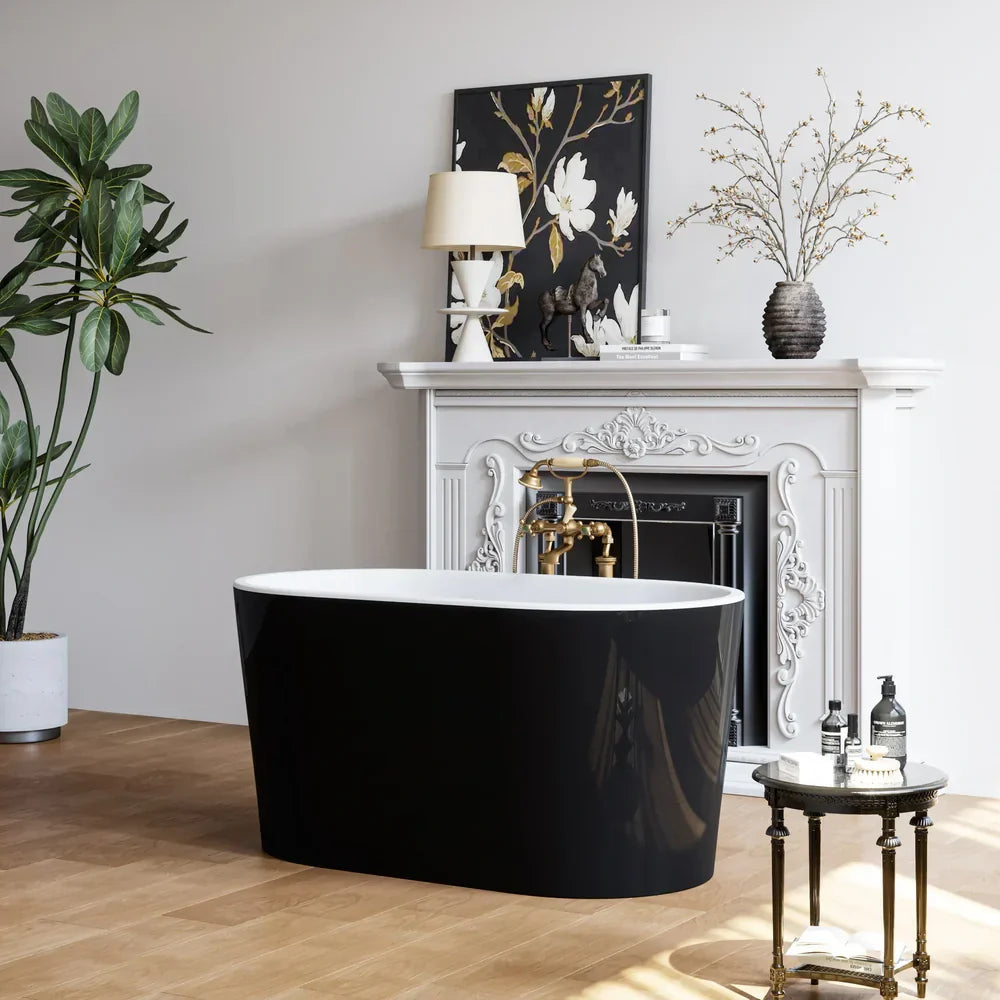
A 67-inch double ended soaking tub sits in a sweet spot: it looks “high-end freestanding,” it usually fits in a normal primary bathroom, and it gives you two sloped ends so you can recline from either side.
But it’s also one of the easiest tubs to buy with the wrong expectations—especially around two-person comfort, center-drain plumbing, and how much space you really need around a freestanding tub.
What follows is a decision-first guide to help you choose with confidence, avoid the common mistakes, and plan your install before the tub shows up at your door.
Decision Snapshot: should you buy a 67" double ended soaking tub?
Before diving into the details, let’s quickly run through the must-know limits that will make or break your 67" double ended soaking tub experience.
Non‑negotiables
Before buying a 67" double ended soaking tub, confirm three non‑negotiable constraints: 24–30" of walk‑around clearance for safe, comfortable movement; feasible center‑drain plumbing access or relocation; and realistic two‑person comfort—this size works best for solo use, with only occasional shared soaking.
Best fit
-
You want a symmetrical freestanding bath for solo or occasional two-person reclining.
-
You prioritize a deep soaking experience over daily shower use.
-
You’re remodeling and can plan for a center-drain installation.
-
You have 24–30" of clear walk-around space in your bathroom.
Avoid it if
-
You need a truly comfortable, full‑time two‑person bathing experience.
-
You have a tight door, hallway, or stair clearance for delivery.
-
You cannot relocate plumbing to support a center drain.
-
You need a stable, flat standing area for daily shower use.
Pre‑buy measurement check
Before purchasing, confirm three critical measurements: bathroom clearance around the tub, doorway/hall/stair width for safe delivery, and interior basin length vs. exterior tub size—interior dimensions determine real comfort, not just outer specs.
Rule of thumb: choose 67" only if you can keep 24–30" of walk‑around space and you’ll actually use the deep soak.
Freestanding tubs need breathing room. If you can’t keep roughly 24–30 inches of clear space on the main walking side, your bathroom may feel pinched fast. (More is better if two people will pass each other.)
Will this work in a small bathroom, or will it crowd everything?
In a small bathroom, a 67" freestanding tub can work only if the rest of the layout is simple: a smaller vanity, a compact toilet zone, and a clear path that doesn’t force you to “shimmy” between the tub and a wall. If you’re already tight around the toilet or vanity, a freestanding tub often makes daily life feel cramped—even if the tub technically fits.
Rule of thumb: choose 67" only if you can keep 24–30" of walk-around space and you’ll actually use the deep soak
Freestanding tubs need breathing room. If you can’t keep roughly 24–30 inches of clear space on the main walking side, your bathroom may feel pinched fast. (More is better if two people will pass each other.)
Will this work in a small bathroom, or will it crowd everything?
In a small bathroom, a 67" freestanding tub can work only if the rest of the layout is simple: a smaller vanity, a compact toilet zone, and a clear path that doesn’t force you to “shimmy” between the tub and a wall. If you’re already tight around the toilet or vanity, a freestanding tub often makes daily life feel cramped—even if the tub technically fits.
Is a Double Ended Soaking Tub 67" the right size, depth, and basin shape for you?
Most 67" models land around 67" long and 29–31.5" wide, and many have a soaking depth in the 14–17" range (varies by how it’s measured and where the overflow sits). Those numbers sound straightforward, but the way the interior is shaped matters more than the spec sheet headline.
Wide 67 inch soaking basin: how width (29–31.5") changes elbow room, shoulder comfort, and turning
Width is where people either feel “wrapped in comfort” or “stuck in a narrow trough.”
-
Around 29" wide: Often feels sleek and space-saving. Good for smaller bathrooms. Some adults with broader shoulders feel confined, especially when trying to shift positions.
-
Around 31–31.5" wide: A wide 67 inch soaking basin tends to feel more relaxed. You get more elbow room and it’s easier to rotate your hips or reposition without scraping the sides.
What I’ve seen in real bathrooms: a tub that’s “only” 2 inches wider can feel meaningfully more comfortable, but it also pushes you closer to walls and vanities. Width is comfort and layout pressure at the same time.
Soaking depth reality (14–17"): who feels “fully submerged” and who won’t
Many people buy a soaking tub expecting a chest-deep soak. Then they fill it, settle in, and realize the waterline sits lower than expected.
A few practical truths:
-
If you’re shorter, a 14–17" soaking depth can feel great.
-
If you’re tall (or long-torso), you may not feel “fully submerged” unless the tub has a deeper interior and the overflow is positioned to allow a higher fill.
-
Your body displaces water, but the overflow sets the max fill. That’s why two tubs with the same “depth” can feel different.
If deep soaking is the whole point for you, look beyond the marketing term “soaking.” Ask for (or measure) the water depth to overflow and compare it across options.
Sloped ends & double-ended ergonomics: neck/back support vs “pretty but slippery” lounging
A double ended tub usually has two sloped ends and a drain in the center. That symmetry is the appeal.
Comfort-wise:
-
The slope can support your back, but many tubs have limited neck support. If you like a long soak, you may still want a bath pillow.
-
Some designs are very smooth and gently curved. They look great, but they can feel a bit slippery when you try to “lock in” a lounging position.
A quick test that helps: imagine where your shoulder blades land. If the slope starts too low, you slide. If it’s too upright, you sit instead of recline.
Symmetrical freestanding bath: when the centered look matters (and when it doesn’t)
A symmetrical freestanding bath makes sense when the tub is a visual feature—centered under a window, aligned with a light fixture, or placed so you see it right when you walk in.
When it doesn’t matter as much:
-
If one end is always against a wall.
-
If you’ll use it mostly as a practical tub and not as the design focal point.
-
If plumbing constraints make an end drain far cheaper and easier.
In those cases, a single-ended or end-drain layout can give you similar bathing comfort with fewer install compromises.
The deal‑breaker trade‑offs: double‑ended + center drain vs other tub layouts
The core trade‑off of a 67" double ended soaking tub is between comfort and installation: you gain symmetric, centered‑drain lounging at both ends for a premium soaking experience, but you often compromise on plumbing access, floor modification needs, and practicality for regular shower use. This balance will define your total cost and daily functionality.

Center drain 67" soaking tub vs end drain: comfort in the middle vs plumbing constraints at the floor
Before committing to a center‑drain tub, verify three key scope items: whether you can open the floor to adjust drainage, if joists allow center‑drain positioning, and if proper venting can be installed. These act as hard decision gates for whether the layout is realistic.
Why is the drain in the center of the tub?
Because in a double ended tub, you recline on either end. A center drain keeps the drain and overflow away from where your back and hips typically land, so you’re not sitting on hardware.
Comfort benefits:
-
No drain under your lower back.
-
Both ends feel the same.
-
Works naturally for solo soaks—pick either end.
The trade-off:
-
The bathroom floor drain location matters a lot. If your existing drain is at one end (common in alcove tubs), moving it to center can mean opening the floor, adjusting joists, and reworking venting.
Is it harder to clean the middle drain?
Not usually. A center drain is easy to reach while standing next to the tub. The real cleaning issue is the finish and crevices of the drain cover/stopper, not the location. Choose a drain design that doesn’t trap grime around tiny seams, and avoid harsh cleaners that dull finishes.
Double ended vs single ended: what you gain (two lounging ends) and lose (flat standing zone, shower pairing)
If you plan to use your tub as a daily shower base, a double‑ended freestanding model is not recommended. The sloped ends create less secure standing space, and splash control and usability will be far more challenging than with a standard tub/shower combination.
What you gain with double ended:
-
Two lounging ends (nice if you like choice, or share the tub occasionally).
-
Better symmetry in a freestanding layout.
-
Center drain comfort.
What you lose:
-
A true “flat end” standing zone. In many double‑ended tubs, both ends are sloped, so standing to shower or shave legs can feel less secure.
-
Easy tub/shower pairing. Freestanding tubs can work with a shower, but it’s often more complicated and splash‑prone than a standard alcove tub/shower.
Large acrylic double ended bath vs cast iron: weight, feel, heat retention, and rust/chip risk
Most 67" double ended freestanding tubs you’ll see are acrylic. There’s a reason: a large tub is hard enough to deliver and install without adding cast iron weight.
Acrylic (common choice)
-
Pros: lighter, easier to get upstairs, generally warmer to the touch, easier install, usually good value.
-
Cons: can scratch, and lower-end shells can flex or feel “drummy” if not reinforced well.
Cast iron (less common in freestanding double-ended at this size)
-
Pros: excellent heat retention and a solid feel.
-
Cons: extremely heavy, harder install, and if the coating is poor, chipping and rust at the base can become a real problem. I’ve seen people discover coating issues early—sometimes even before the tub gets real use—because the base area sees moisture and cleaning right away.
If you’re choosing based on longevity, don’t assume cast iron automatically wins. In real bathrooms, a well-built acrylic freestanding tub can be the safer long-term bet than a poorly coated cast iron tub.
Is a freestanding tub worth it if you’re replacing an alcove tub/shower?
It depends on how you live.
A freestanding tub is “worth it” if:
-
You take baths often.
-
You can keep the bathroom feeling open (walk-around space).
-
You’re comfortable with more involved cleaning around the tub.
-
You’re already renovating floors and plumbing.
It’s usually not worth it if:
-
You mainly shower and the tub is occasional.
-
You’re trying to avoid opening floors/walls.
-
You need grab bars, easy entry, or a daily-use shower setup.
Many regrets come from forcing a freestanding tub into a bathroom that was designed for an alcove tub/shower. The room can end up pretty, but less usable.

Total cost & practical constraints
Total installation cost often exceeds the tub price itself. Plumbing relocation, faucet rough‑in, and extra labor for floor or wall modifications can quickly push your budget beyond the initial product cost—plan for these expenses early.
Real budget ranges: tub + drain/overflow + faucet + installation (DIY vs plumber)
Typical cost buckets:
-
Tub (acrylic): often mid-range to higher depending on reinforcement, finish (glossy white vs matte), and overflow/drain quality.
-
Drain/overflow kit: sometimes included, sometimes not. If it’s missing a small part (like a drain plug/stopper), it can stall the whole project.
-
Faucet: floor-mounted and wall-mounted options vary widely. The valve and rough-in can be a big chunk.
-
Installation: freestanding tubs can be “simple” physically, but the plumbing accuracy is not forgiving—especially with a center drain and tiled floor.
If you’re paying a plumber, budget for extra time if the drain isn’t perfectly aligned, if your floor is uneven, or if you need access panels you didn’t plan for.
Shipping and delivery reality
Freestanding tubs are large, awkward, and prone to shipping scuffs. Also, it’s not rare for a box to arrive missing a small but critical component (like a stopper or a tailpiece).
Before you sign delivery:
-
Measure all doorways, halls, and stairwells before ordering.
-
Confirm delivery path clearances to avoid return or re-delivery fees.
-
Check weight capacity for your home and flooring structure.
-
Verify delivery appointment windows and inside delivery options.
-
Confirm drain, overflow, and stopper are included before installation.
Ongoing cost: water capacity (56–64 gal) and what it does to hot-water supply and energy use
A common question is: How many gallons to fill a 67-inch tub?
For a 67" soaking tub, a typical fill can land around 56–64 gallons, depending on the interior shape and how high you can fill before the overflow.
Two practical impacts:
-
Hot water supply: If your water heater is sized for quick showers, a deep soak can use a big portion of your hot water in one go.
-
Energy use: Heating that water costs money. If you’re a frequent soaker, it’s worth checking your water heater capacity and recovery rate.
If you want 20–40 minute soaks, heat retention and insulation (covered later) also affect how often you top off with hot water.
Visual: quick cost table with “minimum workable” vs “premium” purchase paths
| Cost area | Minimum workable path | Premium path |
| 67" acrylic double ended tub | Mid-range acrylic shell, basic reinforcement | Heavier reinforcement, better finish consistency, better overflow hardware |
| Drain/overflow | Standard kit, basic stopper | Higher-quality trim/stopper, easier-to-clean design |
| Faucet | Basic tub filler (floor or wall) | Higher-grade valve/trim, smoother handle action, better serviceability |
| Installation | Straightforward rough-in, open access | More complex plumbing relocation, access panel planning, floor flattening |
| Typical risk | Flex/wobble, missing small parts | Higher upfront cost, but fewer “do-over” labor charges |
The key point is not the exact dollars—it’s that labor and plumbing changes can cost as much as (or more than) the tub if the bathroom isn’t already set up for a center drain freestanding tub.
Fit & installation realities
A freestanding tub installed can look simple in photos. In real homes, the hard part is planning: floors, drain rough-in, and faucet rough-in.
Floor load + leveling: tub weight + water + bather, uneven floors, and wobble fixes
Even an acrylic freestanding tub gets heavy when filled.
Quick math that surprises people:
-
Water weighs about 8.34 lb per gallon.
-
A 60-gallon fill is about 500 lb of water, plus the tub, plus the bather.
Most modern floors can handle normal bathroom loads, but the issue I see more often isn’t “collapse”—it’s leveling and wobble on tile.
What helps:
-
Check the floor for flatness where the tub feet/base will sit.
-
Know how your tub is supported (full bottom support vs small feet points).
-
Plan to level correctly before final hookup.
Some installers use careful shimming; others use support methods under the base. The goal is the same: no flex, no rocking, and no stress on the drain connection.
Rough-in accuracy: center drain placement, riser height, and tolerance before tile goes down
Even small misalignments in rough‑in measurements can lead to costly rework, drainage issues, or poor fit once the tub is set.
What happens if your drain isn’t centered under a center-drain tub?
If the drain is off-center, you have a few outcomes—none are ideal:
-
The tub won’t sit in the intended spot (you shift the tub, and now the layout looks wrong).
-
The drain connection is forced at an angle, which can leak over time.
-
You end up opening the floor again to move the pipe.
This is why a center drain tub is best when you’re already planning a remodel that allows floor access.
Faucet options that actually work: floor-mounted vs wall-mounted
Freestanding tubs usually pair with either a floor-mounted tub filler or a wall-mounted tub filler.
Floor-mounted faucet
-
Pros: common choice for freestanding tubs, works even if the tub isn’t near a wall.
-
Watch-outs: you need the correct rough-in location, and the faucet base must land where it won’t interfere with the tub rim or supply lines.
Wall-mounted faucet
-
Pros: cleaner floor, easier to mop around, can look very modern in a contemporary bathroom.
-
Watch-outs: valve depth and alignment matter a lot. If the valve is set too deep or too shallow, trim pieces may not fit right. Also, once the wall is tiled, access is limited unless you planned an access route.
If you’re unsure, floor-mounted is often more forgiving in remodels. Wall-mounted can be great, but only when the rough-in is planned carefully.
Daily-use comfort: how a 67" soaking tub feels after the remodel hype
This tub style is not ideal if you have knee or hip limitations, need reliable grab bars, or require a stable, flat standing zone for safe entry and exit. Sloped rims and limited secure footing create real usability risks.

Two-person 67 inch bathtub expectations
A tub can look perfect and still disappoint in daily use. Comfort comes down to interior length, rim height, water warmth, and stability.
Two-person 67 inch bathtub expectations: when it’s romantic vs cramped
Use interior basin length and the flat central area as your main sizing metric—these determine real two‑person comfort. Do not rely only on exterior tub length, as it does not reflect usable space.
Most 67" models land around 67" long and 29–31.5" wide, and many have a soaking depth in the 14–17" range (varies by how it’s measured and where the overflow sits). Those numbers sound straightforward, but the way the interior is shaped matters more than the spec sheet headline.
Entry/exit and rim height: who will struggle and what to do instead
Freestanding soaking tubs often have taller sides than a standard alcove tub. That looks sleek, but it can be harder to step over.
Consider alternatives if:
-
Anyone in the home has knee/hip issues.
-
You need a secure standing area.
-
You want grab bar support (freestanding layouts make grab bar placement trickier).
If you still want the look, plan for:
-
Non-slip bath mats designed for soaking tubs.
-
A nearby stable grab point (properly anchored).
-
A tub with a rim height you’ve tested in person when possible.
Heat retention: acrylic cooling vs optional insulation for 20–40 minute soaks
Acrylic feels warm to the touch, but bath water still cools during a long soak.
If you like long soaks:
-
Look for an acrylic tub with better thickness and reinforcement. Thin shells tend to feel cooler and can flex.
-
Consider insulation strategies during installation if access allows. Some people add insulation around the underside area (done carefully so it doesn’t interfere with leveling, drainage, or future access).
Also, think about your bathroom temperature. A cold room cools bathwater faster than most people expect.
Sound and stability on tile: vibration, flex, and how reinforced acrylic changes the experience
One of the biggest “feel” differences between tubs is sound:
-
A lower-quality acrylic tub can sound hollow when filling and can feel slightly bouncy.
-
A better-supported acrylic freestanding tub feels quieter and more solid.
If you’re sensitive to that, don’t ignore it. In daily use, a tub that flexes a little can feel cheap even if it looks great.
Maintenance, risks, and long-term ownership (what buyers regret later)
This is where real life shows up: hair dye, bath oils, cleaners, kids, pets, and the occasional dropped shampoo bottle.
Post-delivery + pre-install checklist: verify all components, dry-fit plumbing, pressure test, and document issues fast
A lot of remodel stress comes from discovering problems after the tub is in the bathroom and the old one is gone.
Before you commit to install:
-
Verify you have every part that’s supposed to come with the tub (including small items like the stopper).
-
Dry-fit the drain alignment to the floor rough-in.
-
If your faucet is wall-mounted, confirm valve depth and trim fit before tile.
-
Document any defects quickly—many sellers have tight “business days” windows for reporting shipping issues.
Acrylic freestanding tub upkeep: scratch prevention, cleaner do’s/don’ts
Acrylic is popular because it’s easy to live with, but it’s not bulletproof.
To avoid regrets:
-
Skip abrasive powders and rough scrub pads. They can dull the finish and create fine scratches that hold dirt.
-
Use mild, non-abrasive cleaners.
-
Rinse after bath oils or salts when possible.
White finishes (gloss or matte) show grime differently:
-
Glossy white shows water spots but wipes clean easily.
-
Matte white can hide water spots better but may show scuffs if you use the wrong cleaner.
If you have kids bathing often, acrylic is usually a practical choice—as long as you treat it like a finish, not a concrete floor.
Cast iron caution: rust at the base, chipping paint/coating, and when it’s a no-go
Avoid cast iron if coating quality is uncertain: chipping or poor finishing exposes the base to moisture, leading to early rust at the base. Only choose cast iron if you can confirm durable, chip‑resistant coating.
If you’re considering cast iron for the premium feel, pay close attention to coating quality and base protection.
Why the base matters:
-
Moisture gets trapped under and around freestanding tubs.
-
Cleaning water can reach places you don’t see.
-
If the coating chips near the base, rust can start and spread.
If you do go cast iron, inspect immediately after delivery and before installation. Problems are much easier to address before the tub is set and plumbed.
Warranty and durability signals: what “premium” really means
“Premium” should mean something specific, not just a price tag.
Better durability often comes from:
-
Thicker acrylic or better reinforcement layers (less flex).
-
A well-supported base (less stress on plumbing joints).
-
A higher-quality overflow and drain assembly.
-
A clear, written warranty that covers more than shipping damage.
Be cautious with vague warranty language. A good warranty is specific about what’s covered and for how long.

Before You Buy checklist
-
Measure your bathroom and confirm 24–30" walk-around clearance on the main path.
-
Confirm the interior basin length (not just 67" exterior) for your height.
-
Decide if you can relocate plumbing to a center drain (or confirm it already is).
-
Check doorways, hall turns, and stairs for delivery clearance of a 67 inch freestanding tub.
-
Confirm what’s included: drain/overflow, stopper, and any access parts.
-
Plan faucet type early: floor-mounted vs wall-mounted, with rough-in dimensions.
-
Verify floor readiness: flatness, leveling plan, and whether reinforcement is needed.
-
Read the warranty details and keep all delivery photos and paperwork.
FAQs
1. Can two adults fit in a 67-inch tub?
Most 67-inch double ended soaking tubs can technically fit two adults, but “fit” doesn’t always mean comfortable. The interior basin length and the sloped ends matter more than the exterior 67" measurement. With two people, shoulder and knee space can feel tight, especially around the center drain 67" soaking tub’s flat area. If you plan frequent two-person baths, consider wider or longer tubs, but for occasional shared soaks, a 67-inch tub works reasonably well. Material also plays a role—acrylic tends to feel warmer and slightly more forgiving, while cast iron can be heavy and less flexible, making positioning trickier. Overall, one adult can lounge comfortably, while two adults need to accept that it will be a cozier experience rather than a fully spacious soak. Measuring your interior basin length before purchase is key to avoid surprises.
2. Why is the drain in the center of the tub?
A center drain 67" soaking tub puts the drain in the middle so neither end gets in the way while lounging. This is especially important for double ended soaking tubs, where both ends are sloped for reclining. By centering the drain, you avoid sitting on the hardware, which keeps both ends comfortable for solo or occasional two-person use. It also helps balance water drainage and overflow functionality. However, it does come with trade-offs: plumbing may need floor modifications, joist adjustments, or venting changes, so it’s a pre-install decision that can’t be ignored. Most tubs use acrylic or other lightweight materials, which make positioning and installing a center drain easier than heavier materials like cast iron. The key takeaway is that a center drain is about maximizing comfort and symmetry while planning ahead for installation logistics.
3. Is double ended better for single soaking too?
Yes! Even if you mostly soak alone, a double ended soaking tub 67" is still a great choice. Both ends are sloped, so you can recline whichever way feels most comfortable, which adds a little luxury and flexibility. A 67-inch tub gives you plenty of length for stretching out, while a center drain 67" soaking tub keeps your feet and lower back clear. Material matters too—acrylic tends to warm up faster and feels softer to the touch, while cast iron keeps water hotter longer but can be less forgiving when moving around. Essentially, double-ended isn’t just for two people; it’s also about symmetry, ergonomic comfort, and giving you multiple lounging options even for solo baths. So, you get the best of both worlds: design aesthetics and personal comfort.
4. How many gallons to fill a 67-inch tub?
A typical 67-inch double ended soaking tub holds around 56–64 gallons, though it depends on interior shape and how high you fill before hitting the overflow. Center drain 67" soaking tubs may have slightly less usable capacity in the middle flat area because the drain takes up space. The material also affects heat retention—acrylic warms quickly but cools faster, while cast iron holds heat longer, which can change how often you top up with hot water. If you’re a frequent soaker, it’s worth knowing your water heater capacity and recovery rate. Energy use is another consideration; filling 60 gallons of water multiple times adds to heating costs. Measuring the interior basin volume gives a more realistic picture than relying solely on the 67-inch exterior length.
5. Is it harder to clean the middle drain?
Not really. A center drain 67" soaking tub is usually just as easy to clean as an end drain if you choose a smart drain design. The key is that the drain is fully accessible while standing next to the tub, and high-quality materials matter. Acrylic drains are lighter and less prone to scratches, making them easier to wipe down, while cast iron or lower-quality materials may trap dirt around seams if the finish isn’t smooth. Avoid drains with overly intricate patterns or tiny crevices, and skip abrasive cleaners to preserve the tub material. Regular rinse after each soak helps, especially if you use bath oils or salts. Overall, a center drain doesn’t complicate cleaning—it just requires a little attention to the finish and careful product choice.
References


Leave a comment
This site is protected by hCaptcha and the hCaptcha Privacy Policy and Terms of Service apply.