




Which Toilet Should You Choose?
For many older adults who have difficulty sitting or standing, the best default is a comfort-height toilet with an elongated bowl. It can reduce deep knee bending and provide more adult sitting room. However, it is a good choice only when the primary user can keep both feet firmly on the floor and the longer bowl does not restrict the transfer path.
Choose a standard-height toilet when a taller seat leaves the user’s feet dangling or makes controlled lowering difficult. Choose a round bowl when the door, vanity, walker, or caregiver needs the space that an elongated toilet would occupy. Choose a raised seat or safety frame when the need is temporary, changing, or centered on arm support.
The right toilet depends on the user’s body size, hardest bathroom task, available support, and room layout—not a “senior” or “comfort” label.
Choose Comfort-Height Elongated for Easier Transfers
A comfort-height elongated toilet is a strong long-term choice when:
- Rising from a low seat is the main difficulty.
- The user has limited knee or hip movement.
- Both feet remain flat at the finished seat height.
- The room provides an unobstructed approach and enough space for assistance.
- The preferred height has been tested by the primary user.
The taller position can make standing more chair-like, while the elongated bowl gives an adult more front-to-back sitting room.
Choose Alternatives for Short Users or Tight Rooms
Comfort-height elongated toilets are less suitable when the user is short, lowering is harder than rising, or bathroom depth is limited.
In those situations:
- Choose standard height for more reliable foot contact.
- Choose a round bowl to preserve door, walker, or caregiver clearance.
- Choose a removable riser to test additional height.
- Choose a safety frame when pushing with the arms is more important than added height.
- Consider bidet functions only when reaching or personal hygiene is the primary limitation.
Decision Snapshot: Who Should Choose What?
Choose Taller Elongated for Stable Adult Transfers
Choose a comfort-height elongated toilet when the primary user repeatedly struggles to stand from a lower fixture and can sit securely at the proposed height. It generally suits a private or primary bathroom with adequate front and side space.
Do not choose it solely because taller toilets are marketed for older adults. The finished seat height still needs to fit the individual user.
Choose Standard Height When Feet Dangle
A standard-height toilet may be the better option when:
- A taller seat prevents firm foot contact.
- The user slides forward to reach the floor.
- Lowering onto a high seat feels uncontrolled.
- Shorter adults or children regularly share the bathroom.
- The user prefers a less chair-like position.
A toilet that requires more knee bending may still feel more stable to a shorter person.
Choose Round Bowls When Clearance Is Tight
Choose a round bowl when preserving the approach path matters more than maximizing sitting space. This can be important when:
- The bathroom door passes close to the toilet.
- A vanity narrows the approach.
- A walker must remain beside or in front of the user.
- A caregiver needs working space.
- The current toilet already makes turning difficult.
Compare the complete fixture dimensions rather than relying on the bowl label alone. The tank and base also affect how far the toilet projects into the room.
Choose Add-Ons for Temporary or Changing Needs
A raised seat or toilet safety frame can be more practical than replacement when the user is recovering, mobility is changing, the home is rented, or the preferred height remains uncertain.
A raised seat adds height without permanently changing the toilet. A safety frame provides arm support for standing and controlled lowering. Some products combine both functions, but compatibility and stability must be checked against the toilet and the manufacturer’s instructions.
Best Toilet for Seniors vs Alternatives
Comparison Table: Height, Space, Support, Ownership
| Option | Best suited to | Main advantage | Main limitation | Ownership fit |
|---|---|---|---|---|
| Comfort-height elongated | Adults who struggle to rise and have adequate room | Easier rising for many users plus generous sitting space | Can be too tall or project too far | Stable, long-term needs |
| Comfort-height round | Users who need more height in a compact room | Combines a taller seat with reduced projection | Less front-to-back sitting room | Long-term use in smaller bathrooms |
| Standard-height elongated | Shorter users who still want adult bowl space | Better foot contact for some users | Requires deeper knee bending | Shared or private bathrooms |
| Standard-height round | Short users and very compact layouts | Preserves the most room around the fixture | Can feel cramped to larger adults | Small or shared bathrooms |
| Raised toilet seat | Temporary recovery or uncertain height needs | Reversible and useful for testing height | May add movement and cleaning surfaces | Rental or short-term use |
| Safety frame | Users who need arm support | Helps with pushing up and controlled lowering | Requires usable space around the toilet | Temporary or long-term support |
| Bidet seat | Users with reaching or hygiene limitations | Assists with washing without occupying floor space | Adds controls, cleaning, and service considerations | Stable hygiene needs |
| Smart toilet | Users who can manage automated controls | Can combine hygiene and convenience features | More complex to install, operate, and service | Households prepared for added maintenance |
Start with transfer stability and room fit. Construction style and extra features should be secondary decisions.
Comfort-Height Elongated vs Standard-Height Toilets
A comfort-height toilet can reduce the amount of knee and hip bending required to sit and stand. That makes it a reasonable choice when rising from a low fixture is the user’s main challenge.
Standard height is often better when secure foot contact is the priority. It can also suit a shared bathroom where a fixed taller seat would be awkward for shorter household members.
Test the finished seat height, not just the ceramic bowl height. The toilet seat or bidet attachment can change the final sitting position, and product listings may not all describe height in the same way.
Permanent Toilet vs Raised Seat or Safety Frame
A permanent comfort-height toilet is usually the more integrated option for a stable, long-term need. It avoids placing a removable riser on the bowl and may have fewer accessory joints or clamps to clean.
A raised seat is more flexible. It can help during temporary recovery, provide a trial before replacement, or accommodate changing mobility. The trade-off is that some risers reduce the usable opening, move under load, or create additional cleaning areas.

A safety frame addresses a different problem: the need to push with the arms or control the descent. If balance or upper-body support is the main concern, a frame or appropriately planned fixed support may matter more than toilet height.
Basic Toilet vs Bidet or Smart Features
A basic toilet addresses elimination and transfers. Bidet functions address washing and reaching. Smart controls may add automatic operation, but they do not correct poor seat height, blocked floor space, or missing support.
A bidet seat or smart toilet is most useful when the user has difficulty reaching, twisting, or cleaning with toilet paper and can operate the controls confidently. Before choosing one, check:
- Whether the controls are easy to identify and reach.
- How the added seat changes the finished height.
- What cleaning and routine service the unit requires.
- Whether replacement parts and support are available.
- What installation conditions the manufacturer specifies.
- Whether essential functions remain understandable to every regular user.
Electric features may require power planning. Follow the product instructions and use appropriately qualified help when electrical work is involved.
HOROW Toilet Options to Compare

HOROW ST076W
A comfort-height elongated one-piece toilet for buyers considering a conventional design. Confirm the finished seat height and bathroom clearance before choosing.
View ST076W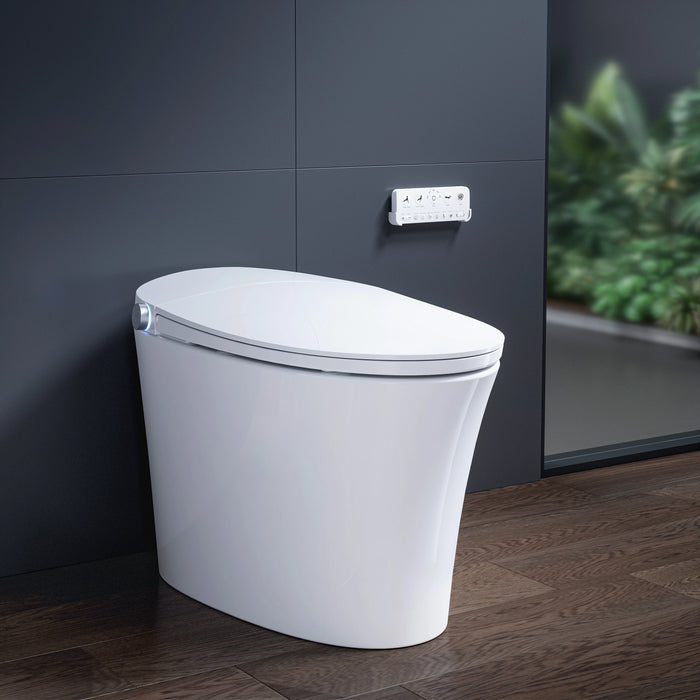
HOROW T33
A smart toilet with built-in bidet washing for buyers considering additional hygiene features. Check the controls, finished seat height, and installation requirements.
View T33Key Differences That Actually Matter
Can Both Feet Stay Flat?
Foot contact is one of the most useful fit tests. Have the intended user try a stable seat close to the proposed finished toilet height while wearing normal bathroom footwear.
Check whether the user can:
- Rest both feet firmly on the floor.
- Sit without sliding toward the seat edge.
- Reposition without feeling unstable.
- Lower with control.
- Stand without pulling on unsuitable bathroom fixtures.
If the feet dangle or the seat edge presses uncomfortably into the thighs, the proposed toilet may be too tall. A standard-height model or a smaller removable height increase may be better.
A chair test can narrow the options, but it does not duplicate a toilet perfectly. Cushions compress, seat shapes differ, and arm support changes the movement. When transfer safety is uncertain, seek an assessment appropriate to the user’s needs.
Will Extra Bowl Length Block Transfers?
An elongated bowl can offer more sitting room, but it also uses more front-to-back space than a comparable round bowl. The practical question is not whether it fits between the walls; it is whether the person can approach, turn, sit, stand, and leave without obstruction.

Use the exact product drawing to mark the proposed footprint with painter’s tape or cardboard. Then test the layout with:
- The door fully open.
- The walker or other mobility equipment in its normal position.
- The user’s usual turning direction.
- The caregiver standing where assistance is normally provided.
- Nearby drawers, cabinets, and shower doors open where relevant.
Do not assume mobility equipment can be folded or moved for every bathroom visit. The layout should work with the user’s normal routine.
Does the User Need Height or Arm Support?
Height and support solve different problems.
Choose additional height when deep knee bending and rising from a low position are the main difficulties. Choose arm support when the user needs help with balance, pushing upward, or lowering slowly. Some people need both.
Do not rely on a towel bar, sink, toilet tank, door handle, or freestanding furniture for transfer support. If permanent support is planned, its location and mounting should be evaluated in relation to the wall structure, toilet position, and intended user.
A taller toilet alone is not a complete accessibility solution. Lighting, floor condition, approach space, seat stability, and the user’s transfer method can also affect everyday usability.
Is Easier Cleaning Worth Harder Installation?
A one-piece toilet combines the tank and bowl, eliminating the tank-to-bowl seam and potentially making the exterior easier to wipe. A smooth or skirted base may also reduce exposed contours.
The trade-off is handling and service access. A one-piece fixture must be moved as a single unit, and some concealed or skirted designs can make mounting points, seat fasteners, the supply connection, or the shutoff valve harder to reach.
A two-piece toilet separates the tank and bowl, so each component can be carried into the bathroom individually. It has an additional seam and connection, but it may be easier to handle and service.
Choose one-piece when minimizing seams is important and the room allows practical installation and future access. Choose two-piece when handling, component replacement, or straightforward service is the priority. You can compare one-piece toilet configurations after deciding on height, bowl shape, and room fit.
When the Best Toilet for Seniors Is Better
Choose Height When Rising Is Hardest
A comfort-height toilet is most useful when the user consistently struggles to rise from a lower seat. It may also reduce the need for a thick removable riser, provided the user remains stable and can keep both feet planted.
Additional height is less useful when the principal difficulty is balance, wiping, approaching the toilet, or controlling the descent. Those problems require different solutions.
Choose Elongated When Adult Comfort Leads
An elongated bowl is preferable when the user values additional sitting room and the bathroom can accommodate the complete fixture without compromising movement. It is particularly reasonable in a private bathroom where the layout can be planned around one primary user.
Do not prioritize the larger sitting surface if it narrows the transfer path. In a compact room, the clearance saved by a round bowl may contribute more to usability than the elongated shape.
Choose Permanent Fixtures for Stable Long-Term Needs
A permanent comfort-height toilet makes sense when:
- The user has tested and accepted the height.
- The mobility need is expected to remain relatively stable.
- The room accommodates the selected bowl and base.
- Other household users can use the fixture comfortably.
- The existing toilet is already due for replacement.
Long-term ownership also makes cleaning and service access important. Before ordering, confirm that the seat fasteners, water connection, shutoff valve, and areas behind the fixture will remain reachable.
Choose It Only With Adequate Transfer Space
A suitable toilet must work as part of the whole room. A model can have the preferred height and bowl shape yet remain difficult to use because the door, vanity, support frame, or mobility equipment blocks the approach.
Measure the existing connection and compare it with the manufacturer’s installation drawing. Check total projection, side access, door movement, seat clearance, supply access, and the space required by any safety frame or bidet attachment. If the plumbing position or installation conditions are unclear, have them inspected before purchase.
When the Alternative Is Better
Would a Taller Seat Make Lowering Unsafe?
Choose an alternative when the user cannot lower comfortably onto a taller seat, loses foot contact, or must slide forward to stand. Selecting the tallest available fixture can create instability rather than solve it.
The right height is the lowest position that supports manageable sitting and standing without requiring excessive knee bending or sacrificing stable posture. That balance varies by person.
Choose Standard Height for Shorter Shared Users
Standard height can be the better compromise in a shared bathroom used by short adults or children. A removable riser can then provide additional height for one user without permanently raising the fixture for everyone.
If one person’s needs cannot be reconciled with those of other regular users, consider whether another bathroom can be adapted more specifically rather than forcing an uncomfortable fixed height on the household.
Choose Round Bowls to Preserve Approach Space
Choose a round bowl when an elongated model would interfere with the door, vanity, walker placement, caregiver position, or normal turning path. This is a functional choice, not merely a space-saving preference.
Round bowls provide less front-to-back sitting room, so the user should still test the seat shape when possible. Compare complete fixture dimensions across available toilet styles rather than assuming every round or elongated toilet projects the same distance.
Choose Risers When Needs May Change
A removable riser is a useful first step when the ideal height is unknown, recovery is temporary, or a larger renovation is planned later. It allows the household to evaluate whether extra height actually improves transfers.
Check that the riser is approved for the toilet shape and installed according to its instructions. Reconsider the setup if it shifts, narrows the opening too much, interferes with hygiene, or encourages the user to grab the seat itself for support.
Final Verdict: Which Option Wins?
Best Default: Comfort-Height Elongated
For an older adult who has difficulty rising, can keep both feet flat, and has adequate transfer space, a comfort-height elongated toilet is the strongest default. It combines a more chair-like position with generous adult sitting room.
It is not a universal winner. Individual fit and room clearance take priority over the category label.
Best Exceptions: Short Users and Tight Rooms
Choose standard height when a tall seat causes dangling feet, awkward lowering, or discomfort for shorter regular users. Choose a round bowl when preserving approach and turning space is more important than additional bowl length.
For temporary or uncertain needs, try a compatible raised seat or safety frame before committing to a permanent replacement.
Choose Bidet Features Only for Hygiene Limitations
Bidet or smart features are worth considering when reaching and personal hygiene are the primary difficulties. They are less suitable when the actual problem is standing, balance, limited floor space, or unavailable transfer support.
Keep the controls as simple as the intended user needs, and account for the added cleaning, installation, and service requirements.
Decision Checklist: Test, Measure, Support, Service
Before buying:
- Identify the hardest task: approaching, lowering, standing, balancing, or cleaning.
- Test the proposed finished seat height with the primary user.
- Confirm that both feet stay firmly on the floor.
- Measure the existing connection and compare it with the product drawing.
- Check total projection, door swing, vanity clearance, and side access.
- Test the layout with normal mobility equipment and caregiver positioning.
- Decide whether the user needs height, arm support, hygiene assistance, or a combination.
- Confirm that the seat, shutoff valve, supply connection, and service points remain accessible.
- Review the manufacturer’s installation and compatibility instructions.
- Add bidet or smart features only when they address an identified need.
Common Questions
What toilet height is best for seniors?
The best height is one that makes sitting and standing manageable while allowing both feet to remain firmly supported. Comfort height suits many older adults, but standard height can be better for shorter users or anyone who feels unstable on a taller seat.
Are elongated toilets better for seniors?
Elongated toilets often provide more adult sitting room, but they are better only when the added projection does not restrict the door, vanity, walker, caregiver position, or transfer path. A round bowl is often more usable in a compact bathroom.
Is a comfort-height toilet worth it?
It can be worth replacing a lower toilet when rising is a recurring problem, the preferred height has been tested, and the bathroom will be used for years. A removable riser may be more appropriate for temporary recovery or uncertain mobility needs.
Is a raised seat better than replacing the toilet?
A raised seat is better for temporary needs, rental homes, changing mobility, or testing additional height. A permanent comfort-height toilet is generally more integrated for a stable, long-term need, but it requires greater confidence in the selected height.
Does a toilet for seniors need a bidet?
No. A bidet may help a person who has difficulty reaching, twisting, or cleaning with toilet paper. It does not correct an unsuitable seat height, poor balance, missing support, or inadequate transfer space.
Is a one-piece toilet easier to clean?
It can be easier to wipe because there is no tank-to-bowl seam. However, the base design, seat hinges, rear clearance, shutoff location, and any bidet connections also affect cleaning. One-piece toilets can be harder to handle because the fixture moves as a single unit.
Reference
https://www.ada.gov/law-and-regs/design-standards/2010-stds/


Leave a comment
This site is protected by hCaptcha and the hCaptcha Privacy Policy and Terms of Service apply.