
The first bathtub sounds like a simple trivia question, but it isn’t. Ask ten people what “first” means, and you’ll get ten different answers: the oldest tub ever found, the first tub with indoor plumbing, or the first modern bathtub you’d recognize in a home today. This article sorts the myths from the proof and explains the clearest “firsts” we can support.
What Was The First Bathtub Quick Answer
The best evidence for the earliest surviving personal-sized bathtub points to Minoan Crete (Knossos) around 1700–1600 BC, where archaeologists have found a pedestal-style tub about 1.5 m (5 ft) long. That’s a strong “first” if you mean “oldest preserved tub you could soak in.”
If you mean the first bathtub in America, there is no single uncontested winner. There are early tubs in wealthy homes in the early 1800s, and there are also well-documented early plumbed examples by the 1830s, but one famous “first” story (Cincinnati, 1842) is a proven hoax.
If you mean the first modern-style bathtub that could be made and sold widely, a key milestone is 1883, when an American manufacturer promoted a cast iron basin with enamel as a bathtub—an important step toward the durable, cleanable bathroom fixture many homes later adopted.
To keep the word “first” honest, it helps to separate the meanings:
| What someone means by “first bathtub” | What they’re really asking |
| First surviving tub | “What is the oldest bathtub ever found?” |
| First plumbed tub (U.S.) | “What’s the earliest documented bathtub connected to a water supply and drain?” |
| First modern mass-market tub | “When did the bathtub become a standardized product (cast iron + enamel)?” |
Why There Is No Single First And Why Sources Conflict
Part of the problem is that the word bathtub is slippery. Sometimes it means any basin used to bathe. Sometimes it means a built-in tub with a pipe bringing water in and a drain sending water out. Sometimes it means a deep soaking tub made for one person, not a shared pool like the grand public baths of the Roman Empire.
The other problem is evidence. An old story can travel fast, especially if it’s funny, dramatic, or sounds “about right.” But history works better when you rank sources by how close they are to real proof. A tub you can measure in a museum storage room usually beats a tale repeated in newspapers a century later.
Here’s a quick myth check you can keep in your head as you read:
| Claim you may hear | Reality |
| “America’s first bathtub was installed in Cincinnati in 1842.” | That specific tale was later admitted to be made up as satire. |
| “The first bathtub was invented in the 1880s.” | People used tubs thousands of years earlier; the 1880s matter for modern cast iron + enamel tubs. |
| “Early plumbing proves early bathtubs.” | Early plumbing can mean drains and wash rooms, not a preserved personal bathtub. |
The Earliest Known Bathtubs
Archaeological evidence shows that humans have designed personal bathing containers for thousands of years. Explore how ancient civilizations created tubs that combined practicality, comfort, and style.
The Oldest Surviving Personal Sized Bathtub Minoan Crete

So, when were bathtubs invented in the most basic sense—when did humans start making a container big enough for a person to wash in? The safest answer is: a very long time ago, and the oldest widely cited surviving personal tub comes from the Bronze Age.
On the island of Crete, in the Minoan world, archaeologists have documented a pedestal tub dating to roughly 1700–1600 BC. It’s about 1.5 meters long—roughly 5 feet—which is striking because it looks like something meant for an individual soak, not just a quick splash of water from a bowl. This was not an everyday object for a typical person. It likely sat in an elite setting where water access, space, and labor made private washing possible.
If you’ve ever stood in a historic room and tried to imagine daily life, this is one of those moments where it clicks. A tub is not just a tub. Someone had to fill it, warm water (if warm bathing was the goal), and empty it. In many eras, that meant a lot of hands and a lot of time.
Early Bathing Infrastructure Vs An Actual Bathtub
You’ll sometimes see much earlier dates linked to bathing, including claims about very early plumbing systems. These can be partly true and still miss the point of “first bathtub.”
Early cities did build systems for moving water and waste—channels, drains, even early pipework in some places. But “a place designed for bathing” is not always “a preserved bathtub.” A bath room could be a wet area where you pour water over yourself. It could be a shared pool. Or it could be a platform with drainage. Those are all important steps in the history of cleanliness and sanitation, but they aren’t always a personal tub you climb into.
So if you’re hunting for the “oldest bathtub,” watch for wording. Does the source talk about a specific object—a tub—found in a specific place? Or does it talk about water engineering in general?
First Bathtub In America: What We Can Actually Document
If you live in the U.S., you may be most curious about the first bathtub in America, especially the kind that sits in a modern bathroom. This is where the myths get loud, because people love a neat origin story.
The Cincinnati 1842 Adam Thompson Story Popular And Debunked
A long-running story claims that a man installed the first U.S. bathtub in Cincinnati on December 20, 1842, supposedly made of mahogany and lined with lead, followed by panic, health warnings, and even bans. The story is colorful. It also collapses under scrutiny.
It was created much later as a satirical piece by a journalist and was eventually admitted to be fabricated. Even so, the tale took on a life of its own and kept getting repeated as “fact.” This is why you’ll still see people confidently cite Cincinnati, 1842, as the first. It’s a good reminder to ask: Who wrote this, and when?
A simple rule helps: if a source treats 1842 Cincinnati as a proven first without mentioning the hoax, it’s not doing careful history.
Early US Private Bathtubs Before The 1840s Documented But Not A Single First
So what’s true? Evidence suggests tubs existed in wealthy American homes by the early 19th century, including references to private tubs in Philadelphia around 1803 in historical writing about bathing habits (archival records from the Library of Congress, Chronicling America. These early tubs were often closer to “big basins” than to the standard fixtures we know today.
That matters because a bathtub without good water supply and a reliable drain is a very different experience. Imagine being a homeowner in the 1800’s. If you wanted a bath, you might use a portable tub, fill it bucket by bucket, and then have it emptied by hand. Hot water could mean kettles on a stove. Privacy could be limited. And in some circles, physicians disapproved of frequent bathing, warning that it might weaken the body. Whether those concerns were based on science or social fashion, they slowed adoption.
So, when did people start using bathtubs in the U.S.? Some people did early on, but it was mostly the well-off, in larger homes, with servants or extra labor. For many families, full indoor bathing came much later, when plumbing and heating made it practical.
A Strongly Documented Milestone Lancaster 1839 Plumbed Wooden Tub
Lancaster, Pennsylvania, provides one of the earliest well-documented examples of a plumbed bathtub, illustrating how indoor plumbing began shaping modern bathing.
Why the 1839 Tub Matters Even If It Isn’t the National First
If you want a U.S. bathtub story with unusually clear details, Lancaster, Pennsylvania is hard to ignore.
In 1839, a wooden tub was installed in the home of Jacob Demuth in Lancaster. What makes this tub stand out is not that it was the first tub ever used in the United States, but that it was connected to the city’s municipal water system. In plain terms, it wasn’t just a washing barrel in a bedroom. It was a bathtub tied to early indoor plumbing in a way we can describe with specifics: a supply line brought water in, and a drain carried water out.
That “in and out” is the heart of the modern bathtub as a household fixture. A tub becomes much more than a piece of furniture once it is part of a system.

Numbers That Make This Claim Concrete
This is also one of the rare early stories that comes with numbers instead of foggy legend.
By the end of 1839, records reported nine bathtubs installed in Lancaster. The city also charged $3 per year for bathtub use on the water system. That fee is a small detail, but it does a big job: it shows the tub was real enough—and common enough—to tax.
The Demuth tub itself also has a long-life detail that makes it feel human. The wooden staves held for decades. When it started leaking, a zinc lining was added in 1870, and the tub stayed in use until around 1890. That’s not a quick fad. That’s a household tool doing steady work for about half a century.
How to Say It Accurately
If you ever need to write or talk about this without overclaiming, here’s the clean wording: it was one of the earliest well-documented plumbed bathtubs in the U.S. It may be a local “first” in some tellings, but the safer point is that it’s a rare example where the plumbing connection is described clearly.
The 1883 Cast-Iron-and-Enamel Turning Point Without The Hype
The 1883 introduction of enamel-coated cast iron tubs marked the beginning of the modern bathtub as a durable, mass-produced home fixture.
What Happened in 1883 and What First It Represents
By the late 19th century, bathtubs were changing fast. The big shift was not that people suddenly discovered the idea of a bath. The shift was materials and manufacturing.
In 1883, a manufacturer in Wisconsin promoted the idea of using a cast iron basin (often described in retellings as a horse trough form) fitted with feet and coated in enamel. The important part is not the horse trough image, which can sound like a joke. The important part is the material combo: cast iron plus a smooth, glass-like enamel coating.
That coating mattered because it made tubs easier to clean, less likely to absorb grime, and more “bathroom ready” for indoor use. It helped turn the bathtub into a standardized household product rather than a custom wood or metal basin.
So, did someone in 1883 invent the bathtub? No. But this period did help define the modern bathtub most people picture: heavy, solid, glossy, and built to connect to home plumbing.
Marketing vs Historical Precision
You will sometimes see claims that an 1880s enamel-coated cast iron tub was the “first bathtub in America” or even the first bathtub anywhere. Those statements skip over ancient tubs and early American home tubs.
A fair way to read the 1883 story is this: it marks an influential step in the spread of the old fashioned bathtub style many people now call classic, including the later popularity of the clawfoot bathtub.
Why Enameled Cast Iron Was a Turning Point
If you have ever touched a cast iron tub full of hot water, you know why people liked them. Cast iron holds heat better than thin metal. Enamel makes a hard, smooth surface that can be scrubbed. Put those together and you get a tub that feels more like a permanent part of the house.
Of course, there were downsides. Cast iron is very heavy. Installation can be harder. But as a home fixture, it fit the moment—especially as cities improved waterworks and as indoor bathrooms became a sign of comfort and, in many places, social status or even luxury.
A Quick Detour: Why Is It Called a “Tub”?
This question sounds almost too basic, but it connects to how tubs were used for most of human history.
A “tub” is a broad old word for a large open container. Long before a bathtub was a fixed bathroom fixture, a tub could be used for many chores: holding water, washing clothes, soaking items, even storing things. When bathing moved indoors, people didn’t invent a totally new word. They simply named the bathing container by the familiar term. A bathtub is, literally, a tub for a bath.
That also helps explain why early bathtubs could look like barrels, bins, or big basins. The word followed the container.
How Did They Drain Bathtubs in the 1800s?
If you want to understand daily bathing in the early 19th century, ask yourself a practical question: Where did the water go afterward?
In many homes, the answer was blunt: someone dumped it. A portable bathtub could be emptied by hand into a yard, a privy area, or a drain if one existed. In homes with early indoor plumbing, draining improved but was still not always like today.
In better-equipped houses, a tub might have a simple drain opening at the low end, with a pipe leading to a waste line. But plumbing was not fully standardized, and bad drainage could create odors and health risks. Over time, better traps and venting practices reduced sewer gas problems and made indoor bathing more pleasant. This “hidden” plumbing work did as much for comfort as any change in tub shape.
So when you read about a “plumbed” tub from the 1800s, it usually means two things: a supply line (sometimes poured in from above) and a drain line that carried water away, not just a servant with a bucket.

What Are Old Bathtubs Made Of?
People often ask what old bathtubs are made of because it helps date a tub in a historic home. Materials also explain why some tubs lasted and others didn’t.
Early tubs could be pottery, stone, or wood in different cultures and periods. In the U.S. and parts of Europe, a common early home tub was wood, sometimes built like a barrel by a cooper, and sometimes lined with metal to reduce leaks. As plumbing improved and factories grew, metal tubs became more common, including heavy cast iron with enamel coatings.
You may also hear about lead and bronze pipes in older plumbing history. Those metals were used in different times and places, but they raise modern health concerns. As systems matured, safer materials and better standards became more common. In many places, copper water pipes became a familiar sight in 20th-century homes because copper resists corrosion and handles heat well.
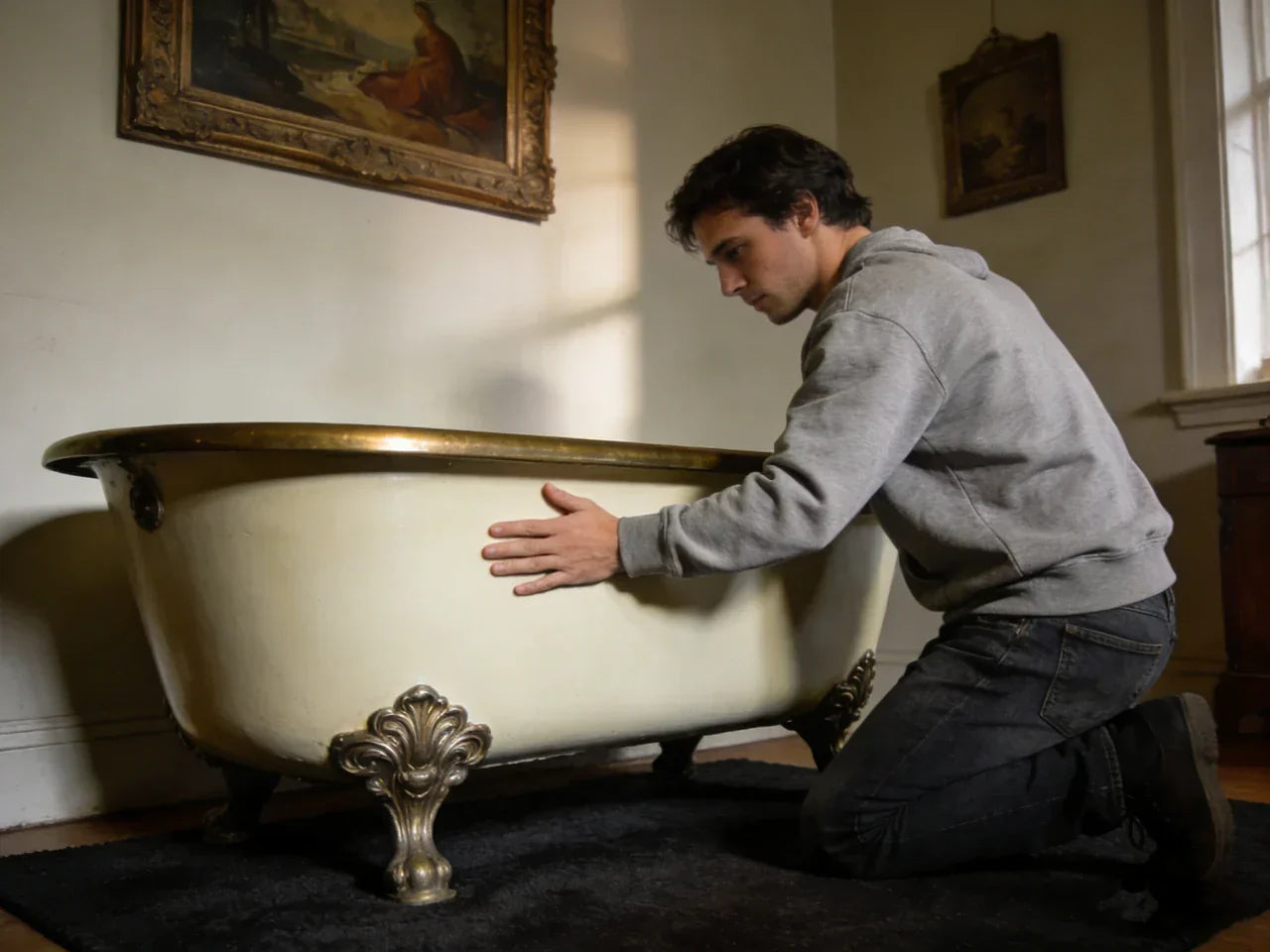
By the time the classic “antique” tub look took hold, the iconic image many people carry is the clawfoot tub: freestanding, often deep, and made of enameled cast iron. Another common older style you might see is a “roll rim” look, where the top edge curves outward for strength and comfort.
The White House Bathtub: A Curiosity That Shows the Real Story
People love to ask about a bathtub in the White House, as if one famous tub could settle the timeline. It can’t, but it does show how bathing became tied to comfort, technology, and image.
In the mid-1800s, indoor water systems were improving, but they were not universal. When President Millard Fillmore lived in the White House, he is often linked in popular history to early efforts to improve water access in the building. Whether you picture him as a “bath reformer” or just a practical homeowner, the point is the same: even at the top of society, modern bathing depended on plumbing, labor, and infrastructure.
Later, as the U.S. entered the 20th century, bathrooms became more standardized, and presidential bathing stories shifted from “Can we even do this indoors?” to “How big is the tub?” You’ll sometimes hear stories about Taft and bathtub size. Even if the details get exaggerated, the reason the stories stick is real: by then, the bathtub had become a normal expectation for comfort in high-status buildings.
When Did Bathtubs Become Common Adoption And Plumbing Reality
Bathtubs became widespread only after plumbing infrastructure improved. This section explores adoption patterns and the public health context.
The Real Bottleneck Indoor Plumbing Not the Tub
It’s easy to focus on the bathtub as an object. But the real hurdle was the system around it.
A bathtub needs a steady water supply, a safe drain path, and enough hot water to make bathing comfortable. That means waterworks, sewer lines, and home plumbing that won’t leak or stink. It also means homes built with space for a bathroom, which is not guaranteed in older housing stock.
If you’ve ever remodeled a bathroom, you already know this lesson. The tub is the visible part. The hard part is what’s in the walls and under the floor.
In the late 1800s and into the early 1900s, more cities invested in clean water and waste removal because improving sanitation reduced disease spread. This wasn’t just about comfort; it was also about public health. Clean water, safe waste systems, and better hygiene practices all worked together.
A Key Adoption Statistic to Anchor the Timeline
Even with all that progress, adoption was slow. A federal-era report in 1936 found that about one in three American homes still lacked plumbing. That helps explain why bathtub history has two speeds: fast invention and slow everyday rollout.
It also helps explain why “my grandmother grew up without a bathtub” can be true even if modern bathtubs were already being made decades earlier.
Bathtubs, Public Health, And A Few Surprising Turns
If bathing seems like an obvious good, history adds some twists.
After the Roman era, many areas of Europe saw a decline in large public bathing culture. Later, during the time of the bubonic plague, people’s fears about disease sometimes changed behavior in ways we now find strange. Some communities became suspicious of bathing or of shared bathing spaces. Add in moral panic, cost, and war, and bathing habits swung back and forth over centuries.
Then, as cities grew crowded in the 19th century, the push to improve sanitation came roaring back. Cleanliness became tied to modern life. Bathrooms became a mark of progress. Plumbing became a quiet revolution.
When you hear “physicians disapproved” in old accounts, it’s worth reading it as a sign of uncertainty and changing knowledge. Medicine and public health were developing. People argued about what was safe, what was fashionable, and what was necessary. Bathing was part of that debate.
The 20th Century Built-In Tubs, Colors, And New Materials
As bathrooms became standard in new housing, the bathtub changed shape to fit tighter spaces and simpler cleaning. The old freestanding clawfoot style looked beautiful, but it left a lot of floor to scrub and could feel drafty in cold houses. So built-in tubs grew popular, with three sides tucked against walls. You still see this today in many family homes because it’s space-smart and easy to pair with a shower.
This is also the era when bathroom fixtures became design choices, not just utilities. By 1921, catalogs and home shows were already treating bathrooms as planned rooms, not afterthoughts. By the U.S. market in 1928, there was strong momentum around coordinated sets and style options, including the idea that fixtures could come in colors, not only white. That shift seems small until you remember what it signals: bathrooms were becoming personal and permanent, not temporary wash spaces.
And materials kept changing. Cast iron remained a heavy-duty option, but lighter tubs made bathrooms easier to build and remodel.
What Were Bathtubs Made Of In The 1960s
If you’re wondering what were bathtubs made of in the 1960s, the common answer is: a mix, depending on budget and the house.
Many homes still use enameled metal tubs, including cast iron in some cases, and also lighter enameled steel in others. At the same time, plastics were starting to matter more. Fiberglass and early plastics-based options grew in popularity because they were lighter and easier to install than cast iron.
By the 1970s—yes, even in everyday home-building eras like February 1975—it was common to see fiberglass tub-and-shower units in new construction because they were cost-friendly and fast to put in. Later, acrylic became a well-known material for modern bathtubs because it can be molded into many shapes, feels warmer to the touch than metal, and is lighter than cast iron.
If you’ve ever stayed in an older motel and noticed a tub that felt a bit “hollow” compared to a heavy old fashioned bathtub, you’ve felt the material change with your own feet.

Timeline Summary
This timeline keeps the “firsts” straight without forcing one winner:
| Date / era | Place | Milestone |
| 1700–1600 BC | Crete | Earliest widely cited surviving personal-sized tub (Minoan pedestal tub) |
| Early 1800s | U.S. (wealthy urban homes) | Documented private tubs exist before the 1840s |
| 1839 | Lancaster, PA | Well-documented plumbed wooden tub tied to municipal water; nine tubs reported that year |
| 1883 | Wisconsin | Cast iron + enamel bathtub milestone that helped define the modern tub as a product |
| 1936 | U.S. | Plumbing still not universal (about one-third of homes lacked it) |
Key Takeaways Back To The Main Question
There is no single uncontested “first bathtub.” The strongest answer depends on what you mean by “first.”
If you mean the oldest surviving bathtub you could step into, the best-supported example is the Minoan tub from Crete around 1700–1600 BC. If you mean early American home use, tubs existed by the early 1800s in some wealthy houses, even if they were not plumbed the way we expect now. If you mean the modern bathtub as a standardized, enamel-coated cast iron fixture that helped spread home bathing, the 1880s matter because manufacturing and materials made bathtubs easier to sell and keep clean.
And if anyone tells you the first U.S. bathtub was installed in Cincinnati in 1842 and caused bans, you now know to ask a follow-up: Where did that story come from, and does it mention the later admission that it was satire?
FAQ
1. Who Invented the Bathtub?
No single person can be credited with “inventing” the bathtub. Bathing vessels evolved independently across many ancient civilizations as people sought ways to soak, cleanse, and relax. Archaeological evidence shows that early tubs or tub-like containers existed in Mesopotamia, the Indus Valley, Egypt, and the Mediterranean. Over thousands of years, the bathtub gradually developed from simple stone or clay basins into purpose-built fixtures, shaped by local materials, hygiene beliefs, and social customs rather than by one inventor.
2. What Is the Oldest Bathtub Ever Found?
One of the oldest surviving personal-sized bathtubs frequently cited by historians is a Minoan pedestal tub discovered on the island of Crete, dating to approximately 1700–1600 BC. This tub was made from fired clay and featured a raised base and curved interior, showing that early designers already considered comfort and drainage. Its discovery suggests that private bathing, not just communal washing, was part of daily life in advanced Bronze Age societies.
3. What Was the First Bathtub in America With Plumbing?
In the United States, one of the earliest well-documented plumbed bathtubs was installed in Lancaster, Pennsylvania, in 1839. Unlike earlier portable tubs that had to be filled and emptied manually, this bathtub was connected to a municipal water supply and drainage system. At the time, indoor plumbing was still rare, and bathtubs were considered a luxury or even a health risk by some critics, making this installation an important milestone in American bathroom history.
4. How Did People Drain Bathtubs in the 1800s?
During the early and mid-1800s, many bathtubs were portable and had no built-in drainage, so water was emptied by hand using buckets. In homes with early plumbing, tubs often included a simple drain hole or stopper connected to a basic pipe that led to a waste line or outdoors. These systems varied widely, lacked standard sizing, and often had limited odor control, which is why consistent plumbing codes and modern traps did not become widespread until later in the century.
5. What Were Bathtubs Made Of in the 1960s?
In the 1960s, bathtubs were commonly made from enameled metal, including cast iron and steel, which were valued for durability and heat retention. At the same time, fiberglass and other early plastics-based tubs were gaining popularity. These newer materials were significantly lighter, less expensive, and easier to install, helping to standardize built-in tubs in mass housing and paving the way for acrylic bathtub designs widely used today.
References




Leave a comment
This site is protected by hCaptcha and the hCaptcha Privacy Policy and Terms of Service apply.