
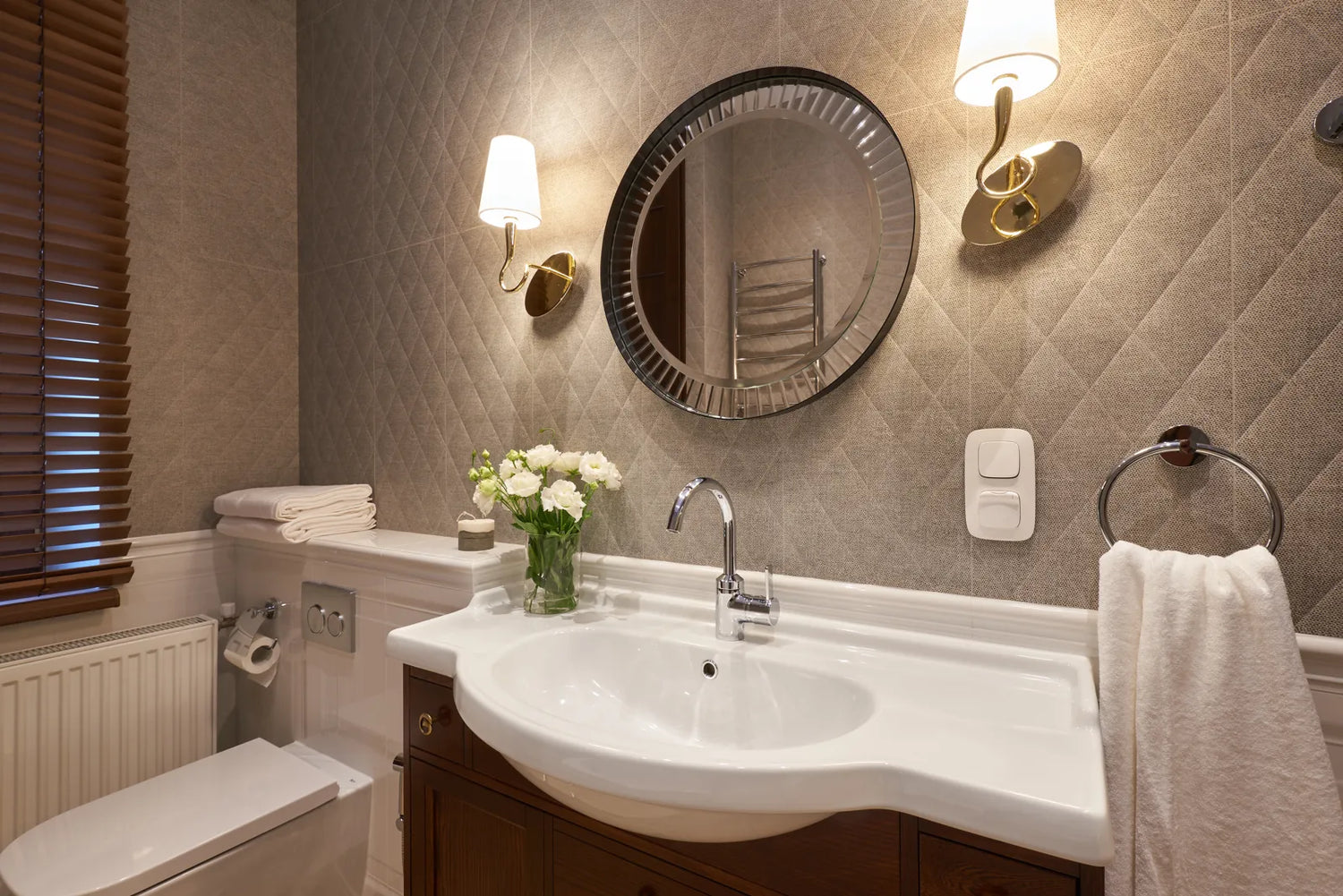
Choosing the proper height of bathroom mirror is one of the most overlooked yet impactful details in bathroom renovation and layout design. Correct placing the mirror balances daily usability, visual aesthetics, lighting coordination and long-term maintenance needs, while improper hanging will bring continuous inconveniences to daily grooming routines. This guide covers universal standard sizes, practical measuring methods, scene-based placement rules and common installation mistakes to help you find the right height and most comfortable vanity mirror mounting height easily.
Quick Answer
Bathroom mirror height works if the mirror clears the highest part of the faucet, fits under your lights, and still puts useful reflection near the main users’ eye level. It does not work if you rely on a fixed “standard” height without checking faucet height, vanity height, backsplash, outlet locations, and who actually uses the bathroom. In real homes, mirrors are usually wrong when they are centered for the wall instead of centered for people.
A bathroom mirror can look fine on paper and still be annoying every day. Most mistakes related to the height of bathroom mirror do not show up until the mirror is on the wall: faucet blocking your face, splash on the bottom edge, kids seeing nothing useful, or the top running into lights.
Decision Snapshot
Before settling on a fixed mounting height, quickly match your bathroom setup with these practical scenarios to pick the most suitable placement logic for your home.
Works best with 32–36 inch vanities
The most forgiving setup is a standard vanity, average-height users, a moderate faucet, and a mirror about 30–36 inches tall. In that range, figuring out the best height for your vanity mirror is easier without hitting lights or dropping too close to the sink.
This is where common guidance like a mirror center around 60–65 inches from the floor often works reasonably well.
Reconsider with tall users or kids
This is where standard rules start failing. If the main user is over 6 feet tall, a short mirror hung at a typical bottom height can cut off forehead or force a slight stoop. If kids use the sink daily, raising the mirror for adults can make the lower half of the reflection useless to them.
Mixed-height households are the hardest. One centerline rarely serves everyone well.
Avoid fixed rules near tall faucets
A lot of bad installs happen because people measure from the countertop and ignore the faucet. The mirror may be “8 inches above the vanity” and still be wrong if the faucet is tall, the spout rises high, or the handles sit in the line of sight.
ADA needs can override standard placement
If a seated user needs access, standard bathroom mirror height from floor may not be the right target. ADA bathroom mirror height requirements are about usable viewing from seated position, not just standing comfort. That can force a lower mirror bottom or a different mirror type entirely.These ADA specifications are based on requirements set by the U.S. Access Board.
Who standard height fits — and who misses
We break down which groups can perfectly adopt standard mirror height rules, and which crowds need to adjust installation positions flexibly based on actual usage demands.
Average eye levels fit center at 60–65 inches
For many homes, figuring out how high should bathroom mirror be to match average eye level lands with the mirror center about 60 to 65 inches above the finished floor. That usually suits adults in the middle height range and vanities around 32 to 36 inches high.
That is why “standard bathroom mirror height” advice often sounds simple. In a plain setup, it often is.
But this only works if three other things are also true:
-
The faucet does not block the lower sight line
-
the mirror is tall enough for head-and-shoulders use
-
the light fixture leaves enough top clearance
If one of those breaks, the centerline rule breaks with it.
Tall users lose forehead at standard bottoms
Tall users lose forehead at standard bottoms
Mirror-too-Short Threshold Decision Box
Fixed rule: If the vertical reflective height of the mirror is under 28 inches, do not adjust installation height repeatedly; directly replace with a taller vertical mirror, height adjustment cannot fix insufficient visible reflection space.
If the mirror bottom lands around 40 to 45 inches from the floor, that may sound normal. For tall users, it often is not enough when the mirror itself is short. The result is common: chin visible, eyes visible, but upper forehead or hairline gets cut off unless they step back.
This gets worse with high faucets. The lower reflection is partly blocked, so the useful mirror area shrinks even more.
If your household has users over 6 feet tall, a safer move is usually one of these:
use a taller mirror
lower the mirror if splash and faucet clearance allow
choose a vertically longer shape instead of a wide short one
A short decorative mirror is where many people regret prioritizing proportion over function.
Mixed-height households rarely fit one centerline
A bathroom shared by a tall adult, a shorter adult, and kids is where bathroom mirror height becomes a compromise. One mirror center cannot perfectly fit all users.
What usually works best is not chasing a mathematical middle. It is giving the mirror enough vertical height that different users can still see comfortably.
This is one reason the old idea that a mirror should be “half your height” is not very useful in bathrooms. It is not a strict rule. What matters more is usable reflection range from the shortest regular user to the tallest regular user, while keeping the mirror out of splash and under the light.
Will this work for a small vanity?
With a small vanity, especially 24 to 30 inches wide, people often buy a mirror that is too small and then hang it at a generic eye-level height. The result can look awkward and work poorly.
In a small bathroom vanity setup:
-
A tiny mirror centered too high makes the room feel top-heavy
-
a low mirror may splash more easily
-
a round mirror usually needs lower visual placement than a rectangle
So if you are looking for bathroom mirror height for small bathroom vanity, the answer is usually not “use the same height as every other bathroom.” Small vanities need tighter measuring and better proportion control.
What trade-offs come with mirror height
Every adjustment to mirror installation height brings distinct pros and cons. Learn these practical trade-offs to strike a balance between convenient daily use and long-term maintenance ease.
Lower placement improves face visibility
If you lower the mirror, most users get better face visibility at close range. Shaving, makeup, contacts, and skin care all become easier because more of the face sits in the most usable part of the reflection.
This works especially well when:
-
the vanity is not overly tall
-
the faucet is low-profile
-
the backsplash is modest
-
the mirror is frameless or has a thin frame
But lower placement has a cost.
Higher placement protects from splash and spouts
The higher the mirror starts, the less likely the bottom edge is to collect water spots, soap film, and toothpaste spray. You also reduce the chance that a faucet or spout visually cuts across the middle of your reflection.
That is why bathroom mirror height above sink and faucet matters more than many buyers expect. A mirror that is technically centered well can still perform badly if the bottom edge sits too close to splash range.
A practical baseline is this:
-
measure from finished floor to the highest point of the faucet or handles
-
leave at least 5 inches
-
6 to 8 inches is safer in most homes
-
up to 10 inches may be needed with tall spouts or active splash
If your setup looks like this, it won’t work: a high-arc faucet, short mirror, thick backsplash, and mirror bottom only a few inches above the counter.

Round mirrors need lower visual centering
With round vs rectangular bathroom mirror height placement, people often make the mistake of hanging the round mirror as if it were a rectangle. That usually puts the useful reflection too high.
A round mirror has less usable vertical area at the sides and a different visual balance. In many bathrooms, it looks and works better slightly lower than a same-width rectangular mirror.
This becomes obvious over a small vanity. A round mirror centered too high can leave a large dead gap over the faucet while still not giving enough lower face visibility up close.
Framed edges reduce usable reflection area
With framed vs frameless bathroom mirror height considerations, the issue is not just style. Thick frames reduce the visible reflective area. So a framed mirror and frameless mirror with the same outer size do not perform the same.
That matters when the mirror is already marginal in height.
A thick frame means:
-
less reflected face area
-
stronger need for precise placement
-
higher chance that “standard” center height feels off
This is where buyers get caught. They choose the right outside dimension but forget that the inside reflective field is smaller.
What retrofit work and cost does height create
Improper mirror height selection often leads to extra renovation adjustments and hidden expenses. Here we cover common construction troubles and related cost impacts you may encounter.
Tile walls reduce adjustment tolerance
On drywall, you may get away with small changes. On tile, bathroom mirror height becomes less forgiving. A bad first placement can mean new holes in visible tile, broken tile, or a mirror that has to be resized because there is no clean way to rehang it.
This becomes a problem when:
-
the wall is fully tiled behind the vanity
-
the mirror uses fixed brackets
-
the grout lines make off-center placement obvious
-
the backsplash or side walls limit movement
If the wall is tile, mock up the mirror first with painter’s tape or cardboard. Do not treat tile like drywall.

Existing lights can block top clearance
A very common retrofit issue is buying a mirror based on vanity width and then realizing the top hits the light fixture or sits so close below it that the face ends up in shadow.
This is especially common when:
-
the vanity is taller than 36 inches
-
the mirror is tall
-
The fixture hangs lower than expected
-
The old mirror was shorter and wider
If you have to move the light higher, that can mean patching, paint work, electrical labor, and possibly tile repair.
So if you are asking how high should a bathroom mirror be above a vanity, the answer is never separate from the light location.
Outlets and switches can be crowded
Mirrors often interfere with switch plates, GFCI outlets, or both. This happens most when the mirror bottom lands around 40 to 48 inches from floor, right where many electrical devices sit near bathroom counters.
Problems include:
-
mirror edge blocking switch access
-
mirror overlapping outlet cover space
-
no room for plugs or toothbrush chargers
-
forced off-center placement
This is usually where installation fails in remodels: the mirror size works, but the wall hardware does not.
Will rehanging cost more than resizing?
Sometimes yes. If the wall is tile, stone, or finished carefully, rehanging can cost more than replacing the mirror with one that actually fits.
Typical cost drivers are:
-
extra holes to patch or hide
-
moving lights or electrical boxes
-
replacing anchors in damaged drywall
-
cutting tile
-
changing mirror hardware
-
buying a different size after failed install
A mirror that is “close enough” in dimension can become expensive once height conflicts show up.
How to measure the right install height
Follow these accurate measuring steps and fixed installation rules, you can quickly figure out the precise mirror height that fits your bathroom perfectly.
Start from finished floor, not countertop
For real planning, always measure from the finished floor first. Countertops can vary. Backsplashes rise. Vanities are not always the height the listing claims. If flooring changes later, your old math can be wrong.
For a reliable standard bathroom mirror height from floor check, record:
floor to countertop
floor to top of backsplash
floor to highest faucet point
floor to bottom of light fixture
floor to center of outlet or switch plates
Required Hard-Stop Measurement Rules
-
Outlet & Switch No-Go Zone: Mark all wall GFCI outlets, light switches and charging socket positions in advance; mirror edges cannot cover or block any operating panel, reserve minimum 1.5 inches side safe spacing as installation forbidden area.
-
Light Fixture Top Clearance Standard: Reserve a minimum vertical breathing clearance of 3 inches between the top edge of the mirror and the bottom of overhead vanity light fixtures; less than this distance will cause facial shadow and insufficient lighting effect, which is regarded as unqualified installation spacing.
That gives you the actual working zone.
Clear the highest faucet by 5–10 inches
For bathroom mirror height above sink and faucet, this is the practical rule that avoids many regrets:
Mirror bottom should sit at least 5 inches above the highest faucet point; 6–8 inches is the safer target; 10 inches may be needed with tall or forward-reaching spouts.
Do not measure from the sink rim alone. Measure from the highest obstruction, including handles if they rise high enough to interfere with the sight line.
If your faucet top is 39 inches from the floor, the mirror bottom often needs to start around 44 to 47 inches from the floor. If the mirror is short, that may push it too high for some users. That is your warning to choose a taller mirror, not to force the old mirror into place.
Leave practical gap above backsplash
For how high to hang a bathroom mirror with backsplash, leave enough space so the mirror does not feel jammed against the backsplash and does not trap grime at the edge.
A practical gap is usually:
-
2 to 4 inches above backsplash in compact setups
-
4 to 6 inches in larger or more decorative layouts
But the gap alone is not the rule. The real rule is that the mirror must still clear the faucet and serve the users.
If your backsplash is tall, the “normal” mirror gap may no longer be possible. That is another sign the mirror size or shape needs to change.
Center from user eyes, not mirror alone
For where should the center of a bathroom mirror be placed, start with the people using it, not just the wall.
Step-by-Step Eye-Height Measurement Method
-
Stand naturally at sink position, keep normal standing posture
-
Measure floor-to-eye level height for the shortest daily user and tallest daily user separately
-
Calculate the middle average eye height between the two data
-
Align this average eye level to the vertical midpoint of the mirror reflective area
-
Double confirm mirror bottom clearance and top light gap meet standard rules
Simple Pass/Fail Eye Level Test
-
Pass standard: Both shortest and tallest users can fully see full face and upper hairline without bending forward or stepping backward
-
Fail standard: Tall users lose upper facial view, short users only see chin and lower faceFor many homes, center at 60–65 inches works. But if your users are taller, your faucet is high, or your vanity is tall, the center may need to shift.
-
The key point: you are not centering on a decoration. You are centering usable reflection.
Fit summary before you buy
Here is the practical fit block most homeowners need:
-
Here is the practical fit block most homeowners need:
Mirror Width-to-Vanity Fit Rule
-
Single vanity: Ideal mirror width = 70%–85% of total vanity width; full visual match allows up to 90%
-
Double vanity: Overall combined mirror width = 65%–80% of full double vanity span
-
Pass example: 48-inch single vanity uses 34–41 inch mirror, perfect proportion
-
Fail example: 48-inch vanity paired with full 48-inch mirror causes cramped visual layout
-
Sconce adjustment rule: If wall sconces are pre-installed on both sides, size mirror width down by 3–6 inches to reserve symmetric side spacing, avoid mirror overlapping light fixtures.
-
Minimum checksVanity height:
-
know actual finished height
-
Faucet highest point: measure from floor
-
Backsplash height: include trim
-
Light bottom edge: measure from floor
-
Mirror actual reflective height: not just outside size
-
Outlet/switch positions: check side clearance
-
Working clearance targets
-
Mirror bottom above highest faucet point: 5–10 inches
-
Mirror above backsplash: 2–6 inches
-
Mirror center from floor: often 60–65 inches
-
Enough top clearance to avoid crowding lights: aim for visible breathing room, not a jammed look
If your setup looks like this, it won’t work
-
tall faucet + short mirror + high vanity
-
thick frame + small mirror + tall user
-
round mirror centered like a rectangle
-
tile wall + untested bracket locations
-
outlet or switch plate touching mirror edge
Where bathroom mirror height fails most often
High spouts block the central reflection
This is one of the most common failures. The mirror looks fine when empty, but once you stand at the sink, the faucet sits right in the lower central reflection. You keep seeing hardware instead of face.
This happens often with:
-
high-arc faucets
-
vessel sinks
-
wall-mount faucets
-
handles set high above the deck
People usually notice it only after installation because they did not test from normal standing distance.
Tall vanities push mirrors into lights
A 36-inch vanity is standard enough. Once you move above that, mirror placement gets tighter fast. A taller vanity raises everything below the mirror, which can force the mirror upward into the light zone.
This becomes a problem when the homeowner assumes standard spacing still applies. It often does not.
If your vanity is taller than 36 inches, treat all standard guidance as suspect until measured.
Small mirrors look wrong at eye level
A small mirror hung exactly at average eye level can still look off and work badly. This is common with decorative round mirrors over practical sinks.
The problem is simple: the wall says “higher,” but the sink task says “lower.” When the mirror is small, there is not enough vertical area to satisfy both.
That is why how to choose the right bathroom mirror height depends on mirror size as much as user height.
What happens if vanity is uneven?
An unlevel vanity or countertop can make a correctly measured mirror look crooked, or a level mirror can expose the vanity as out of level.
If the vanity is off by even a small amount, the eye may notice the gap between vanity and mirror changing from one side to the other.
In that case:
-
level the mirror, not the vanity line
-
use visual checks from the room entry
-
accept that equal gap may not be possible
-
do a tape mock-up before drilling
This matters more with long rectangular mirrors and double vanities.
How lighting and layout change placement
Lighting styles and overall bathroom layout greatly affect mirror positioning. Adjust the installation height accordingly to achieve both attractive visuals and ideal using effects.

Vanity lights need face-level beam clearance
Bathroom mirror placement with vanity lights is not just about physical fit. It is also about light quality. If the mirror top sits too close to the fixture, you can end up with harsh downward shadows or a bright hotspot that reflects badly.
The mirror should sit where light reaches the face well, not just where it fits on the wall.
Can you hang a mirror too high? Yes. A mirror can be physically clear of the faucet and still be too high to light the face properly.
Side sconces limit width and centerline
With bathroom mirror height with sconces on each side, the height decision gets tied to width and side spacing. If the sconces are already fixed, your mirror may have a narrow width range and a forced centerline.
That may leave you with two bad choices:
-
hang the mirror too high to align with sconces
-
hang it lower and accept awkward sconce proportion
In that case, the better fix is often changing mirror size, not forcing height to match side lighting.
Double vanities need separate sight lines
For the best bathroom mirror height for double vanity, one large mirror can work, but it often hides user-specific problems. Two separate mirrors can serve different sink centers more naturally.
Double vanity failures usually happen when:
-
sinks sit far apart
-
The faucets are tall
-
One shared mirror is too short
-
users differ in height
With a double vanity, think in sight lines over each sink, not just one giant centered object.
Where should mirror center actually land?
If you want a practical answer to where should the center of a bathroom mirror be placed, use this order:
-
Clear the highest faucet.
-
Keep a usable gap above backsplash.
-
Stay below light crowding.
-
Put the reflective sweet spot near the main users’ eyes.
-
Check the view while standing at normal sink distance.
That is the real sequence. Not “center it on the wall.”
What problems show up after installation
Many hidden drawbacks will emerge after mirror installation. Here we sort out frequent post-installation issues, accessibility conflicts and typical errors for your reference.
Low mirrors collect splash and soap film
A mirror hung too low often becomes a maintenance problem before it becomes a visual one. The bottom edge catches water, soap, toothpaste, and hand-washing spray. If there is a frame, buildup collects in corners and seams.
This is especially common with:
-
low-profile faucets that splash outward
-
shallow sinks
-
kids using the sink
-
mirrors close to high backsplashes
If you are deciding how much space to leave between vanity and mirror, remember that cleaning access matters too.
Steam worsens on mirrors set too low
A low mirror can fog more in humid bathrooms, especially where airflow is weak. Warm moist air from the sink area and shower zone lingers on the lower half, and if the mirror sits close to backsplash and wall, it may dry slowly.
This is not always a deal-breaker, but in a bathroom with poor exhaust, lower placement can become annoying.
Seated users may need ADA top limits
ADA vs Standing User Height Conflict & Matching Mirror Strategies
Official ADA height standards will directly override conventional household eye-level centerline placement rules, forming obvious usage conflicts between seated users and tall standing adults.
Practical matching solution options:
-
Priority accessibility: Choose full-height frameless long mirrors, meet ADA bottom height limit while expanding upper reflection range to satisfy tall standing users
-
Split layout solution: Install low-position auxiliary small mirrors for seated use, match standard high-position main mirrors for daily standing grooming
-
Unified compromise scheme: Adjust mirror overall vertical position to meet the lower limit of ADA rules, and select mirrors with vertical height above 36 inches to balance dual crowd usage needs
ADA bathroom mirror height requirements matter if seated use is important. In simple terms, accessibility rules commonly require the bottom edge of the reflecting surface no more than 40 inches above the floor, with the top at least 74 inches above the floor.
That creates a different priority than standard residential placement. It favors visibility from a seated position, even if the setup is less ideal for taller standing adults.
If a wheelchair user is part of the household, do not treat ADA as an afterthought. It changes the target from the start.

Common bathroom mirror height mistakes to avoid
The mistakes that come up most often are simple:
-
measuring from countertop instead of finished floor
-
ignoring faucet height
-
centering on the wall instead of user eye level
-
buying too short a mirror for tall users
-
hanging a round mirror as high as a rectangle
-
forgetting frame thickness reduces reflective area
-
not checking light fixture overlap
-
blocking outlets or switches
-
drilling tile before test-fitting
-
assuming one mirror center works for adults and kids
Current trends in bathroom mirrors do not fix these issues. A trendy shape still fails if the reflection zone is wrong.
Before You Buy
Use this checklist before ordering or drilling:
-
Measure from finished floor to countertop, backsplash top, faucet top, and light bottom.
-
Measure the highest part of the faucet or handles, not just the sink.
-
Confirm how much clear wall space exists between backsplash and light.
-
Check whether the mirror’s listed size is the outside size or actual reflective area.
-
For framed mirrors, reduce expectations for usable viewing area.
-
If users are tall, do not buy a short mirror just because the width looks right.
-
If kids use the sink often, test whether the lower reflection is usable.
-
For a small vanity, tape the mirror shape on the wall before buying.
-
For a round mirror, test slightly lower placement than you first expect.
-
If the wall is tile, use a cardboard template and mark hardware exactly.
-
Check switches, outlets, and toothbrush charger access.
-
Stand at normal sink distance and test sight line over the faucet.
-
If the vanity is over 36 inches tall, recheck all “standard” height advice.
-
If accessibility matters, start with ADA limits before design preferences.
-
If the mirror only works at one exact height with no margin, it is the wrong mirror.
FAQs
What is the standard bathroom mirror height?
There is no single universal standard for bathroom mirror installation height. Most ordinary households set the mirror center 60 to 65 inches above the finished floor for daily use. The bottom edge of the mirror is commonly placed 40 to 45 inches off the ground to match most people’s eye level. This common placement only fits regular faucets and average-height family members. It will not work well if you own tall spout faucets or have family members with big height differences. Always adjust the position according to actual home conditions instead of sticking rigidly to fixed data.
How high should a bathroom mirror be above vanity?
You need to set the mirror height above vanity based on actual home layout and fixtures first. The core principle is leaving enough space to bypass the backsplash and the top of the faucet for smooth viewing. In daily home decoration, keep the mirror base 5 to 10 inches above the highest position of the whole faucet structure. Meanwhile reserve 2 to 6 inches reasonable gap between mirror and backsplash for easy daily cleaning. Different vanity sizes, faucet styles and wall designs will change this spacing range properly. Never measure only against the vanity surface and ignore other protruding bathroom fixtures.
Can a bathroom mirror be too high?
Absolutely yes, bathroom mirrors can definitely be hung too high no matter how neat they look on the wall. Once the installation position is overly high, you cannot clearly see your full facial features when standing close to the sink for grooming. Young kids in the family will barely see any usable reflection and struggle to use the mirror comfortably. Too-high mirror placement also messes up the matching of top vanity lights easily. It will form obvious dark shadows on your face and greatly affect daily makeup, shaving and other daily grooming routines.
What is the best bathroom mirror height for a 36 inch vanity?
36-inch height vanity belongs to the most common standard size in most family bathrooms. It is the most friendly type for matching regular standard mirror installation heights. You can directly refer to the mainstream standard to set the mirror center at 60 to 65 inches above the ground for basic use. Even with this suitable vanity height, you still need to check the actual height of home faucets and wall backsplashes carefully. Do not forget to confirm the reserved gap below the top lamp fixtures before finalizing the position. Simply relying on vanity height alone cannot confirm the most suitable mirror installation height.
How much space should be between the sink and mirror?
The reserved space between sink and mirror needs to take practical use and daily maintenance into full consideration first. The main purpose is to block water splashes and leave enough room for wiping and cleaning the mirror surface easily. We should take the highest point of the entire faucet as the measurement benchmark instead of only referring to the flat sink countertop. It is most practical to leave 5 to 10 inches vertical distance above the top of the faucet in daily home use. This flexible spacing rule fits various sink types and faucet styles far better than fixed vanity surface spacing standards.
References


Leave a comment
This site is protected by hCaptcha and the hCaptcha Privacy Policy and Terms of Service apply.