
Bathroom faucets types can feel confusing when you start a remodel. You see endless faucet styles, hole patterns you’ve never heard of, and no clear answer on which faucet will actually fit your bathroom sink or vanity. Pick the wrong type, and you get leaks, splashing, or a faucet that simply cannot mount to your basin.
This buying guide cuts through that confusion. You’ll see a quick comparison table of the main bathroom sink faucets, a clear breakdown of each faucet style (single-hole, centerset, widespread, wall-mount, vessel, bridge, freestanding, touchless, and smart), and real‑world tips on matching them to different sinks and layouts. You’ll also learn 2025 must‑knows like WaterSense water‑efficient faucets, matte black finishes, and touchless/smart faucets. Research from EPA WaterSense, the National Kitchen & Bath Association (NKBA), and major manufacturers backs the data in this guide.
Quick Comparison of Bathroom Faucets Types (At-a-Glance)
Before you fall in love with any faucet style, it helps to see how the main types of bathroom faucets compare on size, mounting, and cost. This table focuses on standard ranges; individual faucet models can vary.
| Faucet type | Typical width / height* | Hole requirements | Best sink / vanity match | Typical “tier” of brands** | Typical price range (faucet only) |
| Single-hole | 4–6" wide; 4–8" tall | 1 hole | Small vanities, modern basins, tight powder rooms | Value to mid-range | $60–$300 |
| Centerset | 4" spread; 4–7" tall | 3 holes, 4" apart | Standard pedestal and drop-in sinks | Value to mid-range | $40–$250 |
| Widespread | 6–16" spread; 5–10" tall | 3 holes, 6–16" apart | Larger vanities, primary baths, undermount sinks | Mid-range to premium | $150–$800+ |
| Wall-mount | Varies; spout usually 4–8" above sink rim | Wall box + in-wall valve | Minimalist baths, vessel and trough sinks | Mid-range to premium | $200–$1,000+ |
| Vessel | 6–8" wide; 10–14" tall | 1 hole | Above-counter vessel sink faucets | Mid-range to premium | $120–$600+ |
| Bridge | 8–16" spread; 8–12" tall | 2–3 holes | Traditional or vintage-style bathrooms | Mid-range to premium | $200–$900+ |
| Freestanding | 36–48" tall (floor to spout) | Floor supply lines | Freestanding tubs, open wet-room layouts | Premium | $350–$1,500+ |
| Touchless | 4–6" wide; 4–8" tall; sensor window in the body | 1 hole (plus battery box or transformer) | Family baths, kids’ baths, guest powder rooms | Mid-range to premium | $150–$700+ |
*Height numbers are from the base of the faucet to the top of the spout.
**“Tier” refers to general market position, not brand names.
In 2025, many of these faucet types now come in matte black, warm brushed brass, and low‑sheen stainless finishes. Smart features such as auto‑shutoff, temperature limiters, and app timers are most common on touchless and some single-hole or widespread models.
Fast picks by bathroom scenario
If you want a quick starting point before you read the full guide, here are strong matches for common bathroom setups:
For small bathrooms or powder rooms, a compact single-hole or 4" centerset faucet is usually best. These keep the sink area open and work well with small pedestal or 18–24" vanities.
For family bathrooms, a single-handle centerset or widespread faucet is a workhorse. One handle is easy for kids to use, helps control water temperature, and is simpler to clean. Touchless faucets are also growing in family baths because they cut germs and prevent water from being left running.
For luxury or spa‑style bathrooms, widespread, bridge, wall-mount, and tall vessel faucets stand out. They give more visual presence and pair well with wide undermount sinks, vessel bowls, and long stone vanities.
For rental properties and budget projects, most landlords stick with basic centerset or single-hole faucets. They are affordable, easy to replace, and fit most standard 3‑hole sinks with a 4" spread.
For ultra‑modern or minimalist spaces, wall-mounted faucets and simple single-hole faucets with clean lines are popular. Touchless or smart versions in matte black or brushed stainless fit that modern bathroom feel.
Pros & cons summary by faucet type
Because this is a buying guide, it helps to see pros and cons side by side. Contractors often report the same patterns on job after job.
Single-hole faucets
-
Pros: Small footprint; simple to clean; often easiest DIY install; great for narrow vanities.
-
Cons: Limited “classic” styling; if your existing sink has three holes you may need a deck plate.
Centerset faucets
-
Pros: Fits most standard 3-hole sinks with 4" spread; budget-friendly; compact for small basins.
-
Cons: Less flexible on layout; can look crowded on large vanities; base can trap grime.
Widespread faucets
-
Pros: Flexible spacing (6–16"); upscale look; easier to clean around each piece.
-
Cons: More parts to install; usually higher cost; not ideal for very shallow or narrow sinks.
Wall-mount faucets
-
Pros: Clears counter space; easy to wipe under; great with vessel sinks and modern designs.
-
Cons: Requires in‑wall plumbing; harder to adjust later; if mis‑measured, spout may cause splash.
Vessel faucets
-
Pros: Extra height for vessel bowls; strong visual impact; often generous spout clearance.
-
Cons: If height or reach is wrong, splashing is common; not ideal for kids’ baths.
Bridge faucets
-
Pros: Classic, vintage look; visible “bridge” becomes a feature; often tall and elegant.
-
Cons: More joints mean more possible leak points; cheap versions can rust in humid bathrooms.
Freestanding faucets
-
Pros: The only option for many freestanding tubs in open layouts; dramatic visual effect.
-
Cons: Higher product and install cost; tub faucet height and line placement must be exact.
Touchless faucets
-
Pros: Better hygiene; saves water by shutting off automatically; good for kids and guests.
-
Cons: Needs batteries or power; sensors can be finicky if installed too close to sink walls.
What is the most common type of bathroom faucet?
In most home remodel surveys for 2025, single-handle centerset and widespread faucets together make up about 65% of bathroom faucet replacements. In starter homes and rentals, centerset models on standard 3‑hole sinks are most common because they are cheap and easy to swap. In custom builds and higher‑end remodels, widespread and wall-mounted options show up more often because they match larger vanities and more modern bath layouts.
For the issue described under “Quick Comparison of Bathroom Faucets Types (At-a-Glance),” continue with bathroom faucet cartridge types to identify the likely cause, the compatible part, and the safe next step.
If “What is the most common type of bathroom faucet?” applies to your project, bathroom faucet parts shows how to identify the likely cause, the compatible part, and the safe next step.
Bathroom Faucets Types Explained: Mounting Styles & Configurations
When people say “lavatory faucet types” or faucet types, they usually mean how the faucet mounts to the sink or countertop, and how many holes it needs. Getting this right is the key to compatibility.
Single-hole, centerset, and widespread faucets
These three are the basic types of bathroom faucets you will see in almost every store and catalog. They all install on the deck (the top of the sink or vanity).
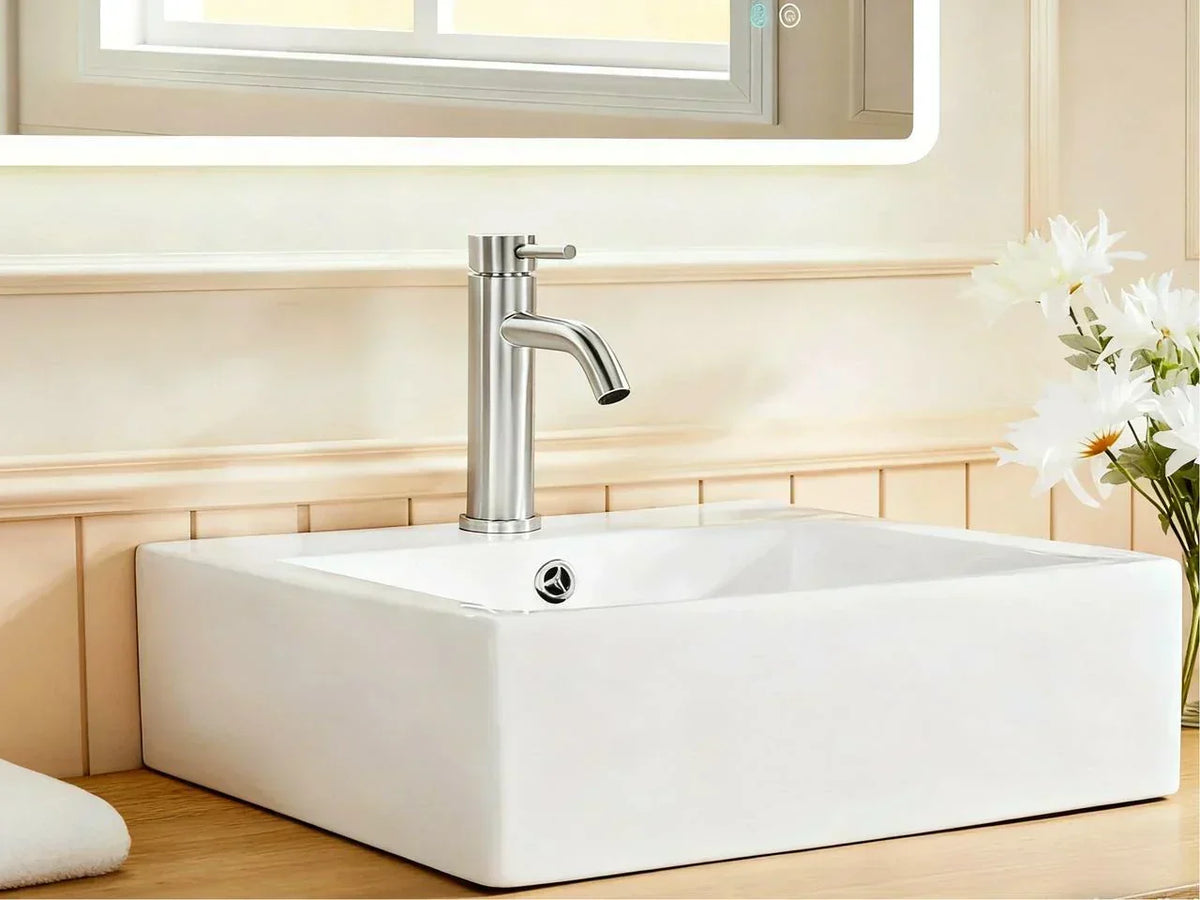
A single-hole faucet has one body and one hole through the sink or countertop. The handle and spout share a single base, so the faucet doesn’t need extra holes for the hot and cold water handles. Many single-hole faucets are single-handle faucets, where one lever controls both water temperature and flow. You’ll see widths around 4–6" and bathroom faucet height in the 4–8" range. These are ideal for:
-
Small vanities from about 18–30"
-
Contemporary bathrooms with clean, simple lines
-
Replacement projects where your existing sink has just one hole
A centerset faucet is built for a 3‑hole sink with a 4" spread. It usually has two handles and a spout mounted on one small base plate or very close together, so it still feels compact. A centerset faucet works well on:
-
Standard pedestal sinks
-
Smaller drop‑in sinks in narrow vanities
-
Budget remodels and rental units
A widespread faucet still uses three holes, but the spread between the handles and spout can range from about 6–16". Each piece has its own mounting hole, so you can space them to fit the sink basin and vanity. A widespread faucet suits:
-
Larger undermount sinks
-
Double vanities with more counter space
-
Bathrooms that lean classic or upscale
If you have ever seen the question “What are the three types of faucets?”, many home guides mean these three mounting styles: single-hole, centerset, and widespread. Plumbers may also use that phrase for internal valve types, which we’ll cover later.
Whenever you pick between single-hole or widespread, think about both size and cleaning. Single-hole is easier to wipe around, but widespread can better fill a big slab of stone and feel less “lost” on a long vanity.

Wall-mount and vessel faucets
A wall-mounted faucet (or wall-mounted bathroom faucet) anchors to the wall above the sink, not the sink or counter. The faucet requires a separate wall-mounted valve hidden in the wall. Only the handles and spout show. Because of this, sink and counter holes are not needed unless you have an overflow or other feature.
Key measurements for wall-mount faucets are:
-
Spout reach: the distance from the wall to the water stream. This has to clear the sink and land roughly in the center of the basin.
-
Spout height above the sink: too high can cause splash; too low can make washing hands awkward.
Wall-mount faucets pair especially well with vessel sinks, long trough basins, and very sleek modern baths. Common mistakes include installing the spout too far back so water hugs the back wall of the sink, or centering it poorly so the stream doesn’t hit the drain. According to many modern bathroom design guidelines, wall-mounted sinks are often chosen to visually support wall-mounted faucets and keep the counter completely clear.
Vessel faucets are deck‑mounted but taller faucets, built to clear an above-counter vessel sink. Many are 10–14" tall from the base of the faucet to the top of the spout. A standard faucet on a tall bowl will send water onto the counter; a true vessel sink faucet puts the water where it needs to be.
To put it simply, if your sink sits on top of the counter, you usually need:
-
A tall deck‑mount vessel faucet, or
-
A properly measured wall-mount faucet with enough reach and the right height
In short, bathroom faucet height must match sink depth and shape to prevent water splash.
Bridge and freestanding (floor-mount) faucets
A bridge faucet has two handles joined by an exposed “bridge” pipe between them, with the spout rising from the center. It is often used in kitchens but appears in bathrooms that lean vintage or traditional. Many bridge designs need 2–3 holes and have spreads from around 8–16".
In bathrooms, bridge faucets show up on:
-
Wide console sinks with a classic style
-
Vanities in historic homes
-
Spaces where the exposed piping is part of the look
One thing plumbers and r/Plumbing‑style forums repeat: cheap bridge faucets may use thin internal parts and cheap finish. In very humid bathrooms those can rust faster than better‑built models, especially around joints where water can sit.
A freestanding faucet is usually a tub faucet, not a sink faucet. It rises from the floor next to a freestanding tub. Typical tub faucet height from floor to spout is around 36–48", depending on tub rim height. Freestanding tub faucets fit open “wet room” layouts or center‑of‑room tubs.
These look amazing, but they:
-
Cost more
-
Need precise rough‑in locations
-
Can be exposed to more moisture, so finish quality and sealing matter a lot
In a small or simple bathroom, a freestanding faucet is often overkill. In a large spa bath, it can be the main design feature.
Touchless and smart bathroom faucets
Touchless and smart faucets are no longer only for airports and restaurants. In 2025, home adoption has grown by about 25%, and short social videos show that more than half of users (around 55%) prefer touchless faucets in at least one bathroom for hygiene.
Touchless faucets use a small sensor near the base of the faucet to turn water on and off. Some also let you set water temperature and time‑out limits. Smart versions may connect to apps or voice assistants for features such as:
-
Timers for kids brushing teeth
-
Usage reports to encourage lower water flow
-
Remote shutoff if a faucet might have been left on
Power usually comes from batteries under the sink or a low‑voltage transformer. Battery vs. hardwired is one of the key choices, especially if you want hands‑free in a high‑use family bathroom.
Many touchless faucets meet WaterSense standards too, so they help both with germs and with water bills.
Handles, Flow Rates, and Water-Efficient Faucet Styles
Mounting is only half the story. The way faucets use water, and how you control them, matters just as much.
Single-handle vs. double-handle configurations
You can find almost every type of faucet (single-hole, centerset, widespread, wall-mount) with either one handle or two.
A single-handle faucet uses one lever to control both temperature and flow. You swing it left or right for hot and cold water, and up or down for pressure. People often choose single-handle taps because:
-
They are simple to use for kids and guests
-
You can adjust temperature with one hand
-
There are fewer nooks to clean
A two-handle faucet has separate handles for hot and cold. In many widespread and bridge faucets, the handles and spout are three distinct pieces. Some homeowners prefer this style because it feels more classic and can give finer control over water temperature.
If you are planning for universal design or ADA‑friendly bathrooms, single-handle or lever handles on a centerset can be easier for people with limited grip strength. Round knobs are harder for many users.
In kids’ bathrooms, a single-handle centerset with a limited hot range (built‑in or via the valve below) can be safer. In guest baths, a simple single-handle or touchless faucet reduces confusion for visitors who are not familiar with your fixtures.
Flow rates, WaterSense, and eco-friendly choices
Flow rates, WaterSense, and eco-friendly choices are important to consider, based on guidelines from the EPA WaterSense program. Older standard faucet models used to run at about 2.2 gallons per minute (GPM). Today, WaterSense labeled bathroom faucets are limited to 1.2 GPM max at 60 psi. That can mean up to 30% water savings with no noticeable drop in comfort for most users.
So what is the ideal flow rate for a bathroom faucet? For most homes, something in the 1.0–1.5 GPM range is a sweet spot. That is high enough to rinse soap and toothpaste, but low enough to save water and meet many local plumbing codes.
You might want:
-
Closer to 1.0 GPM if your home has many bathrooms or if you live in an area with water limits
-
Around 1.2–1.5 GPM if you prefer a stronger stream for washing hair in the sink or filling small basins
To check this, always look for WaterSense labels and the flow rate on the faucet box or product sheet when you are choosing a bathroom faucet. Many efficient faucet models use aerators and cartridge faucets or disc faucets with smooth internal flow paths to keep the feel strong even when water use is low.
Spout height, reach, and splash control
Two measurements often cause confusion: faucet height and spout height.
-
Faucet height usually means the distance from the base of the faucet (where it meets the counter) to the top of the faucet body.
-
Spout height refers to the distance from the base of the faucet to the spout outlet where water comes out.
This difference matters because a faucet can have a tall decorative arch but a lower actual spout, or the reverse. When you see the question “What is the difference between faucet height and spout height?”, that is what it is asking. Spout height is what really controls how much space you have under the water stream.
Typical ranges you’ll see:
-
Standard bathroom sink faucets: 4–8" tall, 4–6" spout reach
-
Vessel faucets: 10–14" tall, with spout reach tuned to clear the bowl
-
Many centerset faucets: about 5–7" spout height and similar reach
The reach (how far the spout extends over the sink) should drop the water stream near the center of the bowl, not at the back wall. For undermount sinks, this is key, because the sink edge is hidden under the countertop. According to common bathroom design practices, undermount sinks with well-defined bowl geometry and centered drain placement help make faucet reach and splash control more predictable. Based on this principle, choosing an undermount sink designed to work with standard faucet reaches can reduce trial-and-error during installation and everyday use.
You can picture a side‑view diagram: the faucet at the back of the counter, the undermount sink faucet spout arching over the edge, and the water landing near the drain. If the reach is too short, your hands end up pushed against the back of the basin. If the reach is too long, water may hit the front and splash out.
In very shallow basins, a very tall faucet can cause spray. Sometimes it is better to choose a slightly lower spout or a waterfall-style spout that spreads the flow to soften the impact.

Matching Faucet Types to Sinks, Vanities, and Layouts
You can find the best faucet only when you match it to your sink type, vanity size, and bathroom layout. This is where many remodels go wrong.
Faucet-to-sink compatibility (sizes, depths, and hole patterns)
A faucet and sink must match on three basic things:
-
Hole pattern: How many holes? What spread?
-
Depth and shape of the basin
-
Backspace: Distance from faucet center to wall or backsplash
Here is a quick cross‑reference for common sink setups:
| Sink type | Typical width / depth | Common hole pattern | Recommended faucet types |
| Pedestal sink | 18–24" wide / 16–20" deep | Usually 3 holes, 4" spread | Centerset, some single-hole with deck plate |
| Drop-in sink | 16–24" wide / 12–20" deep | 1 or 3 holes | Single-hole, centerset, or widespread (larger tops) |
| Undermount sink | 16–24" wide / 12–20" deep | Holes in the counter, not sink | Widespread or single-hole, sometimes wall-mount |
| Vessel sink | 16–20" dia. / 5–8" bowl depth | Usually 1 hole (or none for wall) | Tall vessel faucet or wall-mount |
If your existing sink already has 3 holes with a 4" spread, you will usually choose a centerset or a single-hole faucet with a deck plate. If your stone counter has three holes spread at 8", you are in widespread faucet territory.
Common mismatch issues include:
-
A short spout that does not reach far enough into the sink
-
Handles that slam into the backsplash because there is not enough space behind the faucet
-
A vessel faucet that is shorter than the bowl it needs to clear
When you are choosing a faucet, think of your sink first. The right bathroom faucet always fits your sink or vanity, not the other way around.
From the “Faucet-to-sink compatibility (sizes, depths, and hole patterns)” section, move to bathroom sink sizes for the full steps to check the relevant measurements, clearances, and fit requirements.
Small bathrooms and powder rooms: space-saving faucet choices
If you have a tight powder room or small hall bath, the wrong faucet can eat up precious inches. In these rooms, a single-hole or compact 4" centerset faucet usually works best.
A narrow vanity paired with a small bathroom sink sometimes leaves only an inch or two behind the faucet. In this situation, check that the handle range of motion will not hit the wall. If the vanity is tiny, a wall-mounted faucet can free counter space and make cleaning easier.
Some homeowners also use corner sinks to free floor space in tiny bathrooms. These often pair with small single-hole or mini centerset faucets with shorter spout reach so they do not overshoot the basin.
Good lighting and mirrors can help small baths feel larger, but they do not fix splashing or tight clearances. The right faucet type does.
Large vanities, double sinks, and luxury primary baths
On wide vanities and in large primary baths, scale matters. A tiny centerset faucet on a 72" double vanity will look and feel out of place.
In these spaces, widespread, bridge, and wall-mounted faucets shine. You can center each faucet on its sink basin and still leave space for soap, cups, and décor. Some designers recommend at least 30" of counter per sink in a double vanity, with each faucet spaced evenly from the center and sides.
If you have an undermount sink, a widespread faucet works very well because it can be placed exactly where you need it on the stone top. A wall-mounted faucet above an undermount or trough sink creates a clean, modern line and keeps your sink area easy to wipe.
Think about drawer and door placement, too. A very deep faucet valve body under the counter can block a top drawer. This is another reason to plan faucet type before you order the vanity.
How do I know which faucet will fit my sink?
Here is a short step‑by‑step compatibility checklist you can follow before buying or installing a new faucet:
-
Measure the spread: Measure from the center of one outer hole to the center of the other outer hole (hole to the center of the next). This tells you if you have a 4" centerset, 8" widespread, or something else.
-
Count the holes: Do you have one hole, three holes, or something custom? That limits which faucet mounting options will work.
-
Measure backspace: Measure from the center of the faucet hole to the wall or backsplash. Make sure the handle’s range of motion will not hit it.
-
Check sink depth vs. spout height and reach: Deeper sinks can handle taller faucets with higher spouts. Shallow sinks often do better with lower spouts or softer flows to prevent water from bouncing out.
-
Note the sink type: Is it a pedestal, undermount, vessel, or drop‑in? That will point you toward or away from certain faucet types.
Many people find it helpful to sketch this on paper or print a simple measuring guide. Spending 10 minutes here can prevent costly returns or extra plumber visits later.

Brands, Finishes, and Smart Features by Faucet Type
This guide does not name individual brands, but it is still helpful to know which kinds of manufacturers tend to focus on which faucet styles and features.
Best brands for each major faucet type
In general:
-
Many value brands focus on single-hole and centerset faucets for basic replacement and rental use.
-
Several mid-range and premium brands focus on widespread, wall-mount, and bridge faucets with more finish options and longer warranties.
-
A few tech‑focused makers specialize in touchless and smart faucets, often offering app control, voice integration, and detailed specification sheets.
As you compare brands, look at:
-
Warranty length on both finish and function
-
Valve type (ceramic disc valves last longer than older compression types)
-
Availability of WaterSense‑certified models
-
Reviews that mention durability and leak resistance over time
Finish trends: matte black, brushed nickel, brass, and more
Since 2024, sales of matte black bathroom fixtures have jumped by around 40%, and that trend is still strong in 2025. People like how matte black hides fingerprints and how it pairs with both white and wood tones.
Other popular finishes include:
-
Chrome – Bright, classic, easy to match and often the cheapest
-
Brushed nickel – Soft gray tone that hides spots better than chrome
-
Brushed brass / gold – Warm and rich, used in many “modern classic” baths
-
Stainless / brushed stainless – Pairs well with other stainless hardware
Many 2025 faucets also offer spot‑resistant coatings or even antimicrobial surface treatments. These can be helpful in family bathrooms and high‑humidity spaces where fingerprints, water spots, and bacteria build up quickly.
When you choose a finish, think about the full room: cabinet hardware, shower trim, towel bars, and even the mirror frame. They do not have to match perfectly, but they should feel like part of the same range of styles and finishes.
Smart, touchless, and voice-controlled bathroom faucets
Smart features used to be rare in a faucet for bathroom sink, but more 2025 models now include:
-
Motion sensors with adjustable distance
-
Built‑in temperature limiters to prevent scalding
-
Timers that shut off after a set time
-
Voice or app presets like “warm water for 30 seconds”
For families with kids, or older adults who may forget to shut off water, these faucets also add a layer of safety. In multi‑generation homes, touchless or single-handle faucets can make bathrooms easier for everyone to use.
If you do not want to rely on batteries, look for faucets that hardwire to a low‑voltage transformer in the vanity. Just note that this often requires a qualified plumber or electrician and must follow local building codes.
Installation, Budget, and Cost Breakdown by Faucet Style
Even the perfect faucet type will not work if it blows your budget or demands plumbing changes you did not plan for.
Typical costs by faucet type (product + installation)
Here is a general idea of what you might spend for different bathroom faucet types in 2025, including typical labor if you hire a pro.
| Faucet type | Budget (DIY-friendly) | Mid-range | Premium / smart | Typical pro install (per faucet) |
| Single-hole / centerset | $50–$150 | $150–$300 | $300–$500 | $100–$200 |
| Widespread | $120–$250 | $250–$500 | $500–$1,000+ | $150–$250 |
| Wall-mount | $150–$300 | $300–$700 | $700–$1,200+ | $250–$500+ (in‑wall work) |
| Vessel | $80–$200 | $200–$500 | $500–$800+ | $100–$250 |
| Bridge | $150–$300 | $300–$700 | $700–$1,000+ | $150–$250 |
| Freestanding tub faucet | $200–$400 | $400–$800 | $800–$1,500+ | $300–$600+ |
| Touchless / smart (sink) | $150–$300 | $300–$600 | $600–$1,000+ | $150–$300 |
Prices can vary by region and by material quality, but this gives you a planning range.
DIY vs. professional installation considerations
When is DIY installing a new faucet realistic, and when should you call a plumber?
DIY is often safe when:
-
You are replacing a faucet with another of the same type (for example, a centerset faucet with another centerset)
-
You are not changing the valve location or altering pipes inside the wall
-
Shutoff valves under the sink work properly and are not corroded
You should strongly consider a professional when:
-
You are switching from deck‑mount to wall-mounted faucet
-
You are adding a freestanding tub faucet or changing tub faucet height
-
Your home has old or damaged valves, or you see signs of leaks in the cabinet
-
Local plumbing codes require inspection for certain changes
A good plumber will also know how to support heavy stone tops, seal holes to prevent water from reaching cabinets, and set valves at correct heights so the faucet doesn’t feel awkward.
Planning a remodel: aligning faucet choice with overall budget
Your bathroom faucet is only one piece of the full project, but it affects many other parts:
-
Sink or basin style and hole pattern
-
Vanity or counter dimensions
-
Backsplash height
-
Mirror placement
It makes sense to choose faucet types early, even if you do not order the exact model yet. That way your sink setup and rough plumbing can match.
A simple planning tip:
-
Splurge a bit more on faucets in primary baths and kids’ baths that see daily use. High‑quality valves and finishes here save headaches.
-
Save in low‑use powder rooms where you can pick a stylish but simpler faucet because it will not be used as heavily.
Change orders, like moving from a centerset to a wall-mount after cabinets are installed, can be far more expensive than the faucet itself.
How much should I expect to spend on a bathroom faucet?
For most homeowners, typical bathroom sink faucet price ranges in 2025 are:
-
$50–$150 for basic single-hole or centerset faucets for simple replacements
-
$150–$400 for mid-range widespread, vessel, and some touchless models
-
$400–$1,000+ for designer finishes, wall-mounted systems, and advanced smart faucets
When you factor in long-term cost of ownership, a cheap faucet that leaks or fails early may cost more than a mid‑range faucet with quality ceramic disc valves and a strong warranty. Water‑efficient WaterSense models also save money on your water flow over many years.
Maintenance, Durability, and Real-World Performance
Even the nicest lavatory faucet can disappoint if it drips, corrodes, or is hard to clean.
Longevity data, warranties, and advanced seal technologies
Some faucet makers now advertise very high cycle counts on their valves (into the millions of on/off operations) and back those claims with long warranties. While marketing claims vary, there are a few practical tips you can use:
-
Look for a lifetime warranty on both finish and function for primary baths
-
Read the fine print: some “lifetime” warranties only cover the original owner or only certain parts
-
Check if the warranty covers leaks at the valve, not just defects in casting
Technical reports on valve life, often shared in manufacturer spec sheets or engineering journals, show that ceramic disc valves tend to outlast older compression styles by a large margin and are less sensitive to normal hard water particles.
Cleaning and maintenance routines by finish and faucet type
Cleaning needs depend on both finish and faucet type.
For chrome, a soft cloth and mild soap usually work well. Hard water spots can be removed with a half‑vinegar, half‑water solution. Avoid bleach and harsh cleaners that can strip the shine.
For matte black and brushed metals, gentle cleaners are even more important. Abrasive pads can scratch or polish away the matte look. Many people just wipe these finishes with a damp cloth, then dry them.
Wall-mount faucets make it easy to wipe the counter because nothing sits on it, but you will need to reach around the back of the spout on the wall to clean. Bridge faucets and older styles have more crevices where grime can gather, so they may need a soft brush and more attention.
No matter the finish, it helps to:
-
Wipe the faucet dry after heavy splashing
-
Clean aerators now and then if you see reduced flow
-
Check under the sink every few months for signs of moisture

Common failure points and how to avoid them
Most faucet problems show up in the same spots:
-
The cartridge or ceramic disc inside the valve wears or gets debris, causing drips at the spout
-
Handle stems or joints loosen and wobble
-
The spout base or connections under the sink leak
-
Cheap finishes peel or spot badly in the humid bathroom environment
You can avoid many issues by:
-
Choosing faucets with ceramic disc valves or modern cartridge faucets instead of old rubber washers
-
Checking that faucets are made from solid brass or stainless where possible, not thin plated plastic
-
Using flexible supply lines rated for hot and cold water, installed without kinks
-
Making sure the base and any unused holes are sealed so splashes do not soak the vanity below
Threads in plumbing forums often warn about very cheap bridge faucets and unknown brands that rust around the joints within a year or two in steamy baths. Spending a bit more on quality valves and finishes is usually worth it.
Case studies & social proof from real installations
Homeowners and plumbers often share real‑world results online. A few common themes show up again and again:
-
A well‑made centerset faucet with a WaterSense aerator on a 20–30" vanity can cut water use by around 30% while still feeling strong for handwashing.
-
Popular widespread faucets on 30–60" vanities earn praise for easy cleaning, and many users report no leaks after many months when installed correctly with quality valves.
-
Some waterfall‑style faucets that spread the flow into a sheet give a more spa‑like feel and, when matched well to the sink depth, can even reduce splash vs. a tight, aerated jet.
Many short videos and forum threads show how choosing a faucet that matches both the sink and the users (kids, older adults, renters) makes daily life in the bathroom smoother.
How to Choose the Right Bathroom Faucet Type
Choosing a bathroom faucet gets much easier when you follow a clear path instead of starting with random pictures.
Step-by-step faucet selection checklist
-
Confirm your sink type, size, and hole pattern Check if you have a pedestal, drop‑in, undermount, or vessel sink. Measure width and depth, count holes, and note the spread.
-
Measure spout height and reach needs Think about how far the faucet should reach into the basin and how high you want the water stream for washing hands or face.
-
Decide handle type and flow rate Choose between single-handle and two-handle. Look for WaterSense or 1.0–1.5 GPM if you want water savings.
-
Choose finish and style Match the finish to your other bathroom fixtures. Decide if you want modern, classic, or transitional styling.
-
Set your budget and smart/touchless level Decide what you can spend and whether you want touchless or app‑connected features.
-
Confirm DIY vs. pro install plan If you are changing faucet mounting type (for example, to wall-mount or freestanding), plan for a plumber and permit if needed.
If you follow these steps, the right faucet tends to reveal itself.
Which bathroom faucet type is best for small sinks?
For small sinks and narrow vanities, the best choices are usually:
-
Single-hole faucets with short spout reach, or
-
4" centerset faucets with low, compact bases
In very tight spaces, a wall-mounted faucet can also work well, because it keeps the deck clear and makes even a tiny sink feel more usable. When choosing a faucet for a small sink, look less at the visual footprint and more at how the spout reach, spout height, and handle movement fit the space.
Are touchless bathroom faucets worth it in a home?
Touchless bathroom faucets can be worth it in many homes because they reduce germs on handles, help kids avoid leaving water running, and feel more modern. They shine in kids’ bathrooms, busy guest powder rooms, and multi‑generational homes where hygiene and ease of use are top concerns.
The trade‑offs are higher upfront cost and the need to replace batteries or add a power supply. If you do not mind changing batteries every year or two, or if you are already opening the wall for other work, many families find touchless faucets a smart upgrade.
Can I change faucet type without replacing my sink?
Sometimes yes, sometimes no.
You can often move from a centerset faucet to a single-hole faucet if you use a deck plate to cover the extra two holes. But you usually cannot move from a 3‑hole 4" centerset to a true 8" widespread without drilling new holes or changing the sink or countertop.
If you want to go from deck‑mount to wall-mounted bathroom faucets, that almost always requires new rough‑in work and sometimes a new sink with no faucet holes. In short, you can switch types as long as you respect the existing hole pattern or are willing to update the sink or counter too.
Conclusion
Understanding the different bathroom faucets types is key to creating a functional and stylish bathroom. Whether you choose a single-hole, centerset, widespread, wall-mounted, or vessel faucet, matching the faucet to your sink, spout height, handle style, and flow rate ensures optimal performance. Modern bathroom faucets types now include touchless and smart options for added convenience, hygiene, and water efficiency. By considering your bathroom layout, vanity size, and personal needs, you can select the perfect bathroom faucets types that enhance both aesthetics and long-term durability.

FAQs
1. What are the three types of faucets?
When people talk about the “three types of faucets,” they’re usually referring to single-hole, centerset, and widespread deck‑mount faucets. These are the most common mounting styles you’ll encounter in bathrooms. A single-hole faucet has one main body with the handle integrated, making it compact and easy to install. A centerset faucet sits on a 3-hole sink with a 4-inch spread, usually with two handles and a spout mounted close together. Widespread faucets give you more flexibility, with separate handles and a spout that can spread anywhere from 6 to 16 inches apart, perfect for larger vanities. Some plumbers, however, use the term “three types” differently, referring to valve mechanisms—compression, cartridge, or ceramic disc—with ball valves sometimes added as a fourth. For homeowners, the key takeaway is to focus on the mounting type first, because it determines what will fit your sink and countertop without extra plumbing work or modifications.
2. How can I tell what type of bathroom faucet I have?
Figuring out your faucet type is simpler than it looks once you know what to check. Start by counting the holes in your sink or countertop. If there’s just one hole and the faucet body is all in one piece, you’ve got a single-hole faucet. If there are three holes spaced 4 inches apart, with handles close together on a single base, that’s a centerset faucet. When the holes are spread farther apart, typically 6–16 inches, with the handles and spout separate, it’s usually a widespread faucet. Don’t forget wall-mounted faucets—they come straight out of the wall, so the mounting is not on the deck at all. Also, pay attention to spout height and reach. A faucet might look right, but if the water stream misses the drain or splashes onto the counter, it’s not the right fit. Measuring the holes and spacing first avoids headaches during installation.
3. What is the best faucet for a bathroom?
There really isn’t a single “best” faucet for every bathroom. The right choice depends on your sink type, vanity size, bathroom layout, who will use it, and your budget. For small to medium bathrooms, a single-hole or single-handle centerset faucet is a practical choice—easy to use, simple to clean, and often WaterSense-certified, so you save water without sacrificing comfort. For larger or luxury bathrooms, widespread or wall-mounted faucets can make a statement while giving flexibility for double sinks and deeper basins. If you have kids, touchless or single-handle options help prevent scalding and reduce water waste. Ultimately, the best faucet balances style, function, and convenience. Focus on the faucet’s fit with your sink, spout height, and handle reach, and you’ll get a fixture that performs well and lasts for years.
4. Are all bathroom faucets 4 inches?
Not at all. A lot of centerset faucets use a 4-inch spread because they fit standard 3-hole sinks, but widespread faucets can range anywhere from 6 to 16 inches. Single-hole faucets only need one hole, so they don’t follow a standard spread at all. That means you can’t just assume your new faucet will fit your sink—you have to measure. Take note of the distance between the holes and also check the spout reach. A faucet that’s too short may dump water near the back of the basin, while one that’s too long could splash onto the countertop. Knowing the spread and reach is especially important if you’re swapping out an old faucet or upgrading to a wider or taller model. Always measure before buying, and if you’re unsure, take a photo of your sink setup to the store or check specs online.
5. What is the difference between faucet height and spout height?
Faucet height and spout height aren’t the same thing, though people often mix them up. Faucet height refers to the total distance from the base of the faucet (where it mounts on the sink or countertop) to the top of the faucet body—basically, the tallest point of the fixture. Spout height, on the other hand, measures from the base to where the water actually comes out of the spout. This is crucial because spout height determines how much clearance you have above the sink, which affects handwashing, filling tall containers, or preventing splashing. For example, a high-arc faucet might have a tall faucet height, but the spout may still be low if it curves downward. When choosing a bathroom faucet, always check the spout height relative to your sink depth to ensure comfortable use and minimal splash. Understanding both measurements helps you pick a faucet that looks good and works well.
6. What type of faucet for undermount sink?
For undermount sinks, designers usually recommend either widespread or single-hole faucets mounted on the countertop behind the sink. These give you the freedom to center the faucet perfectly and adjust the spout reach so the water lands near the drain. Single-hole faucets are easy to clean and compact, while widespread options offer a more upscale look, ideal for larger vanities. Wall-mounted faucets are another stylish choice if your sink is deep enough—they free up counter space and create a sleek, modern look. The key is to consider spout height relative to sink depth. Too high, and water will splash; too low, and it will be awkward to use. Also, make sure the faucet handles have enough room to move without hitting the backsplash. Matching the faucet type to your undermount sink ensures both function and aesthetics in your bathroom.
References



Leave a comment
This site is protected by hCaptcha and the hCaptcha Privacy Policy and Terms of Service apply.