



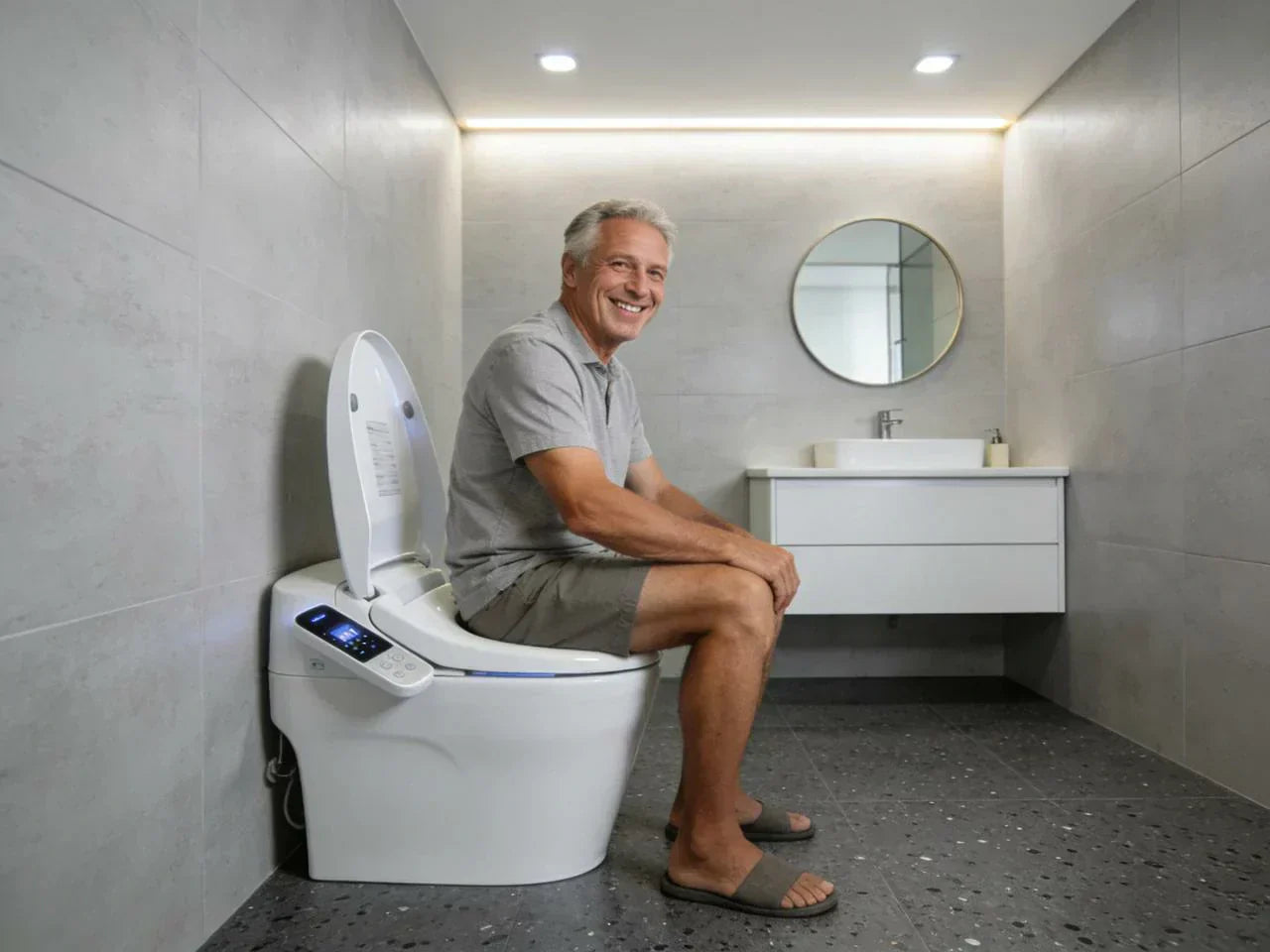
A perfect smart toilet bidet combo (also called an all-in-one bidet, intelligent toilet, or bidet toilet combo) replaces your whole toilet with a single unit that washes, dries, and often flushes with sensors and a remote.
If you’ve only used a bidet seat before, the full-unit combo feels cleaner and more “built-in.” It can also be more complicated to install and repair, because you’re bringing electronics into a place that already has water, humidity, and hard-water minerals.
This guide is written to help you make a confident first decision: Should you buy a full smart toilet bidet combo, or choose a simpler path? And if you do buy one, what should you check before you order so you don’t end up with returns, surprise electrician bills, or a toilet that doesn’t fit your bathroom.
Is a smart toilet bidet combo right for you?
Here’s the rule of thumb I use in real homes:
Buy a smart toilet bidet combo if…
You want maximum hygiene + comfort in one replacement unit, and you’ll actually use the features:
-
A heated seat that’s warm every morning
-
Warm water washing without waiting for sink water to heat up
-
Touchless/auto features (auto open/close, auto flush, night light)
-
A clean, modern look with fewer exposed parts
These units make the most sense when you care about the whole bathroom experience, not just adding a spray function.
Skip it (or delay it) if…
Any of these apply:
-
You can’t add a nearby grounded outlet (often GFCI-protected) without opening walls or hiring an electrician
-
You want the simplest long-term repairs with off-the-shelf toilet parts
-
You’re doing this in a rental where you can’t control electrical work, plumbing changes, or warranty/returns
In those cases, a bidet seat on your existing toilet is usually the safer first step.
Best-fit households
Smart toilets tend to be a great fit for:
-
Homes with frequent users (busy families, shared bathrooms)
-
People doing a bathroom remodel or planned upgrade
-
Anyone with mobility limits, arthritis, or postpartum needs (warming, drying, touchless controls)
-
Cold-climate homes where a warm seat is not “luxury,” it’s comfort
-
Households trying to use less toilet paper (for comfort, plumbing, or septic reasons)
Worst-fit households
They often disappoint in:
-
Rentals and temporary living situations
-
Ultra-tight budgets where one surprise service call breaks the plan
-
Hard-water homes if you don’t want maintenance (mineral buildup is real). Based on data from the United States Geological Survey (USGS), hard water contains dissolved calcium and magnesium minerals that accumulate on plumbing fixtures and nozzles, making maintenance more frequent in appliance-style toilets.
-
DIY-averse buyers without a trusted plumber/electrician
If you’re on the fence, decide based on two things: (1) electrical readiness and (2) your tolerance for model-specific parts later.

What are the deal-breaker trade-offs vs a bidet seat or standard toilet?
Most buying regret comes from expecting a smart toilet to behave like a basic toilet. It doesn’t. It’s closer to an appliance.
Full-unit “intelligent toilet” convenience vs harder repairs
A full smart toilet bidet combo is clean-looking and integrated. You don’t have a separate add-on seat, extra hoses, or a “retrofit” feel.
On the other hand, repairs can be harder because:
-
Electronics are built into the unit (often the lid and seat area)
-
Some parts are model-specific
-
A small issue (sensor glitch, lid problem, board failure) can be a bigger deal than replacing a standard flapper
If you like the idea of “fix it with a $15 part from any hardware store,” a standard toilet wins.
Luxury features vs more things that can fail
Features like auto flush, night light, warm air drying, deodorizing fans, and self-opening lids are nice—when they work and when your household likes them.
They also add:
-
More settings to learn
-
More sensors (which can misread users)
-
More points of failure over 2–5 years
A practical approach: pay for features you’ll use every day (heated seat, good wash). Be cautious with features you’ll only notice when they break (auto lid, complicated remotes).
Superior hygiene and comfort vs a learning curve
Smart toilets can feel “cleaner” in daily life because washing is consistent and hands-free. According to the US Centers for Disease Control and Prevention (CDC), proper personal hygiene significantly reduces exposure to germs and cross-contamination in shared bathroom environments.
But expect a learning curve:
-
Seat sensors may require you to be seated for wash/dry to start
-
Controls may be remote-based (guests get confused)
-
Dryers are helpful, but they’re not a full replacement for toilet paper for most people
If you want truly simple guest use, a basic toilet is still the easiest.
Is a smart toilet bidet combo worth it if you already have a great existing toilet?
Sometimes yes—but only if you’re buying for the right reason.
A full unit is worth it when:
-
You want a sleeker one-piece look and fewer add-ons
-
Your current toilet has issues (weak flush, uncomfortable height, worn bowl coating)
-
You want heated seat + warm wash + drying as a daily routine
If your existing toilet flushes well, fits your space, and you just want washing, a bidet seat can get you 70–90% of the benefit for far less money and risk.
What should you budget for (price, install, and ownership costs)?
A smart toilet bidet combo is not just “toilet price.” The real cost is unit + install + electrical + maintenance.
Price tiers and the “value” line
Prices vary a lot, but homeowners usually land in one of three ranges:
-
Affordable / entry smart: You get core bidet functions, heated seat, basic drying, simple remote. Materials and service support can be mixed.
-
Mid-range / best value for most homes: Better wash performance, better bowl finish, quieter operation, more reliable sensors, stronger support.
-
Premium / luxury smart toilet: Nicer fit and finish, smoother lid/seat, more automation, more consistent drying, better noise control—also more expensive parts.
The “value line” is where the unit has:
-
dependable wash temp control
-
stable water pressure
-
a seat that heats evenly
-
decent warranty and available parts
If a unit is cheap but parts are hard to get later, it may not be a bargain.
Installation budget reality
Even when the product listing says “easy setup,” real bathrooms have real problems: old shut-off valves, tight clearances, uneven floors, and flanges that aren’t at the right height.
Plan for:
-
Plumber time for removal + install + leak checks
-
Electrician time if the outlet/circuit isn’t already right
-
Possible fixes to the shut-off valve, supply line, or toilet flange
If you’re remodeling, it’s usually cheaper to handle outlet placement and plumbing upgrades while walls are open.
Ongoing costs (electricity + filters + parts)
Ongoing costs usually include:
-
Electricity for the heated seat and warm air dryer
-
Water filter replacements (some models use them; some don’t)
-
Occasional inlet screen cleaning (especially with hard water)
-
Potential replacement of wear parts over time
Most owners underestimate two things: hard-water buildup and how annoying a small refill noise can be at night if a valve starts leaking.
Visual: total-cost snapshot (unit + install + yearly ops)
These are typical ranges homeowners report planning for. Your region may vary.
| Cost item | Budget expectation | Notes that change the number |
| Smart toilet bidet combo unit | $800–$3,500+ | Big jumps for premium finishes and automation |
| Plumber installation | $200–$600 | More if flange/valve is old or recessed |
| Electrician / new outlet | $200–$900+ | Can be higher if a new circuit is needed |
| Yearly electricity | $15–$60 | Depends on seat heat and dryer use |
| Filters / maintenance parts | $0–$120/year | Varies by model and water quality |
| “Surprise fixes” reserve | $100–$400 | Old shut-off valves, cracked flange, etc. |
What about toilet paper savings? Most households do use less, but many still use some for drying or “final check.” Treat paper savings as a bonus, not the reason to justify the investment.
Will it fit your bathroom, body, and household routines?
Fit problems cause the fastest returns. Before you fall in love with features like a night light or touchless flush, make sure the unit physically works in your space.
Fit checklist: rough-in, footprint depth, seat height, clearance
These are the measurements that matter most:
-
Rough-in distance: Most homes are 12 inches (from finished wall to closet bolts), but 10 and 14 exist. If you guess wrong, the toilet may not sit correctly.
-
Footprint depth (front projection): Smart toilets often project farther than older round-front toilets. In small bathrooms, this can crowd the door or vanity.
-
Seat height: Some are comfort-height (taller). Great for many adults, not always great for small kids.
-
Side clearance: You need room to sit comfortably and to access controls and cleaning.
-
Door/vanity swing: Measure with the door fully open and closed. A 1–2 inch difference can matter.
If you’re replacing an old toilet in a tight alcove, measure twice. A full-unit combo is less forgiving than swapping a standard toilet.
Will this work in a small bathroom or tight toilet alcove?
It can, but you need to be careful about:
-
Knee room: A longer bowl can feel cramped.
-
Cleaning access: You still need to clean around the base. If the unit barely fits, routine cleaning becomes a pain.
-
Remote placement: Many people mount the remote on the wall. In a tight alcove, there may be nowhere convenient that stays dry and reachable.
If your bathroom is very small, a bidet seat on your existing toilet can be the safer move unless you’ve confirmed dimensions.
Household usability: multi-user settings, guests, and night light
Smart toilets are great when your household actually uses the features correctly.
In multi-user homes, look for:
-
Easy adjustment of water pressure and adjustable water temperature
-
Simple “one button” wash options (front/rear/basic)
-
A night light that’s soft, not harsh
-
Clear icons (guests won’t read a manual in your bathroom)
One real-life issue I see: if the remote is confusing, guests won’t use the bidet and may accidentally trigger settings. Simpler controls often win in shared bathrooms.
Accessibility and comfort
Smart toilets can be a genuine quality-of-life upgrade if you have:
-
Arthritis (harder to wipe, harder to twist for controls)
-
Mobility challenges (less reaching, more touchless)
-
Sensitivity to cold seats
-
Post-surgery or postpartum needs
Look for:
-
A comfortable seat shape
-
Large, readable controls
-
Reliable seat sensor (so wash starts when it should)
-
Gentle wash mode and gradual pressure steps
Comfort is not just heat. A seat that fits your body and a spray that feels controlled matter more than extra automation.
Can your home support it? (Electrical + plumbing prerequisites)
This is the section that prevents “I bought it and now what?” moments.
Do smart toilets need a special electrical outlet?
Most smart toilets need a nearby grounded outlet, usually GFCI-protected in a bathroom. The US Consumer Product Safety Commission (CPSC) advises that bathroom outlets should include modern safety devices such as GFCI protection to minimise electrical shock risks in wet environments. Some recommend a dedicated circuit or a certain amperage. The key point is:
If you don’t already have a safe, grounded outlet within reach of the cord, plan for an electrician.
Common homeowner mistakes:
-
Using an extension cord (don’t)
-
Sharing an outlet with other high-draw appliances and tripping breakers
-
Forgetting that the cord may exit on one side, not the other
If your bathroom has no outlet near the toilet, treat electrical work as part of the purchase, not an optional extra.

What happens if you don’t have a nearby 20-amp grounded outlet (or GFCI protection)?
In many homes, the fix is straightforward: add a GFCI outlet on an existing bathroom circuit. In others, an electrician may recommend a new circuit if loads are already high or wiring is outdated.
If you can’t add the outlet cleanly (tile walls, concrete, no access), your realistic options are:
-
Choose a bidet seat that can reach an existing outlet (still not ideal if cords cross walking paths)
-
Choose a non-electric bidet attachment (cold water only, no seat heat)
-
Delay the upgrade until you remodel
Water supply realities: shut-off valve, pressure, and leak checks
Smart toilets connect to your cold water supply like other bidets. A few practical checks matter a lot:
-
Shut-off valve condition: If it’s old and crusty, replace it now. A failing shut-off is a common cause of leaks during install.
-
Supply line length and routing: Too-long lines can kink or press against the skirt of the toilet.
-
Water pressure stability: Very low pressure can reduce wash performance. Extremely high pressure is harder on seals.
-
Leak prevention: Make sure gaskets are seated, screens are clean, and connections are snug (overtightening can also cause problems).
This is one of those areas where slow, careful install beats speed.
DIY vs pro install: when “simple setup” becomes a service call
If you’ve installed a standard toilet before, you might be able to DIY—if:
-
the flange is in good shape
-
the shut-off valve works perfectly
-
the outlet is ready
-
you can safely lift and place the unit (some are heavy and awkward)
Hire a pro if:
-
you’re unsure about flange height or floor level
-
your shut-off valve doesn’t fully stop water
-
you have a history of slow leaks in that bathroom
-
you’re not comfortable troubleshooting electronics and sensors
A common pattern: homeowners DIY the physical install, then end up calling a plumber for a wobble (mounting alignment) or a slow drip at the supply connection. Paying for installation upfront is often cheaper than paying for a “fix my install” visit.

Visual: pre-buy compatibility checklist
Measure and confirm these before ordering:
| Check | What to look for | Why it matters |
| Outlet | Grounded, bathroom-safe (often GFCI), within cord reach | No safe power = no smart features |
| Circuit capacity | Breaker trips? other loads on same circuit? | Seat heat + dryer can add load |
| Rough-in | 10/12/14 inch (measure wall to bolts) | Wrong rough-in = won’t fit |
| Depth | Toilet-to-door/vanity clearance | Avoid knee/door conflicts |
| Shut-off valve | Turns fully off, not corroded | Prevent install-day flooding |
| Water line routing | No kinks, correct length | Avoid leaks and low flow |
| Flange height | Solid, level, not cracked | Prevent rocking and seal failures |
| Floor level | Flat enough for stable mount | Wobble leads to leaks over time |
What’s it like day-to-day (cleanse, dry, flush, noise, convenience)?
This is where expectations matter. The “best smart toilet” isn’t the one with the most buttons—it’s the one your household enjoys using without thinking.
Cleaning performance: what “superior hygiene” feels like
A good smart toilet wash is consistent and targeted:
-
You can set pressure from gentle to strong
-
You can set adjustable water temperature
-
The stream should feel stable (not sputtery)
-
The nozzle should rinse itself before/after use (self-cleaning nozzles)
In practice, the biggest drivers of satisfaction are:
-
Spray control (aim and pattern)
-
Pressure steps that are actually usable (not “too weak” to “too strong”)
-
Warm water stability (not hot/cold swings)
If you’re buying for hygiene, prioritize wash quality over fancy lid automation.
Drying reality: warm air limits and when you still use paper
Most warm air dryers help, but many people still use a small amount of toilet paper to finish drying or to confirm cleanliness.
Drying can disappoint when:
-
The airflow is weak (quiet but slow)
-
The heater is mild (warm, not hot)
-
The seat sensor stops the dryer if you shift position
-
Settings are confusing (heat level may be separate from fan level)
A realistic expectation: drying reduces paper, it may not eliminate it. If “zero toilet paper” is your main goal, test your patience: are you okay sitting for an extra minute?

Auto flush and sensors: convenience vs noise and false triggers
Auto flush can be great—especially for kids and guests—but it has trade-offs:
-
It can flush at awkward times if sensors misread movement
-
Night flushes can be loud in quiet homes
-
Some people prefer manual control for water savings
If you’re sensitive to noise at night, consider whether you can disable auto flush or adjust its timing.
Can it work during a power outage?
In many homes, the toilet will still function as a basic toilet in an outage, but:
-
Bidet wash and warm air dry typically won’t work without power
-
Auto open/close and auto flush may not work
-
Some units may have a manual flush method; others are more limited
Before buying, confirm how it flushes without power and whether there’s a manual override. This is a decision detail that matters in storm-prone areas.

Does it require a hot water line?
Most smart toilet bidet combos do not require a separate hot water line. They usually heat water internally. That’s a big reason people choose them: you get warm wash even if your sink hot water takes a while.
What you should confirm:
-
Whether the unit has an internal heater (common)
-
Whether warm water is “continuous” or has a short warm reservoir (you feel the difference during longer washes)
“What if the dryer stops heating or blowing?”
First, check the simple stuff that causes most “it’s broken” reports:
-
Are you seated (seat sensor engaged)?
-
Is the dryer turned on and set above the lowest level?
-
Is there a child mode or energy saver limiting heat?
-
Did a GFCI outlet trip?
If settings are correct and it still won’t blow or heat, it may be a fan/heater issue. That’s when warranty and parts support matter. This is also why I suggest not overspending for extra features if the core wash/dry system isn’t backed by good support.
What are the long-term risks (maintenance, hard water, reliability, and support)?
A smart toilet is part plumbing fixture, part appliance. Long-term satisfaction depends on your water quality and your patience for maintenance.
Hard-water ownership: deposits, clogged filters, reduced pressure
Hard water leaves mineral deposits on:
-
inlet screens/filters
-
valves and seals
-
nozzles and spray ports (over time)
-
flush components
What it looks like in daily use:
-
Gradually weaker spray pressure
-
More frequent need to clean inlet screens
-
Occasional drips or refill cycles if a seal can’t close cleanly
If you have hard water, you don’t have to avoid smart toilets—but you should plan for more upkeep, or consider a whole-home water softener if that’s already in your plans.
Common regrets after 2–3 years
The issues that tend to frustrate owners are not always the “smart” parts. Often it’s small, persistent annoyances:
-
A refill noise at night caused by a slow leak or valve sealing problem
-
Sensor quirks (seat detection becoming finicky)
-
Remote wear or battery hassle
-
Trouble finding the exact replacement part for a model
This is why warranty length and parts availability matter more than one extra feature.
Self-cleaning nozzles and real hygiene: what still needs manual cleaning
Self-cleaning nozzles are helpful, but they don’t eliminate cleaning.
You still need to:
-
Wipe the exterior and under-seat areas
-
Clean the bowl like any toilet
-
Periodically inspect and clean the nozzle area (following the manual)
-
Clean inlet screens if pressure drops
How do you clean the bidet nozzle? In most homes, it’s a mix of:
-
Using the unit’s nozzle-clean function so the nozzle extends for access
-
Wiping gently with a soft cloth or soft brush
-
Avoiding harsh abrasives that scratch plastics/coatings
-
Cleaning more often if your water is hard
If you want truly low-maintenance, a basic toilet still wins.
Do smart toilets still make sense in hard-water areas?
Yes, if you buy with eyes open.
If your water is hard and you can’t soften it, choose a model that:
-
makes inlet filters/screens easy to access
-
has a reputation for stable wash pressure
-
has good parts support
-
lets you dial pressure down (strong pressure can kick up more scaling inside small passages)
Also: keep a small maintenance habit. A 10-minute check every few months can prevent the “why is the pressure suddenly weak?” moment.
Putting it together: choosing the right type of intelligent toilet
When homeowners ask me what to buy, I try to narrow it to three “types” of buyers:
Type 1: “I want the best experience, I’ll use it daily”
You care about comfort and hygiene every day. You like warm seat, warm wash, and drying.
Prioritize:
-
reliable heating (seat and water)
-
easy controls for daily use
-
consistent wash performance
-
good support and warranty
Be cautious with:
-
too many automated features that you can’t disable
Type 2: “I want smart features, but I hate maintenance”
You want touchless and convenience, but you don’t want upkeep.
Your best move might be:
-
a simpler smart toilet (core wash + heat, fewer sensors), or
-
a bidet seat on a solid, standard toilet so repairs are easier
Avoid:
-
complicated automation in a hard-water home unless you’re okay with periodic cleaning
Type 3: “I’m budget-focused, but I want an all-in-one”
If you’re trying to stay affordable, the risk is buying a unit that’s hard to support later.
Prioritize:
-
correct fit
-
basic wash quality
-
a warranty you can actually use
And keep a reserve for install fixes. A “budget” unit can become expensive if you need electrical work and flange repairs.
Before You Buy Smart Toilet(checklist)
-
Measure your rough-in (10/12/14 inches) from finished wall to closet bolts.
-
Confirm a grounded, bathroom-safe outlet within reach (often GFCI). No extension cords.
-
Check toilet depth clearance: door swing, vanity, knees, and cleaning access.
-
Inspect the shut-off valve: it must turn fully off without dripping.
-
Look at your water quality: hard water means more filter/screen cleaning.
-
Decide who’s installing it: DIY only if the flange is solid and you can lift the unit safely.
-
Confirm manual flush behavior in a power outage and how settings work without power.
-
Make sure the control style fits your home: remote, side panel, night light, guest friendliness.
FAQs
1. Are smart toilet bidet combos worth it?
They’re generally worth it when you’ll actually use the comfort features every day — things like a heated seat, warm adjustable wash, gentle drying, deodorisation, night light, and automatic lid or flush. A smart toilet bidet combo (sometimes called an intelligent toilet or all-in-one bidet) can genuinely upgrade bathroom comfort, especially in colder climates where a heated seat becomes a daily luxury rather than a novelty. Homeowners who get used to them often say they’re “hard to go back from,” particularly models in the luxury smart toilet category.
The main trade-off is price versus usage. If your main goal is simply adding washing on a tighter budget, a bidet seat gives you most of the washing essentials for far less money, which is why seats remain the better value upgrade for many homes.
2. Do smart toilets need a special electrical outlet?
Yes — most smart toilet bidet combos and intelligent toilets need a grounded outlet nearby, commonly GFCI/RCD-protected for bathroom safety. Cable lengths vary, so sometimes the outlet needs to be closer than expected. If you don’t already have one within reach, factor in a quick electrician visit to avoid unsafe DIY wiring or trailing extensions, especially with water involved.
3. Can a smart toilet bidet combo flush during a power outage?
Many all-in-one bidet toilets can still flush during a power cut, using either gravity, a mechanical lever, or another manual mechanism built into the unit. However, the powered features — warm washing, drying, auto lid, auto flush, deodoriser, and seat heating — all rely on electricity. It’s always worth checking the model’s manual flush method before buying so you know what to expect the first time the lights go out.
4. Does a smart toilet need a hot water line?
Most luxury smart toilet systems do not need a dedicated hot water line. They connect to the standard cold supply and heat water internally. The main difference is whether the unit provides continuous heating or a tank-based system that only delivers warm water for a limited duration. If your home has very cold winter water, continuous heating feels noticeably more comfortable during washing.
5. How do you clean self-cleaning nozzles?
Most intelligent toilets and smart bidet combos have self-cleaning nozzles that rinse automatically using fresh or filtered water. For deeper maintenance, gently wipe the nozzle area following the manufacturer’s instructions. In hard-water regions, mineral scale can reduce spray pressure, so cleaning inlet screens or filters occasionally keeps everything running smoothly. It’s a quick job and usually requires no tools.
References


Leave a comment
This site is protected by hCaptcha and the hCaptcha Privacy Policy and Terms of Service apply.