



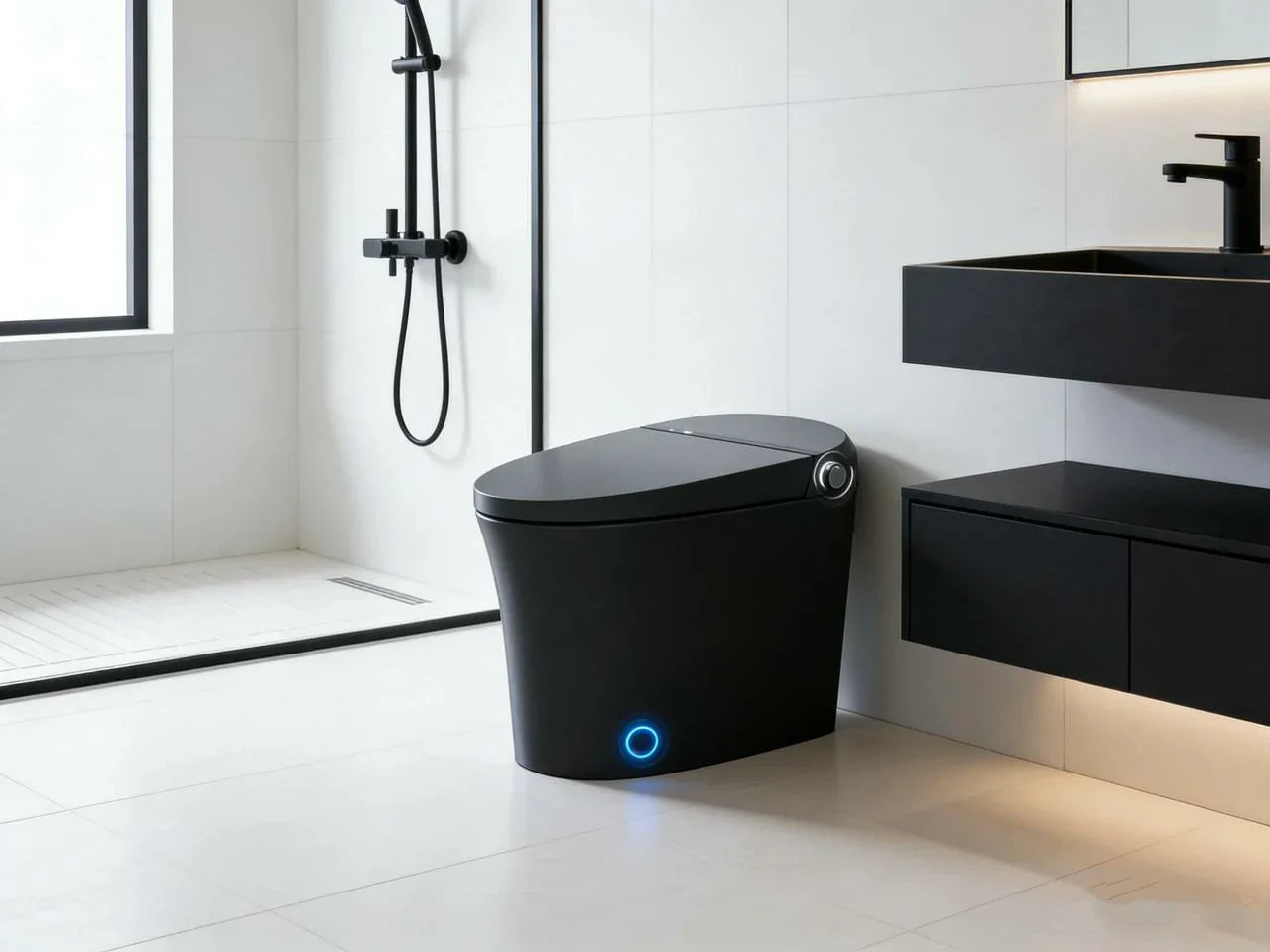
A matte black smart toilet can look sharp and feel great day to day. It can also turn a simple bathroom fixture into something you clean more carefully, plan around, and sometimes troubleshoot.
Here’s where it tends to fit real homes—and where it tends to cause regret.
Should you get a matte black smart toilet? (Decision Snapshot)
Choosing a matte black smart toilet isn’t just about aesthetics—it’s also about daily habits, maintenance comfort, and your bathroom setup. This section helps you quickly figure out whether the sleek, modern look and full bidet features fit your lifestyle, or if the complexity might outweigh the style. Think of it as a quick reality check before committing.
Makes sense for: modern remodels prioritizing black bathroom fixtures + daily bidet use
You’re a good match if:
-
You’re already building a modern black bathroom look (black fixtures, simple lines, strong contrast).
-
You expect to use the bidet features most days, not “once in a while.”
-
You’re fine doing light hands-on cleaning around nozzles and vents.
-
You have (or can add) a safe bathroom outlet in the right spot.
Non-negotiables before committing:
-
Stable GFCI-protected power
-
Easy shutoff valve access
-
Side/rear service clearance
-
Willingness to clean nozzles and vents
-
Comfort with potential repairs
Skip it if: you want “set-and-forget” reliability or hate troubleshooting bathroom electronics
You’ll likely be happier skipping it if:
-
You have hard water and you already fight water spots on black fixtures.
-
You want the simplest possible toilet with the fewest failure points.
-
You hate the idea of sensors, remotes, heaters, and internal seals that might need service.
-
Your bathroom is tight and hard to access behind the toilet.
Quick self-check: space, power, cleaning tolerance, and repair comfort checklist
Ask yourself:
-
Can I add a GFCI-protected outlet close enough without cords crossing walk paths?
-
Can I reach the shutoff valve easily after installation?
-
Am I okay with cleaning the nozzle area and nearby surfaces more often than a normal toilet?
-
If it leaks or a feature fails, am I okay calling for service and possibly pulling the toilet?
If any of those are a “no,” the matte black look may not be worth the friction.
Note: Matte black finish offers bold aesthetics and contrast but can show water spots, fingerprints, or scratches depending on cleaning habits. Smart bidet electronics provide heated seats, warm wash, and auto features, yet require maintenance, occasional troubleshooting, and power access. Separating these helps you weigh style versus functional complexity.
Will the matte black finish stay “luxury” in real bathrooms?
Matte black looks clean in photos because it hides glare and makes a strong shape. In real bathrooms, the finish can be either forgiving or fussy—depending on your water, lighting, and cleaning habits.
Will matte black show water spots, fingerprints, or scratches?
Matte black hides some things and highlights others. Avoid harsh abrasives, steel wool, or high-pH cleaners; damage is often cosmetic but permanent.
-
Fingerprints: Matte can show skin oils as slightly shiny patches, especially on lids and side panels you touch often. If multiple people use the bathroom, this is more noticeable.
-
Water spots and mineral marks: Hard water can leave pale outlines when droplets dry. Matte finishes can make those spots look “chalky.”
-
Scratches: Matte finishes can scratch if you use the wrong pads or gritty cleaners. Even a small scratch can look lighter than the surrounding area because it changes how the surface reflects light.
What I’ve seen in practice: people who already wipe down black faucets regularly do fine. People who like to “deep clean once a week” but ignore daily marks often feel like the toilet never looks as good as it did on day one.
Cleaning reality: you may need softer cloths and gentler products than you use on white porcelain, especially if you’re used to abrasive powders or rough scrub pads.

What the “star of the bathroom” look depends on (lighting, contrast, and surrounding fixtures)
Matte black can look high-end, but the effect depends on the room.
-
Lighting: In dim bathrooms, matte black can read as a dark block. In bright bathrooms, it looks crisp.
-
Contrast: Matte black stands out best when it’s intentional—paired with lighter walls, a lighter floor, or warm wood tones. In an already-dark bathroom, it can feel heavy.
-
Visual clutter: Smart toilets often have seams, sensor windows, side access panels, or a visible cord path. If your bathroom is very minimal, those small details can bother you more than you expect.
Matching risk: when black bathroom fixtures don’t match (undertones, sheen, and fading)
“Black” is not one color in the real world. You can end up with:
-
One fixture that is warm-black (brownish) and another that is cool-black (bluish).
-
Different sheens: matte toilet, satin faucet, powder-coated towel bars, painted cabinet pulls.
-
Uneven aging: some finishes fade or polish up on high-touch spots.
If you care about a coordinated black bathroom fixture look, plan for the possibility that the toilet won’t match other blacks perfectly—especially across different materials (ceramic vs metal vs coated plastic).
Are the smart bidet features actually worth using every day?
Smart features are only “worth it” if you use them enough to justify the extra complexity. The features that win people over are comfort features. The ones that cause regret are the ones that don’t match real routines.
Bidet comfort wins people actually notice: heated seat, warm wash, nightlight, adjustable settings
These are the features most homeowners say they notice every day:
-
Warm wash (especially in winter)
-
Heated seat
-
Adjustable spray position/pressure
-
Nightlight for late trips without turning on full lighting
If you’ll use these daily, you’re more likely to feel the value. If you think you’ll “try it sometimes,” you may end up paying for features you stop using once the novelty fades.
Will the air dryer actually get you dry?
This is one of the biggest expectation gaps.
In many homes, the air dryer:
-
takes longer than people want, and
-
may leave you slightly damp.
So people still use a small amount of toilet paper, or they towel dry (which raises its own hygiene and laundry habits). If your goal is “no paper ever,” plan on testing your patience first. The key point is that dryers are comfort features, not guaranteed replacements for drying the way you expect.
Convenience trade-offs: auto-open/close, touchless flush, and remote quirks in shared bathrooms
Smart convenience features can help—or annoy.
-
Auto-open/close: Helpful with hands full, but can feel “busy” in a small bathroom where people pass close by.
-
Touchless flush: Nice when it works. Annoying when sensors misread movement, especially with kids or pets.
-
Remote control: Great for customizing settings, but remotes can be misplaced, get wet, or respond inconsistently. In a shared bathroom, different preferences can become a daily micro-annoyance (“Who changed my settings?”).
If you have guests often, ask yourself: will they know how to flush, stop a wash cycle, or adjust the seat? Smart features that confuse guests become your problem.
Daily Benefit vs Long-term Effort
Even after the initial excitement wears off, a matte black smart toilet continues to deliver value—but some features require ongoing attention, while others may become less impactful over time. Here’s a realistic look at what tends to keep paying off and what might demand extra effort or get overlooked:
| Feature | Daily Benefit | Long-term Effort / Reality Check |
|---|---|---|
| Heated seat | Keeps you cozy, especially in winter mornings | Minimal maintenance; rarely fails, remains a noticeable comfort |
| Auto-flush | Hands-free convenience after every use | Sensors can misread movement occasionally; may require occasional adjustment or reset |
| Air dryer | Reduces paper use and improves hygiene | Often takes longer than expected; many users still use a small amount of toilet paper or towel dry |
| Nozzle cleaning / bidet hygiene | Ensures clean, warm water for wash | Recurring cleaning is critical; ignoring it can reduce performance and hygiene over time |
Thinking in terms of daily benefit vs long-term effort helps set realistic expectations. Compared with a standard black toilet, the smart model adds comfort, warmth, and hygiene, but these gains come with extra cleaning, occasional troubleshooting, and attention to electronics. Planning for this balance upfront prevents frustration and helps owners enjoy the luxury features without surprises.
Does your bathroom layout support installation without awkward compromises?
A smart toilet is less forgiving than a basic toilet about power, clearance, and service access. Many regrets come from “it fits” on paper but is awkward in the real room.
What happens if there’s no space for the filter and hoses?
Many smart toilets add parts that need room:
-
a water filter cartridge (on some setups)
-
extra hoses and connections
-
an electrical cord and sometimes a bulky plug
In a tight alcove, people end up mounting a filter at a strange angle, bending hoses too tightly, or blocking access to the shutoff valve. Those shortcuts can turn into leaks or service headaches later.
Hookups that decide everything: outlet location, shutoff access, and water line routing
Three make-or-break checks:
-
Outlet: You want a nearby GFCI-protected outlet. If the only outlet is far away, you may end up with an extension cord look (and a safety concern).
-
Shutoff valve: If the toilet skirt or body blocks the shutoff, you’ll hate it the first time you need to stop water quickly.
-
Water line routing: Smart toilets can require specific hose paths. If the supply comes up in an odd spot, you may see the line, or it may pinch.
A small planning note that saves regret: measure not just the rough-in and bowl space, but also the “service space” behind and beside the toilet.
Note: Extension cords or adapters are unsafe long-term, posing shock and tripping hazards.

Simple clearance and access
When planning your matte black smart toilet installation, make sure there’s enough clearance around the unit. Leave a few inches of rear space—typically 2–4 inches—for hoses, power cords, and bends to avoid sharp kinks or crushed lines. Ensure the GFCI outlet is within reach without stretching cords across walkways. Also, allow easy side access if possible, and make sure there’s enough room to reach the shutoff valve and any filters you might use. You don’t need a huge gap, but adequate clearance is essential for safe, trouble-free installation and future maintenance.
Measure before you buy:
-
Rough-in distance from wall to bowl center
-
Side clearance for panels and cords
-
Rear service gap (2–4 inches) for hoses/filters
-
Outlet distance and cord path to avoid stretching
What real-world problems show up after the honeymoon phase?
Most owners who love their smart toilets still mention at least one annoyance they didn’t expect. The common theme: once electronics and internal seals are involved, problems are less DIY-friendly. Owners often struggle with finish upkeep, limited service access, and occasional electronics downtime. Highlighting these early sets realistic expectations.
What happens if internal gaskets leak after installation?
Leaks are one of the most expensive regrets because diagnosis can be tricky.
A slow leak may show up as:
-
a faint odor,
-
a damp spot near the base,
-
intermittent running sounds,
-
or a higher water bill.
With a smart toilet, fixing internal gaskets or seals may require more disassembly than a typical toilet, and in some cases the toilet needs to be pulled. If the unit is heavy or tightly installed, that can mean a plumber visit even for what sounds like a “small” leak.
Regret trigger: choosing matte black for style, then finding out service involves removing a large, delicate-looking fixture you don’t want scratched.
Owner checks vs service:
-
Can safely verify shutoff, visible fittings, reset/power cycle
-
Internal gaskets or hidden seals typically require professional service
-
Avoid disassembling internal electronics yourself

Maintenance reality: debris behind fan/nozzle and how often it forces hands-on cleaning
Smart bidet parts add new “collection points” for dust, lint, and splatter.
Owners often report buildup:
-
around the nozzle area,
-
behind vents or fan intakes (for dryers/deodorizers),
-
and in seams where panels meet.
This doesn’t mean the toilet is dirty all the time. It means there are more nooks than a standard toilet, and ignoring them can lead to smells, reduced dryer performance, or visible grime in a place you notice.
If you’re the kind of homeowner who wants cleaning to be quick and mindless, this is where smart toilets can start to feel like work.
Reliability expectations: heating failures, odd start-up cycling/noises, and intermittent remote response
A smart toilet is part appliance. Appliances have failure modes.
Common complaints after a few years can include:
-
water heating that stops working,
-
seats that don’t warm consistently,
-
start-up cycles that sound strange after plugging in,
-
sensors that act up,
-
or a remote that responds only sometimes.
Some issues are solved under warranty. Some happen after warranty, and parts/service become the question. The key point is you’re trading simplicity for features, so your risk profile changes.
Expect quick wipe-downs after daily use, with occasional deeper cleaning of nozzles, vents, and seams as part of routine maintenance.
A quick “hidden cost” table (not the toilet itself)
These aren’t guaranteed costs, but they’re common enough to plan for:
| What might be needed | Why it comes up | Typical range (US) |
| Add/relocate GFCI outlet | Outlet isn’t close or safe | $150–$500+ |
| Plumber install/service | Tight space, leaks, removal | $200–$800+ |
| Water filter replacements (if used) | Protects internals in some homes | Ongoing cost varies |
| Finish-safe cleaners/cloths | Avoid scratching matte black | Small ongoing cost |
Ranges vary by region and access. The point is to budget for “setup and support,” not just the fixture.
Daily / Weekly Maintenance Checklist for Matte Black Smart Toilets
Maintaining a matte black smart toilet doesn’t have to be complicated, but keeping up with a few simple routines will help it stay looking sleek and functioning smoothly. Here’s a practical checklist you can follow:
Daily Quick Wipe
Use a soft microfiber cloth to wipe down the lid, seat, and side panels each day. This removes fingerprints, skin oils, and minor dust, keeping the matte black finish looking clean and even. Avoid abrasive sponges or powders that can scratch the surface—gentle wiping is all you need.
Nozzle Inspection and Auto-Clean
Check the bidet nozzle area daily or every other day, depending on usage. If your toilet has an auto-clean function, run it regularly to flush out residue and prevent buildup. For toilets without auto-clean, gently wipe the nozzle with a soft cloth or small brush. This keeps the water stream hygienic and avoids unpleasant odors.
Weekly Vent and Fan Cleaning
Smart toilets often have vents for dryers or deodorizers, which can accumulate dust, lint, or bathroom debris. Once a week, inspect these openings and use a small brush or canned air to remove any buildup. Keeping vents clear ensures optimal airflow and prevents smells or reduced dryer performance.
Spot Clean Water Drips and Mineral Marks
Hard water can leave pale spots on matte black surfaces, which are more noticeable than on white porcelain. After use, quickly wipe any water drips on the bowl, seat, or surrounding panels. For minor mineral buildup, a damp cloth with mild soap is usually enough. Regular attention prevents chalky or streaky patches from forming.
Following this routine takes just a few minutes each day and a slightly longer check once a week, but it keeps your matte black smart toilet looking luxurious and ensures all smart features work reliably. Think of it as a small investment in both aesthetics and performance—no special tools required.

Before You Choose (Checklist)
Before committing to a matte black smart toilet, it’s worth running through a few practical considerations. These aren’t just “nice-to-haves”—they help ensure the sleek design actually works in your daily routine without constant frustration.
Power – Make sure you have a GFCI-protected outlet nearby. Avoid relying on extension cords, as smart toilets need stable, safe power for heaters, sensors, and bidet functions, according to the National Electrical Code (NEC) published by NFPA.
Access – Check that you can reach the shutoff valve easily and leave a little space behind or to the side for service. Even 2–4 inches of clearance can make a big difference when you need to clean or service hoses, cords, or filters, based on building and plumbing standards outlined by the ICC iCodes.
Water Quality – Matte black finishes look striking but show water spots. If you have hard water, be ready to wipe down the toilet occasionally to keep it looking its best.
Maintenance – Smart toilets have extra features like bidet nozzles and vents that require attention. Make sure you’re willing to clean around these areas, not just the bowl, to maintain performance and hygiene.
Risk Tolerance – Finally, consider your comfort with potential repairs. If a heater, sensor, or internal gasket fails, you should be okay handling service calls and possible downtime. Knowing this upfront prevents future frustration and ensures the investment actually enhances your bathroom experience.
FAQs
1. Do black toilets show more water spots?
Black toilets, especially glossy ones, can show water spots or mineral deposits more than lighter-colored toilets. A matte black smart toilet tends to hide spots and smudges better, making it ideal for busy bathrooms. Just a quick wipe or rinse after use is usually enough to keep it looking sleek. So, while no black toilet is completely “spot-proof,” a little regular care keeps your luxury black toilet looking pristine.
2. How do you clean a matte black toilet without scratching?
When cleaning a matte black smart toilet, skip abrasive cleaners or rough scrub brushes that could scratch the surface. A soft microfiber cloth with mild soap or a pH-neutral cleaner works perfectly. For stubborn stains, a soft sponge does the job without damaging the finish. Gentle, consistent cleaning keeps your black bathroom fixtures looking smooth and modern, without any unwanted shiny streaks.
3. Are black toilets out of style in 2026?
Not at all. Luxury black toilets are still very much in style in 2026, especially in modern or minimalist bathrooms. Matte black finishes are trending because they add bold, sophisticated contrast without feeling outdated. Pair them with matching black bathroom fixtures or a modern black bidet, and you instantly elevate your bathroom design.
4. Does the bidet nozzle match the black finish?
Many modern black bidets and matte black smart toilets come with nozzles that match the overall black finish, keeping the look cohesive. Some even feature matte black nozzles to perfectly align with the bowl. If the nozzle doesn’t match, it can look a little off, so it’s worth checking the specs to ensure a seamless, luxury aesthetic.
5. Is the ceramic finish durable?
Yes, the ceramic finish on a matte black smart toilet is highly durable. Ceramic resists chipping, scratching, and staining, making it ideal for long-term use. Matte finishes may require gentle cleaners to prevent dulling, but overall, your luxury black toilet will stay sleek and modern for years while complementing your black bathroom fixtures.
References




Leave a comment
This site is protected by hCaptcha and the hCaptcha Privacy Policy and Terms of Service apply.