

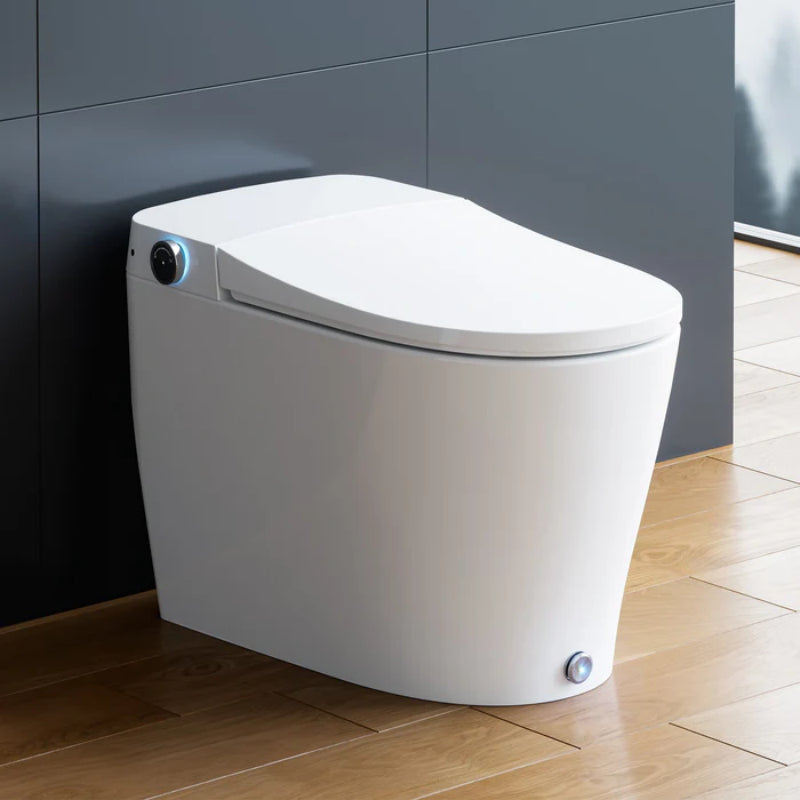

A fully skirted one piece toilet looks simple from the outside: one solid body, no exposed trapway, and an easy clean toilet base you can wipe in seconds. The problems show up underneath and behind that skirt.
In real installs, the skirt does two things at the same time:
-
It hides the messy parts (trapway, bolts, shims, wax/seal), which is why people like the “modern commode” look.
-
It blocks access to the messy parts, which is why small layout or floor issues can turn into returns, extra labor, or a leak you don’t notice until the flooring is damaged.
This guide is not selling the style; it’s here to help you decide if a fully skirted one piece toilet will fit your bathroom, connect to plumbing without hacks, and remain serviceable for 10–20 years.
Decision Snapshot: choose or avoid a fully skirted one piece toilet
When deciding whether to opt for a fully skirted one-piece toilet, it’s essential to ensure your installation conditions align with its requirements. Below, we’ll break down the decision-making process into three categories: Go, Caution, and No-go, based on your specific installation conditions.
Decision Snapshot: Go / Caution / No-go
Go
-
Rough-in = 12" ± 1/4" (center of flange to finished wall)
-
Supply valve outside skirt footprint and reachable
-
Floor flatness ≤ 1/4" across the footprint
-
Seat can be installed/removed without pulling the toilet
Caution
-
Rough-in near edge (11 1/2" or 12 3/4")
-
Valve close to skirt or slightly awkward to reach
-
Floor slightly uneven (up to ~1/4")
-
Seat removal tight in confined space
No-go
-
Rough-in < 11 1/2" or > 12 3/4"
-
Valve under skirt, inaccessible, or supply hose can’t bend without kinking
-
Floor out-of-level > 1/4" or significantly uneven
-
Seat removal impossible without lifting the entire toilet
Trade-offs to note
-
Blocked valve access
-
Hidden leaks that may go unnoticed
-
Heavier handling
-
One-shot seal placement required
Choose it when your rough-in is truly standard (center-of-flange to finished wall = 12" ± 1/4") and the supply valve sits outside the skirt footprint.
Choose it when your rough-in is truly standard (center-of-flange to finished wall = 12" ± 1/4") and the supply valve sits outside the skirt footprint
A skirted one-piece is most trouble-free when:
-
Rough-in is truly 12" (finished wall to center of closet flange), and the toilet’s spec sheet matches that 12" rough-in without needing a special adapter.
-
Your shutoff valve and supply line can be reached and connected without the skirt covering the valve or forcing a kinked hose.
-
Your floor is flat enough that the toilet can sit solidly without a pile of shims you can’t easily access later.
Why skirted toilets can cause regret
This style causes regret when:
-
Side clearances are tight and the seat can’t be installed/removed after the bowl is set.
-
You expect to swap seats often (kids, rentals, bidet seats, seat damage), because some skirted designs make seat hardware harder to reach.
-
You want “easy DIY later,” because skirt + concealed trapway often means you can’t reach what you need without pulling the toilet.

Don’t buy before confirming flange height/levelness—skirted bases hide leaks and make bolt/wax-ring work harder (and costlier)
If your flange is high, low, offset, corroded, or the floor is out of level, a skirted base can:
-
Prevent full seating on the seal
-
Make bolt tightening awkward (side access)
-
Hide early leak clues until damage spreads
Rule of thumb: if you wouldn’t feel confident setting a standard toilet on your flange without “fussing,” a skirted one-piece usually adds more fuss, not less.
Who this is for / NOT for
If your home matches these conditions → choose a fully skirted one piece toilet:
-
Rough-in = 12" ± 1/4"
-
Accessible shutoff valve outside skirt footprint
-
Flat finished floors
-
Enough room to lift and place the toilet and later remove the seat without pulling
If any of the following applies → avoid or reconsider:
-
Rough-in outside tolerance
-
Valve covered or hard to reach
-
Floor out-of-level > 1/4"
-
Tight quarters where seat swaps/DIY adjustments are frequent
-
Older subfloor or uncertain flange height
Best-fit homes: flat finished floors, accessible shutoff valve, straight rough-in, and room to lift/position a heavy one-piece toilet
Fully skirted one piece toilet installations go smoothly when the bathroom checks these boxes:
-
Flat finished floor (tile done right, or solid vinyl/LVP over a flat underlayment)
-
A standard 12" rough-in that has not drifted due to added wall thickness, tile builds, or a bumped-out baseboard
-
Shutoff valve location that leaves room for the skirt and still allows your hand to turn the valve
-
Enough open space to lift and set a heavier toilet without banging a vanity, tub, or door jamb
A one-piece is usually heavier and more awkward than a two-piece because you can’t split the tank off. If the only way into the room is sideways through a narrow door past a vanity, this matters.
Poor-fit homes: older remodels with uncertain flange height, patched subfloors, or non-standard drain placement that needs “wiggle room”
Skirted toilets are less forgiving in older homes because older homes often have:
-
Flanges set too high after tile work, or too low after floor patches
-
Subfloors that sag or hump near the flange
-
Drains that are not perfectly centered or square to the wall
A standard exposed-base toilet gives you more visual feedback and more access to bolts and shims. A skirted base can block access right when you need it.
If you rely on easy DIY servicing: a concealed trapway + skirt can turn simple fixes (seat bolts, minor rocking) into full removal jobs
In practice, homeowners get surprised by service jobs that would be simple on a standard toilet:
-
Tightening closet bolts after a minor rock
-
Replacing a supply hose
-
Fixing seat hardware that spins, strips, or drops into a cavity
-
Diagnosing a slow leak at the seal
With a concealed trapway and skirt, you often can’t see the problem and can’t reach the fasteners easily. That’s where the “modern” look costs time later.
The trade-offs you’re accepting with a concealed trapway and easy clean toilet base
While a concealed trapway and easy-clean toilet base offer sleek design and easier maintenance, there are several hidden trade-offs that come with this feature. Let’s explore the potential issues that may remain hidden behind the smooth exterior, and why these could pose problems over time.
The “easy clean” exterior can hide the exact problems you want to see (micro-leaks, wax ring failure, rocking, sewer gas clues)
A skirted base can be easier to wipe. But the same smooth skirt can hide:
-
A faint water trail from a seal that’s starting to fail
-
Moisture wicking from a bad seal into grout lines
-
Small rocking that slowly breaks the seal
-
Sewer odor clues (sometimes you smell it before you see it)
On a standard toilet, a tiny leak often shows up as staining around the base. On a skirted base, water can stay hidden longer, especially if it runs inside the skirt cavity and only shows up after it has soaked into underlayment or subfloor.
The skirt limits access to closet bolts, flange, and shims—small alignment issues become big installation issues
A standard toilet is set, bolts are visible, you snug them down evenly, you shim where needed, and you can see what’s going on.
A fully skirted one piece toilet often uses:
-
Side access holes for bolt tightening
-
A concealed mounting bracket
-
Or a hybrid system that still depends on flange bolts but hides them
This becomes a problem when:
-
The bolt slots don’t line up cleanly on the first try
-
The toilet has to be shifted slightly to square it to the wall
-
You need to add or adjust shims after you think it’s seated
With a skirt, the “one more tiny adjustment” can turn into lifting the whole toilet again.
Modern commode look vs. serviceability: anything behind the skirt (seat anchors, supply alignment, bolt tightening) is slower and fussier
Here’s what tends to happen in practice:
-
The homeowner buys it for easy cleaning and modern lines.
-
The installation takes longer than expected because the skirt blocks fastener access.
-
Years later, a seat issue or a small rock becomes annoying because access is limited.
None of this means skirted toilets are “bad.” It means they are less tolerant of real-world bathrooms that are slightly out of square, slightly tight, or slightly uneven.
Installation Considerations: Rough-in, Valve, and Clearance
-
Labor reality: extra time for alignment, side-fastener tightening, leveling, and leak verification
-
Handling risk: heavy one-piece toilet; improper movement → chip tile or ceramic
-
One-shot placement warning: setting then lifting = new wax/waxless seal required; always dry-fit first
Practical tip: Dry-fit to confirm:
-
Skirt clears shutoff valve
-
Bolt alignment correct
-
Level across footprint
-
Supply hose connects without kinking

Will it physically fit? Rough-in, valve location, and clearance thresholds
-
Rough-in edge cases: 10"/12"/14" layouts; almost 12" at 11 1/2" or 12 3/4" → Do not buy unless spec sheet explicitly supports it
-
Valve checklist: Confirm height/offset does not land under skirt bulge, hand can reach valve, supply hose bends without kinking
-
Seat install/remove: Verify seat can be installed/removed without moving toilet
Why skirted toilets are less forgiving:
-
Deep fixed rear profile
-
Shallow gaps behind toilet can reveal misalignment only after installation
-
Slightly off rough-in → visible gaps or rocking → seal failure
Can your floor flange and floor surface accept a skirted base?
Fix flange first: high, low, corroded, offset, or broken flange → must correct before buying
-
Floor out-of-level > 1/4" → correct before install
-
Subtle unevenness (< 1/4") → plan shims carefully and check stability
Levelness & bolt access:
-
Side-hole bolt access may force uneven tightening
-
Misalignment requires lifting the entire toilet → risks seal damage
What fails later: maintenance access, hidden leak risk, and long-term ownership consequences
-
Seat swaps, DIY fixes → may require full toilet removal
-
Hidden leaks → skirt hides early warning signs (soft floor, odors, staining)
-
Clean exterior does not equal low-maintenance; concealed trapway can trap debris
Pre-purchase Bathroom Audit & Checklist
Required measurements:
Finished wall → flange center (rough-in)
-
Toilet centerline → nearest side obstruction
-
Front clearance from bowl/projection → door/fixture
-
Supply valve: wall-to-valve, floor-to-valve, centerline-to-valve
-
Flange condition: solid, anchored, not corroded or cracked
-
Floor flatness/levelness ≤ ~1/4"
-
Seat install/removal space without pulling toilet
Stop and don’t buy if any audit item fails:
-
Rough-in outside tolerance
-
Valve inaccessible or under skirt
-
Seat cannot be removed/installed without lifting
-
Floor out-of-level > 1/4"
-
Flange questionable
Labor reality: expect extra time for alignment, side-fastener tightening, leveling, and leak testing that’s harder to verify
A standard toilet install is usually straightforward if the flange is good. A fully skirted one-piece often adds time for:
-
Dry fitting to confirm the skirt clears the shutoff valve
-
Confirming bolt alignment through side access points
-
Leveling the base when you can’t easily see all contact points
-
Double-checking for leaks when the skirt hides the perimeter
Cost reality: in many markets, a skirted one-piece installation is priced higher than a standard two-piece because it is heavier and more time-consuming. If the floor or flange needs work, the labor gap gets bigger because the toilet is harder to pull and reset.
Handling risk: heavy one-piece toilet positioning on tile can crack finishes or chip the base if it rocks before tightening
One-piece toilets are awkward to set because the weight is one unit and the center of mass is higher than you expect. Common avoidable damage:
-
Chipping the ceramic base on tile edges during the “drop onto bolts” moment
-
Scratching tile because the toilet gets slid instead of lifted
-
Cracking a tile if the toilet rocks on a high spot and gets tightened down anyway
If you’re doing it DIY, plan on:
-
A second person to guide alignment
-
A protected path (cardboard/blanket) if you have to maneuver in a tight bathroom
-
A no-slide policy: lift, place, and commit
If you might need to reposition it after setting: moving it breaks the seal—plan a one-shot placement with full dry-fit checks
This is a big one. Once a toilet is set onto a wax ring (or many waxless seals), you don’t get unlimited do-overs. If you set it, compress the seal, then lift to “fix alignment,” you often need a new seal.
Skirted bases increase the chance you’ll want to reposition after setting, because:
-
You can’t see bolt alignment well
-
You may discover the supply hose can’t connect after the toilet is down
-
You may find the skirt hits the shutoff valve only after it’s in place
So the smart move is to dry-fit and confirm every clearance before the real set.
Will it physically fit? Rough-in, valve location, and clearance thresholds that cause returns
While determining if a toilet will fit in your space seems straightforward, it's important to understand how small measurement variations—such as rough-in errors and wall adjustments—can lead to alignment issues and potential returns. Let’s break down how these discrepancies play out in real-world bathroom installations.
Rough-in edge cases: 10"/12"/14" layouts, “almost 12-inch” walls, and how ±1/8"–±1/4" errors show up as gaps or misalignment
Rough-in is measured from the finished wall (not the baseboard) to the center of the closet flange (or the center of the closet bolts).
Most homes aim for 12", but real bathrooms drift:
-
Added tile, wall board, wainscoting, or a furred-out wall can steal 1/4"–1/2"
-
Older framing can be out of square
-
Some flanges are not perfectly centered
Why skirted one-piece toilets are less forgiving: many have a deeper, fixed rear profile. If your rough-in is “almost 12” but not quite, you may get:
-
A visible gap behind the toilet (if the toilet lands too far forward)
-
The tank/body touching the wall (if the toilet lands too far back), which can prevent full seating on the seal or cause rocking
Rough-in diagram (measure from finished wall):
-
Finished Wall: This is the wall at the back of your bathroom where the toilet will be installed.
-
12" Target (± 1/4"): The ideal measurement from the finished wall to the center of the closet flange/bolts should be 12 inches, with a tolerance of plus or minus 1/4 inch.
-
Center of Flange/Bolts: This is the point where the toilet flange (the base that attaches to the floor) and bolts are centered. It's crucial for proper installation.
-
Closet Flange in Floor: This shows the location of the closet flange in the floor, which is where the toilet will be mounted.
Essentially, this diagram is used to ensure that the toilet’s rough-in measurement aligns with the recommended 12 inches (with some flexibility), which is key for proper toilet fit and installation.
If your measurement is 11 1/2" or 12 3/4", don’t guess. Some toilets can adapt; many skirted one-piece models cannot without specific mounting systems. If the spec sheet does not clearly allow your measurement, expect trouble.
Will this work in a small bathroom? Minimum side/front clearance to install/remove the seat without pulling the toilet
Building codes vary, but the real-life problem is not only “can you sit.” It’s “can you service it.”
Skirted one-piece toilets in tight rooms often create two headaches:
-
You can’t get tools into side access holes without removing the toilet paper holder or vanity trim.
-
You can’t remove the seat later because the seat hinges hit the wall or a cabinet before the seat clears.
Top View (Plan):
-
Side Obstruction (vanity/tub): This refers to any nearby structures like a vanity or tub that could potentially block access to the toilet.
-
Toilet Footprint: This is the overall space that the toilet occupies on the floor.
-
Seat Arc: This indicates the space needed for the toilet seat to move up and down, meaning it requires enough room to lift and remove the seat comfortably.
-
Centerline: The center of the toilet, used as a reference point for measurements.
-
≥ 15" from Centerline to Each Side: A minimum of 15 inches of clearance from the center of the toilet to any obstruction (like a wall, vanity, or tub) is recommended for comfortable use and servicing.
-
Front Clearance: The space from the front of the toilet bowl to the door or any other fixture. This space should be enough for someone to stand, clean, and, if necessary, remove the toilet in the future.
In short, when installing a toilet, ensure there’s sufficient clearance from both the sides and front for proper installation and future maintenance.
If your bathroom is tight enough that you already dislike cleaning around the current toilet, a skirted base can help. But if it’s tight enough that you can’t comfortably reach the shutoff valve or seat hinges now, a skirted one-piece can make that worse.

Supply valve and hose conflicts: skirt interference with valve height/offset, shutoff access, and where the line must land to connect cleanly
This is one of the most common “it looked standard online” failures.
Problems happen when:
-
The shutoff valve is close to the toilet centerline and the skirt covers it
-
The valve is higher than normal and lands right where the skirt bulges
-
The supply hose connection point on the toilet is tucked inside the skirt and hard to reach
What you need to confirm before buying:
-
Distance from the centerline of the toilet to the shutoff valve (left side is typical)
-
Valve height above finished floor
-
Whether you can fit your hand to operate the valve after installation
-
Whether a standard flexible connector can make the turn without kinking
If you can’t turn the shutoff valve without scraping your knuckles, you’re going to hate it the first time you need to stop water in a hurry.
Can your floor flange and floor surface accept a skirted base without leaks or rocking?
A secure, properly positioned flange is crucial for a skirted toilet’s seal to function correctly. Let’s examine how flange height and condition—such as offset, corroded, or uneven flanges—can disrupt the toilet’s seating and lead to leaks or rocking, often hidden by the smooth exterior of the skirted base.
Flange height & condition: high flanges, uneven rings, offset flanges, and why the skirt can block full seating on the wax/seal
A toilet seal only works if the toilet can sit down evenly and compress the seal properly.
Flange issues that cause skirted installs to fail or leak:
-
Flange set too high (common after new tile). The toilet may bottom out on the flange instead of compressing the wax/seal evenly.
-
Flange set too low (common after flooring removal). The seal may not compress enough, leading to micro-leaks.
-
Corroded or broken flange that won’t hold closet bolts firmly.
-
Offset flange (drain is slightly moved to avoid joists). This can force the toilet into a position where the skirt hits the wall or valve.
With a non-skirted toilet, you can usually see the bolt angle, shim points, and how the base is landing. With a skirt, you may not realize it’s not seated until water shows up later.
If your flange is questionable, fix it first. A skirted one-piece is not the place to “see if it works.”
Levelness tolerance: if the floor is out-of-level more than ~1/4" across the base footprint, expect shims + repeat leveling checks
Toilets don’t need a perfectly level house, but they do need a stable base so the seal isn’t stressed.
In practice:
-
If the floor is out by a little, shims can stabilize it.
-
If it’s out a lot, you end up stacking shims, and a skirted base can make it harder to place them neatly and hide them cleanly.
Practical threshold: if you measure more than about 1/4" out of level across the toilet footprint, plan on shimming and spending extra time verifying it doesn’t rock after tightening.
Also watch for tile “lippage” (one tile edge higher than the next) right under the base. A skirted one-piece can bridge that edge and rock in a way that’s hard to diagnose.
Bolt/fastener access: side-hole tightening, bolt-slot alignment, and what happens when standard bolts/wax methods don’t seat evenly
Homeowners often assume “it fits standard floor bolts.” Sometimes it does, sometimes it uses a bracket system, and sometimes it uses standard bolts but you tighten them through side holes.
Here’s where people usually run into trouble:
-
You can’t get a wrench onto the bolt head because the skirt blocks it.
-
The side holes are small and you can only turn the nut a fraction at a time.
-
One side tightens more than the other because you can’t see the washer seating.
-
You overtighten because you’re working blind (and ceramic does crack).
What changes vs a standard toilet: the effort shifts from “simple and visible” to “precise and partly hidden.” If your flange and bolts are perfect, it’s fine. If they’re not, this is where installs bog down.
What fails later: maintenance access, hidden leak risk, and long-term ownership consequences
While a skirted one-piece toilet offers a sleek appearance, long-term maintenance and repair can be trickier than you might expect. Let’s dive into how common seat issues and hidden access points can turn simple fixes into costly, time-consuming tasks, particularly when the toilet needs to be removed for repairs.
If the seat loosens or a well nut fails: can you fix it from above, or will you have to uninstall the toilet to reach behind the skirt?
Seat issues are common over time: kids wiggle seats, cleaners loosen hardware, plastic well nuts age and spin.
On many toilets, you can tighten seat bolts from above. On some skirted one-piece designs, the seat hardware or access is awkward enough that:
-
You can’t reach the underside of the seat mount area
-
The fastener drops into a cavity
-
The nut spins and you can’t grab it
That’s when a “tighten the seat” job turns into pulling the toilet. Pulling a skirted one-piece costs more (labor) and usually means replacing the seal.
If your household is hard on toilet seats, or you plan to use a heavier specialty seat, this is worth taking seriously.
Hidden leak timeline: why skirted bases can delay detection until flooring/subfloor damage is significant
Toilet seal leaks often start small:
-
A few drops per flush
-
A damp ring that dries
-
Moisture that wicks into grout
A skirted base can hide that early evidence. The first obvious sign may be:
-
Soft flooring near the toilet
-
A smell that comes and goes
-
Staining on the ceiling below (if there’s a level under the bathroom)
By then, the “easy clean base” has cost more than it saved, because subfloor repair is where budgets get hit.
If you choose a skirted base, you need to be more disciplined about:
-
Checking for rocking
-
Watching for unexplained odor
-
Inspecting the floor around the toilet periodically
“Clean” doesn’t mean low-maintenance: concealed trapway geometry, debris traps, and the reality of cleaning where you can’t see or reach
A concealed trapway is easier to wipe on the outside. Inside, it’s still a toilet: minerals build up, dust collects behind it, and the floor around it still needs cleaning.
Two practical cleaning realities:
-
The skirt creates tighter gaps where dust and hair can collect along the floor edge.
-
If the toilet is installed too close to the wall or vanity, you may not be able to clean behind it well, even if the sides are smooth.
Also, if you have hard water, scale can still build in the bowl’s water path. The skirt doesn’t change that.
Pre-purchase bathroom audit (measurements + go/no-go checklist)
Before committing to a purchase, a thorough bathroom audit is essential to ensure the toilet will fit perfectly in your space. Start by carefully measuring key areas like the rough-in, side and front clearance, and supply valve position—these measurements will determine whether the toilet is a viable option for your bathroom.

Measurement checklist: finished wall-to-flange center, side clearance to obstructions, front clearance, and supply valve position/height
Do these measurements before you buy. Don’t eyeball them.
-
Rough-in (critical)
-
Measure from finished wall to the center of the closet bolts (or flange center).
-
Target: 12" ± 1/4" for most “12-inch rough-in” toilets.
-
If you measure 11 5/8" or 12 1/2", that’s the danger zone where some models fit and some don’t.
-
Side clearance
-
Measure from toilet centerline to nearest obstruction on both sides (vanity, tub, wall).
-
Also think about hand access to side fasteners if the design uses side access holes.
-
Front clearance
-
Measure from the front of the existing bowl (or from the flange center plus the bowl’s “projection” in the spec sheet) to the door or fixture.
-
Supply valve location
-
Measure from finished wall to valve center.
-
Measure from floor to valve center.
-
Measure from toilet centerline to valve center.
-
Confirm the valve will not land inside the skirt footprint and that you can still turn it.
Retrofit vs new-build checks: verifying flange height, subfloor flatness, and bolt spacing before you commit to a skirted design
Retrofit (most homes):
-
Pull the old toilet if you can (or at least inspect closely) and check flange condition.
-
Confirm the flange is solid and anchored.
-
Check floor flatness around the flange with a straightedge.
-
Verify the shutoff valve is reachable and not trapped behind a skirted shape.
New build or full remodel:
-
You can plan for skirted, which is where it shines.
-
Set the flange at the right height for the finished floor.
-
Place the shutoff valve where it will be accessible and not covered.
-
Make sure the rough-in is truly 12" from the finished wall, not framing.
Visuals to include: rough-in diagram with tolerances, clearance map for seat access, and a flange-height/levelness decision table
-
Rough-in tolerance visual (quick check):
If your measurement is:
-
11 3/4" to 12 1/4" → This range is generally safe for toilets with a "12-inch rough-in."
-
11 1/2" to 11 3/4" → The toilet may hit the wall or may not sit properly on the flange.
-
12 1/4" to 12 1/2" → This range might leave a gap or cause the toilet to push forward slightly.
-
Outside these ranges → Expect compatibility issues unless the toilet is specifically designed to fit.
-
Seat access clearance reminder (real-life service issue):
If the toilet seat cannot be lifted or removed without hitting a wall or vanity, it is likely that replacing the seat will require pulling the entire toilet out. This can be a costly and inconvenient process, so it's important to consider this factor before purchasing the toilet.
-
Flange height / levelness decision table (go/no-go):
| Condition at flange/floor | What it means for a skirted one-piece | Recommended action |
|---|---|---|
| Flange solid, correct height, floor flat | Likely straightforward install | Proceed if rough-in + valve clear |
| Flange high after tile | Toilet may rock or not compress seal | Correct flange height or use proper flange solution before install |
| Flange low / floor built up | Seal may not compress enough | Address flange height; don’t “double up” seals as a guess |
| Floor out-of-level up to ~1/4" | Shims likely; check for rocking | Dry-fit, plan shim placement, re-check after tightening |
| Floor out-of-level more than ~1/4" | Higher leak/rock risk, more labor | Fix floor/underlayment first or avoid skirted |
| Offset flange / drain not centered | Fit and squaring issues | Confirm with spec sheet and dry-fit; avoid if tight clearances |
Before You Buy
-
Measure finished wall to flange/bolt center and confirm it is 12" ± 1/4" (or matches the toilet’s stated rough-in requirement).
-
Confirm the shutoff valve will sit outside the skirt footprint and you can still reach and turn it after installation.
-
Verify you have enough side clearance to access any side fasteners and enough space to remove/replace the seat later without pulling the toilet.
-
Inspect the closet flange condition (solid, not cracked/corroded, properly anchored) and correct any issues before buying.
-
Check floor flatness/levelness around the flange; if it’s more than about 1/4" out, plan to correct the floor or expect extra labor and shims.
-
Plan for handling: confirm you have a way to lift and set a heavy one-piece without sliding it on tile or bumping fixtures.
-
Do a dry-fit plan: assume you get one good set on the seal—avoid installs where you “might need to shift it later.”

FAQs
1. Is a skirted toilet harder to install?
Installing a skirted toilet can definitely be trickier than a standard two-piece model. The skirt hides most of the hardware—bolt heads, shims, and the wax ring—so you don’t get the visual feedback you usually have when positioning a toilet. If your bathroom has a perfect 12-inch rough-in, a solid, level flange, and plenty of clearance, installation goes fairly smoothly. But even slight deviations, like an uneven floor, a flange that’s a bit too high or low, or a valve that sits too close, can turn a simple job into a frustrating one. You’ll often need to lift or wiggle the entire toilet multiple times just to get everything aligned, and if you make a mistake after the seal is compressed, you may need a new wax ring or seal. For DIYers, this is a job where having a second person and planning a careful dry-fit is almost mandatory.
2. Do skirted toilets fit standard floor bolts?
It depends on the model, and this is where a lot of surprises come from. Some skirted toilets are designed to work with regular floor bolts like a traditional toilet, but many use concealed brackets or side-hole access for mounting. These hidden systems look sleek but can be finicky: if your floor bolts aren’t perfectly aligned or your flange is slightly off, it can be hard to get the toilet square to the wall. You may also need to adjust shims or brackets while working blind inside the skirt. The upside is that once installed correctly, you get a clean, modern look with no exposed hardware, but the downside is that misalignments are less forgiving and fixing them later usually means lifting the whole toilet again. Always double-check the spec sheet before committing to a model.
3. How do you reach the water line on a skirted toilet?
Water line access is one of the most overlooked challenges with skirted toilets. Because the skirt wraps around the base, it can block the shutoff valve or make the flexible supply hose awkward to attach. If the valve is too high, tucked behind the skirt, or sits very close to the wall, connecting a standard hose may require creative bending or even removing the toilet. Even after installation, turning the valve can be uncomfortable if your hand doesn’t fit. The trick is to measure carefully before buying, ensuring the shutoff valve is reachable and that the supply hose can bend without kinking. A dry-fit before the final seal is a must. Some homeowners install an offset or longer supply line, but that adds extra cost and effort. Basically, what looks standard on paper can become surprisingly tight in practice.
4. Are they heavier than non-skirted toilets?
Yes, fully skirted one-piece toilets are heavier and bulkier because the tank and bowl are fused into a single unit. That weight matters when you’re trying to maneuver the toilet through doorways, lift it onto a flange, or avoid scratching tiles. Even small bathrooms can become challenging, especially if you need to rotate the toilet sideways past a vanity or tub. This weight also affects DIY handling: moving the unit after the wax ring is seated risks breaking the seal or chipping the base. Having a second person and a clear path is essential. In comparison, two-piece toilets allow you to handle the bowl and tank separately, which is easier in tight spaces. While the extra weight gives the toilet a sturdy feel once installed, it also increases installation time and labor risk.
5. Why are skirted toilets more popular now if they’re fussier?
Skirted toilets have exploded in popularity because of their sleek, modern look and the promise of easy cleaning. The smooth, uninterrupted sides eliminate exposed trapways and awkward nooks, so wiping down the base takes just seconds. In bathrooms with a standard 12-inch rough-in, a solid level floor, and a well-placed shutoff valve, these toilets perform very well. The main issues appear in retrofits or older homes, where walls aren’t perfectly square, valves sit in tight spots, or the floor isn’t flat. Here, the hidden hardware and skirted base can make even minor adjustments laborious. So while they’re a bit fussier to install, the combination of aesthetic appeal and the perception of easy maintenance explains their growing popularity among homeowners and designers.
6. Why popular despite fussier installs?
Skirted toilets have become popular for their sleek, modern design and easy-to-clean exterior. With no exposed trapway or bolts, they create a minimalist look that works well in contemporary bathrooms. In homes with standard rough-ins, flat floors, and well-placed valves, these toilets install smoothly, making them a great choice for new builds or renovations. However, in older homes or bathrooms with non-standard plumbing, installation can be trickier due to uneven floors, awkward valve placements, or incorrect rough-ins, which can make the process more time-consuming. Despite these challenges, many homeowners still choose skirted toilets for their aesthetic appeal and low-maintenance design. While installation might take more effort, the sleek look and easy upkeep often make them worth it for those looking to elevate their bathroom’s appearance.
References


Leave a comment
This site is protected by hCaptcha and the hCaptcha Privacy Policy and Terms of Service apply.