

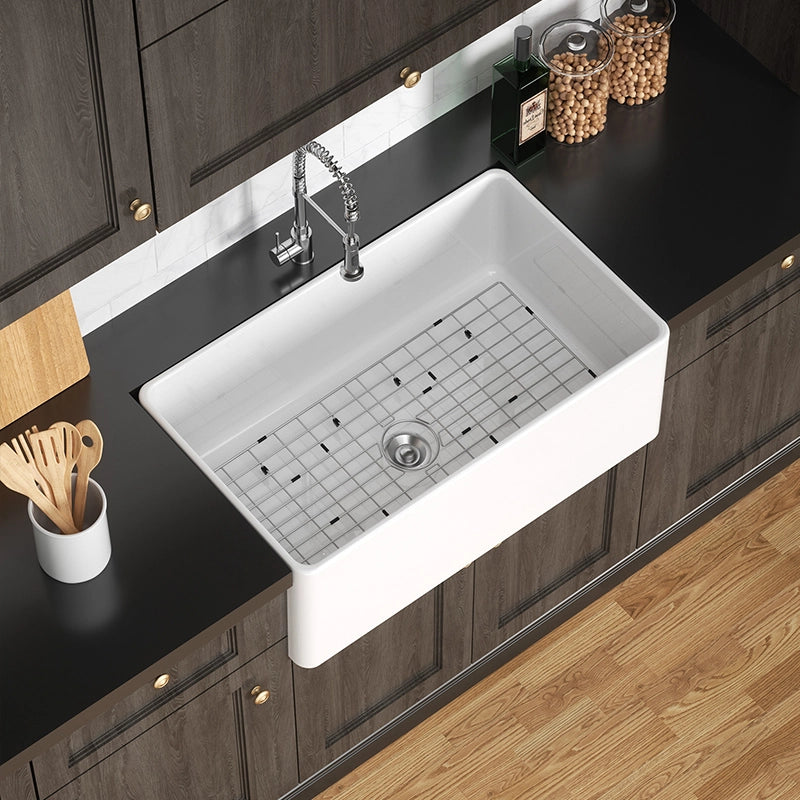
A drop in farmhouse sink (also called a top mount apron sink or self-rimming apron-front sink) is a specific compromise: you get the farmhouse apron front look and a deep kitchen sink, but you also accept a visible rim on top of the countertop.
That rim is the whole story. It’s why these are popular for easy install farmhouse sink projects. It’s also why some homeowners regret them after the first month of cooking.
This guide is written to help you make a confident first choice—especially if you’re replacing an existing sink and trying to avoid cabinet drama.
Decision Snapshot: drop in farmhouse sink vs undermount apron-front vs standard kitchen sink
If you only read one section, read this.
Avoid a drop in farmhouse sink if…
-
You dislike rim seams and expect wipe-to-clean countertops
-
You prefer a modern, seamless countertop edge
-
You don’t want to wipe or re-seal around the rim regularly
-
Your kitchen is small and landing space around the sink is limited
Choose a drop-in farmhouse sink if…
-
You want the classic apron front 16 gauge stainless look or flat apron front style without rebuilding your base cabinet.
-
You’re replacing an existing top-mount stainless steel single bowl kitchen sink and want similar farmhouse sink features.
-
Your countertop is laminate (or another surface where undermount is harder or not recommended).
-
You can live with a rim seam that needs regular wiping.
Rule of thumb: If your kitchen already has a top-mount sink and you want the farmhouse look with the least disruption, a drop-in farmhouse sink is usually the lowest-risk path.
Choose an undermount farmhouse / apron-front sink if…
-
You wipe crumbs straight into the bowl and you hate seams.
-
You have stone countertops (quartz, granite) and want a cleaner, more modern edge.
-
You’re already doing a bigger remodel and can plan support and cutouts properly.
Rule of thumb: If daily clean-up speed matters more than easy installation, undermount often feels better to live with.
Choose a standard top-mount or undermount kitchen sink if…
-
Your kitchen is small and you want to protect counter space.
-
You don’t really want a “feature sink” that draws the eye.
-
You’re worried a deep farmhouse basin will feel awkward (shorter users, aging joints, kids washing hands).
Rule of thumb: If you’re trying to make the kitchen more functional without changing the whole vibe, a conventional sink is still the safer bet.
Non-negotiables to verify before choosing:
Cabinet interior width, apron-front clearance, countertop cutout coverage, and sink depth comfort for daily use.
The rim problem: sealing, mildew, and why drop-in seams age differently than undermount edges
This is the biggest long-term issue unique to drop-in farmhouse sinks.
Because the rim sits on the countertop, you have:
-
a visible seam
-
sealant exposed to water, cleaners, and scrubbing
Over time, that seam can:
-
discolor
-
collect grime
-
grow mildew if it stays damp (especially behind the faucet)
This doesn’t mean a drop-in is “bad.” It means you should plan for:
-
careful initial sealing
-
occasional re-sealing as normal maintenance
-
avoiding harsh cleaners that damage sealant
Who actually wins with an easy install farmhouse sink (and who regrets it)
A drop in farmhouse sink sounds like the best of both worlds. In real homes, it’s more like two benefits plus one new daily annoyance.
Don’t choose this if you cook daily and expect “wipe-to-clean” counters
If fast cleanup is part of how you cook, a drop-in farmhouse sink will likely frustrate you.
With an undermount sink, crumbs and spills wipe straight into the bowl. With a drop-in (top mount) sink, those same crumbs hit the rim seam or sealant line first.
It’s manageable—but it breaks the “one swipe and done” habit.
If that habit matters to you, this is usually the wrong sink type.
Choose this if you’re replacing an existing top-mount sink and want the farmhouse look with minimal disruption
This is the sweet spot.
If you already have a standard top-mount kitchen sink (a self-rimming sink with a visible lip), you’re used to some edge on the counter. A drop-in farmhouse keeps the basic install logic: the sink drops into a cutout and the rim sits on the countertop.
In practice, this can reduce:
-
cabinet modifications (compared to many undermount apron-front installs)
-
the need for precise mounting rails/clips
-
the “what did we just uncover?” surprises during demo
This is one reason drop-in apron-front sinks show up a lot in quick remodels and DIY replacements.
Choose this if you want a deep single bowl for large cookware and batch cooking
If you regularly wash:
-
stockpots
-
sheet pans
-
roasting trays
-
large colanders
…the deep single bowl farmhouse workflow can feel like a real upgrade.
A single bowl drop in farmhouse sink handles oversized items better than many standard double-bowl kitchen sinks, especially in busy cooking households.
Don’t choose this if your kitchen is small and counter landing space is critical
A farmhouse sink is deeper and wider by design. A drop-in version adds rim width on top of that.
In smaller kitchens, this can reduce:
-
usable landing space next to the sink
-
room for cutting boards or drying racks
-
space behind the sink for faucet reach
If every inch of the countertop does a job, a standard-size sink often keeps the kitchen flowing better.
Don’t choose this if you expect it to live like an undermount farmhouse sink
This expectation causes the most regret.
A drop in farmhouse sink does not clean or feel the same as an undermount apron-front sink. The rim changes how crumbs, grease, and water move across the counter.
If you accept that difference up front, many homeowners are happy.
If you expect undermount behavior, disappointment usually follows.
Quick self-check before moving on
You’re likely a good fit only if:
-
You’re okay wiping a rim seam regularly
-
You value easier installation over seamless cleanup
-
You want farmhouse style without cabinet reconstruction
If any of those feel like compromises you don’t want, pause here—another sink type may suit you better.

The trade-offs that separate a top mount apron sink from the alternatives
The single biggest daily trade-off between a drop-in farmhouse sink and the alternatives is simple:
rim seam cleaning versus wipe-in convenience.
Cleaning fork: self-rimming lip vs undermount edge (crumb sweep, grease, caulk line, and “rim grime” reality)
What you’ll do weekly:
Wipe the rim seam and plan for periodic re-sealing.
A self-rimming sink (top mount) has a rim that rests on top of the countertop. That rim:
-
creates a seam where grease and crumbs can collect
-
usually needs a bead of sealant that can discolor over time
-
adds corners and edges you end up scrubbing with a brush
Risk + prevention required:
Edge leaks with a drop-in farmhouse sink are not a product-quality issue—they’re a sealant exposure issue.
Because the rim sits on top of the countertop, the sealant is exposed to splashing, cleaners, heat, and movement. If the countertop isn’t flat, the rim isn’t fully supported, or re-sealing is delayed, leaks can develop over time.
Proper sealing at install and periodic re-sealing are required to keep a drop-in sink watertight.
Look/finish fork: visible rim + exposed apron front vs seamless modern lines (and how it reads with quartz/granite)
Yes, you can see the rim on a drop-in apron sink. That’s not a flaw—it’s the design.
But it changes the vibe:
-
In a rustic or classic farmhouse kitchen, the rim can look intentional.
-
In a modern kitchen with thin-profile quartz, the rim can look bulkier than expected.
This is where the question comes up: Is a drop-in sink less modern than undermount?
Most of the time, yes. Not because “drop-in is old,” but because modern kitchens lean toward uninterrupted lines and fewer visible edges.
Space fork: deeper bowl and wider front presence vs losing usable countertop landing space around the cutout
Farmhouse sinks tend to be:
-
deeper
-
wider front-to-back
-
visually heavier (especially with a wide apron front)
A drop-in version adds rim width on top of that.
That can reduce:
-
landing space next to the sink (where you set a cutting board or plate)
-
usable space behind the sink if the faucet must shift forward
This matters most in smaller kitchens where every inch does a job.
What happens if I choose drop-in instead of undermount—what’s the daily annoyance I’ll notice first?
For most busy cooks: the rim seam.
For many style-focused homeowners: the rim can feel visually “thicker” than expected once it’s installed.
If neither of those sounds like a big deal to you, that’s a sign you may be a good fit.
Fit and real-life constraints: cabinet, countertop, and body mechanics that decide the winner
Before diving into the technical measurements, it’s important to understand why real-life cabinet dimensions and countertop layouts often challenge simple sizing rules. Here’s what to look for to ensure your farmhouse sink fits without surprises.
Measuring reality: cabinet width rules, sink flange coverage, and why “3 inches smaller than cabinet” can still fail
Stop if:
The apron front collides with cabinet face frames, rails, or doors—even if the sink technically fits the cabinet width.
People love simple rules like “get a sink 3 inches smaller than the cabinet.” It’s a start, but it’s not enough for farmhouse sinks.
You need to check:
-
Cabinet interior width, not just the advertised cabinet size
-
Sink outside dimensions (not bowl size)
-
Rim/flange coverage (a drop-in rim can hide some cutout mistakes, but only to a point)
-
Apron-front clearance: the front of the sink may need room where cabinet rails or false drawer fronts sit
A common failure: the sink technically “fits” the cabinet width, but the apron front collides with the cabinet face frame, doors, or rails.
Ergonomics fork: deep farmhouse sink comfort for tall users vs back/shoulder strain for shorter or aging households
Farmhouse sinks are often deeper. That can feel great if you’re tall—less splashing, more room, less stacking.
But depth can also mean more bending.
If anyone in your home is:
-
shorter
-
dealing with back pain
-
aging and planning to stay in the home
…a very deep single bowl can become annoying fast.
A practical compromise is choosing:
-
a slightly shallower bowl depth, or
-
a sink with a sloped bottom and efficient drain so it still handles big items without being a “bucket”
Small-kitchen fork: when farmhouse depth/width crowds prep zones and a conventional sink improves flow
In a small kitchen, the sink is not just a wash basin—it’s part of the prep line.
A big farmhouse sink can steal:
-
counter landing space
-
dish-drying zones
-
room for a cutting board near the faucet
Sometimes a standard-size undermount (or even a smaller single bowl) makes the kitchen feel bigger day to day.
Will a drop in farmhouse sink work with my existing countertop cutout and faucet placement?
Sometimes, but don’t count on it.Retrofit success depends on three things only: rim coverage of the existing cutout, corner alignment, and faucet reach to the drain.
Here’s the reality:
-
A farmhouse apron front changes the front edge geometry.
-
Your old cutout may not align with the new sink’s corners or rear deck.
-
Faucet holes may land too close to the new rim or too far back to reach comfortably.
If you’re trying to avoid replacing countertops, focus on:
-
a sink whose rim can cover the old cutout
-
a faucet reaches that lands water near the drain (not on the rim seam)
-
verifying whether your existing faucet hole spacing matches what you want (especially if you’re changing to a single-handle faucet)
Can I replace a standard drop-in sink with an apron front?
Yes, sometimes—but it’s not a guaranteed “same hole, new sink” swap.
A standard drop-in sink cutout is usually a rounded rectangle. A drop-in apron-front sink may need:
-
a different front-to-back depth
-
different corner radiuses
-
space for the apron front to sit correctly against the cabinet
In practice, replacement often falls into one of three scenarios:
-
Easy win: the new rim fully covers the old cutout and the cabinet front can be adjusted cleanly.
-
Medium difficulty: countertop needs a careful recut (especially stone), and plumbing shifts slightly.
-
Not worth it: the cabinet face/frame conflicts with the apron design, or the faucet placement becomes awkward.
If you’re trying to avoid countertop work, choose a drop-in farmhouse sink specifically sized and shaped for retrofit, and confirm rim coverage before buying.
Cost and value: where drop-in farmhouse is cheaper (and where it’s not)
People often start here, but cost only helps after you pick the right type.
Hidden costs: cabinet strength for heavy fireclay sink, countertop recut surprises, disposal/plumbing shifts
Most common budget-breakers:
Cabinet weight support and countertop recut surprises.
This is where many “budget” plans crack.
Common hidden costs:
-
Fireclay sink weight: fireclay farmhouse sinks can be very heavy. Cabinets sometimes need reinforcement.
-
Countertop cutout changes: a drop-in farmhouse sink may not match your old cutout shape, even if the top opening looks similar.
-
Faucet placement: deeper bowls and wider rear decks can push the faucet location forward or require a new hole.
-
Disposal fit: deep basins + disposal + trap can get tight in shorter cabinets.
Upfront pricing: drop-in farmhouse sink vs undermount farmhouse vs standard kitchen sink (typical installed ranges)
Real pricing varies by material, size, and how much your cabinet/counter needs to change. Typical installed ranges many homeowners run into:
| Sink type | Typical installed range (common projects) | Why it lands there |
| Standard top-mount kitchen sink | $300–$900 | Simple swap, common plumbing alignment |
| Standard undermount sink | $500–$1,500 | More labor, sealing/mounting, stone work can add cost |
| Drop-in farmhouse sink (top mount apron-front) | $600–$1,800 | Sink cost + possible cabinet/front trim work |
| Undermount farmhouse / true apron-front | $1,200–$3,500+ | Cabinet modification/support + countertop work + heavier install |
A drop-in farmhouse sink is often cheaper than undermount farmhouse because it can avoid some mounting complexity. But it’s not always cheaper than a standard sink replacement.
Labor and risk: easier top mount installation vs undermount clipping/sealing vs true farmhouse support/bracing
A drop-in farmhouse sink is often described as “easy install,” and compared to a true apron-front undermount, it usually is.
Still, “easy” depends on what you’re replacing.
-
Replacing a standard top-mount with another top-mount shape can be straightforward.
-
Replacing a standard sink with an apron-front sink can still involve cabinet face adjustments and plumbing tweaks.
True farmhouse sinks (especially heavy ones) may need:
-
support rails
-
a reinforced cabinet base
-
careful leveling, so the apron front sits flat and looks intentional
Value over time: paying less now but “spending” more in cleaning time (who feels that cost most)
This is the part homeowners don’t price in.
If you cook daily, the rim seam can add:
-
more wiping
-
more detailing around the edge
-
occasional re-caulking
If you don’t cook much, or you’re already used to a self-rimming sink, you may barely care.
Bowl and workflow choices: single vs double bowl, workstation accessories, and how you actually use the sink
Choosing the right bowl configuration isn’t just about style—it directly affects your daily cooking workflow and how efficiently your kitchen handles large or multiple tasks.

Single bowl farmhouse vs double bowl farmhouse: big-pot cooking vs multitasking/parallel use (and disposal placement)
A single bowl farmhouse sink is usually chosen for:
-
large cookware
-
baking sheets
-
soaking and rinsing big items
A double bowl farmhouse is chosen when you want:
-
one side for washing, one side for rinsing/air-drying
-
a dedicated side for food prep without moving dirty dishes
The trade-off is simple: double bowls reduce the maximum size item you can lay flat.
Also think about disposal placement:
-
Many people prefer the disposal on the smaller bowl (if double), so the larger bowl stays clear for big pans.
-
In a single bowl, the disposal can take up space under the sink and can make the cabinet feel tighter.
Workstation sink vs plain basin: accessories that reduce counter clutter vs parts that add cleaning and storage needs
A workstation sink (or farmhouse workstation) often includes:
-
ledges for sliding accessories
-
a cutting board
-
a colander
-
a drying rack
In the right kitchen, it’s genuinely useful—especially if counter space is limited.
But accessories also mean:
-
more items to store
-
more crevices to clean
-
more “where did that rack go?” moments in busy households
If you love tidy counters, a workstation kitchen sink can help.
If you already dislike sink clutter, it can feel like one more system to manage.

Faucet + reach fork: tall pull-down convenience vs splash on the apron front and surrounding rim seam
A tall pull-down faucet is popular with farmhouse sinks because the basin is deep.
Two practical checks matter more than style:
-
Spout reach: water should land closer to the drain, not near the front apron or rim.
-
Spray pattern: strong sprays can splash onto the apron front and the countertop seam.
This is where some owners get surprised: the apron front looks great, but it also shows water spots and drip lines more than a standard sink front.
Do I really need a farmhouse sink, or will a traditional kitchen sink match my cooking and cleanup habits better?
Ask yourself two honest questions:
-
Do I regularly wash things that don’t fit well in my current sink?
-
Do I care more about quick counter wipe-downs than a deep basin?
If you mostly use the dishwasher and your “big sink moments” are rare, a traditional kitchen sink often works better (and looks cleaner longer).
If you cook a lot and wash big items often, farmhouse depth can be worth the trade.
Materials and finish decisions: stainless steel vs fireclay vs copper (and which complaints come with each)
Best default for most busy kitchens: stainless steel.
Material choice changes the day-to-day experience more than most people expect—especially with a drop-in rim that you’ll see and touch constantly.

Stainless steel farmhouse sink: 16 gauge practicality vs scratch/patina tolerance and noise expectations
A stainless steel farmhouse sink is usually the most practical for busy kitchens.
Why do many homeowners choose it:
-
it won’t chip like ceramic-style materials
-
it’s lighter than fireclay (easier on cabinets)
-
It pairs well with modern and transitional kitchens
What you need to accept:
-
it will scratch (especially a brushed finish), but scratches often blend into a uniform patina
-
thinner steel can be noisy; look for sound-deadening pads and a solid install
-
16 gauge stainless steel single bowl models are popular because they’re sturdier than thinner options (though even thick stainless can dent if abused)
If you want a farmhouse look that functions like a work sink, stainless is usually the safest bet.
Fireclay farmhouse kitchen sink: classic look vs chips/marks and the “you must baby it” household mismatch
Wrong-fit household:
High-mess, shared kitchens where heavy cookware is handled roughly.
A fireclay sink (often grouped with ceramic sink options) is chosen for the classic farmhouse look: bright, smooth, and iconic.
Trade-offs I see in real kitchens:
-
Fireclay can chip if heavy cookware is dropped.
-
Dark metal marks can show on light surfaces (often removable, but still annoying).
-
The sink is heavy, so cabinet support matters more.
A fireclay farmhouse sink can be a great choice in a calmer kitchen. In a high-mess household where people toss pans into the basin, it can become a source of stress.
Copper farmhouse sink: statement style vs maintenance discipline and water-spot/patina acceptance
A copper farmhouse sink is about style first. It will change over time (patina), and you need to be okay with that.
Common ownership realities:
-
water spots can show
-
patina is uneven at first
-
cleaning products matter (some can damage the finish)
If you like a “living finish” that ages, copper can be rewarding. If you want it to look the same every day, it’s not the right fit.
The “best on paper” material that becomes the wrong choice in shared, high-mess kitchens
In shared kitchens (kids, roommates, frequent guests), the wrong fit is usually:
-
very heavy, chip-prone fireclay with rough handling, or
-
copper with inconsistent cleaning habits
In those homes, stainless steel tends to cause the fewest arguments.
Maintenance, annoyance risks, and long-term ownership differences
Understanding daily maintenance is key—how an apron-front farmhouse sink shows water, drips, and smudges can affect your cleaning routine more than you might expect.

The apron-front reality: water spots, drip lines, and how often you’ll wipe the front of the sink
An apron front sink makes the front panel part of your “visual clean zone.”
If your faucet drips, or if kids splash, you’ll see:
-
water spots
-
drip trails
-
smudges from leaning against the sink
In many homes, the front of the sink gets wiped almost as often as the countertop.
Damage patterns: fireclay chips vs stainless dents/scratches (what you’ll notice daily vs what you can ignore)
-
Fireclay: chips are hard to unsee because they break the smooth surface.
-
Stainless steel: scratches happen early, then become part of the finish; dents are less common but possible.
So the question isn’t “which one is perfect?” It’s: which type of wear bothers you more?
Trend and resale risk: when the bold farmhouse look helps, and when a bulkier drop-in rim looks dated sooner
Farmhouse style is common enough now that it’s not automatically a resale problem. But there are two risk points:
-
A very bold, chunky rim can feel more dated than a cleaner undermount edge.
-
A highly stylized apron front may clash with a future buyer’s taste more than a simple stainless sink.
If resale is a concern, a safer middle ground is often:
-
a stainless steel farmhouse sink with a simpler apron design, or
-
skipping a farmhouse and choosing a clean, well-sized undermount
Before You Buy (Checklist)
-
Measure inside cabinet width and confirm the sink’s required minimum cabinet size.
-
Confirm the outside sink dimensions (not just “bowl size”) and check front-to-back clearance.
-
Verify the rim/flange will cover your existing cutout if you’re retrofitting.
-
Decide whether you can live with a visible rim seam and periodic re-sealing.
-
Check sink depth against your comfort (especially for shorter users or back issues).
-
Confirm faucet compatibility: reach to drain, hole spacing, and sprayer clearance.
-
If choosing fireclay, confirm cabinet can handle the weight and plan support.
-
Plan where accessories go if you’re buying a sink with accessories / workstation sink.
FAQs
1. Is a drop-in farmhouse sink easier to install than undermount?
Most of the time, yes—especially if you’re doing a DIY kitchen update. A drop-in farmhouse sink, also called a self-rimming or top-mount sink, basically sits right on the countertop, so it doesn’t require complicated under-counter mounting. You just drop it in, align it with your cutout, and seal around the edges. Undermount sinks, on the other hand, need brackets, clips, or adhesive underneath, and the countertop edge has to be perfect to avoid leaks. That can get tricky, especially with stone counters like granite or quartz, where drilling or adjustments are harder. So if you’re looking for a simpler installation that doesn’t involve heavy lifting or precision supports, a drop-in sink is usually the safer, faster choice—but keep in mind you’ll see the rim, which adds a small maintenance task every now and then.
2. Can you see the rim on a drop-in apron sink?
Yes, you will notice the rim—it’s part of what gives a drop-in farmhouse sink its signature look. Unlike an undermount, where the countertop flows seamlessly to the sink, the apron-front drop-in has a small lip that sits on top of the counter. This rim is functional—it supports the sink’s weight and makes installation easier—but it also creates a seam that can collect water, crumbs, or grime if you don’t wipe it regularly. Think of it as a tiny ledge you need to glance at during cleanup. It’s not a flaw, just part of the design. Many homeowners like the visual impact it gives, especially in a classic or modern farmhouse kitchen, but it does mean occasional attention: wiping, keeping the sealant in good shape, and preventing mildew build-up behind the faucet.
3. Do drop-in sinks leak more around the edges?
They can, but it’s usually avoidable with proper care. The main point is that the rim sits on top of the countertop, so the sealant along the edge is exposed to water, cleaners, and scrubbing. If the countertop isn’t perfectly flat or the sealant is old, gaps can form, letting water seep through. That doesn’t mean drop-ins are “leak-prone”—it just means regular maintenance matters. A good initial seal, occasional touch-ups, and wiping the rim dry when possible will prevent most issues. Compared with undermount sinks, which hide the seam underneath, you might notice drops more easily, but the trade-off is simpler installation. So, think of it as a little daily attention versus a more complex installation—you choose which inconvenience works better for you.
4. Is a drop-in farmhouse sink less modern than undermount?
It depends on how you define modern. Undermount sinks give a smooth, uninterrupted countertop edge, which many designers associate with contemporary kitchens. Drop-in farmhouse sinks, by contrast, have a visible rim that’s a classic element of the style. That doesn’t mean they look dated; in fact, paired with the right countertops, cabinets, and fixtures, a drop-in can feel fresh and intentional. The rim is more noticeable, so in a minimalistic kitchen it might stand out more than you expect, but in a farmhouse or transitional space, it adds charm. Ultimately, it’s about your kitchen design goals—if sleek, seamless lines are your priority, undermount wins. If you love the apron-front character and don’t mind a visible edge, the drop-in is still a stylish, functional choice.
5. Can I replace a standard drop-in sink with an apron front?
Sometimes yes, sometimes no—it depends on the fit. A drop-in apron-front sink sits a little differently than a standard top-mount, so you need to check your cabinet face clearance, countertop cutout dimensions, and faucet placement first. Often, the new apron can cover the old cutout completely, which is ideal, but in some cases you’ll need to trim the countertop or adjust plumbing. If your faucet holes are too close to the rim or the cabinet rails are in the way, a straightforward swap won’t work. It’s definitely doable in many kitchens, especially if you’re retrofitting, but plan ahead, measure carefully, and be ready for minor modifications. When done right, it gives you that deep, stylish farmhouse look without a full remodel.
References


Leave a comment
This site is protected by hCaptcha and the hCaptcha Privacy Policy and Terms of Service apply.