
Bathtub hairline crack problems often start as barely visible, under-1-mm surface fractures. They show up most in acrylic and fiberglass because those shells can flex, even when the crack looks harmless. The risk is simple: once water slips into the layers of the bathtub, the crack can grow, the finish can lift, and hidden moisture can lead to mold smells and floor damage. This guide helps you spot whether a crack in tub is only cosmetic or a leak risk, clearly explains the causes of bathtub cracks—most commonly poor under-tub support combined with a 300–500 lb load of water and a bather—and walks you through a reliable epoxy or resin repair process so a cracked bathtub can be addressed before hidden damage begins. You’ll also get material-specific methods, a clear cost comparison, and prevention steps so the crack doesn’t return.
Fast Diagnosis: Cosmetic Crack Or Leak Risk
A bathtub hairline crack can be either “just on the surface” or the first visible warning of deeper structural cracks forming beneath the finish as the tub flexes and weakens underneath. The hard part is that both can look almost the same at first glance. So before you buy a repair kit or start sanding, take one minute to classify what you’re seeing and decide if it’s safe to keep using the tub.
Hairline Cracks Vs Stress Cracks Vs Spiderweb Patterns
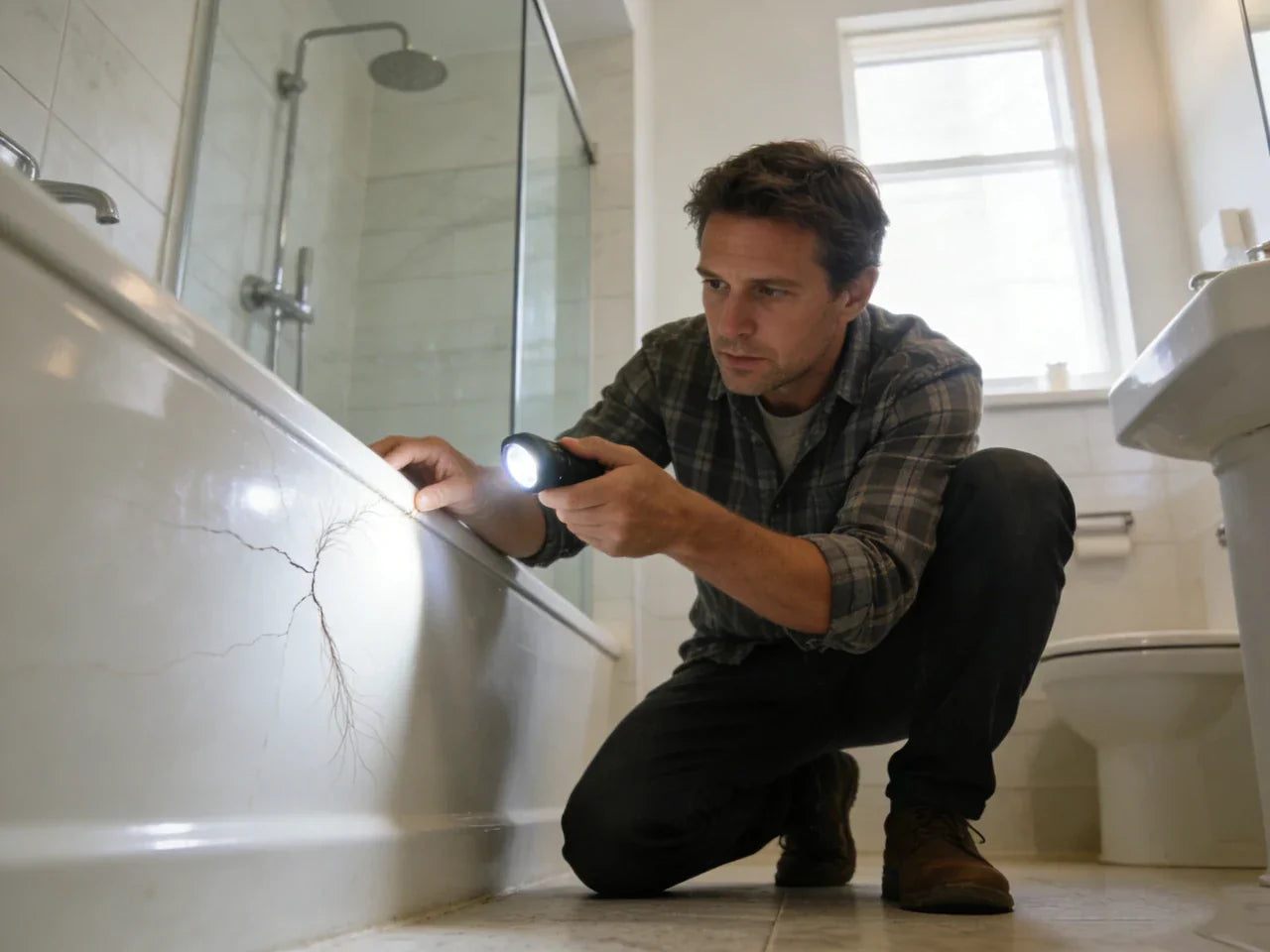
A true hairline crack in a bathtub is thin, often straight or gently curved, and may look like a pencil line under bright light. Many minor cracks stay shallow for a while, especially on the side wall where weight doesn’t press down much. If you run a fingernail across it and your nail barely catches (or doesn’t catch at all), it may be mostly in the finish layer.
A stress crack is often longer, may start near a “pressure point,” and can show up where people sit, step in, or where the tub floor meets the side. It might look like a line with slight branching at the ends. Stress cracks usually mean the shell is bending, which is often the early stage of structural cracks developing below the surface. That ongoing movement is what causes many repairs to fail later if the support problem isn’t fixed.
A spiderweb pattern is what it sounds like: a cluster of fine cracks spreading outward. This pattern is common in fiberglass tubs that have been flexing for a long time or have a weak spot. Spiderweb cracking is more likely to spread, and it often points to ongoing movement under the bathtub surface.
If you’re wondering, “Should I worry about hairline cracks on tub?” The honest answer is: worry enough to check it now, because the early stage is when a basic repair has the best chance of lasting.
60-Second Safety Checklist To Know When To Stop Using The Tub
If any item below is true, pause tub use until you inspect further. These signs suggest the crack may be letting water through, or the tub is moving too much for a simple patch.
-
Soft “give” or flexing underfoot, especially near the crack location
-
Water stains on the ceiling below (or damp drywall near the tub)
-
A persistent damp or musty smell that wasn’t there before
-
The crack lines are expanding week to week, or new cracks appear nearby
A tub that flexes can turn a small crack into deeper cracks quickly, because every bath “works” the shell like bending a plastic card again and again.
Crack Severity Diagram And Repair Decision Tree
Use this simple diagram to size up the severity. It’s not a lab test, but it’s a strong practical guide.
| Crack Severity (Side View) | Topcoat / Gelcoat | Crack Detail | Tub Shell / Notes |
|---|---|---|---|
| A) Cosmetic hairline (finish layer) | ────────────── | tiny surface line | ██████████████ tub shell (sound) |
| B) Stress crack (into shell) | ────────────── | crack cuts deeper │ | ███│██████████ shell under stress |
| C) Leak / structure risk (through or flexing) | ────────────── | crack + movement ││ | ██││█████████ shell may be wet/weak |

Now the decision tree:
| Decision Point | Yes → Action | No → Next Step |
| Do you see flexing/soft spot near the crack? | Treat as structural risk → address support first; consider professional help | Do you see water stains / smell moisture below? |
| Do you see water stains / smell moisture below? | Possible leak path → stop use; inspect underside/subfloor | Is it a single thin line (<1 mm) with no spreading? |
| Is it a single thin line (<1 mm) with no spreading? | DIY patch is reasonable | Multiple cracks or spiderweb → refinish or professional repair |
Can You Still Use A Tub With A Hairline Crack
If it’s a single, stable hairline crack in an acrylic or fiberglass tub, with no flexing and no moisture signs below, many people continue using a cracked bathtub short-term—often assuming the damage is harmless. The catch is that “short-term” can become months, and water may still work into the layers of the bathtub. If you can repair it within a few days, that is safer for your home.
If you see any flexing, damp smells, or stains below, stop using it. A leak under a tub can stay hidden until the subfloor is soft, and then the repair cost jumps fast.
Why Bathtub Hairline Cracks Happen
Most bathtub cracks don’t happen because someone took one “too heavy” bath. The real causes of bathtub cracks are usually repeated stress, uneven support, and long-term flexing of the tub shell. They happen because of repeat stress. A bathtub made from acrylic or fiberglass is strong for its weight, but it still needs correct support. When support is missing or uneven, the shell bends a little each time. That tiny movement is what leads to cracks.
Installation And Support Failures That Cause Bathtub Cracks
Acrylic and fiberglass tubs are flexible shells. They’re designed to be supported evenly underneath, not “floating” across gaps. If the base is uneven, or if the tub was installed without the intended support layer, the floor of the tub becomes a trampoline. You might not notice it right away—until a hairline crack forms in the spot that flexes the most.
A typical combined load is often around 300–500 lbs when you add a person plus water. Put that load on a tub floor that isn’t fully supported and the weight concentrates in one area, like the sitting spot or the step-in zone. Over time, that bending can create a crack in a bathtub, even if nobody drops anything.
If you’ve ever stepped into a tub and felt a slight “give,” that’s a big clue. Repairs often fail not because the epoxy is bad, but because the tub keeps moving under the patch—allowing small surface damage to reopen and progress into structural cracks over time.
Repeated Impacts And Daily Wear That Lead To Hairline Cracks
Many cracks start with a tiny dent. A shampoo bottle slips, a toy drops, or a metal shower head taps the same area again and again. The dent weakens the finish, then normal use spreads that weak spot into a hairline crack.
Homes with kids see this a lot. The dent may be so small you ignore it, and then one day under the right light you see a thin line running from it. This is why “broken bathtub” problems often begin with what looks like no big deal.
Chemical And Finish Damage From Abrasive Cleaners
Harsh cleaners and rough scrub tools wear down the glossy surface that protects the tub. When the finish gets thin, it becomes easier for moisture to get into tiny defects. Over time, that moisture can weaken the bond between layers (common in fiberglass) or make a repaired spot peel sooner.
If you use strong bleach mixes often, or gritty powders, you may not cause a crack directly—but you can make the surface more likely to crack under normal stress.
Bathtub Hairline Crack Repair Step By Step
eople often ask, “Can a crack in a bathtub be repaired?” In many cases, yes—especially early hairline cracks in acrylic or fiberglass—making it possible to restore your bathtub without full replacement when the structure is still sound. The most reliable DIY repair method for a small crack is a 2-part epoxy or resin system made for tub crack repair, followed by careful sanding and polishing.
This section is the core “how to repair a cracked tub” workflow. The steps are simple, but the results depend on prep and patience. If you rush cure time or skip cleaning, repairs peel, sink, or show through the gloss.
Tools And Materials Checklist For Tub Crack Repair
You don’t need a workshop, but you do need clean prep tools and safe airflow. Plan for good ventilation because many repair materials have strong fumes while curing.
You’ll typically need a bathtub crack repair kit matched to your tub material (acrylic repair kit or fiberglass repair kit), sandpaper in several grits, cleaning supplies to remove grime and oils, mixing cups, applicators, and a polishing compound to restore sheen. Gloves and eye protection matter here because uncured epoxy can irritate skin, and sanding dust is not something you want to breathe.
Step-By-Step Bathtub Crack Repair Workflow
Use this as your step-by-step instruction set. If your kit instructions differ, follow the kit for mix ratios and cure time.
-
Clean the area around the crack. Wash with a non-abrasive cleaner, rinse well, and dry fully. Then wipe with a solvent recommended by the kit (often used to remove oils). Any soap film can block bonding.
-
Sand around your bathtub crack. Lightly sand a few inches around the crack so the repair material can grip. Start with a medium grit, then feather outward so you don’t leave a sharp edge you can see later. Remove dust.
-
Open the crack slightly if needed (only if instructed). Some repair methods work better if the crack is not “sealed shut” at the top. Don’t gouge the tub. The goal is to help the repair material reach the crack, not to create a bigger problem.
-
Mix the epoxy/resin. Mix exactly as directed. Wrong ratios are a common DIY crack failure point. Once mixed, you usually have limited working time before it thickens.
-
Apply the repair material evenly over the crack. Press it in so it fills the crack completely, then smooth the surface. Slightly overfill so you can sand flush later.
-
Let it cure. Typical cure time is about 24 hours, but always verify your specific kit. Keep the bathroom warm and dry. Avoid fans blowing dust onto wet resin.
-
Sand level and blend the finish. Start with a fine grit to level the patch, then go finer to reduce scratch marks.
-
Polish to match gloss. Use polishing compound to restore shine and help the patch blend with the rest of your bathtub surface.
If you’re fixing a hairline crack that is truly tiny, the best repairs are usually thin fills done in layers, not one thick blob. Thick patches can shrink or look like a bump.

Common DIY Repair Failure Points
Most bad outcomes come from one of four problems.
First, the tub still flexes. If the base isn’t supported, your repair becomes a “hard spot” on a moving shell. The crack may return at the edge of the patch, or a new crack may form nearby.
Second, prep was too light. Soap film, body oils, and cleaner residue are invisible, but they block bonding. If you can’t get a good bond, the patch may peel.
Third, the filler type doesn’t match the bathtub material. Acrylic, fiberglass, and porcelain each need different bonding approaches. A “general” filler might stick for a while but fail when hot water heats and cools the area.
Fourth, cure time was rushed. It’s tempting to “just use it tonight,” but that’s when repairs dent, sink, or turn cloudy.
Six-Step Repair Infographic And Printable Checklist
Here is a simple text infographic you can save or print:
| Step | Action |
| 1 | Clean and dry completely |
| 2 | Sand and remove dust |
| 3 | Mix epoxy/resin carefully |
| 4 | Fill crack and smooth |
| 5 | Cure (often ~24 hours) |
| 6 | Sand fine and polish |
Copy/paste checklist:
| # | Task | Completed (✓) |
| 1 | Take crack photo (before) | [ ] |
| 2 | Ensure tub is dry; bathroom ventilated | [ ] |
| 3 | Clean and wipe area (no residue) | [ ] |
| 4 | Sand/feather beyond crack line | [ ] |
| 5 | Mix 2-part material in correct ratio | [ ] |
| 6 | Fill crack fully; slight overfill | [ ] |
| 7 | Cure full time (per instructions) | [ ] |
| 8 | Sand flush; polish to match sheen | [ ] |
| 9 | Take crack photo (after) | [ ] |
| 10 | Monitor at 48 hours, 30 days, 6 months | [ ] |
Material-Specific Repair Methods
Not all tubs crack the same way, and not all tub crack repair steps finish the same. The key point is how the tub is built. Acrylic is usually a capped surface over a reinforced body. Fiberglass often has layers that can separate if water gets in. Cast iron tubs are rigid, but porcelain enamel can chip.
Acrylic Tub Crack Repair And Flex Control
A hairline crack in acrylic tub is often tied to movement. Before you repair, stand in the tub (carefully) and feel for flexing. If the floor gives, the best “repair method” includes addressing support, not only patching the line.
For the patch itself, acrylic repairs look best when you sand lightly and feather wide. Acrylic shows sanding marks easily under bathroom lighting, so take your time moving to finer grits. Many people stop too early and end up with a dull oval around the patch.
Also keep fills thin. A thick mound may cure harder than the surrounding acrylic tub and can stand out. Several thin layers, fully cured, usually blend better.
Fiberglass Bathtub Crack Repair And Reinforcement Options
Fiberglass repair is about restoring the surface and, when needed, strength. Small cracks may only need a surface fill and finish sanding. But if you see a spiderweb pattern, a soft spot, or a crack near a pressure zone, you may need reinforcement so the crack repair lasts.
Reinforcement can mean adding support from below (if you can access the underside) or using fiberglass mat with resin in deeper repairs. The idea is to spread the load so the crack location is not the “hinge” point.
If you only patch the top and the fiberglass tub keeps flexing, cracks may return fast. People often blame the epoxy, but the real issue is movement.
Cast Iron Tub Cracks Vs Porcelain Enamel Damage
Here is where wording matters. Many “cast iron tub cracks” are not cracks in the iron. They are chips or hairline fractures in the porcelain enamel coating on top.
Porcelain enamel chips are often repairable as a spot repair if the tub is otherwise solid. You clean, sand lightly, fill, and blend. The goal is to seal out water and smooth the surface so it’s not a cut hazard.
A true cast iron fracture is different. Cast iron is rigid and strong, so if the iron itself is cracked, that can be a serious structural issue. It often needs professional repair services or full bathtub replacement, depending on location and severity of the crack. If you suspect the iron is cracked (not just the enamel), get a pro evaluation.
Best Repair Approach By Tub Material And Crack Location
This table is a quick comparison for choosing the right approach. It can also help you decide when a professional repair is safer.
| Bathtub material | Floor crack (standing area) | Seat/sitting area | Near drain/overflow | Side wall crack |
| Acrylic | Patch + fix support if any flex; feather sand + polish | High flex risk; support is critical; patch may fail without base fix | Be cautious: water exposure; seal well; consider pro if spreading | Often cosmetic; DIY patch usually works |
| Fiberglass | Patch; consider reinforcement if soft | Often stress point; reinforcement/support strongly recommended | Higher leak risk; inspect plumbing area; consider pro if moisture signs | Usually easier DIY unless spiderweb cracking |
| Cast iron + enamel | Usually enamel chip repair; true iron crack is rare and serious | Same as floor; treat enamel damage | Seal carefully; rust risk if exposed iron | Enamel spot repair typically |
| Porcelain enamel over steel | Spot repair for chips; watch for rust | Same | Seal and monitor; rust can spread | Spot repair if stable |
Costs, Time, And When To Call A Pro
Cost is often the deciding factor. People see a crack in an acrylic tub and think, “Is this a small weekend repair… or a full remodel?” The real answer depends on whether the tub is stable and whether water has already gotten below the surface.
Bathtub Crack Repair Cost By Scenario
Here is a straightforward cost view. Prices vary by region, but these ranges match what many homeowners see.
| Scenario | Typical scope | Typical cost range | Typical time |
| DIY repair kit (small crack) | Clean, sand, fill, polish | $30–$100 | 2–4 hours + cure |
| DIY patch + wider touch-up | Larger sand area; more finish blending | $150–$300 | Half day + cure |
| Professional refinishing/repair | Surface prep + coatings; may include multiple cracks | $300+ | 1 day + cure window |
| Replacement | Remove tub, plumbing work, new tub install | Varies widely | Days to weeks |
So, how much does it cost to repair a crack in a bathtub? For a simple early hairline crack, the bathtub crack repair cost is often closer to the DIY kit range. Costs rise when the crack spreads, the finish is worn everywhere, or moisture has damaged the subfloor.
DIY Vs Professional Repair Trade-Offs
DIY repair makes sense when the crack is small, stable, and in a low-flex area. It also makes sense when you’re comfortable with sanding and careful mixing, because most DIY crack repair failures come from rushing.
Professional repair makes sense when you need a near-invisible finish match, when there are multiple cracks, or when the tub’s integrity is in question. A pro can also tell you if the tub is moving due to poor support, which is often the real cause of repeat cracking.
If you rent your home, it’s also worth thinking about liability. A leak you didn’t report can become a bigger issue later.
Replacement Red Flags That Justify A New Tub

Some tub cracks cross a line where repair is more of a temporary patch than a fix. If you see multiple spreading cracks, ongoing flexing that you can feel, active leaks, or signs of subfloor damage (soft flooring, stains below, swelling trim), replacement becomes easier to justify.
A broken bathtub is not always obvious from above. If the structure under the tub is damp and soft, the real damage is below the shell. At that point, the right job is often “repair the building,” not just “repair paint.”
Repair Vs Replace Cost Calculator
In some homes, replacing a damaged tub with a low-threshold shower base can reduce both maintenance issues and slip risks. You can estimate your decision using a simple scoring + cost check. This isn’t a perfect calculator, but it helps you think clearly.
Inputs
-
Material: acrylic or fiberglass vs. enamel/iron
-
Crack count: 1, 2–3, many/spiderweb
-
Flexing: yes/no
-
Leak evidence: yes/no (stains, damp smell, wet access panel)
-
Location: side wall vs. floor/seat vs. near drain
Quick rule
-
If flexing = yes, add support cost (or pro visit) to any repair.
-
If leak evidence = yes, include inspection/repair of moisture damage in your plan.
Simple decision math
-
DIY path estimate = (kit cost) + (your time value)
-
Pro path estimate = (pro repair/refinish)
-
Replace path estimate = (tub + install + any subfloor repair)
If your tub has flexing or leak evidence, the “hidden cost” can exceed the patch cost fast. That’s when calling a pro for an assessment can save money.
Preventing Recurrence: Support, Maintenance, and Safe Use
A good patch can fail if the reason for cracking never changes. Prevention is not complicated, but it does require you to be honest about what caused the crack in the first place.
Fix The Cause: Improving Under-Tub Support — Mortar Bed, Foam, Or Support Pads Where Appropriate
If your acrylic or fiberglass tub flexes, support is the first priority. Many tubs are meant to be set into a supportive base, so weight spreads evenly. When that base is missing or uneven, the tub bends in the same spot every time, and it keeps leading to cracks.
If you have access from below (like an unfinished ceiling), you may be able to see the underside and confirm whether there are gaps. In some homes, improving support is a bigger job that may involve removing the tub. In others, limited reinforcement may be possible from below. The right approach depends on the bathtub material and how it was installed.
If you’re not sure, this is one of the best moments to get professional repair advice. A perfect surface patch on a moving tub is often a short-lived fix.
Cleaning Do’s And Don’ts For Acrylic And Fiberglass Finishes — Avoid Abrasive Chemicals And Tools
If you want to maintain a bathtub surface and avoid new cracks, treat the finish gently. Acrylic and fiberglass finishes scratch more easily than many people think. Scratches can trap grime, and then people scrub harder, and that cycle wears the finish down.
Use non-abrasive cleaners and soft sponges. Avoid gritty powders and rough pads. Also be careful with strong chemical mixes, especially if they sit on the surface for a long time. The goal is to keep the top layer intact so moisture can’t work into tiny defects.
Impact Prevention Habits — Storage, Mats, And Careful Handling
Most impacts are not dramatic. They’re daily: bottles tipping off a ledge, metal cans placed on the rim, kids dropping toys in the same spot. A few small changes help a lot.
If you use a bath mat, choose one that doesn’t trap water underneath for long periods. Trapped moisture can discolor finishes and may hide early damage. After bathing, letting the tub dry out is a simple habit that protects repairs too.
Progression, Risks, And Real-World Timelines: What Happens If You Ignore It
Ignoring a hairline crack often feels safe because nothing bad happens right away. Then one day you notice a musty smell, or paint bubbles on the ceiling below, or the crack has turned into a cluster. That delay is exactly why small cracks become expensive.
How Hairline Cracks Widen: Moisture Intrusion → Weakening → Spiderweb Cracking And Leaks Over Months To Years
In many acrylic or fiberglass tubs, the first crack is only in the surface. But water can enter through that tiny opening, especially if the tub is used daily. Over time, moisture can weaken the bond in layered materials, and the crack can spread when the tub heats and cools.
If the tub flexes, the timeline speeds up. Repeated bending is like bending a paper clip: it might take many cycles, but it doesn’t heal. A crack that stays cosmetic in a firm, well-supported wall area might become a leak risk in a flexing floor area in months.
Health And Property Risks: Mold Under The Bathtub, Subfloor Rot, Odors, And Hidden Water Damage
Water under a tub does not always show up as a puddle. It can soak insulation, wood, or drywall and stay hidden. That damp space can support mold growth and can also rot wood over time. Research articles archived by the National Center for Biotechnology Information (NCBI) on PubMed Central link long-term indoor dampness and mold exposure to respiratory irritation and other health effects, highlighting why hidden bathtub leaks should not be ignored. According to the U.S. Environmental Protection Agency (EPA), mold thrives in damp indoor environments and prolonged moisture problems can lead to material deterioration and indoor air quality concerns, even when water damage is not immediately visible. If you smell dampness that cleaning doesn’t fix, it’s a reason to investigate, not just to spray air freshener.
If you’re dealing with a long-term leak, treat it seriously. Fixing your bathtub surface is only part of the job if the structure underneath is already wet.
Safety Note: Cracked And Uneven Surfaces Can Increase Slip Hazards
Cracks and chipped areas can create sharp edges and uneven footing. Even a small ridge from a poor repair can be slippery with soap. Slips and falls in tubs are common, and any surface damage can raise that risk. Slips and falls in tubs are common, and any surface damage can raise that risk. Injury data tracked by the U.S. Centers for Disease Control and Prevention (CDC) through its WISQARS system shows that bathroom slip-and-fall incidents are a significant source of nonfatal injuries, making smooth and even tub surfaces an important safety factor. If the crack is in a standing zone, smoothness matters as much as sealing.

Three Real-World Timelines: Short Stories
In one family home, a few dropped toys caused tiny dents that didn’t seem important. Over time, those dents turned into hairline fractures. The tub was still usable, so the family waited. Months later, a damp smell showed up, then discoloration near the baseboard. The repair ended up including drying and fixing materials behind the tub, not just the surface crack.
In another home, an unsupported acrylic base flexed most where someone sat to wash a child. A hairline crack started there, then two more appeared nearby. The homeowner patched the first line, but the tub kept moving. Within 6–12 months, the cracks returned and spread enough to justify professional refinishing and support correction.
In a third case, an older fiberglass bathtub was cleaned with abrasive products for years. The finish dulled, then small cracks appeared across a wide area. The owner tried spot fixes, but new fractures kept forming. Over about two years, the surface started flaking in places, and the best solution became a full surface restoration or replacement, depending on what was underneath.
Takeaways: Action Plan
If you’ve read this far, you’re probably deciding between a quick DIY repair and a bigger fix. The simplest plan is: inspect, classify, repair correctly, fix support if needed, and then monitor.
A good monitoring habit is what separates a “nice patch” from a long-lasting repair. Take a clear photo before and after, from the same angle and lighting. Then check it on a schedule: 48 hours, 30 days, and 6 months. If the line grows, or if you see new cracks, treat that as a sign of movement or moisture.
Quick Takeaway Checklist: Inspect → Classify → Repair → Reinforce → Monitor
Use this short action plan as your guide:
-
Inspect under strong light and feel for flexing.
-
Classify the severity (cosmetic vs. stress vs. spiderweb/leak risk).
-
Repair with the correct epoxy/resin method for your tub material.
-
Reinforce or correct support if the tub moves.
-
Monitor with photos at 48 hours, 30 days, and 6 months.
FAQs
1. What causes hairline cracks in fiberglass or acrylic tubs?
Hairline cracks usually appear due to stress on the tub surface over time. They can result from flexing when the tub isn’t properly supported, repeated pressure in the same spot, minor impacts from dropped items, or wear from abrasive cleaning that gradually weakens the finish. These cracks often start as cosmetic issues but can worsen if the underlying causes aren’t addressed.
2. What is the best sealant/epoxy for a bathtub hairline crack?
The ideal repair material is a two-part epoxy or resin designed for your tub’s surface type, whether acrylic or fiberglass. The best choice bonds well to the material, allows the crack to be filled smoothly, and includes steps to blend the finish so the repair is discreet. Using a product that matches the tub ensures durability and a cleaner appearance, while generic epoxies may not adhere properly or could discolor over time.
3. How long does a bathtub crack repair last?
A well-prepared repair on a stable tub can last for several years. Longevity depends on factors like proper support, keeping moisture from getting underneath, and thorough surface preparation. Repairs may fail sooner if the tub flexes or water penetrates under the crack, so addressing structural issues is key for long-lasting results.
4. How do I find a hairline crack in tub surfaces?
To locate cracks, dry the tub completely and shine a bright light across the surface at a low angle so thin lines catch the light. Check high-stress areas such as the floor, built-in seats, and around the drain. Running your hand gently over the surface can also help detect slight depressions or rough spots that indicate a crack.
5. Should I stop using the tub if I see a crack?
You should stop using the tub if there is flexing, water stains below, a damp smell, or if the crack is spreading. If the crack is a single stable hairline with no signs of leakage or structural stress, brief use may be acceptable while planning a repair, but addressing it promptly is recommended to prevent further damage.
References




Leave a comment
This site is protected by hCaptcha and the hCaptcha Privacy Policy and Terms of Service apply.