
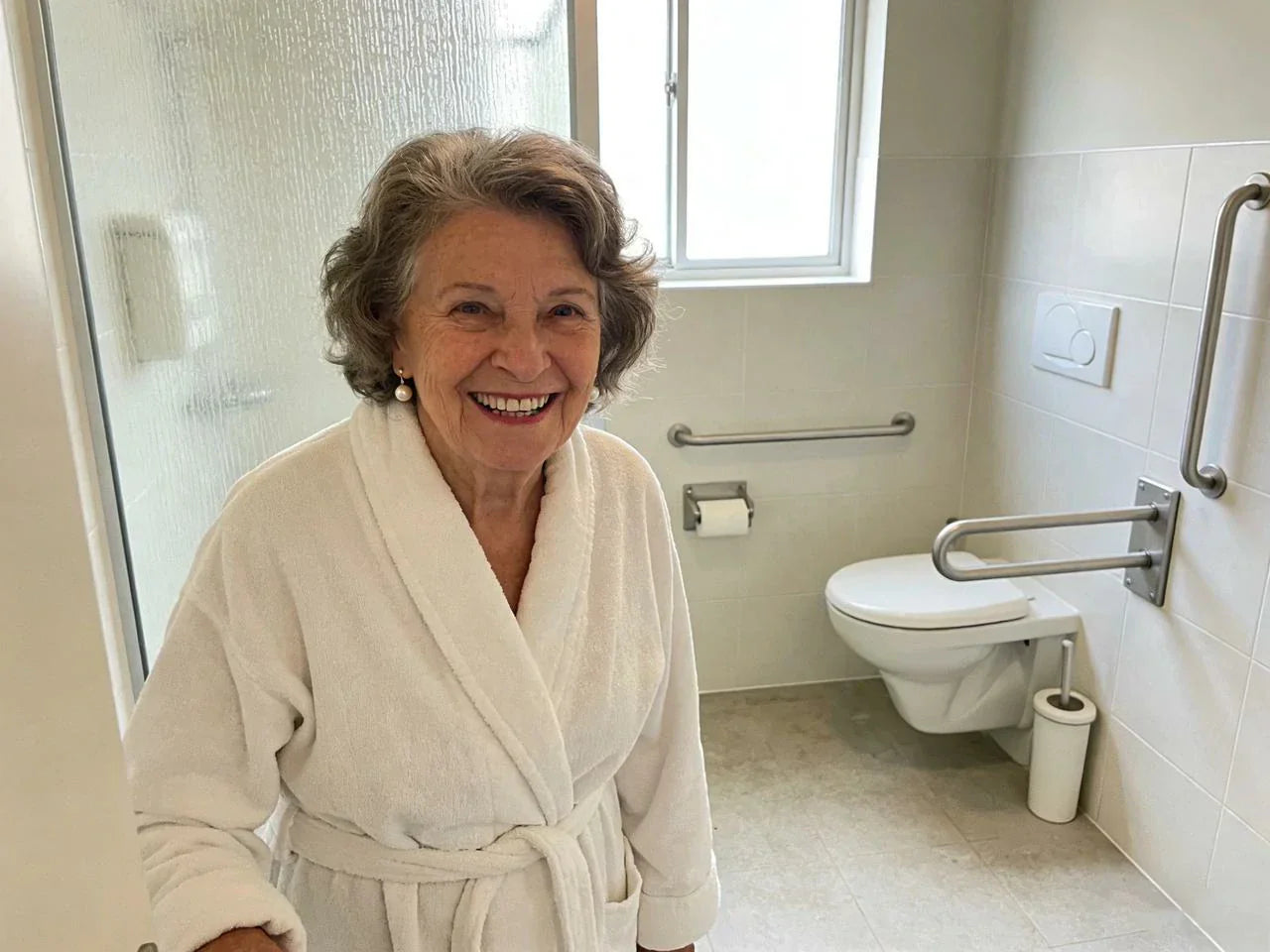
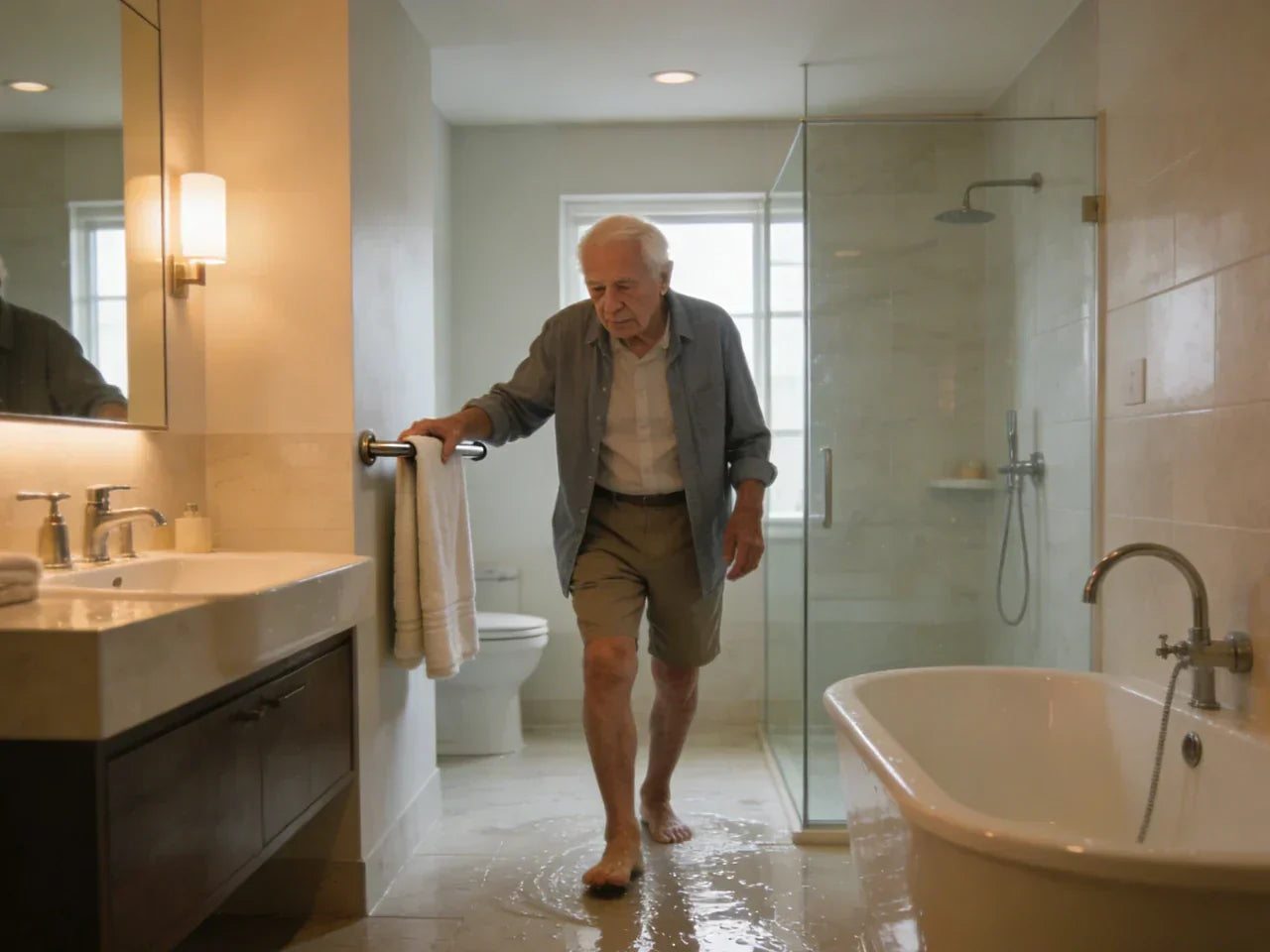
Bathroom safety for elderly adults is urgent: about 1 in 4 people age 65+ falls each year, and the bathroom is one of the most dangerous rooms in senior living settings because wet floors, tight spaces, and hard surfaces make slips and hard landings more likely. Making the bathroom bathroom safe is essential for independence and peace of mind. A single fall can lead to fractures, head injury, and loss of independence, which is why bathroom safety for elderly people should be treated as a priority for families focused on
The good news is that you can lower risk fast and make the bathroom safer. A few small changes can improve bathroom safety for elderly adults and turn the bathroom into a safe bathroom or safe place for daily routines. In this guide, you’ll get quick, low-cost changes you can do today, then a clear plan for bigger aging-in-place bathroom modifications when you’re ready.
Quick Start — 10 practical tips you can do for a safe bathroom today
If you’re worried about bathroom safety for elderly loved ones, start here. These steps focus on the most common hazards in the bathroom environment: slippery surfaces, poor lighting, and unstable transfers that create an increased risk of falls in and out of the tub or onto the toilet.
-
Add non-slip protection in the tub or shower today. Use non-slip strips or bath mats where feet land and where you turn. These simple changes are recommended to reduce fall risk in older adults based on guidance from the National Institute. If the mat slides, it can become a hazard, so test it with your hand and foot before trusting it.
-
Dry the bathroom floor fast after bathing to make the bathroom safer and reduce slipping. Keep an absorbent towel or microfiber mop easily accessible. Wet tile is one of the easiest ways to increase the risk of falling.
-
Light the path from the bed to the bathroom to help seniors and seniors with limited mobility avoid nighttime tripping hazards. Motion night lights in the hallway and bathroom reduce nighttime stumbles when someone is groggy.
-
Clear the walking route by removing clutter, baskets, and cords so older adults can use the bathroom independently.
-
Remove loose throw rugs, which is one of the simplest bathroom safety for elderly people improvements. If you must keep a rug, anchor it firmly so it cannot bunch up under a foot or walker.
-
Use a shower chair or bench right away if balance is an issue — it dramatically improves shower safety for seniors. Sitting to bathe reduces the risk of falling for those with balance issues when shampooing, turning, or closing their eyes.
-
Set the water heater water temperature to about 120°F (49°C), which keeps the temperature of the water coming from the tap set to a safe temperature of 120 degrees Fahrenheit or lower.
-
Put essential items at waist height. Shampoo, soap, toilet paper, and towels should be easily accessible without bending, twisting, or stepping into awkward positions.
-
Keep a way to call for help within reach in case of a fall or case of an emergency. A phone, wearable alert, or call button matters most in the bathroom, where falls can be serious.
-
Prompt a medication and vision check. Many falls involve dizziness, low blood pressure, sleep medicines, or a change in vision. Fixing the health cause is part of efforts to improve bathroom safety for the elderly, not separate from it.
If you only do 3 things: non-slip surfaces + properly installed grab bars + better lighting.
Bathroom safety for elderly — key stats & risk zones
Falls are not rare “accidents.” They are a predictable safety problem, which means they can often be prevented.
The Centers for Disease Control and Prevention reports that about 1 in 4 older adults falls each year, and falls are a leading cause of injury and injury death in this age group. Many of these falls happen at home, and the bathroom is a common danger zone because water reduces traction and hard fixtures do not “give” during impact.
You may also see widely shared estimates that a very large share of home falls happen in or around the bathroom. Exact percentages vary depending on the study and how “bathroom fall” is defined, but the practical message is consistent: wet surfaces + tight transfers + hard edges create a high-risk bathroom environment, especially for older adults with arthritis, weakness, neuropathy, or vision loss.
Why bathrooms are uniquely risky
A living room is usually dry and open. A bathroom is often the opposite.
Wet floors and slick tub walls turn small missteps into sudden slips. Tight layouts force quick turns. Toilets and tubs require stand-to-sit and sit-to-stand moves that demand leg strength and balance. Nighttime trips add low light, urgency, and sometimes dizziness. If someone uses a walker, cane, or wheelchair, the bathroom can feel like a narrow obstacle course.
Risk “heatmap”
The highest-risk spots are almost always:
-
Tub or shower entry and exit (stepping over a lip, shifting weight, turning)
-
The wet floor zone right outside the tub or shower
-
Toilet transfers (sitting down and standing up)
-
The sink area if someone leans heavily on it for balance (many sinks are not meant to hold body weight)
If you want one simple way to “see” hazards, stand in the doorway and ask: Where would I fall if my foot slid right now? What would I hit? That question alone often leads to the most important changes.

Most effective senior-friendly bathroom modifications (by zone)
People often ask, “How to make a bathroom safer for the elderly?” The clearest answer is: reduce slipping, make transfers steadier, improve visibility, and keep every needed item easy to reach. Below is a zone-by-zone plan that fits most bathrooms, from small apartments to larger homes.
Floors (slip prevention is #1)
If you do nothing else, make the bathroom floor less slippery. A fall on tile is unforgiving, and the bathroom floor is the one place where water is expected.
Start with what’s already there. If the floor is glossy and slick when wet, treat it like a hazard even if it looks clean. Use non-slip bath mats where feet land after a shower, and consider adhesive strips inside the tub or shower where soap can make surfaces slippery. Remove any rug that can fold, curl, or slide.
Also think about habit, not just products. Many slips happen during ordinary routines: stepping out quickly of the bathtub, reaching for a towel across the room, or walking on a damp floor in socks. These small changes support bathtub safety for seniors and reduce fall risk. A safer routine is to keep towels within arm’s reach of the shower exit and to wear non-slip footwear made for wet floors.
Here’s a simple comparison of common floor options:
| Option | Best for | Typical cost (USD) | DIY or pro | Key maintenance |
| Non-slip bath mat (outside tub/shower) | Wet floor zone after bathing | 10–30 | DIY | Wash and replace if edges curl |
| Adhesive non-slip strips (in tub/shower) | Foot traction where you stand/turn | 10–25 | DIY | Replace when peeling; scrub soap film |
| Slip-resistant flooring (textured vinyl/rubber) | Bigger upgrade for frequent slipping | 3–10+ per sq ft (materials vary) | Often pro | Clean with non-slip-safe products |
A quick warning: adding a thick, fluffy mat can backfire if it bunches under a foot or walker. The safest mat is flat, grips the floor, and stays put.

Shower/tub (highest consequence transitions)
Many families worry about tub safety for seniors because the “transition moment” is when the body is least stable: stepping over the tub wall, turning, and lowering down. This is also when people are most likely to hurry.
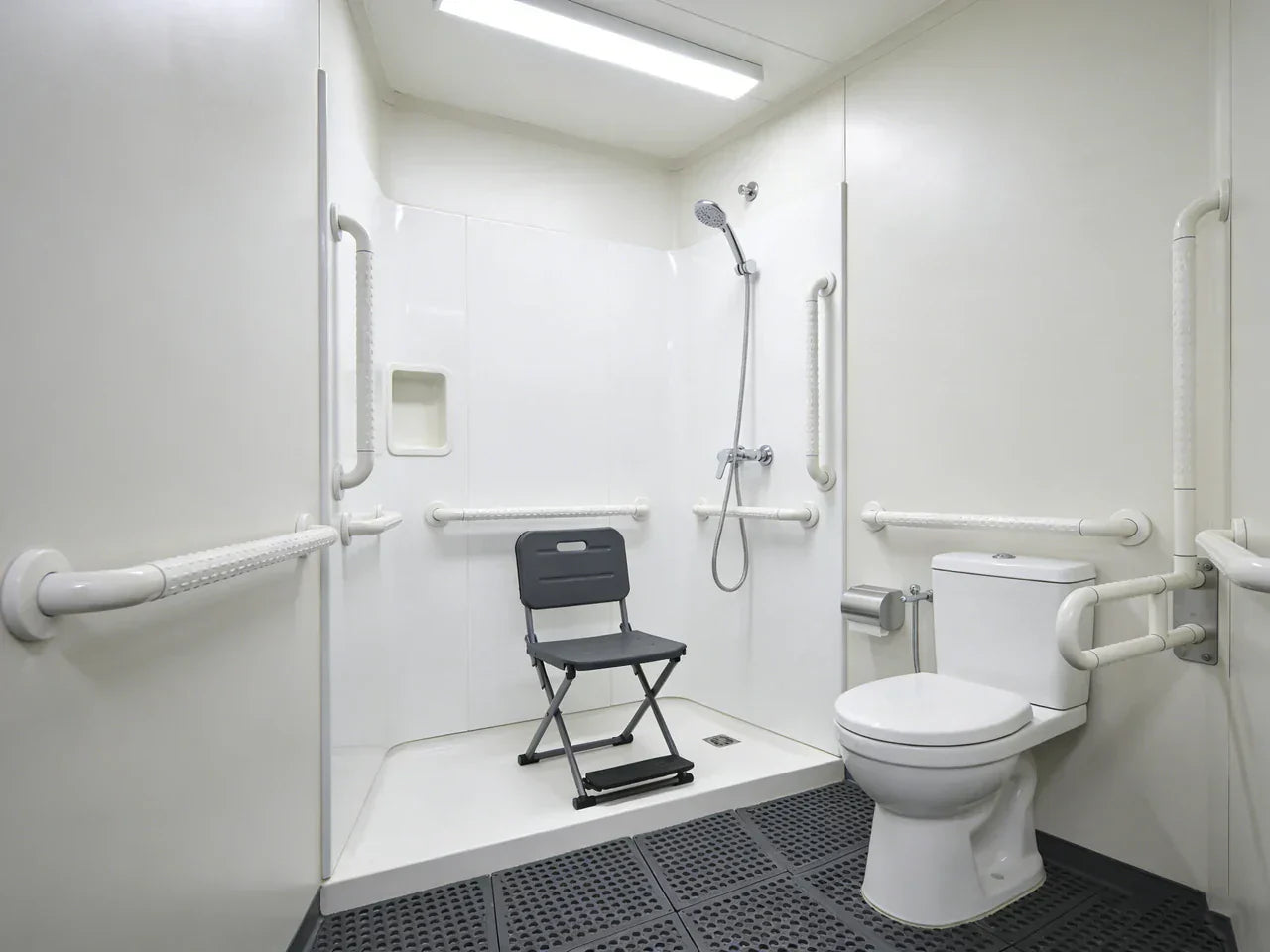
Grab bars are one of the highest-impact upgrades for shower safety, but only when installed correctly. A towel bar is not a grab bar. A suction handle is not the same as a fixed bar. For real safety, bars should be secured into wall studs or proper blocking so they can hold a sudden, full-body load.
Once stable handholds are in place, the next big question is whether the person should sit to bathe. A shower chair works well when someone can step into the tub or shower but feels unsteady standing. A transfer bench is often safer when stepping over a tub wall is hard, because it allows the person to sit first, then lift legs over while seated.
Here is a practical comparison:
| Option | Best fit | What it helps with | Typical cost (USD) |
| Shower chair | Standing balance is the main issue | Lets you sit while washing | 40–120 |
| Transfer bench | Stepping over a tub wall is hard | Reduces risky tub entry/exit | 70–200 |
Add a hand-held shower (shower wand) so rinsing is easy while seated. Place controls where they can be reached without stretching. If the person has limited mobility or shoulder pain, reachable controls prevent sudden grabbing and twisting.
How to get out of the bathtub safely after 60 (a safer method)
People often ask this when they’ve already had a near-miss. If an older adult still uses a bathtub, here’s a safer sequence that many occupational therapists teach. It assumes grab bars are properly installed and a stable seat or bench is available.
-
Move slowly and pause first. After bathing, sit upright for 10–20 seconds. Hot water can lower blood pressure and cause dizziness when you stand.
-
Turn your body so you can face the grab bar. Keep one hand on a stable bar before shifting weight.
-
Bring your feet under you while seated. Avoid standing with feet far forward, which increases slipping.
-
Push up using legs and hands together. Use the grab bar and seat edge as support, not the towel bar or sink.
-
Step onto a non-slip mat immediately. Dry one foot at a time if needed.
-
Do not twist while standing on a wet surface. Turn in small steps.
If this still feels hard, that’s important information. It may mean the tub is no longer the right bathing setup, and a walk-in shower or bathtub modification should be considered for safer transfers.
Is it safer to take a shower or a bath?
For many older adults, a shower is safer than a bath because it avoids lowering into the tub and pushing back up, which demands leg strength and balance. A shower also works well with a shower chair, grab bars, and a hand-held shower.
A bath can still be safe for some people, especially if they have strong legs, no dizziness, and a stable plan for getting in and out. But if someone has frequent balance issues, neuropathy, Parkinson’s disease, or a history of falls in the bathroom, stepping into and out of a tub is often the highest-risk part of the routine.
If you’re choosing between a walk-in tub and a walk-in shower, think about the person’s real-life habits. Some people love soaking, but a walk-in tub still requires stepping in, sitting down, and waiting for the tub to fill and drain. A walk-in shower with a low or no threshold, a bench, and properly placed grab bars often supports faster, simpler bathing with fewer transfer steps.

Toilet area (standing/sitting stability)
Toilet transfers are one of the most repeated “mini-workouts” of the day. If leg strength is reduced, each sit and stand becomes a risk of losing balance. This is why bathroom safety for seniors often focuses on the toilet zone even when the shower seems like the obvious danger.
Installing a raised toilet seat can reduce the distance the person must lower and lift, making toilet use much safer for seniors and improving overall bathroom safety. This is especially helpful for seniors with arthritis, knee pain, hip stiffness, or after surgery. A toilet safety frame can add stable handholds if wall-mounted grab bars are not yet installed.
Grab bar placement matters here. The goal is to give support during the full movement: the start of standing, the moment of full weight shift, and the final step away from the toilet. If bars are too far away, people reach, lean, and tip—exactly what we’re trying to prevent.
Also look at space. Can a walker fit beside the toilet? Is there room for a caregiver to stand safely without twisting? Tight bathrooms sometimes need a layout change, but small steps like moving a trash can, changing the door swing, or re-hanging towel storage can open up valuable clearance.
Sink/vanity (balance + burns + reach)
Many older adults steady themselves by leaning on the sink. The problem is that most sinks and vanities are not built to hold a person’s weight. If the sink shifts, the person can fall forward into the counter edge or mirror.
A better plan is to install a stable grab bar where it helps most and to reduce the need to reach. Keep daily items—soap, toothbrush, grooming tools—at waist height in easy-to-open storage.
For hands weakened by arthritis, lever-style faucet handles are easier than knobs. Temperature control is part of safety, too. If the water suddenly turns hot, the person may jerk back and slip. Keeping the water heater set to about 120°F helps reduce scald risk, and in some homes a mixing valve can keep temperatures steady at the tap.
Lighting & visibility (night falls)
Nighttime bathroom trips are common, and they come with a perfect storm: low light, urgency, and sleepiness. Improving visibility is one of the fastest ways to reduce the risk of falling, and it often takes minutes.
Motion-activated lights along the path, a brighter (but not glaring) bathroom bulb, and a night light aimed at the floor can make a big difference. If glare is a problem, choose softer lighting or use shades so the person isn’t blinded when they flip on a light.
If depth perception is poor, adding contrast can help. For example, a light-colored mat on a darker floor can make the safe landing zone easy to see. The goal is not decoration—it’s clarity.
DIY vs. pro installation (and common mistakes to avoid)
Many people search for bathroom safety tips for seniors and end up with a cart full of products. Some are helpful. Some create “false confidence.” The line between DIY and professional work is about one thing: Will it still be safe during a sudden slip, when full body weight hits it fast?
What you can DIY safely (low-risk changes)
Most homes can improve bathroom safety for elderly in one afternoon without tools.
Non-slip mats, non-slip strips (installed with careful surface cleaning), motion night lights, decluttering, and moving items to easy-to-reach shelves are all good DIY moves. A hand-held shower head is often a simple swap if the existing shower arm and fittings are standard and you’re comfortable with basic plumbing. If you try this, check for leaks right away and again the next day.
What should be professionally installed
Grab bars are the big one. A bar that is not anchored correctly can rip out of the wall when it is needed most. Professional installation helps ensure the bar is placed at a useful height and angle, tied into studs or solid blocking, and sealed so water does not enter the wall.
Curbless shower conversions, walk-in shower builds, walk-in tub installs, and flooring replacement usually deserve a pro because water damage and improper slope can create new hazards. Anti-scald valves and plumbing changes also belong on the “hire help” list unless you have the right training.
Common mistakes that raise fall risk
One common mistake is using a suction grab bar as the main support. Some suction devices are marketed as “easy safety,” but they can fail if the surface is imperfect, wet, or slightly textured. If you use suction at all, treat it as a light balance cue, not a device to catch a fall.
Another common mistake is placing safety items where they look neat, not where hands actually need them. A grab bar that is too far forward, too high, or blocked by a towel rack won’t be used in the moment it matters.
Finally, avoid building a “maze.” Too many stools, racks, and bins can narrow walking space and catch walkers. The safest bathroom often looks simpler, not more “equipped.”

Costs, funding, and ROI
Cost is real, and it’s often the reason families delay changes. A better way to think about cost is to match the spending to the risk. If someone has already had falls in the bathroom, the bathroom is no longer a “nice-to-have upgrade.” It’s a safety project.
Here are typical cost ranges many families see:
| Level | What it may include | Typical cost (USD) |
| Basic DIY bundle | Non-slip mat/strips, brighter bulbs, motion night lights, simple shower chair | 50–300 |
| Mid-tier safety upgrade | Raised toilet seat, toilet frame, professionally installed grab bars | 300–1,200 |
| Bigger aging-in-place remodel | Walk-in shower conversion, improved flooring, layout changes | 2,000–10,000+ |
Prices vary by region and bathroom size. Even within the same city, labor and materials can differ widely.
Funding and assistance pathways
Coverage rules change, so it’s smart to verify what applies right now. In general, health coverage may help only in limited situations when equipment is considered medically necessary and properly documented. If a clinician recommends equipment, ask for written notes. An occupational therapist (OT) home safety assessment can also support a clear plan, including the right type of shower chair or transfer bench.
If the person is a veteran or has local aging services in the area, there may be home modification support through public programs. Some communities offer fall prevention programs that include home safety checks, too.
ROI in plain language
A bathroom injury can lead to an ambulance ride, emergency care, rehab, and weeks of lost function. Even when someone “recovers,” confidence often drops, and people begin avoiding bathing or rushing through it—both of which raise risk again. Compared with that, basic safety measures are often a small cost for a big reduction in danger and stress.
Advanced options & 2026 trends
Not every safety tool needs to be a major remodel. Newer options can support bathroom safety for elderly in quieter ways, especially when families cannot be there every day.
Smart leak sensors can alert you to water on the floor or a slow leak that could lead to slick spots. Motion-sensing lights are now brighter and more reliable, and some can be set to a low “night mode” so the bathroom is visible without harsh glare.
Wearable fall alerts and voice assistants can help, but only if the person will actually use them. A simple routine like “turn on bathroom lights” can prevent fumbling for switches. Still, technology should never replace physical safety measures like non-slip traction and strong grab bars. Tech is a backup plan, not the foundation.
If you rent, you may need renter-friendly solutions. Focus on changes that don’t damage walls: lighting, decluttering, safe mats, a stable shower chair, a raised toilet seat, and storage adjustments. For anything that must hold body weight, ask the landlord about proper installation rather than relying on no-drill products that may not be safe under load.
Maintenance + caregiver plan (keep safety gains long-term)
Bathroom safety is not “set it and forget it.” Small changes over time—worn mats, loose screws, shifting routines—can quietly bring risk back.
A simple monthly check helps:
-
Check traction. If a mat curls or a strip peels, replace it.
-
Check stability. If a grab bar or toilet frame wiggles, stop using it until it’s tightened and verified safe.
-
Check clutter creep. Are new items collecting on the floor or tub edge?
-
Check lighting. Replace dim bulbs and confirm motion lights still trigger fast.
-
Check the person, not just the room. New dizziness, new meds, vision changes, and new weakness can turn an “okay” bathroom into a risky one.
If you’re a caregiver, protect your own body too. Avoid unsafe solo lifts from the tub or toilet. Plan transfers, use stable supports, and get training if you’re helping someone who has major mobility limits. Caregiver strain can lead to rushed moves, and rushed moves lead to falls for both people.
For emergencies, decide ahead of time: Who gets called? Where is the phone or alert device kept? Can the bathroom door be opened from the outside if someone falls against it? Some families choose privacy locks that can be opened from outside in case of a fall, which balances dignity and access.
Real-world examples (what this looks like at home)
A few years ago, I spoke with a daughter caring for her father who had arthritis and was proud of staying independent. He didn’t want “a hospital bathroom.” He wanted his bathroom.
They started small: a non-slip mat, brighter lighting, and moving towels so he didn’t have to reach across the room. That helped, but the real change came after adding properly installed grab bars and switching to a transfer bench. He stopped grabbing the towel bar when stepping out, and he stopped rushing because he felt steady. The bathroom didn’t look medical—it looked normal. He just moved through it with more control.
That’s the key point: bathroom safety measures work best when they fit the person’s body and habits. The right setup helps seniors use the bathroom independently and feel calm, not scared.
Beyond the Bathroom: Whole-Home Aging-in-Place Safety for Seniors
Bathroom safety is only one part of the daily picture. Many falls begin before a person even enters the bathroom—getting out of bed at night, walking down a dim hallway, stepping over a rug, or reaching into a kitchen cabinet. Once the bathroom is safer, the next step is to extend aging-in-place modifications across the rest of the home so seniors can move, cook, rest, and navigate their day without rushing, climbing, or bending into risky positions.
Aging in place works best when adjustments follow a simple pattern: clear paths + reachable storage + steady handholds + safe lighting + predictable routines.
Below is a practical room-by-room guide that reflects how seniors use their homes in real life.
Bedroom Safety (nighttime starts and ends here)
Nighttime bathroom trips are a common trigger for falls because alertness, hydration, and balance are often at their lowest. The goal is to make the path from bed to bathroom as straightforward and stable as possible.
Helpful modifications include:
-
Bed height that matches leg strength — beds that are too high require a jump down; too low require a deep squat.
-
Stable bedside surfaces — a heavy nightstand or assist rail works better than a flimsy lamp table.
-
Motion-sensing night lights from bed to bathroom to reduce stumbles when groggy.
-
Clear walking space — remove pet beds, baskets, chargers, and loose objects from floor level.
-
No slippery throw rugs unless they are low-profile and firmly secured.
-
Easy access to medications, glasses, and water so seniors don’t stand up multiple times at night.
-
Bedside call device or phone for emergency communication if dizziness or falls occur.
For seniors with Parkinson’s, neuropathy, or post-surgical weakness, a bed assist rail or floor-to-ceiling pole can dramatically reduce strain during sit-to-stand transitions.
Kitchen Safety (reaching, lifting, bending, and heat hazards)
The kitchen is an independent living hotspot—this is where cooking, hydration, and daily routines happen. The primary risks are not usually slipping but burns, lifting injuries, and falls from climbing to reach high shelves.
A safer aging-in-place kitchen uses:
-
Reachable storage at waist-to-shoulder height for daily-use items (pots, plates, and pantry goods).
-
No step stools for everyday tasks — if climbing is required to cook, storage needs rethinking.
-
Lever-style faucet handles that require less grip strength than round knobs.
-
Induction cooktops or auto-shutoff kettles to reduce burn and fire risk.
-
Lightweight cookware for seniors with arthritis or reduced grip strength.
-
Non-slip footwear to improve traction while standing on tile or vinyl floors.
-
Hydration cues — a water carafe or dispenser visible on the counter can improve daily fluid intake and reduce dizziness-related falls.
If arthritis or tremor is present, adaptive utensils, rocker knives, and jar openers can support safe meal preparation without overloading grip strength or wrist joints.
Living Areas, Entryways & Stairs (movement safety + environment control)
Living rooms may seem safe, but they introduce trip hazards: throw rugs, clutter, and unstable furniture that shifts when leaned on. Entryways add weather, thresholds, and hand-carry bags. Stairs combine balance, vision, and leg strength demands.
Key improvements include:
-
Clear walkways at least 32 inches wide for canes, walkers, or wheelchairs.
-
Stable seating with arms for safer sit-to-stand transfers.
-
No rolling furniture unless it locks firmly in place.
-
Eliminate loose throw rugs or secure them with anchors to prevent sliding.
-
Bright, glare-free lighting with switches at both ends of hallways and stairs.
-
Handrails on both sides of stairs, not just one.
-
High-contrast stair edges for seniors with reduced depth perception.
-
Low-threshold or ramped entryways to prevent tripping on the way in and out.
-
Covered, well-lit outdoor entrances to reduce slips during wet weather.
-
Shoe-traction upgrades during winter climates to prevent icy porch falls.
If a person uses mobility aids, furniture spacing and pathways matter as much as grab bars do in bathrooms. A “safe living room” often looks slightly more minimalist—not for style reasons, but because fewer obstacles mean fewer catches and stumbles.

Whole-Home Aging-in-Place Framework
Once individual rooms are addressed, the most effective aging-in-place designs follow a whole-home framework built around movement, visibility, access, and control. A practical way to think about it is:
-
Movement & Transfers
Can the person get up, sit down, walk, turn, and climb without sudden grabs or risky twisting?
Supports include:
-
grab bars beyond the bathroom (hallways, bedroom)
-
level thresholds
-
ramps or stair lifts where needed
-
raised seating heights
-
walkers/canes with predictable routes
-
Visibility & Lighting
Lighting prevents hesitation, hesitation leads to missteps, and missteps lead to falls.
Supports include:
-
motion lights for nighttime
-
glare reduction
-
contrast markings
-
outlet-height night lights
-
switches at logical points (e.g., both ends of hallways)
-
Reachability & Storage
Aging in place reduces climbing, crouching, bending, and overreaching.
Supports include:
-
waist-height storage redesign
-
pull-out shelves and lazy susans
-
doorway widening for aids
-
ADA-like countertop zones
-
Temperature & Burn Safety
Changes in sensation, reaction time, or cognition increase burn risk.
Supports include:
-
induction appliances
-
anti-scald valves
-
120°F water heater settings
-
insulated grab points
-
Communication & Monitoring
Fall survivability improves with faster assistance, not only fall prevention.
Supports include:
-
wearable emergency alerts
-
voice assistants
-
fall-detection systems
-
routine check-in schedules
-
Cognitive Ease & Layout Simplicity
Confusion increases risk, especially with dementia or medication changes.
Supports include:
-
clear pathways
-
intuitive storage
-
labeled drawers
-
visual cues for frequently used items
The Big Picture
Aging in place is not a single renovation—it is a living environment strategy. Bathrooms are the highest immediate fall risk, but long-term independence depends on the entire home becoming easier to move through, easier to see, easier to use, and easier to recover from small mistakes.
When the home supports the older adult instead of challenging them, families spend less energy worrying and seniors maintain dignity, control, and daily independence longer.
Bathroom safety for elderly adults is one of the highest-impact home safety upgrades because falls in the bathroom are common, and injuries can be severe. The strongest plan is simple: reduce slipping, support transfers, and improve visibility.
If you want the three highest “return” fixes, start with non-slip surfaces, properly installed grab bars, and better lighting. Do the quick checklist today, then consider scheduling an OT or home safety assessment for a plan tailored to the person’s mobility, bathroom layout, and daily routine.
FAQ
1. How to prevent elderly from falling in the bathroom?
Preventing falls starts with improving overall bathroom safety and removing slip hazards that put seniors at risk. Common upgrades include non-slip mats, tub traction strips, secure bath rugs, and well-placed grab bars—small changes that dramatically reduce instability on wet surfaces. Better lighting and motion lights help with nighttime visibility, while shower benches, handheld showerheads, and raised toilet seats reduce awkward bending and twisting. Families planning long-term aging in place often consider walk-in tub conversions because eliminating the tall tub step makes entry safer and greatly lowers fall risk, making it one of the most effective bathroom safety tips for seniors.
2. What exercises help you get out of the bath for seniors?
Exercises that improve leg strength, balance, and grip can make getting out of the bathtub easier and safer, supporting better tub safety for seniors. Chair squats, seated leg raises, and gentle core work help seniors lift themselves more confidently, while grip exercises make holding grab bars more secure during transfers. These routines are simple, functional, and aimed at supporting independence rather than athletic performance, and they directly reduce strain and instability during bathing—one of the most common risk points in senior bathroom safety.
3. How to make a bathroom safer for the elderly?
To improve bathroom safety for older adults, focus on surfaces, support, and accessibility. Non-slip flooring and tub traction strips reduce slipping, while grab bars near the toilet and tub provide stability for standing and sitting. Shower chairs, handheld showerheads, raised toilet seats, and anti-scald valves further reduce risks related to mobility, fatigue, and sudden temperature changes. For seniors aging in place or already experiencing mobility limits, converting a traditional tub into a walk-in tub is one of the most recommended bathroom safety tips for seniors, because it removes the dangerous tub-entry step and adds built-in seating.
4. Is it safer for an elderly person to take a shower or a bath?
Showers are generally safer because they involve less bending, lowering, and climbing, and they can be paired with shower chairs and grab bars for extra support—making them a strong option for bathroom safety. Baths require stepping over a high tub wall and lowering the body down, which increases fall risk, so if baths are preferred for comfort or arthritis relief, improving tub safety for seniors with non-slip surfaces, transfer benches, handheld sprayers, and grab bars is essential. For those who want the benefits of a bath without the risky step-in motion, a walk-in tub offers a safer middle ground
5. How can I make my bathtub safe for the elderly?
The easiest way to improve tub safety for seniors is to reduce slipping and make tub entry safer with traction strips, non-slip mats, and strong grab bars at key transfer points. Adding a bath seat or transfer bench allows seniors to sit and slide in instead of stepping over the tub wall, while handheld showerheads support seated bathing. Secure bath rugs outside the tub help prevent post-shower slips. For long-term bathroom safety upgrades, switching to a walk in tub is considered one of the most effective solutions because it eliminates the hazardous high step and adds built-in safety features for independent bathing.
References


Leave a comment
This site is protected by hCaptcha and the hCaptcha Privacy Policy and Terms of Service apply.