



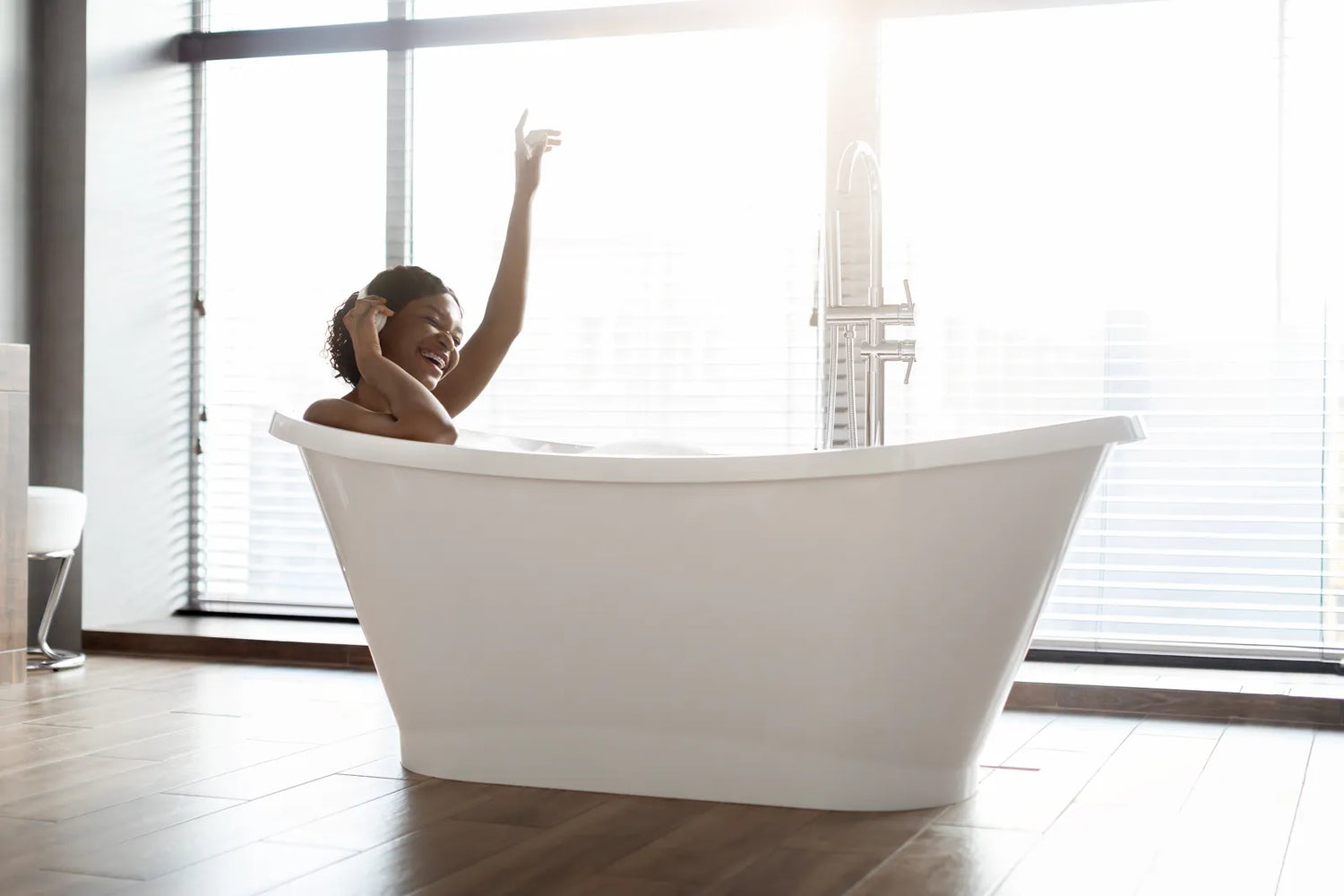
A 59 inch acrylic soaking tub sounds like a “standard size freestanding bath,” but most problems happen outside the brochure: getting it into the room, lining up the drain over real plumbing, leveling it on real floors, and living with the maintenance realities of a glossy white acrylic finish.
A 59-inch freestanding tub is close to the common 60" alcove length, but it behaves very differently in installation. Alcove tubs use an apron and ledger support, hide plumbing at a wall, and tolerate tighter clearances. A freestanding acrylic bathtub is more like a piece of furniture that must be perfectly level, correctly drained, and serviceable later—even when the drain is buried under it.
Below is an execution-focused guide to help you decide if a 59 inch acrylic soaking tub will actually work in your house, and what tends to break, cost more, or become annoying when it doesn’t.
Decision Snapshot: 59 inch acrylic soaking tub
A 59 inch acrylic soaking tub can provide an ideal balance between comfort and space efficiency—but only when the room, structure, and plumbing are truly ready for it. Before moving from measurement to purchase, it helps to quickly assess access, load capacity, and drain alignment to avoid costly surprises during installation.
Red flags that cause “it fits on paper but fails in real life”: tight corners, slab drain mismatch, uneven floors, unplanned filler rough-ins
If any of these are present, pause before purchasing:
-
A hallway turn that forces the tub to rotate upright and pivot (common failure point).
-
Slab foundation with a drain that is even a few inches off where the tub needs it.
-
Tile floor that looks fine but is out of level enough to make a lightweight 59 inch soaking tub rock.
-
A freestanding faucet (tub filler) planned “later,” without verified rough-in height, shutoffs, and reach to the tub deck.
The key point is simple: most regrets are not about the tub’s look—they’re about access, alignment, and leveling.
Choose it when your transport path is 32"+ clear, the room allows install clearance, and the drain can align without major rework
A 59 inch freestanding soaking tub tends to go smoothly when all three are true:
-
You have a true 32"+ clear transport path from delivery point to bathroom (not just the door slab width—clear opening and turning room).
-
You can keep a practical “working gap” around the tub (for leveling, caulk line, and cleaning).
-
The existing drain/trap can land under the tub’s drain zone without risky shortcuts (like forcing a “flexible drain” into a bad alignment).
Avoid it when you’re on an upper floor/wood framing without confirmed load capacity or you can’t access/relocate the trap
This tub choice often turns into rework when:
-
It’s on an upper floor and you haven’t verified the floor can handle 400 kg+ combined load (tub + water + bather). Acrylic is lightweight, but water is not.
-
You can’t access plumbing from below (slab foundation, finished ceiling below, no crawlspace), and the drain location isn’t already close.
Do not buy until you confirm
-
Transport path clear opening ≥ 32" at all doorways, hallways, and turns.
-
Drain alignment matches spec drawing within a few inches unless plumbing access below exists.
-
Floor can support full load: tub + water + bather ≥ 400 kg (≈880 lb).
Will it work?
-
Transport path check: Pass if ≥32" at all critical pinch points; fail if any smaller.
-
Drain alignment check: Pass if matches spec drawing or access exists below; fail if misaligned.
-
Floor load check: Pass if floor can hold ≥400 kg total; fail if uncertain or below threshold.
Best fit / Poor fit:
-
Best fit: New-build bathroom products layouts, accessible-from-below floors.
-
Poor fit: Retrofit in tight upper-floor spaces with slab floors and non-accessible plumbing.
Key trade-offs created by a 59" acrylic freestanding soaking tub
A 59" acrylic freestanding soaking tub sits in a popular middle ground—compact enough for many bathrooms, yet large enough to promise a comfortable soak. What often goes unnoticed are the trade-offs hidden behind that “standard” label. Small dimensional differences, structural sensitivity, and interior design choices can significantly affect installation complexity and daily comfort.
“Standard size freestanding bath” isn’t standard in drain location, rim height, or base footprint—small variances create big retrofit pain
“59 inch” sounds precise, but the trouble is in the other dimensions:
-
Drain location (center, end, offset, left/right)
-
Drain diameter and shoe style
-
Base footprint width vs rim width
-
Bottom shape and slope to drain
-
Rim height and overflow height
Two different 59 inch soaking tub models can both “fit” in the same space and still require totally different plumbing. That’s why homeowners get caught after purchase: they planned a drain in the “usual spot,” then the tub arrives and the drain lands 4" away—too far to force without rework.
The practical rule: pick the tub only after you know where your trap can be, not just where you wish it was.
Pre-buy actions referencing spec drawing:
-
Verify drain offset L/R according to the tub specification drawing.
-
Measure drain-to-end distance.
-
Compare base footprint vs. rim dimension.
Lightweight acrylic reduces handling stress, but increases reliance on perfect leveling and perimeter silicone (movement risk)
A lightweight 59 inch soaking tub is easier to carry upstairs and less likely to overload floors during install. The downside is it can be more sensitive to:
-
slight floor slope,
-
tiny humps in tile,
-
uneven grout lines,
-
flex in the subfloor.
Many freestanding acrylic installs are not mechanically anchored. In practice, the tub is held by gravity, its feet/base geometry, and silicone at the base. If the base isn’t fully supported and level, you can get:
-
a subtle rock when stepping in,
-
hairline gaps that open in the caulk line.
That’s why leveling isn’t “nice to have.” It’s what keeps the drain sealed long-term.
Action: Level tub before drain tightening and final caulking to prevent wobble and leaks.
Deep 59" acrylic bathtub expectations vs reality: soaking depth, sloped backs, and interior length can disappoint taller bathers
A deep 59" acrylic bathtub can still feel short inside because of:
-
thick backrests,
-
sloped ends,
-
a wide rim that steals interior length,
-
a raised seat area.
So the exterior says 59 inches, but the usable flat length can feel much less. For taller bathers, the common complaint is: “My knees are up” or “I can’t fully stretch.”
Also, “deep” doesn’t always mean “deep water over your shoulders.” Many tubs have an overflow set lower than the rim (for safety), so your actual soaking depth is limited by overflow height, not marketing photos.
If you’re considering this for two people: most 59-inch tubs are not comfortable for two adults unless they’re petite and okay with limited legroom. Two-person soaking is usually more realistic in longer tubs with a wider interior and symmetrical backrests. A 59-inch size can do it in rare models, but it’s the exception, not the normal experience.

Who it's for / not for (home constraints)
A 59 inch freestanding tub is not just a style decision—it’s a home-constraint decision. Homeowners with similar layouts may face identical transport or drain alignment issues. Even when the bathroom layout looks perfect on paper, access paths, structural capacity, and plumbing conditions often determine whether the installation is smooth or unexpectedly expensive. The sections below clarify who this size works well for—and when it may create avoidable risk.
If door openings are under 32" or corridors have tight corners, it may not physically reach the bathroom—even if floor space is sufficient
This is the most common “we didn’t see it coming” problem.
A 59 inch acrylic freestanding bathtub ships in a large box, often with foam end-caps. Even if the tub itself is slim, the packaging makes it wider and harder to pivot. People measure the bathroom footprint, buy the product, then find out the tub cannot clear:
-
a 30" or 28" door,
-
a narrow hall with a sharp turn,
-
a stair landing with a low ceiling,
-
a bathroom door that opens into a tight space where you can’t rotate the tub.
What it costs when you miss this: door casing removal, door frame removal, railing removal, or in the worst cases, paying return shipping for a large item or storing it while a new plan is made. Sometimes the only “solution” is unboxing outside and risking damage during a tight carry—then warranty arguments start if the finish gets scratched or cracked.
What to do instead: measure the clear opening at every pinch point (door jamb to door jamb, not door slab). Then map the tightest turn and ask: can a 59" rigid object pivot there without hitting walls or ceiling? If you have a tight corner, make a cardboard “L” template or use painter’s tape to simulate the tub’s longest rigid dimension during a turn.
Pre-buy actions:
-
Measure clear opening jamb-to-jamb at every pinch point.
-
Identify tightest turn or landing.
-
Flag areas that require tilt or removal of doors/molding.
Action callout: Only unbox the tub if needed; tight carries increase damage risk and may affect warranty.
If the floor system can’t be verified for 400kg+ combined load, a lightweight 59 inch soaking tub can still be unsafe
Homeowners hear “acrylic is lightweight” and assume structure is no longer a concern. Acrylic helps during handling and shipping, but once filled, the load is mostly water.
Reality check using typical numbers:
-
Many deep 59" acrylic bathtub designs hold roughly 50–80 gallons to a normal soaking level (not always “to the brim”).
-
1 gallon of water weighs about 8.3 lb (3.8 kg).
-
That’s 415–664 lb (188–301 kg) of water alone.
-
Add the tub (often 70–120 lb / 32–54 kg).
-
Add a person (say 150–250 lb / 68–113 kg).
It’s easy to land in the 700–1,000+ lb range on a concentrated footprint. That doesn’t guarantee failure, but it does mean you shouldn’t guess—especially on upper floors, older homes, long joist spans, or remodels where framing was cut for plumbing.
What it costs when you guess wrong: floor bounce that cracks grout, doors that go out of alignment, ceiling drywall cracks below, and in the worst cases, structural repair. Even when it doesn’t “collapse,” movement can loosen drain seals over time.
If you’re unsure, a contractor or structural professional can verify joist sizing, spacing, span, and whether blocking or reinforcement is needed. That cost is usually small compared to repairing a leak plus structural damage.
Pre-buy actions:
Consolidated example: tub 120 lb + water 500 lb + 1 adult 180 lb = 800 lb total.
Action callout: Stop and verify joists/span before buying.
If you can’t access plumbing below (slab, finished ceiling below, no crawlspace), “standard” freestanding assumptions break fast
Freestanding tubs do not use the same “set it against the wall and connect” approach as many alcove tubs.
If you have a slab foundation, a drain that’s off by inches can mean cutting concrete. If you’re over a finished space (kitchen ceiling below, for example), a drain adjustment can mean opening drywall, moving a trap, and then patching and repainting.
What becomes annoying later: even a simple drain service (tightening a fitting, resealing) is harder when there’s no access panel and the tub sits tight to walls.
Action callout: Confirm drain centerline from two fixed walls before purchase; finished-ceiling-below access may require concrete cutting.
Cost & practical constraints that show up after purchase
A 59" freestanding tub often feels like a finished decision once it’s ordered—but several practical costs tend to surface only after delivery. Drain alignment, faucet rough-ins, and floor flatness can shift a straightforward install into a coordination project involving plumbing, tile, and finishing trades. Understanding these post-purchase realities helps prevent budget creep and last-minute redesign.
Drain relocation costs: offset/center mismatch can mean slab cutting, subfloor opening, or rerouting vents (not just a “flexible drain” fix)
Drain mismatch is where budgets break.
A “flexible drain” can help with minor alignment tolerance, but it does not solve:
-
a trap that is too far away,
-
wrong direction to the vent,
-
improper slope,
-
a drain that ends up under the tub base where you can’t tighten it.
Typical cost drivers (highly variable by region and access):
-
Open subfloor from above: removing tile, cutting subfloor, moving trap, patching, re-waterproofing.
-
Access from below: opening ceiling drywall, moving trap, then drywall repair and paint.
-
Slab foundation: saw-cut and chip concrete, move plumbing, then patch slab and repair floor finish.
The expensive part is often not the pipe—it’s the demolition and restoration.
Where people get burned: they tile the floor, set the tub location, then realize the drain can’t be connected without shifting the tub. Now the tub “fits,” but it can’t sit where the design needs it unless you redo finished work.
Water supply & faucet costs: floor-mounted filler placement, 12–18" rough-in height realities, shutoff access, and leak testing time
Freestanding tubs often pair with a floor-mounted tub filler (freestanding faucet). That creates a second rough-in that’s easy to underestimate.
Common realities:
-
The filler must reach the tub deck at the right height and distance.
-
You need shutoffs you can access later (not buried permanently).
-
The supply lines must be secured to prevent movement.
-
If you’re on a slab, floor rough-ins are harder and more permanent.
-
A filler in the wrong place can cause splash, slow fill, or awkward handle reach.
Even wall-mounted fillers have constraints: the spout must clear the tub rim and land water into the basin without hitting the overflow or splashing off the slope.
Time cost that shows up late: proper leak testing takes longer than people expect. A careful installer will fill and drain, then check all connections for seepage before final sealing and finishing.
Floor correction costs: leveling compounds, shims/feet adjustment, or mortar bed needs when floors are out of plane
Your tile can look “flat” but still be out enough to cause trouble.
What happens in practice with a glossy white 59" master bath tub on an unlevel floor:
-
The waterline looks tilted (your eye catches it fast).
-
The tub drains slowly or leaves a puddle.
-
The tub rocks slightly at one corner.
-
The caulk line opens unevenly because the tub shifts.
Depending on the base design, fixing it might involve:
-
adjusting integrated leveling feet (if present),
-
using approved shims at specific points,
-
localized floor leveling compound,
-
in some installations, a mortar bed (only if the tub manufacturer allows it).
Important: don’t assume you can “just shim it anywhere.” Shimming the wrong points can concentrate stress and crack acrylic later, especially near the drain zone.
Will a 59-inch tub actually fit your bathroom layout (not just the footprint)?
A 59-inch freestanding tub can technically “fit” within your bathroom dimensions and still create daily friction. True layout compatibility depends on clearance for installation, cleaning, door movement, and comfortable circulation—not just whether the footprint measures 59 inches. Reviewing full spatial interactions before purchase prevents a layout that works on paper but feels cramped in use.

Minimum clearance targets: 62–65" length zone plus side access for leveling, caulk line, and cleaning behind the freestanding tub
According to OSHA guidelines on workplace ergonomics and clearances, ensuring sufficient access around fixtures is critical to prevent injury during installation and maintenance. A 59 inch freestanding tub rarely lives happily in exactly a 59" space. You typically need breathing room for:
-
sliding the tub slightly during drain hookup,
-
running a silicone bead at the base,
-
cleaning behind it,
-
reaching the drain area if something smells or leaks.
A practical planning target is often 62–65 inches of usable length zone, depending on whether the tub sits centered, near a wall, or between features.
Side clearances matter too. If the tub is tight to a wall on one side, you may still want enough room on the other side to:
-
step in safely,
-
wipe down and dry the floor,
-
access the tub filler controls comfortably.
A tub that fits but can’t be cleaned behind becomes a long-term grime trap, especially in hard-water areas.
Will this work in a small bathroom with a door swing, vanity toe-kick, or tight toilet clearance competing for the same inches?
This is where 59" feels “almost perfect” on paper and then becomes annoying daily.
Check these conflicts:
-
Door swing: does the door hit the tub or force a tiny entry gap?
-
Toilet clearance: do you still have comfortable knee/foot space?
-
Vanity toe-kick: can you stand at the vanity without turning sideways?
-
Towel bars and hooks: are they now unreachable or bump points?
A freestanding tub also changes “walk lines.” You don’t want to squeeze between tub and vanity daily if the tub edge is at hip height.
Confirm fit with a full-height template: footprint outline plus rim height to catch window ledges, niches, and baseboard interference
Most homeowners only tape the footprint. That misses the real surprises:
-
a window stool that bumps the rim,
-
baseboard that prevents the tub from sitting where you planned,
-
a niche or ledge that conflicts with the tub’s flare,
-
a radiator or vent that gets blocked.
Do a template in two parts:
-
Tape the base footprint on the floor.
-
Mark the rim height on the wall (painter’s tape line), then check windows, sills, and accessories.
This is also when you confirm where the tub filler will land and whether the spout clears the rim.
Drain, venting, and supply compatibility (where most “standard” assumptions fail)
When planning your tub installation, it’s not just about the style or size—your plumbing setup can make or break the project. Drain placement, venting, and water supply all have practical limits, and understanding these early can save you costly reroutes or frustrating slow fills.
Do not rely on flexible drains to fix:
-
Trap too far from tub drain.
-
Incorrect slope causing slow drainage.
-
Inadequate venting that may cause gurgling.
What happens if my drain is center/offset/side and the tub drain doesn’t match—can I avoid rerouting without leak/backflow risk?
Drain location mismatch is not just a “can I connect it” question. It’s also about whether the drain will work correctly.
Problems that show up when people force alignment:
-
Improper slope in the waste line, causing slow drains and buildup.
-
Stressed connections that seep only when the tub is full (the worst kind of leak).
-
Trap arm too long or configured wrong, affecting venting and allowing gurgling or siphoning.
If the tub drain is offset and your existing drain is centered (or vice versa), you may be able to move the trap a few inches in accessible framing. But if you can’t access the area, you’re choosing between relocating finished surfaces or changing tub placement.
A “flexible drain” can help within a small tolerance, but it’s not a cure for bad geometry. Also, flexible parts can be harder to inspect later because they’re hidden under a freestanding base.
Slab-home threshold: if the trap sits below slab level with no practical reroute path, drainage can require concrete cutting
In slab homes, the trap and drain line are literally cast into your problem.
-
cutting and patching concrete,
-
relocating the tub a few inches and living with a weird layout,
-
abandoning the freestanding plan for a tub that matches the existing rough-in.
This is where “standard size freestanding bath” assumptions break. The size may be standard-ish, but the drain location isn’t.
If you’re on a slab and the drain location is unknown, it’s usually worth locating it precisely (measurement from two fixed walls) before you buy the tub.
Action: If drain is off by inches, plan concrete cutting or reconsider tub plan.
Is this still a good idea if my water supply/pressure is limited and filling a deep soaking tub becomes slow (or cools off early)?
Deep soaking tubs ask more from your plumbing than a shallow tub, especially if maintaining the water temperature is important for a comfortable soak.
Two common disappointments:
-
Slow fill: if your tub filler has low flow (or your house has pressure/volume limits), filling can take long enough that the first water cools before you get in.
-
Hot water capacity: if your water heater can’t deliver enough hot water, you end up topping off with lukewarm water.
This isn’t just comfort—slow fills also increase the time you’re watching connections for leaks. And if the overflow is set low, you may never reach the “deep soak” level you pictured.
A practical check is to estimate your realistic fill level (below overflow), then compare that gallon estimate to your water heater capacity and recovery. If you already run out of hot water in showers, a deep 59 inch soaking tub can be frustrating.
Installation realities that cause wobble, leaks, and rework
Installing a 59" acrylic freestanding tub isn’t just about placing it in position—the realities of leveling, sealing, and stabilizing can make or break the finished result. Small floor imperfections, insufficient support, or rushed drain connections often lead to wobble, leaks, or rework that’s far more costly than careful preparation upfront.
Perform full tub fill-and-drain leak test before final placement and sealing.

Leveling is not optional: uneven floors cause rocking, poor drainage, and a visibly “twisted” glossy white 59" master bath tub
A glossy white acrylic finish is unforgiving. Your eye catches crooked lines because the rim reflects light.
What tends to happen on real floors:
-
One corner is slightly high, so the tub rocks when you step in.
-
The tub drains, but leaves a small “pond” because the drain isn’t the lowest point.
-
The caulk bead separates in a thin spot because the tub shifts.
Fixing it after the tub is plumbed and sealed is harder than doing it at the start. The tub may need to be lifted, re-shimmed, reconnected, and re-caulked.
If your model has leveling feet, you still need a flat-enough floor so the feet share the load. If only one or two feet carry most of the weight, the tub can creak, flex, and stress the drain.
Most freestanding acrylic installs aren’t mechanically anchored—silicone beads and gravity resist movement (until they don’t)
Many homeowners assume the tub is “attached.” Often, it’s not—at least not in a way you’d notice.
Common stabilization methods:
-
silicone at the base perimeter,
-
the drain connection (not intended as a structural anchor),
-
the tub’s own weight.
This becomes a problem when:
-
kids push against the rim,
-
someone uses the tub edge for support getting in/out,
-
the floor is slick and the silicone bond is minimal,
-
the tub is installed with too little contact area at the base.
Movement is not just annoying. It can slowly work the drain seal loose, especially if the drain was tightened under stress.
Drain sealing failure modes: overtightening cracks, undertightening leaks, and missed leak-tests before final placement
Drain leaks are common because the connection is hidden and hard to re-check later.
Three real failure modes:
-
Overtightening: acrylic can crack around the drain opening or create stress lines that later become leaks.
-
Undertightening: it seems fine during a quick test, then seeps only when the tub is full and someone shifts weight.
-
Skipped full test: people test a small amount of water, see no leak, then seal everything. A full tub test is different: it adds pressure head and flex.
A careful install usually includes:
-
checking the subfloor for moisture after fill-and-drain,
-
leaving access (or at least not finalizing trim) until testing is complete,
-
confirming the tub drains fully without standing water.
Step-by-step actions:
-
Assemble drain with specified sealant.
-
Tighten drain to snug (do not overtighten).
-
Fill tub completely and test for leaks.
-
Apply final seal and caulk after successful test.
Long-term ownership: what fails first, what you’ll maintain, and what you’ll wish you planned
Owning a 59" acrylic freestanding tub is as much about upkeep as it is about soaking. Long-term satisfaction depends on anticipating what will wear, leak, or require access—small issues like caulk gaps, minor stains, or hidden seepage can become major headaches if not planned for. Understanding these realities upfront helps protect both your tub and your bathroom over time.

What fails first over time: caulk gaps at the base, slow seepage, and hidden floor/wall damage without routine inspections
The most common long-term issue is not the acrylic shell—it’s water where it shouldn’t be.
A freestanding tub can splash during entry, or drip from wet bodies and towels. If the base isn’t sealed well, that water migrates. If the base is sealed too perfectly without considering where incidental water goes, you can trap moisture.
What homeowners notice first:
-
mildew line at the base edge,
-
a faint musty smell,
-
a slightly soft floor area near the tub (worst case),
-
staining at grout lines around the tub footprint.
The fix is usually simple early (re-caulk properly), but expensive late (subfloor repair, tile replacement, ceiling repair below).
A habit that prevents damage: every few months, wipe dry around the base and look for any new gaps or discoloration.
Finish and wear realities: stain resistance, fade risk in bright bathrooms, and scratch visibility on glossy white acrylic
High-quality acrylic is generally stain-resistant, but glossy white shows:
-
hair dye and bath oils if not cleaned promptly,
-
micro-scratches from gritty cleaners,
-
dull patches from abrasive pads.
Sunlight can matter too. If the tub sits in strong direct sun from a window, long-term fading or yellowing is possible in some materials and finishes. The tub may still be “fine,” but the color can shift compared to nearby fixtures.
Cleaning reality (simple, but strict): use non-abrasive cleaners, soft cloths, and avoid powders. A shiny tub is easy to keep nice if you don’t scratch it early. Once scratched, it catches dirt and looks dull faster.
Access and repair constraints: replacing drains, tightening fittings, and resealing when the tub is tight to walls or boxed-in by remodel choices
Freestanding looks clean until you need service.
Common “wish we planned it” moments:
-
The drain needs tightening but the tub is too close to the wall to lift safely.
-
A slow leak is suspected but there’s no access from below and no access panel nearby.
-
The tub filler connections need attention and the shutoffs are not accessible.
If you’re remodeling, think about future access:
-
Can you reach shutoffs without removing tile?
-
Is there a reasonable way to inspect below (access panel in adjacent closet, or ceiling below)?
-
Is the tub so tight to walls that resealing becomes a contortion act?
A little planning here prevents expensive exploratory demolition later.
Before You Buy checklist
-
Measure the true transport path: every door clear opening, hall width, and the tightest turn. Don’t assume a 59-inch tub will pivot in a small hallway.
-
Verify floor capacity for a full tub load: plan for 400 kg+ total load as a reality check, especially upstairs or on older framing.
-
Confirm drain location in the room: measure from two fixed walls to the drain center, then compare to the tub’s drain spec drawing.
-
Decide how you’ll access plumbing later: slab vs crawlspace vs finished ceiling below changes your risk and cost.
-
Plan the tub filler rough-in: location, reach, shutoffs, and whether you can service it without tearing out finishes.
-
Check clearance beyond the footprint: leave room to level, caulk, and clean; don’t trap the tub between a vanity and a wall.
-
Confirm realistic soaking depth: look at overflow height and interior basin length, not just “deep” marketing.
-
Plan leveling method before delivery: know whether the model has feet, and how you’ll handle an out-of-level floor.
FAQs
1. Is 59 inches the same as a standard alcove tub?
No. A 59 inch acrylic soaking tub is not the same as a standard alcove tub. Most alcove models are 60 inches long and designed to fit tightly between three walls with an integrated flange and fixed drain placement. A standard size freestanding bath, including many 59-inch models, is built to sit independently on the finished floor and typically has different drain positioning, base dimensions, and clearance requirements. Even though a 59-inch tub may physically fit in a 60-inch space, installation standards and plumbing layouts are not interchangeable, so it’s important to verify measurements before replacing an alcove unit.
2. How many gallons does a 59 inch acrylic soaking tub hold?
A typical 59 inch acrylic soaking tub holds around 50–80 gallons depending on depth, interior slope, and overflow height. According to the US Department of Energy, household water heaters should be sized based on peak volume demand to ensure sufficient hot water for bathing. A deep 59" acrylic bathtub will naturally hold more water than a shallow model, but usable capacity is limited by the overflow drain. When selecting a lightweight 59 inch soaking tub, it’s wise to compare the manufacturer’s listed gallon capacity with your hot water heater output to ensure you can comfortably fill the tub to soaking level without running out of hot water.
3. Is a 59-inch tub big enough for two adults?
In most cases, a glossy white 59" master bath tub is ideal for one person rather than two. While the exterior length measures 59 inches, the interior soaking space is usually shorter due to sloped backrests and thicker acrylic walls. A deep 59" acrylic bathtub may feel spacious for a single person to bathe, especially in a modern master bathroom layout, but two adults will typically find it tight unless the design is wider and double-ended. For regular two-person use, longer freestanding tubs are generally more comfortable.
4. Can I use a flexible drain to avoid moving plumbing?
A flexible drain can help slightly when installing a standard size freestanding bath if the alignment is only off by a small margin. However, it won’t correct major plumbing misalignment, improper trap location, or slope issues. If you’re upgrading to a 59 inch acrylic soaking tub and the drain is significantly offset, rerouting the plumbing is usually the safer long-term solution to prevent drainage problems.
5. What’s the easiest way to clean glossy acrylic without scratching?
To maintain a glossy white 59" master bath tub, use a soft microfiber cloth or non-scratch sponge with a mild, non-abrasive cleaner. Avoid powder cleansers or rough pads, as they can scratch the smooth acrylic surface. Regular gentle cleaning helps preserve the shine of a lightweight 59 inch soaking tub and keeps a deep 59" acrylic bathtub looking bright and polished for years without damaging the finish.
References


Leave a comment
This site is protected by hCaptcha and the hCaptcha Privacy Policy and Terms of Service apply.