

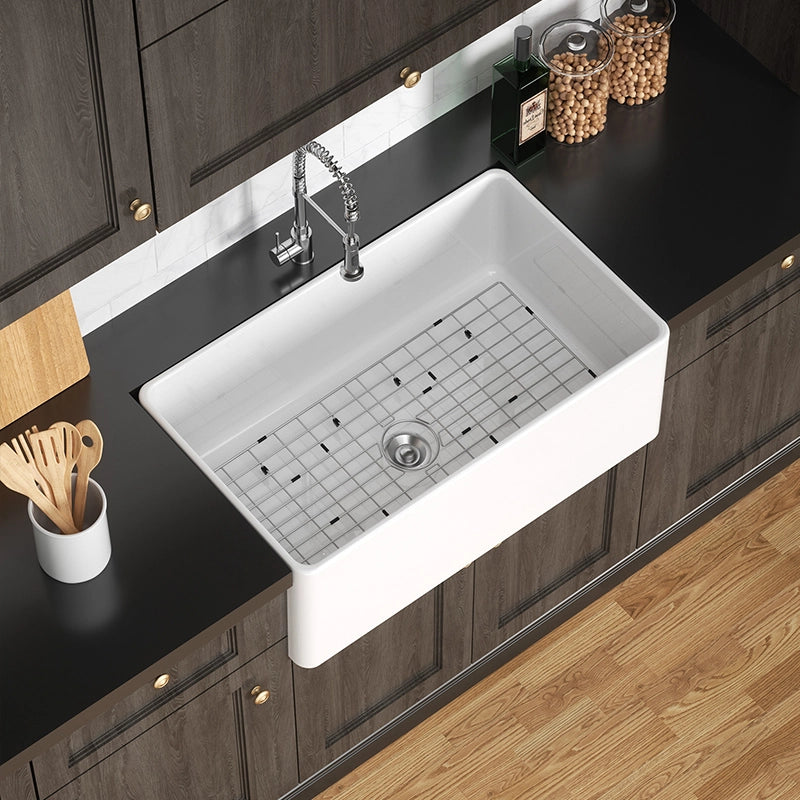

A 30 inch farmhouse sink (30" apron sink) can be a smart way to get an apron-front look in a compact kitchen sink layout. It can also be the sink size that triggers the most “we didn’t think of that” problems: cabinet cuts that can’t be undone, countertops that don’t match the real sink, and plumbing that suddenly has no room to connect—even in layouts that include a nearby bathtub in a kitchen-adjacent wet area.
This guide is not about what looks best. It’s about whether a 30-inch farmhouse sink will physically fit your cabinet and countertop, whether it will drain and seal correctly, and what tends to break (or become annoying) when it doesn’t.
Decision Snapshot: When a 30 inch farmhouse sink works (and when it doesn’t)
Whether you’re choosing a stainless steel single bowl kitchen sink, a fireclay kitchen sink, or a workstation farmhouse model with bottom grid and strainer, consider the cabinet width, countertop support, and overall farmhouse design. From apron front kitchen styles to undermount kitchen sinks, small differences in size, material, or features like a stainless steel drain or rounded corners can influence installation ease and long-term performance.
Choose it if your base cabinet interior is ≥ 33" wide and you can dry-fit before cutting anything
A “30-inch” farmhouse apron-front sink rarely measures exactly 30.0" in the real world. You want enough cabinet interior width to handle minor variance, shims, and the support frame. In practice, a 33" sink base is the usual starting point, but you still need to confirm the interior width and the manufacturer’s required minimum cabinet size.
Avoid it if you’re retrofitting a fixed countertop or your cabinet can’t be reinforced for a heavy sink (up to ~300 lb when filled)
A 30" fireclay sink can be very heavy, and the weight is not something you want sitting on countertop stone alone. If your sink base is particleboard, has water damage, or is already sagging, the sink can slowly go out of level. That’s when you get standing water, stress cracks, and leaks that rot the cabinet floor.
Reconsider if you need a garbage disposal, tight plumbing space, or a perfectly centered drain with zero rerouting tolerance
A deep single bowl plus a disposal plus a tight 30-inch cabinet area is where installs get “creative.” Sometimes that creativity becomes a shallow trap arm, a stressed disposal connection, or supply valves you can’t reach later without pulling drawers—especially if the plumbing layout also serves a nearby toilet, adding to the spatial constraints.
Who a 30" apron sink is for / not for (based on your kitchen constraints)
Choosing the right farmhouse kitchen sink isn’t just about style—it’s about space, workflow, and support. A 30 inch undermount or apron front farmhouse sink can transform a new kitchen, whether you prefer a stainless steel kitchen sink or a fireclay single bowl design. From matte black finishes to 16 gauge stainless steel single models, these apron front sinks offer a mix of classic farmhouse charm and modern design practicality. Pay attention to cabinet width, sink apron depth, and sides of the sink support—because even a single bowl sink with the best front design can underperform if your base isn’t strong enough or your workspace is too tight.
Works best in compact kitchen sink layouts where a single-bowl workflow matters more than multitasking
A 30 inch farmhouse sink single bowl is often chosen because a single open basin is easier for:
-
sheet pans and cutting boards
-
soaking a large pot
-
washing a pet bowl or small appliance parts
In a smaller kitchen, that single-bowl workflow can beat a cramped double bowl, even if you lose the ability to rinse and wash at the same time.
Where it tends to work well:
-
33" sink base in a smaller kitchen
-
new countertops (or countertops that are coming off anyway)
-
homeowners who can live with one bowl and use a rack/grid to “split” tasks
Not for weak/particleboard sink bases unless you’re willing to add a full support frame and cabinet reinforcement
Farmhouse sinks are not like a typical drop-in sink that hangs from the countertop. Even a 30-inch model can need real structure under it.
If your cabinet is:
-
particleboard sides
-
stapled face frame that already flexes
-
damaged from past leaks
…plan on adding a support system. If you can’t or won’t, this is where the long-term regret starts: the sink settles, the caulk joint opens, and every splash becomes cabinet damage.
Not for tight-aisle kitchens if the apron-front reduces toe-kick space or bumps knees at your counter height
This surprises people after install. The apron front changes how you stand at the sink:
-
Your toes may not tuck under the cabinet the same way.
-
Your knees can touch the apron sooner than they touched a normal cabinet face.
In a narrow galley kitchen, where you already stand “sideways” sometimes, that can become an everyday annoyance, not a one-time install issue.
Key trade-offs you accept with a small farmhouse sink (before you measure anything)
Before you start measuring, it’s worth understanding what a farmhouse apron front or single bowl fireclay farmhouse kitchen sink really offers. From stainless steel sinks—including apron front 16 gauge or gauge stainless steel single bowl models—to bowl fireclay farmhouse kitchen sinks, every farm sink has its quirks. Consider the bottom of the sink, bowl apron, and flat front design, as well as sink features like integrated grids or workstation sinks. Whether you’re renovating a new kitchen or upgrading a white farmhouse layout, these details help you weigh space, material, and installation trade-offs before committing. After all, handcraft and precision matter because the right sink truly brings back the ultimate in both style and function.

Single bowl vs double bowl: what you give up in parallel prep + dish workflow in a 30" cabinet size
Many buyers ask: “Does a 30-inch sink come in double bowl?” Yes, but the execution matters.
In a 30" apron-front kitchen sink, a double bowl often means:
-
two small bowls that don’t fit common cookware well
-
less usable flat bottom area
-
tighter space for a garbage disposal (if you want one)
A single bowl kitchen sink at 30 inches usually gives the most usable basin space for the footprint. The cost is that you cannot truly separate dirty dishes and clean rinsing without accessories (rack, bottom grid, or a basin insert). If you hate dish piles sitting in the same basin you rinse in, a small farmhouse sink can feel messy fast.
Depth trade-off: deep single bowl reduces splatter control and can feel cramped under low faucet height
A deep single bowl sounds great until you match it with:
-
a low faucet spout height
-
a short faucet reach
-
a high water pressure line
Then you get two common complaints:
-
You bang knuckles into the back wall while washing tall items.
-
You get splash-back because the water stream hits the bottom hard.
Depth also changes ergonomics. If you are tall, a deep sink in a standard-height counter can mean bending more than you expect. If you are shorter, it can be shoulder fatigue.
Material trade-off (fireclay vs stainless steel): dimensional variance risk vs dent/noise risk
This is not about which is “better.” It’s about what fails or annoys people.
-
Fireclay farmhouse sink (including apron front fireclay): heavier, can be slightly irregular in size, and does not forgive uneven support. If it’s not fully supported and level, you can get stress points that lead to cracking or chipping, especially around corners and the drain.
-
Stainless steel farmhouse (including 16 gauge stainless steel apron-front): lighter and more forgiving to install, but can be noisy and can show dents or scratches. In smaller cabinets, sound-deadening matters more because the cabinet acts like a drum.
A common execution issue: homeowners template the countertop from the spec sheet, then the real fireclay sink arrives a few millimeters “proud” and won’t drop into the opening. That turns into last-minute grinding, re-cutting stone, or a new top.
Cost and project scope: what this sink forces you to change (especially in retrofits)
Even before a hammer hits the countertop, the reality of a farmhouse sink retrofit starts to ripple through the entire project. Every adjustment—whether it’s the cabinet front, the base framing, or the plumbing layout—has a domino effect on time, labor, and materials. What looks like a straightforward swap quickly turns into a coordinated effort across carpentry, plumbing, and countertop work. Understanding these knock-on impacts upfront is what separates a predictable installation from one where costs and scope quietly spiral.
Retrofit reality: keeping an existing countertop often fails unless you remove it and template from the physical sink
If you are replacing a standard sink with a 30-inch farmhouse apron sink, the hard truth is: many retrofits fail at the countertop interface, not the cabinet width.
Here’s why:
-
A farmhouse apron-front sink often needs a different front cut and a different support method.
-
The reveal (how much of the sink edge shows) must match the actual sink, not a drawing.
-
If your existing countertop is stone, you get very few “second chances” after cutting.
If you are trying to upgrade from a 24-inch sink to a 30-inch sink, you may be changing:
-
cabinet front rail
-
sink base framing
-
plumbing location
-
countertop cutout size and shape
That’s not a small swap, even though “30 inches” sounds close.
Cabinet-front modification: apron reveal cuts, false-front panels, and door/rail interference costs
A 30" apron-front kitchen sink changes the cabinet face. Common extra work items:
-
cutting the face frame or front rail to create the apron opening
-
building a new false-front or modifying doors so they clear the apron
-
adjusting drawer depth or converting a drawer to a tilt-out
This is where costs creep in because it’s finish carpentry, not just plumbing. If you cut too much, you can’t put it back. If you cut too little, the sink won’t seat or you’ll be forced to mount the sink too low.
Labor + risk premium: extra hands, shimming time, and the “redo” cost when openings are cut wrong
Even a small farmhouse sink is awkward to maneuver because:
-
it has to land level on a support frame
-
it must be aligned to the cabinet front precisely
-
the countertop must meet it cleanly
Realistic “risk premium” items that show up on invoices:
-
two-person lift (especially for fireclay)
-
extra dry-fitting time
-
shimming and leveling
-
plumbing rework because the drain is not where the old sink’s drain was
If something is cut wrong, the redo cost is rarely limited to the sink. It’s usually countertop + cabinet face + plumbing time.

Will a 30 inch farmhouse sink fit your cabinet and countertop (real tolerances)
Before worrying about finish carpentry or plumbing tweaks, the first question is simple but critical: will the sink actually fit? Even a “standard” 30-inch farmhouse model can surprise you once the cabinet interior, countertop, and apron front are measured against real-world tolerances. Thinking in terms of exact widths, clearances, and adjustability helps prevent cutting too much—or too little—before anything is installed.
Minimum cabinet size rule: cabinet interior width must be at least 3" wider than sink width (or expect modifications)
People search: “Can a 30-inch sink fit in a 33-inch cabinet?” Often, yes—if the 33" is real interior space and the sink’s spec calls for it.
A practical rule that prevents most fit surprises:
-
Aim for at least 3" more interior cabinet width than the listed sink width.
Why this works in real installs:
-
cabinet sides are not always square
-
you may need filler strips or a support ledger
-
the sink may measure slightly larger than the marketing size
-
you need room for clips (if any), caulk, and alignment
Measure the interior width, not the cabinet’s advertised size. A “33-inch sink base” does not always have 33" clear inside.
Quick fit check (typical, not universal):
| Item | What to measure | What you want to see |
| Cabinet interior width | Inside left to inside right | ≥ 33" (or the sink’s stated minimum) |
| Cabinet interior depth | Inside front to inside back | Enough for bowl + drain + faucet clearance |
| Cabinet opening height | From cabinet floor/support to top | Enough for sink depth + trap/disposal |
If your interior width is 32 1/2", a “30-inch” sink might still fit, or it might not—especially with fireclay. That half inch is where installs turn into sanding cabinet sides, removing face-frame thickness, or forcing the sink in (which you don’t want).
Fireclay edge case: actual sink dimensions can vary ~2%, so “spec-sheet perfect” can still bind
Fireclay sinks can vary slightly because of how they’re fired and finished. On a 30" sink, a 2% variance is about 0.6"—enough to turn a clean fit into a jam.
What tends to happen:
-
The countertop is cut to the spec sheet.
-
The sink arrives and is slightly wider at the front apron or top lip.
-
Now the fabricator has to modify stone or the cabinet opening, under time pressure.
If you’re set on fireclay, the safer execution plan is: have the sink on site before templating and cutting anything.
Apron-front clearance threshold: confirm cabinet-top-to-door/rail clearance (leave ~1/4" adjustability)
The front apron has to land at the right height:
-
too high, and the countertop won’t sit or the reveal looks wrong
-
too low, and you get a gap at the top edge that collects water and grime
Leave about 1/4" of adjustability in your plan so you can fine-tune:
-
reveal height
-
level (front-to-back and side-to-side)
-
countertop fit
That adjustability usually comes from how the support frame is built and shimmed, not from “forcing” the sink into place.
Visual: cabinet interior width + apron cut diagram with “no-cut / cut / rebuild” zones
Use this as a mental model before you touch a saw:
NO-CUT ZONE (safe):
-
cabinet interior width meets the sink’s minimum
-
sink can slide in without scraping sides
-
support frame can sit on cabinet sides without weakening them
CUT ZONE (common):
-
you need to notch the face frame/front rail for the apron
-
you need to remove a false drawer front
-
you need to trim small amounts for reveal alignment
REBUILD ZONE (risk):
-
cabinet interior is too narrow
-
cabinet sides are weak or damaged
-
you have to remove structural cabinet parts to make the sink fit This is where you should expect reinforcement, new panels, or a new sink base cabinet.
Installation realities that cause failure (support, leveling, and countertop interface)
Even with perfect measurements and a clear cabinet opening, the installation itself can make or break a farmhouse sink retrofit. A heavy apron-front sink doesn’t just slide into place—the support structure, leveling, and countertop interface all have to work together. Overlooking any of these realities is how otherwise “fitting” sinks end up warped, leaking, or impossible to seal properly.
Support requirement: ledger/frame must carry a heavy sink without relying on countertop strength
A farmhouse sink should be supported from below. Even when the sink is “undermount,” the countertop is not meant to be the primary structural support for a heavy apron sink.
Typical support methods that work:
-
a full plywood platform on a cleat/ledger
-
a built frame that cradles the sink bottom
-
side ledgers with cross braces
What fails in the field:
-
relying on a thin rail or a few screws into particleboard
-
uneven support that creates twist in a fireclay sink
-
support that blocks the drain/disposal space
Also plan for the “filled weight.” The sink isn’t just its shipping weight. Add water, cookware, and someone leaning on the front apron.
Buyer-doubt: Can I cut the countertop opening before the sink arrives?
If you want fewer surprises: don’t.
Farmhouse sinks are one of the top cases where cutting early causes expensive problems:
-
spec sheets are not always exact to the shipped product
-
fireclay can vary slightly
-
the reveal choice (flush, positive, negative) changes the cut line
If you must move forward (tight schedule), at least delay the final cut until:
-
sink is on site
-
you can dry-fit the sink into the cabinet support
-
you have confirmed the sink is level and at final height
Leveling failure mode: unshimmed installs lead to pooling, soap scum, and corner staining that only shows up after daily use
A sink can look level to the eye and still hold water.
Common callback: “There’s always water sitting in the back corner.”
That’s usually:
-
sink not level side-to-side
-
sink pitched slightly away from the drain
-
cabinet twisted and the sink followed the twist
Fixing it later is hard because the countertop and plumbing may need to come apart. That’s why leveling is not a cosmetic step. It’s a functional step.
Undermount/seal reality: unsealed gaps and poor flange support become leaks that rot the sink cabinet
Many 30 inch farmhouse sink installs are treated like a normal undermount. The problem is the apron-front changes how water behaves:
-
water drips off the counter edge differently
-
splashes can hit the seam more often
-
any gap becomes a channel into the cabinet
Failure pattern I see often:
-
caulk looks fine on day one
-
a tiny gap forms after a few hot/cold cycles or cabinet movement
-
water tracks into the sink base, swells the cabinet floor, and you smell mildew weeks later
The seal only lasts if:
-
the sink is fully supported and not moving
-
the surfaces were clean and dry at install
-
the joint is sized correctly (not a huge caulk “bridge”)
Plumbing, disposal, and clearance constraints that break “it technically fits”
Even once the sink is fully supported and perfectly level, the job isn’t done. The plumbing, disposal, and clearance around the cabinet can turn a technically “fitting” sink into a daily headache. Tiny misalignments in drain location, under-sink height, or faucet reach can force rework, stress joints, or block access—issues that only show up once water starts flowing.

Drain alignment risk: support frame must be pre-cut precisely or the trap/disposal can’t connect cleanly
A farmhouse sink support frame is great—until it blocks the exact area where the drain body and trap need to pass.
Two common mistakes:
-
The platform hole is too small or in the wrong place, so the drain assembly hits wood.
-
The cross brace sits right where the disposal needs to rotate into position.
Plan the drain opening with the real sink on site, because the drain location can be:
-
centered
-
rear-set
-
offset (some single bowl farmhouse sinks do this for more under-sink storage)
Buyer-doubt: Will a garbage disposal fit in a 30-inch base cabinet with a deep bowl?
Sometimes. Sometimes it becomes the thing that forces a redesign.
What limits disposal fit in a 30" sink base:
-
deep single bowl (less vertical room)
-
thick sink bottom (common in fireclay)
-
low outlet height to the wall (trap arm location)
-
drawers above that reduce vertical space for the disposal body
What tends to happen in tight installs:
-
the disposal barely fits, but the trap has to be “flattened” to make it connect
-
the dishwasher hose and disposal compete for the same space
-
access to the disposal reset button becomes annoying
If you want a disposal, measure:
-
cabinet interior height from the planned sink bottom to the cabinet floor
-
height to the wall drain connection
-
how far forward/back the drain sits (rear drains often help)
If your current plumbing is high and fixed, a deep bowl plus a disposal can push you into a plumbing relocation.
Supply lines + faucet compatibility: hole spacing, reach, and connection access behind an apron front
The sink is only half the system. According to the EPA, choosing faucets with certified flow rates can save water without compromising sink performance. Faucet execution problems still show up as:
-
splashing because the faucet reach is too short for a deep, wide single bowl
-
handles that hit the backsplash or shower door hinges if the sink shares a compact wet space
-
supply valves that you can’t reach because the sink bowl and support frame block access
Before you buy the sink, confirm:
-
faucet hole count you plan to use (single-hole vs widespread)
-
spout reach that lands water near the drain, not on the front apron
-
enough space behind the sink for hands/tools to tighten fittings
Also confirm whether the sink is undermount style, top-mount, or requires a special apron-front installation method. “Undermount sink” and “apron-front” can coexist, but the details change the countertop cut and access.
Buyer-doubt: What happens if my drain is a few inches off-center from the sink outlet?
If the new sink drain doesn’t match the old one, you usually have three paths:
-
Minor offset (often workable): a trap adjustment and a new trap arm section.
-
Moderate offset (common): re-routing with new fittings and careful slope.
-
Low tolerance setup (problem): disposal + tight cabinet + fixed wall outlet, where even a small offset causes interference.
The risk isn’t just “will it connect.” The risk is:
-
stressed joints that leak later
-
a trap that sits too high and slows drainage
-
an S-trap-like setup if someone “improvises” to make it fit (that can violate local code)
If you have little tolerance, treat drain alignment as a pre-buy requirement, not a post-buy problem.
Long-term ownership: maintenance, damage patterns, and “regret scenarios”
Even a perfectly installed farmhouse sink can become a source of frustration over time if small issues are overlooked. Stress on the support frame, minor misalignments, or hidden plumbing tension may not cause immediate problems—but years of daily use can turn them into cracks, leaks, or cabinet damage. Understanding these long-term patterns helps owners plan maintenance and avoid regret scenarios before they start.
Fireclay crack/chip risk: overtightened hardware and stress points from uneven support
Fireclay is hard, but it doesn’t like being twisted.
Real-life causes of chips/cracks:
-
drain assembly overtightened against a rigid surface
-
sink slightly out of level so weight loads one corner
-
cabinet settling because the support frame wasn’t solid
-
someone drops a cast iron pan right on the front edge
If you choose fireclay, the most important “maintenance” step is not a cleaner. It’s making sure the sink never moves. Movement is what turns normal use into stress.
Stainless steel regret: noise and vibration if sound-deadening isn’t complete in a compact cabinet
A stainless steel farmhouse sink can be great in a small farmhouse sink size, but smaller cabinets amplify noise. What people complain about:
-
“It sounds like a drum when I run water.”
-
“The disposal vibrates the whole cabinet.”
Noise control usually requires:
-
adequate sound pads/coating coverage
-
a bottom grid (also protects the finish)
-
tight, well-supported mounting so nothing rattles
If you are sensitive to noise, don’t assume “16 gauge stainless steel” alone solves it. Install quality matters more than the number on the listing.
Buyer-doubt: What fails first over time—sealant, cabinet support, or plumbing joints?
Most long-term failures start as movement.
Common order of failure:
-
Support settles (cabinet flex, screws loosen, shims compress)
-
Sealant joint opens (water finds the gap)
-
Cabinet damage begins (swelling, mold smell, delamination)
-
Plumbing joints leak (from stress or repeated bumping while storing items)
You prevent that by building the support like it’s permanent furniture, not temporary bracing.
Checklist visual: pre-finalization leak test + level test (before countertop is permanently set)
Before the countertop is fully locked in (or before you commit to final caulk), do two tests:
-
Level test: check side-to-side and front-to-back at multiple points. Then fill the sink with a few inches of water and confirm it drains cleanly with no corner pooling.
-
Leak test: fill and drain while watching the drain connection, trap joints, and the seam area. Put dry paper towels under joints so small drips show up.
If you can’t access the joints after the install, test harder now. “I’ll keep an eye on it” usually turns into cabinet repair later.
Before You Buy (checklist)
-
Measure base cabinet interior width (not the labeled cabinet size). Confirm it meets the sink’s minimum cabinet size, with room to spare.
-
Decide whether you can wait to template/cut until the sink is on site. If not, reconsider the project timing.
-
Confirm you can build a real support frame/platform that carries the sink’s full weight without relying on the countertop.
-
Verify drain location (center/rear/offset) and compare it to your existing wall outlet and trap arm height.
-
If you want a garbage disposal, measure vertical clearance under the bowl and confirm the support frame won’t block the disposal body rotation.
-
Confirm faucet fit: spout reach and height for a deep single bowl so you don’t splash the apron or hit the back wall.
-
Plan the cabinet front work: apron cut, false-front, and door/drawer interference—before you buy the sink.
FAQs
1. Can a 30-inch sink fit in a 33-inch cabinet?
Often it can, but the key is checking the actual interior width of the cabinet, not just the advertised size. A 33-inch cabinet might sound big enough, but you need at least a few inches of extra space for clips, caulk, and the support frame that holds the heavy sink. You may also need to notch the cabinet front for the apron and ensure there’s room for leveling shims. In practice, if the cabinet isn’t perfectly square or if the countertop has limited clearance, a “fit” can quickly turn into a tricky modification job.
2. Is a 30-inch sink big enough for a family?
A 30-inch sink can work for a family, especially if you’re fine using a single large bowl for washing and rinsing. It handles oversized pots, baking sheets, and big pans much better than a standard sink, but it doesn’t offer the separation of a double bowl setup. For families that want to multitask—wash in one bowl, rinse in another—30 inches can feel tight. Adding a grid or dish rack inside the sink helps manage space efficiently. Ultimately, it’s about how you use your sink and whether you’re comfortable adjusting your workflow.
3. What is the most popular farmhouse sink size?
Among homeowners, the 30-inch farmhouse sink is the sweet spot. It’s big enough to handle large pots and baking sheets without overwhelming a standard base cabinet. Smaller options, like 24 inches, are easier to fit but can feel cramped, while anything above 33 inches often requires major cabinet changes. The 30-inch size strikes a balance between usability, cabinet compatibility, and cost. It’s especially popular in kitchens where people want a single, deep bowl for soaking and washing large items, yet don’t have the space—or budget—for a custom oversized sink.
4. Does a 30-inch sink come in double bowl?
Yes, you can get a 30-inch double-bowl sink, but each bowl is narrower than a single-bowl option. That can make it tricky to fit larger items like baking sheets or oversized pots. Many homeowners find the single deep bowl more practical, even in a compact 30-inch footprint, because it’s easier to clean, soak, and rinse big items without juggling between two smaller bowls. Double bowls in this size work best if you mostly need separation for prep and washing, but for heavy-duty or family cooking, a single bowl often feels more convenient.
5. Can I upgrade from a 24-inch to a 30-inch sink?
Sometimes, but it’s rarely a simple swap. Moving from a 24-inch to a 30-inch farmhouse sink usually means modifying the cabinet front, adding support under the sink, and adjusting the countertop cutout. The apron may interfere with existing doors or drawers, so some carpentry work is almost always required. Even if the cabinet interior width is technically enough, you’ll still need to account for leveling, plumbing alignment, and the extra weight. Upgrading is doable, but it’s more of a mini-renovation than a straightforward replacement.
References


Leave a comment
This site is protected by hCaptcha and the hCaptcha Privacy Policy and Terms of Service apply.